
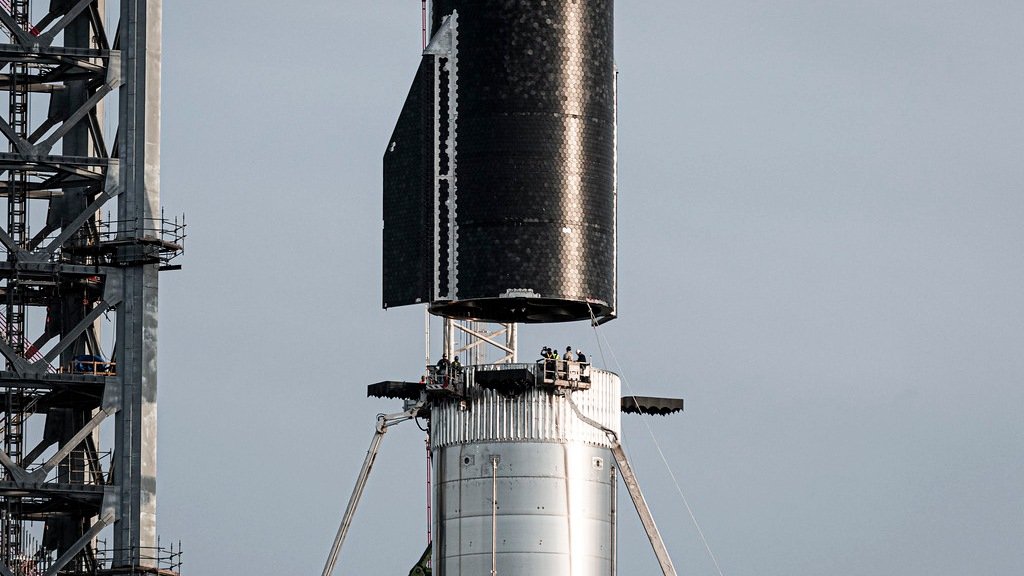
The Genius Reason Why SpaceX Deleted A Grid Fin: When SpaceX revealed major design changes for Starship Version 3, one of the most surprising details was hiding in plain sight on the Super Heavy booster. Instead of the familiar four-grid-fin arrangement, the new design uses three massive grid fins.
At first glance, deleting one of four aerodynamic control surfaces might seem like a strange decision. In rocket engineering, however, symmetry is not always the goal. What matters is whether every component provides enough performance to justify its mass, complexity, and structural cost.
For Super Heavy, SpaceX’s three-fin configuration is based on a combination of aerodynamics, mass optimization, control authority, and Mechazilla catch operations.
Why Did SpaceX Delete One Grid Fin?
The basic explanation is surprisingly simple. During Super Heavy’s atmospheric return, the booster flies at a high angle of attack. This orientation creates a large aerodynamic wake behind the vehicle.
One of the four fins can end up operating inside that turbulent, low-energy region. Instead of receiving clean airflow, the fin is partially shadowed by the booster’s enormous cylindrical body.
That means the fourth fin does not necessarily provide control authority proportional to its size and weight.
SpaceX can therefore remove the underutilized fin, enlarge the remaining three, and potentially achieve better aerodynamic efficiency with less dry mass.
This follows an important aerospace principle: every kilogram removed from a reusable launch vehicle can potentially improve its performance.
How Do Starship’s Grid Fins Work?
Grid Fins Are More Than Simple Wings
Grid fins, sometimes called lattice fins, are aerodynamic control surfaces designed to change the vehicle’s attitude during atmospheric flight.
Unlike a conventional airplane wing or planar rocket fin, a grid fin consists of a lattice-like structure containing multiple intersecting aerodynamic surfaces.
When the fin is angled into the airflow, it generates aerodynamic forces that help control the vehicle’s pitch, yaw, and overall trajectory.
This is particularly valuable during the high-speed atmospheric portion of a rocket’s descent.
Why Use Grid Fins Instead of Conventional Fins?
One major advantage is the location of the aerodynamic center relative to the pivot point.
A conventional large planar fin can create substantial torque around its actuator. Grid fins can achieve useful aerodynamic control while keeping the effective aerodynamic load closer to the hinge or pivot.
That can reduce the actuator forces required to move the control surface.
Grid fins also offer several practical advantages:
- High control authority
- Compact structural geometry
- Strong performance at high speeds
- Reduced actuator torque requirements
- Compatibility with reusable rocket designs
For a gigantic reusable booster like Super Heavy, those characteristics become particularly important.
Falcon 9 vs. Starship: A Completely Different Grid-Fin Philosophy
SpaceX already has extensive experience with grid fins through Falcon 9 first-stage landings. But Super Heavy operates at a dramatically different scale.
Falcon 9’s first-stage grid fins are relatively compact and use titanium construction, folding against the vehicle during ascent before being deployed for the return phase.
Super Heavy’s grid fins are considerably larger and are integrated into a vehicle designed around a different recovery architecture.
The Major Differences
| Feature | Falcon 9 First Stage | Starship Super Heavy |
|---|---|---|
| Grid-fin construction | Titanium | Stainless steel |
| Deployment | Folding | Permanently extended |
| Actuation | Hydraulic | Electric |
| Recovery | Landing legs | Tower catch system |
| Primary atmospheric control | Grid fins + engines | Grid fins + engine control |
| Catch integration | Not applicable | Grid fins incorporate catch interfaces |
The difference illustrates how Starship is not simply a larger Falcon 9.
Its architecture has been redesigned around rapid reuse, enormous scale, and the Mechazilla tower catching system.
Why Don’t Starship’s Grid Fins Fold?
One of the most interesting aspects of the Super Heavy design is that its enormous grid fins can remain extended throughout flight.
That might seem inefficient because the fins create additional exposed structure during ascent. But folding such enormous steel aerodynamic surfaces would require additional:
- Hinges
- Actuators
- Motors
- Structural reinforcement
- Deployment mechanisms
- Mass
Super Heavy already uses its Raptor engines and thrust-vector control for primary guidance during powered ascent.
Therefore, SpaceX can potentially avoid the additional complexity of folding mechanisms and accept the aerodynamic consequences of keeping the fins extended.
The result is another example of SpaceX prioritizing simplicity and mass reduction.
The Real Aerodynamic Secret: The Wake
Super Heavy Creates Its Own Problem
The most important part of the three-fin redesign is the airflow around the booster during re-entry.
Super Heavy does not descend like a conventional airplane. During atmospheric return, it adopts a steep attitude that allows the vehicle’s enormous body to interact with the atmosphere and generate aerodynamic forces.
But this creates a complicated airflow pattern.
On the windward side, air strikes the vehicle directly. A grid fin positioned there can receive strong, relatively clean airflow.
On the leeward side, however, the vehicle produces a large turbulent wake.
This is where the fourth grid fin becomes problematic.
The Fourth Fin Can Sit in the Wake
A fin positioned inside the booster’s wake does not experience the same airflow as one exposed to the atmosphere.
Its aerodynamic effectiveness can therefore be substantially reduced.
Instead of carrying four equally useful fins, SpaceX can use three strategically positioned fins that receive more effective airflow during the most important portions of the descent.
The remaining fins can also be enlarged to compensate for the removed surface area.
This creates an intriguing engineering trade:
One less fin + larger remaining fins = potentially more useful control authority with less unnecessary hardware.
Three Fins Also Help Mechazilla
Aerodynamics isn’t the only reason behind the redesign.
Super Heavy’s recovery system is fundamentally different from traditional rocket landing systems because the booster is intended to be captured by Mechazilla’s tower arms.
The grid fins are deeply integrated into this architecture.
A four-fin configuration places the fins at approximately 90-degree intervals. That creates a major geometric problem during tower catching.
One fin can occupy a position directly toward the tower’s catching hardware.
With three fins, SpaceX gets a different geometry that can provide better clearance around the tower and catching arms.
This means the aerodynamic redesign can also improve the physical compatibility between the booster and its recovery infrastructure.
The Clever Solution to Asymmetric Aerodynamics
Removing a fin creates another challenge.
A perfectly symmetrical four-fin configuration naturally distributes aerodynamic forces around the vehicle. Three fins introduce asymmetry.
SpaceX therefore has to account for the additional aerodynamic moments created by the new arrangement.
One solution is to incorporate carefully designed geometry into the remaining grid fins.
Instead of constantly commanding the electric actuators to compensate for an unwanted aerodynamic force, the structure itself can provide part of the correction.
This is an elegant engineering concept: use passive aerodynamic shaping to reduce active control requirements.
The vehicle effectively gets some of its aerodynamic trimming from the geometry of the fin itself.
Every Kilogram Matters on Starship
The most important takeaway from the three-fin design is not simply that SpaceX removed one grid fin.
It demonstrates how Starship’s design is being optimized as an integrated system.
Removing one fin can eliminate not only the lattice structure itself, but also associated:
- Actuation hardware
- Support structures
- Electrical components
- Reinforcement
- Mechanical interfaces
That saved mass can contribute to improved vehicle performance.
For a reusable launch system intended to carry substantial payloads to orbit, seemingly small mass reductions can become extremely valuable over hundreds or potentially thousands of flights.
Starship Version 3 Shows the Power of Iteration
The three-grid-fin Super Heavy design is a perfect example of SpaceX’s iterative engineering philosophy.
Instead of assuming that an earlier configuration must remain unchanged, engineers can examine actual aerodynamic behavior, recovery requirements, structural loads, and manufacturing complexity.
If one component is found to provide insufficient value, it can be removed or redesigned.
The result is a rocket that may look less conventional but is potentially better optimized for its mission.
The Bigger Picture
The genius of deleting a grid fin isn’t simply about having three fins instead of four.
It is about recognizing that more hardware does not automatically mean more performance.
By studying airflow, wake effects, actuator requirements, vehicle mass, and Mechazilla’s catching geometry, SpaceX can redesign Super Heavy around what the vehicle actually needs.
That philosophy could become increasingly important as Starship moves toward a future centered on rapid reusability, high launch cadence, and lower cost per launch.
In aerospace engineering, the most impressive component may sometimes be the component that engineers decide doesn’t need to exist.
FAQs
1. Why did SpaceX delete one grid fin from Super Heavy?
SpaceX’s three-fin design is intended to improve mass efficiency and aerodynamic control. The removed fin could operate in the booster’s aerodynamic wake during re-entry, making it less effective than the other fins.
2. How many grid fins does the new Super Heavy design have?
The revised configuration described for Starship Version 3 Super Heavy uses three grid fins instead of the traditional four-fin arrangement.
3. What is a grid fin?
A grid fin is a lattice-shaped aerodynamic control surface used to steer rockets during atmospheric flight. It generates aerodynamic forces when positioned against the airflow.
4. Why are grid fins important for Starship?
Grid fins help provide aerodynamic control during atmospheric descent and re-entry, allowing Super Heavy to adjust its orientation and trajectory as it returns toward the launch site.
5. Why was the fourth grid fin considered less effective?
During high-angle-of-attack re-entry, part of the booster’s airflow can separate and form a large leeward wake. A fin positioned within this wake receives less effective airflow and therefore contributes less control authority.
6. Does removing a grid fin make Super Heavy less controllable?
Not necessarily. SpaceX can increase the size of the remaining three fins and optimize their geometry to provide sufficient or improved overall aerodynamic control.
7. What is the advantage of three larger grid fins?
Three larger fins can potentially provide greater useful control authority while eliminating the mass and hardware associated with a fourth fin.
8. How are Starship’s grid fins different from Falcon 9’s?
Falcon 9 uses folding titanium grid fins that deploy for landing operations. Super Heavy’s grid fins are much larger, use a different structural approach, and are designed around Starship’s tower-catching recovery system.
9. Why don’t Super Heavy’s grid fins fold during ascent?
Folding extremely large grid fins would require additional hinges, motors, actuators, structural reinforcement, and deployment mechanisms. Keeping them extended can eliminate this extra hardware and save mass.
10. What material are Super Heavy’s grid fins made from?
The design described uses stainless steel grid fins, unlike Falcon 9’s titanium grid fins. The material choice reflects the different scale and operating requirements of Super Heavy.
11. How do Super Heavy’s grid fins help with Mechazilla?
The grid-fin structures are integrated with the booster-catching architecture. Their geometry and catch interfaces are designed to work with the mechanical arms of the Mechazilla tower.
12. How does a three-fin configuration help tower catching?
A three-fin arrangement changes the geometry around the booster and can provide improved clearance between the fins and tower-catching hardware, reducing potential interference during the catch maneuver.
13. What is the aerodynamic wake behind Super Heavy?
The aerodynamic wake is the turbulent, lower-energy airflow created behind the booster as it moves through the atmosphere. Components inside this region can experience reduced aerodynamic effectiveness.
14. Can the three-fin configuration create aerodynamic imbalance?
Yes. Removing one fin creates an inherently asymmetric aerodynamic arrangement. Engineers can compensate through fin geometry, vehicle attitude, and active guidance and control systems.
15. Why is reducing rocket mass so important?
Lower dry mass can improve a reusable rocket’s performance and propellant efficiency. Removing unnecessary structures can potentially leave more capability available for payload or recovery operations.
16. What does the three-grid-fin design reveal about SpaceX’s Starship strategy?
It demonstrates an emphasis on iterative engineering and system-level optimization. Instead of simply adding hardware for symmetry or redundancy, the design can be adjusted according to aerodynamic performance, structural requirements, manufacturing considerations, and recovery operations.
Read More:
- Tesla hints at new Roadster design in surprise clip
- SpaceX completes another secret Pentagon launch, adding to suspected Starshield buildout
- SpaceX Is READY For Starship Go Orbit! Flight 15 & 16 Launch Dates Even Crazier
- Tesla Optimus Gen 3 2027 LEAKED Amazing Design, It’s Eye-Opening
- Google just picked SpaceX for its first step into orbital AI