
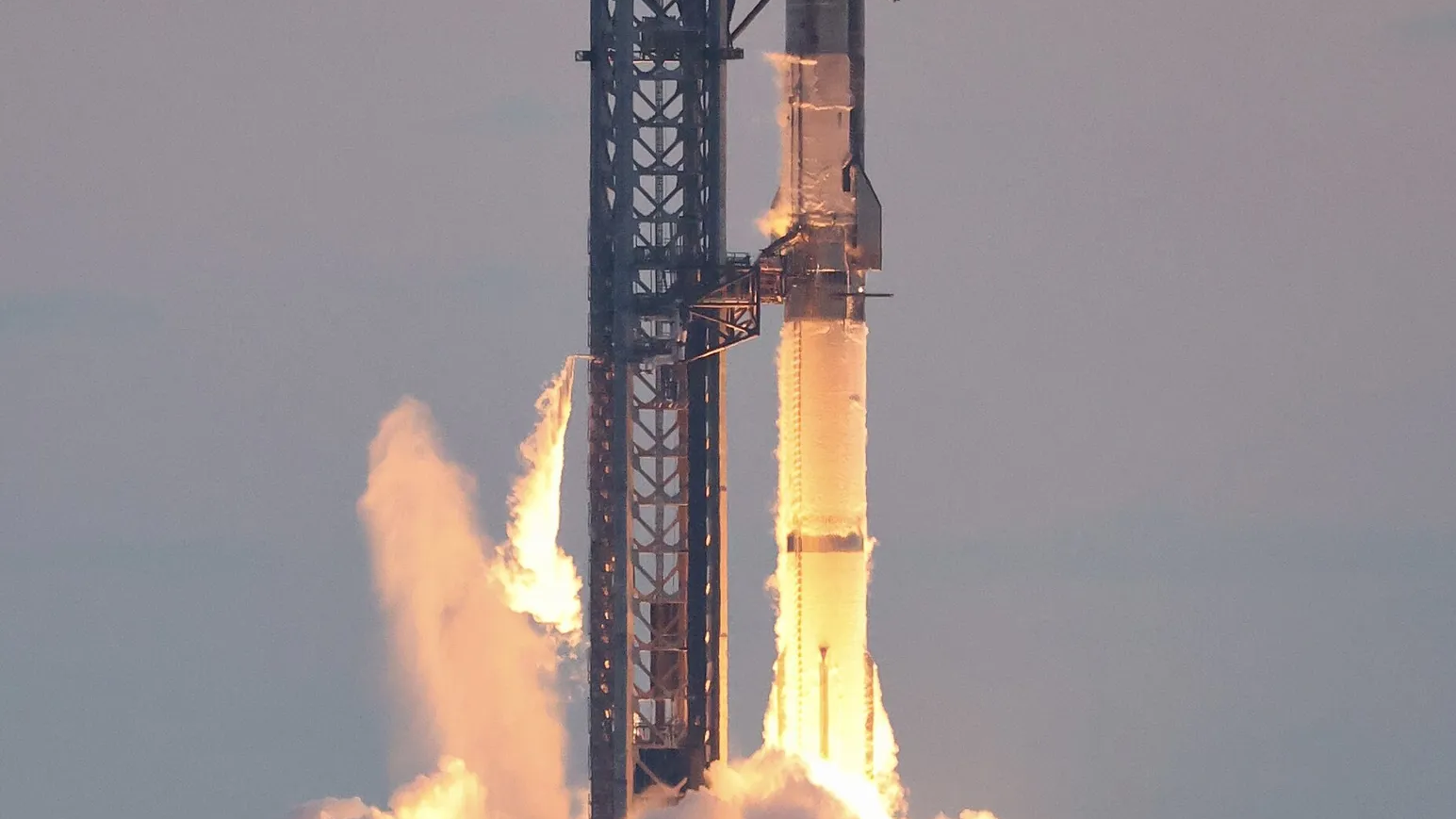
It’s mind-blowing! What SpaceX Starship Flight 15 just Did Shocked whole Industry: SpaceX Starship Flight 15 delivered another extraordinary milestone in the rapidly evolving history of space exploration. With a powerful liftoff, successful orbital insertion, next-generation Starlink V3 satellite deployment, and an unprecedented 21-hour mission profile, the latest flight demonstrated how quickly SpaceX is advancing its ambitious vision of fully reusable space transportation.
Although the mission did not achieve the planned Super Heavy booster tower catch, the controlled offshore splashdown demonstrated the importance of safety and precision in experimental rocket operations. Meanwhile, the Starship upper stage continued its journey, completing several major objectives that could reshape the future of orbital transportation.
From upgraded Raptor engines to extended orbital operations, Flight 15 provided valuable information about the next generation of Starship capabilities.
SpaceX Starship Flight 15: A Powerful Liftoff and Successful Ascent
The mission began with a remarkably smooth countdown at Starbase, Texas. As the launch sequence reached zero, the massive Starship rocket roared to life, producing enormous thrust and climbing rapidly into the atmosphere.
The upgraded Raptor engines demonstrated impressive performance throughout the initial ascent. Unlike previous developmental flights that encountered isolated engine-related challenges, Flight 15 maintained stable operating conditions during its primary climb.
Clean Raptor Engine Performance
One of the most important achievements was the performance of the upgraded propulsion system. Maintaining consistent engine operation is essential for a rocket designed to transport massive payloads into orbit.
The successful ascent demonstrated improvements in:
- Engine reliability during high-thrust operations.
- Propulsion stability throughout the initial climb.
- Vehicle control during atmospheric acceleration.
- Overall coordination between the rocket’s propulsion and guidance systems.
These improvements are important because SpaceX ultimately wants Starship to become a reliable transportation system capable of supporting frequent launches.
Successful Hot-Staging and Stage Separation
Another major milestone occurred during hot-staging, when the Starship upper stage separated from the Super Heavy booster.
The hot-staging ring successfully completed its sequence, allowing six Starship Raptor engines to ignite on schedule. The upper stage separated cleanly while the Super Heavy booster began its flip maneuver and prepared for the boost-back burn.
Although one outer-ring engine failed to reignite during the boost-back sequence, the vehicle continued executing its planned flight operations.
This demonstrated the importance of propulsion redundancy and the ability to maintain flight control despite isolated engine irregularities.
Super Heavy Booster Catch Aborted: SpaceX Chooses Safety First
One of the most surprising moments of Starship Flight 15 occurred during the Super Heavy booster’s return toward Starbase.
Spectators were anticipating another spectacular recovery attempt involving the massive Mechazilla launch tower. However, mission controllers ultimately executed a downrange booster abort, redirecting the vehicle away from the launch tower.
While the decision prevented a historic booster catch, it demonstrated SpaceX’s commitment to operational safety.
Why Did SpaceX Abort the Booster Catch?
Recovering a Super Heavy booster using the launch tower’s mechanical arms requires extremely precise control.
Even relatively minor propulsion irregularities or pressure fluctuations can create unacceptable risks during the final approach.
When flight conditions do not satisfy the required recovery criteria, mission controllers can prioritize a safer downrange landing instead of attempting a tower catch.
This approach protects:
- The Mechazilla launch tower and its recovery equipment.
- Ground infrastructure at Starbase.
- Personnel and surrounding facilities.
- The overall safety of the experimental flight program.
Controlled Ocean Splashdown Demonstrates Recovery Progress
Despite the canceled tower catch, the Super Heavy booster demonstrated impressive control during its terminal descent.
The landing sequence progressively reduced engine activity from 13 engines to five and eventually to three inner Raptors.
The booster maintained a stable descent before completing a controlled offshore splashdown.
The event also produced a powerful sonic boom, highlighting the tremendous energy involved in bringing such a massive rocket back toward Earth.
Although an ocean splashdown is not equivalent to a successful tower recovery, it provides valuable information about booster guidance, propulsion management, and descent performance.
Starship Reaches Orbit for the Second Time
While the Super Heavy booster completed its return sequence, the Starship upper stage continued toward one of the mission’s most important objectives: reaching orbit.
Following a precise orbital insertion burn, Starship successfully established its intended orbital trajectory.
According to the supplied mission account, this represented only the second successful orbital insertion in the vehicle’s developmental program.
This achievement is particularly important because reaching orbit requires more than simply escaping Earth’s atmosphere. The spacecraft must achieve the necessary velocity, maintain its trajectory, and manage its propulsion systems throughout the transition into space.
Successful Orbital Insertion Marks Major Progress
The successful orbital burn demonstrated the capabilities of Starship’s sea-level and vacuum-optimized Raptor engines.
Orbital insertion is a fundamental requirement for future missions involving:
- Satellite deployment and commercial payload delivery.
- Cargo transportation to orbital destinations.
- Future lunar exploration missions.
- Long-duration spacecraft operations.
- Crewed missions beyond Earth’s orbit.
Every successful orbital mission provides SpaceX with additional operational data that can support future improvements.
26 Starlink V3 Satellites Deployed: A Massive Networking Upgrade
Perhaps the most exciting achievement of Flight 15 was the successful deployment of 26 next-generation Starlink V3 satellites.
After reaching orbit, Starship opened its payload delivery phase and released the next-generation spacecraft into their planned deployment trajectory.
These satellites represent an important step toward expanding the capabilities of SpaceX’s global satellite internet network.
Starlink V3 Could Transform Satellite Internet Capacity
The major advantage of Starlink V3 technology is its significantly increased networking capacity.
According to the supplied mission information, the bandwidth represented by a single Starship deployment is approximately equivalent to ten traditional Falcon 9 missions.
That comparison highlights why SpaceX is developing Starship as a much larger and more capable satellite delivery platform.
The ability to transport larger batches of advanced satellites could help the company expand its network more efficiently.
Potential benefits include:
- Higher overall network capacity.
- Improved satellite internet performance.
- Greater data transmission capabilities.
- More efficient constellation expansion.
- Increased support for demanding connectivity applications.
Mission control also confirmed successful two-way communication links with all 26 deployed satellites as they began raising their operational orbits.
This was an important confirmation that the payload deployment phase had achieved its primary objectives.
The Record-Breaking 21-Hour Orbital Mission
Another extraordinary achievement was the extended orbital coast phase.
Following the successful satellite deployment, Starship closed its cargo doors and began a complex sequence of orbital operations designed to evaluate its performance over an extended period.
14 Orbits Around Earth
The mission followed an approximately 21-hour flight profile, covering 14 orbits around Earth.
This represented the longest continuous Starship test described in the supplied mission account.
Extended orbital operations are essential because future missions will require Starship to remain functional in space for significantly longer periods than a typical short-duration test flight.
Engineers need to understand how the vehicle performs under changing thermal conditions, power requirements, and communication demands.
Power Management and Thermal Control
During the orbital coast, mission controllers systematically powered down selected non-essential avionics and antennas.
These operations helped conserve battery reserves and manage the spacecraft’s thermal environment.
Power management is particularly important for spacecraft operating in orbit because they experience repeated transitions between sunlight and Earth’s shadow.
The ability to manage electrical systems and maintain essential spacecraft functions will become increasingly important as Starship moves toward longer-duration missions.
Preparing for Future Starship Tower Catches
The extended mission also provided valuable information about the spacecraft’s ability to survive multiple orbital cycles.
Passing important thermal checkpoints, including the Hawaii return threshold mentioned in the mission account, represents another step toward future upper-stage recovery demonstrations.
Eventually, SpaceX wants to recover both the Super Heavy booster and Starship upper stage using its launch tower infrastructure.
Achieving that objective would represent a major breakthrough in fully reusable rocket technology.
Why Starship Flight 15 Is Important for SpaceX’s Future
Flight 15 demonstrated that Starship is progressing beyond basic launch and ascent testing.
The mission combined several important capabilities into one flight:
- Successful liftoff and atmospheric ascent.
- Clean hot-staging and stage separation.
- Controlled Super Heavy booster splashdown.
- Successful orbital insertion.
- Deployment of 26 Starlink V3 satellites.
- Approximately 21 hours of orbital operations.
- Valuable data for future spacecraft recovery attempts.
Each achievement contributes to SpaceX’s long-term goal of creating a transportation system capable of delivering massive payloads into space at significantly lower costs.
The combination of reusable hardware, high-capacity satellite deployment, and extended orbital operations could eventually transform commercial spaceflight.
Conclusion: Starship Flight 15 Takes SpaceX One Step Closer to Full Reusability
SpaceX Starship Flight 15 demonstrated just how quickly the company’s ambitious rocket development program is evolving.
Although the Super Heavy booster did not complete its planned Mechazilla tower catch, the controlled offshore splashdown showed the value of safety-focused recovery decisions.
More importantly, the successful orbital insertion, deployment of 26 Starlink V3 satellites, and record-setting 21-hour orbital mission represented significant developmental achievements.
The mission highlighted the growing capabilities of Starship as both a heavy-lift launch vehicle and an orbital spacecraft.
As SpaceX continues analyzing flight data and improving its hardware, the ultimate objective remains clear: building a fully reusable rocket system capable of supporting frequent satellite launches, lunar missions, and eventually human exploration of Mars.
Flight 15 was another major step toward that future, and the aerospace industry will be watching closely to see what SpaceX accomplishes next.
FAQs
1. What happened during SpaceX Starship Flight 15?
SpaceX Starship Flight 15 successfully completed its ascent, hot-staging, orbital insertion, and deployment of 26 Starlink V3 satellites. The mission also completed an approximately 21-hour orbital flight, while the Super Heavy booster performed a controlled offshore splashdown instead of attempting a tower catch.
2. Did SpaceX Starship Flight 15 successfully reach orbit?
Yes, according to the supplied mission details, Starship successfully achieved orbital insertion following a precise burn of its sea-level and vacuum Raptor engines. This represented the second successful orbital insertion in its developmental program.
3. Why was the Super Heavy booster catch aborted during Flight 15?
The planned Mechazilla tower catch was aborted as a safety precaution. Potential propulsion irregularities or other flight anomalies can trigger a downrange diversion to prevent damage to the launch tower and surrounding infrastructure.
4. Where did the Super Heavy booster land during Starship Flight 15?
The Super Heavy booster completed a controlled ocean splashdown off the coast. Its terminal descent involved progressively reducing engine activity from 13 engines to five and finally to three inner Raptor engines.
5. How many Starlink V3 satellites did Starship Flight 15 deploy?
Starship Flight 15 successfully deployed 26 next-generation Starlink V3 satellites into space. These satellites are designed to significantly expand the capacity of SpaceX’s satellite internet network.
6. What makes Starlink V3 satellites special?
Starlink V3 satellites offer significantly greater networking and bandwidth capabilities than previous generations. According to the supplied mission information, one Starship deployment can represent approximately the bandwidth capacity of ten traditional Falcon 9 missions.
7. How long did SpaceX Starship Flight 15 last?
The mission followed an approximately 21-hour flight profile, including 14 orbits around Earth. This represented the longest continuous Starship test described in the supplied mission account.
8. What is hot-staging in SpaceX Starship?
Hot-staging is a separation technique in which the upper-stage engines ignite before the booster has completely separated. This allows Starship to transition more efficiently between flight stages and continue its journey toward orbit.
9. How many Raptor engines ignited during Starship Flight 15 stage separation?
According to the supplied mission details, six Starship Raptor engines ignited during the hot-staging sequence, allowing the upper stage to separate cleanly from the Super Heavy booster.
10. Did any Raptor engines experience problems during Flight 15?
Yes, one outer-ring engine failed to reignite during the boost-back maneuver. However, the booster continued its planned return sequence and completed a controlled offshore splashdown.
11. What is the Mechazilla tower catch system?
The Mechazilla tower catch system is SpaceX’s recovery infrastructure designed to capture returning Super Heavy boosters and eventually Starship upper stages using large mechanical arms known as chopsticks.
12. Why is the 21-hour orbital coast important for Starship?
The extended orbital coast allows engineers to evaluate spacecraft durability, thermal management, battery performance, and avionics reliability. These capabilities are essential for future long-duration orbital and deep-space missions.
13. How many times did Starship orbit Earth during Flight 15?
Starship completed approximately 14 orbits around Earth during its extended 21-hour mission profile, providing valuable information about its performance during prolonged orbital operations.
14. Did Starship Flight 15 successfully close its payload bay after satellite deployment?
According to the supplied mission account, Starship successfully completed its Starlink V3 satellite deployment and closed its cargo doors before beginning the extended orbital coast phase.
15. How does Starship Flight 15 support future Mars missions?
Flight 15 helps SpaceX develop essential technologies for future Mars missions, including reliable propulsion, orbital operations, spacecraft power management, payload delivery, and reusable rocket systems. These capabilities will be necessary for transporting cargo and eventually humans to Mars.
16. What was the biggest achievement of SpaceX Starship Flight 15?
The biggest achievement was combining successful orbital insertion, deployment of 26 Starlink V3 satellites, and approximately 21 hours of orbital operations into one mission. The flight demonstrated significant progress toward Starship’s long-term operational capabilities.
17. What can we expect from SpaceX after Starship Flight 15?
Following Flight 15, SpaceX can use the collected flight data to improve Raptor engine reliability, booster recovery procedures, orbital endurance, and Starship heat-shield performance. Future developmental flights are expected to focus on improving vehicle recovery and advancing fully reusable space transportation.
Read More:
- Elon Musk is already planning a bigger Starship, and the Moon may be why
- Tesla makes €3 billion Cybercab bet at Giga Berlin
- SpaceX makes history, catching Starship from orbit for the first time
- MKBHD just ordered the Tesla Cybercab with his hair on the line
- Elon Musk’s $179 Tesla Pi Phone: FREE Starlink & Premium LOOK. Ending Apple