
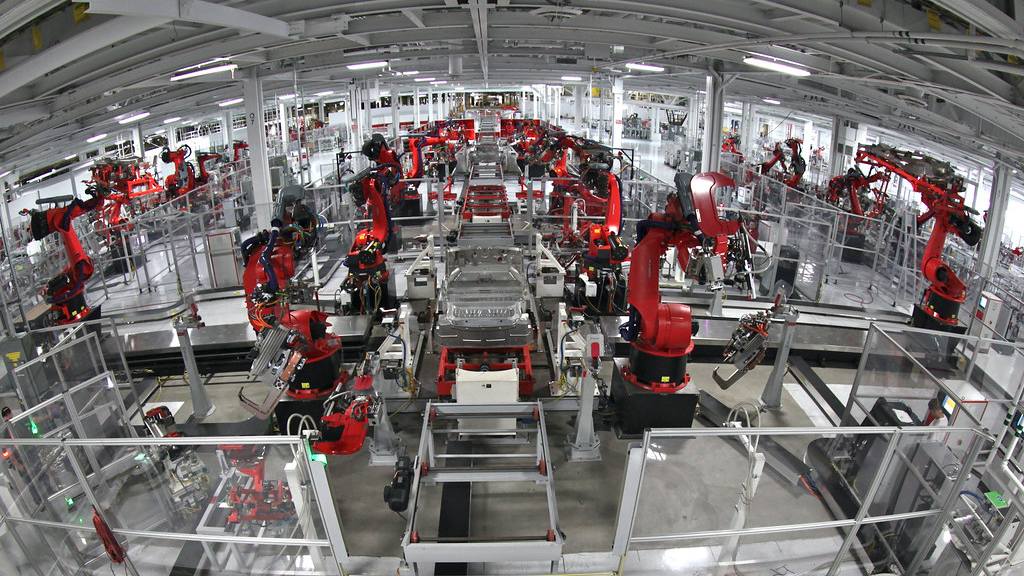
Next-Gen GigaPress 4.0 Entirely Change Automakers in 2027: The automotive industry is entering a moment of profound disruption—one that rivals the invention of the assembly line itself. As we approach 2027, a groundbreaking innovation is reshaping how vehicles are designed, manufactured, and delivered: the 50,000-ton GigaPress. This isn’t just a bigger machine or an incremental upgrade—it represents a fundamental shift in manufacturing philosophy.
What makes this development so powerful is not just its size, but its ability to eliminate complexity entirely. Instead of refining traditional systems, this new approach replaces them. The result? Faster production, lower costs, and a serious competitive threat to legacy automakers who fail to adapt.
The Rise of the 50,000-Ton GigaPress
The concept of giga casting has been around for a few years, but the leap to a 50,000-ton press changes everything. This machine exerts an astonishing 500,000 kilonewtons of clamping force, making it roughly three times more powerful than the most advanced presses currently in use.
This leap in capability allows manufacturers to rethink how a car is built from the ground up. Instead of assembling dozens—or even hundreds—of parts, entire sections of a vehicle can now be created in a single casting process.
The Physics of Power and Precision
Extreme Force Meets Engineering Accuracy
At first glance, a machine of this magnitude might seem difficult to control. But the real breakthrough lies in its precision.
Despite its immense power, the GigaPress can achieve micron-level accuracy—down to 25 microns, which is thinner than a human hair. This level of precision ensures that even large structural components meet strict engineering tolerances.
Molten Aluminum at Lightning Speed
One of the biggest challenges in casting large components is ensuring that molten metal doesn’t cool too quickly. Traditional machines struggle with this, especially when handling large volumes like 80 kilograms of aluminum.
The 50,000-ton GigaPress solves this by injecting molten aluminum at extremely high speeds, ensuring:
- Complete mold filling
- No premature solidification
- Superior structural integrity
Advanced Thermal Control
The process doesn’t stop at injection. The metal is subjected to a rapid cooling phase known as thermal shock:
- Heated to approximately 850°C
- Rapidly cooled to around 50°C
This dramatic temperature shift locks in improved material properties, resulting in stronger, more durable components.
Destructive Productivity – Eliminating Complexity
The most disruptive aspect of the GigaPress isn’t just what it creates—it’s what it eliminates.
From 100 Parts to One
In traditional vehicle manufacturing:
- A chassis may consist of 70–100 individual parts
- Hundreds of robots are required for welding and assembly
With giga casting:
- Entire sections are replaced by a single cast structure
This dramatically simplifies production while improving structural integrity.
Factory Space Optimization
By removing complex assembly lines, manufacturers can reduce factory floor space by 30% to 40%. This opens up opportunities for:
- Smaller factories
- Lower real estate costs
- Faster production scaling
Multi-Part Production Capability
Unlike traditional systems that produce one component per cycle, the 50,000-ton GigaPress can manufacture multiple large parts simultaneously—up to five at once.
This results in:
- Higher throughput
- Reduced cycle times
- Greater efficiency per machine
Reduced Labor and Supply Chain Complexity
With fewer parts and processes:
- Hundreds of welding robots become unnecessary
- Labor costs drop significantly
- Supply chains become streamlined
The “logistics nightmare” of sourcing and managing thousands of components is replaced with a simplified, localized production model.
The Economics of Manufacturing Domination
The GigaPress isn’t just an engineering marvel—it’s a financial strategy.
High Investment, Higher Returns
A single 50,000-ton GigaPress costs between $43 million and $65 million, making it a substantial capital investment. However, the long-term benefits outweigh the initial expense:
- Lower per-unit manufacturing cost
- Reduced material waste
- Higher production speed
Enabling the $25,000 Electric Vehicle
One of the most significant outcomes of this technology is the ability to produce affordable electric vehicles at scale.
By eliminating unnecessary parts and processes:
- Manufacturing costs could drop by up to 50%
- Vehicles priced around $25,000 become viable
- Profit margins remain strong despite lower retail prices
This isn’t just about making cheaper cars—it’s about redefining affordability in the EV market.
2027 – The Judgment Year for Automakers
The year 2027 is shaping up to be a decisive moment for the automotive industry. Companies that adapt to giga casting will thrive, while those that hesitate risk falling behind.
Global Industry Response
Automakers worldwide are racing to respond, but their approaches vary:
- European manufacturers are cautiously adopting mid-scale casting systems
- American companies are investing heavily in new casting facilities
- Asian automakers are focusing on reducing production steps and consolidating components
The Problem with Incremental Change
Many legacy companies are treating giga casting as an add-on, rather than a complete transformation.
This creates a critical disadvantage:
- Partial adoption leads to limited cost savings
- Existing systems still carry inefficiencies
- Competitors with fully integrated approaches gain a massive edge
The real shift isn’t just technological—it’s philosophical.
Vehicles Designed for Giga Casting
Not all vehicles benefit equally from this technology. Some are specifically engineered to maximize its advantages.
The CyberCab – Built for Autonomy
The CyberCab represents a new category of vehicle designed for continuous operation.
Key advantages include:
- Structural rigidity from single-piece casting
- Fewer failure points due to eliminated welds
- Increased durability for 24/7 usage
This makes it ideal for autonomous ride-hailing networks, where uptime is critical.
The Model 2 – Redefining Affordability
The Model 2 is designed to compete in the low-cost EV segment, but with a completely different strategy.
Ultra-Fast Production Cycles
The goal is an astonishing 5-second production cycle, enabling massive output.
Massive Cost Reduction
By leveraging giga casting:
- Manufacturing costs drop significantly
- Production becomes highly scalable
- Competitive pricing becomes achievable without sacrificing quality
This vehicle isn’t just assembled—it’s effectively “printed” at industrial scale.
The Two-Front War – Innovation vs. Optimization
The global EV market is witnessing two distinct strategies:
Traditional Cost Reduction
Many manufacturers focus on:
- Lower labor costs
- Localized supply chains
- Incremental efficiency improvements
While effective in the short term, this approach has limits.
Process Elimination Strategy
The GigaPress introduces a radically different approach:
- Remove entire production steps
- Replace complexity with simplicity
- Focus on engineering efficiency rather than labor cost
This strategy delivers:
- Better structural integrity
- Lower long-term costs
- Greater scalability
Why Giga Casting Changes Everything
The impact of the 50,000-ton GigaPress goes beyond manufacturing—it reshapes the entire automotive ecosystem.
Faster Time to Market
With fewer parts and simplified assembly:
- New models can be developed more quickly
- Production ramps up faster
- Market responsiveness improves
Improved Vehicle Performance
Single-piece structures offer:
- Increased rigidity
- Better crash safety
- Reduced weight
Lower Lifetime Costs
Fewer components mean:
- Less wear and tear
- Reduced maintenance
- Longer vehicle lifespan
In the future, the key metric may shift from purchase price to cost per mile.
Challenges and Risks
Despite its advantages, the GigaPress approach isn’t without challenges.
High Capital Requirements
The upfront investment is substantial, making it difficult for smaller manufacturers to compete.
Limited Flexibility
Large cast components can be harder to modify, requiring:
- Precise design from the outset
- Advanced simulation tools
Repair Complexity
If a major structural component is damaged, repairs may be more complicated compared to traditional multi-part designs.
The Future of Automotive Manufacturing
As we move closer to 2027, the direction is becoming clear: simplification at scale.
The GigaPress represents a shift toward:
- Fewer parts
- Faster production
- Integrated design and manufacturing
This approach aligns perfectly with the needs of the electric and autonomous vehicle era.
Conclusion: Forging a New Industrial Era
The automotive industry is no stranger to innovation, but the 50,000-ton GigaPress marks something different—it’s not an evolution, it’s a reinvention.
By eliminating complexity, reducing costs, and enabling unprecedented production speeds, this technology is setting a new standard for manufacturing excellence.
By 2027, success in the automotive world won’t depend on who builds the cheapest car. It will depend on who redefines how cars are built.
The companies that embrace this shift will lead the next generation of mobility. Those that don’t may find themselves outpaced in a world where efficiency, scalability, and innovation are no longer optional—but essential.
FAQs
1. What is the 50,000-ton GigaPress?
The 50,000-ton GigaPress is an advanced industrial casting machine capable of producing large sections of a vehicle’s structure in a single piece using immense clamping force and high-pressure aluminum injection.
2. How is the GigaPress different from traditional manufacturing machines?
Traditional machines assemble dozens of smaller parts, while the GigaPress replaces them with one large casting, drastically simplifying production and improving efficiency.
3. Why is the 50,000-ton capacity significant?
It provides approximately 500,000 kilonewtons of force, allowing faster injection of molten metal and the ability to create larger, more complex structures with high precision.
4. What materials are used in GigaPress casting?
The process primarily uses molten aluminum, which is lightweight, strong, and ideal for electric vehicle structures.
5. How does the GigaPress improve vehicle strength?
By eliminating welds and joints, it creates a single, unified structure that enhances rigidity and reduces weak points in the vehicle.
6. Can the GigaPress really reduce manufacturing costs?
Yes, by cutting down the number of parts, labor, and supply chain complexity, it can reduce manufacturing costs by up to 50%.
7. What is the role of thermal shock in the process?
Thermal shock rapidly cools molten aluminum from around 850°C to 50°C, improving material strength and durability.
8. How fast can the GigaPress produce parts?
Advanced setups aim for cycle times as low as 5 seconds, enabling extremely high production rates.
9. What impact does this technology have on factory size?
Factories can shrink by 30% to 40% due to fewer assembly lines and simplified workflows.
10. Does the GigaPress reduce labor requirements?
Yes, it eliminates the need for hundreds of welding robots and reduces manual labor, lowering operational costs.
11. What types of vehicles benefit most from giga casting?
Electric vehicles, especially those designed for mass production and autonomy, benefit the most due to simplified structures and scalability.
12. What is the expected price impact on electric vehicles?
This technology could enable affordable EVs priced around $25,000 by significantly lowering production costs.
13. Are there any disadvantages to using the GigaPress?
Yes, challenges include high initial investment, reduced flexibility in design changes, and potentially complex repairs.
14. How are traditional automakers responding to this innovation?
Many are investing in casting technologies, but often as partial upgrades rather than full manufacturing transformations.
15. Why is 2027 considered a critical year for this technology?
It is expected to be a turning point where automakers either successfully adopt advanced manufacturing or fall behind competitors.
16. Will GigaPress technology dominate the future of automotive manufacturing?
While not guaranteed, its ability to reduce cost, increase speed, and simplify production makes it a strong candidate to become the industry standard.
Read More:
- SpaceX’s Insane Upgrades on Starship Refueling System to the Moon after Artemis 2
- Tesla owners keep coming back for more
- Tesla reigns supreme in the heaviest EV market on Earth
- Tesla adds new in-app feature to solve the used EV market’s biggest headache
- Tesla begins factoring international designs in Full Self-Driving visualization
2 thoughts on “Next-Gen GigaPress 4.0 Entirely Change Automakers in 2027”