
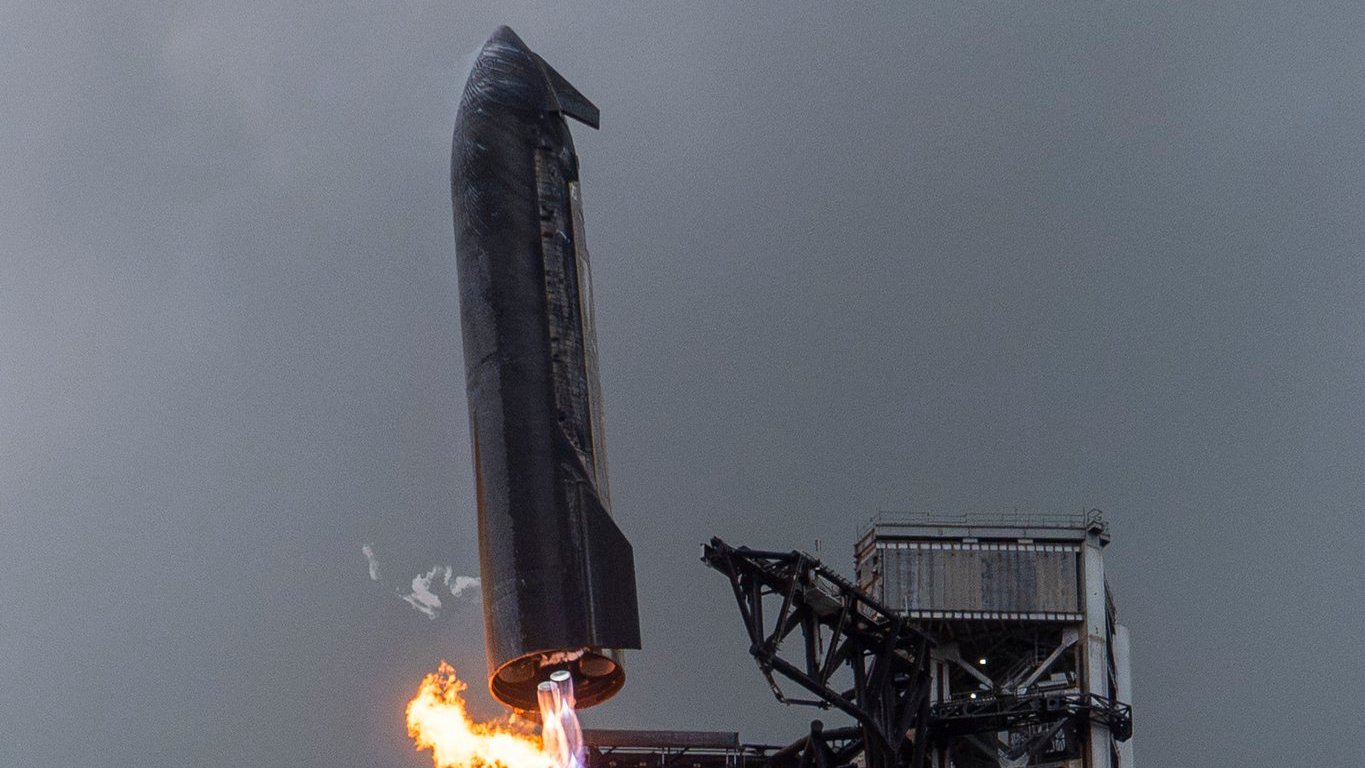
No Catch, No Landing! SpaceX’s BIZARRE Plan for Starship Flight 16: SpaceX is preparing for another major milestone in its Starship development program, but its plans for the upcoming Starship Flight 16 are raising some surprising questions. After achieving a historic breakthrough during Flight 15, many space enthusiasts expected SpaceX to reuse Ship 42 for another mission. However, Elon Musk has indicated that the spacecraft will not fly again, despite its apparently good condition after completing its historic orbital journey and tower catch.
Even more interesting, details from a recent Federal Communications Commission (FCC) filing suggest that SpaceX may approach Flight 16 differently, potentially launching without publicly specified recovery plans for either the Super Heavy booster or Starship upper stage.
The upcoming mission could feature Booster 23 and Ship 43, representing the next generation of Starship hardware known as Block 3. With a potential launch window beginning in December 2026, Flight 16 could become an important test of SpaceX’s evolving engineering strategy.
But why would SpaceX retire a spacecraft that successfully completed an orbital flight and survived a tower catch? And why might the company skip another ambitious landing attempt?
Starship Flight 15: A Historic Achievement for SpaceX
Flight 15 represented a significant turning point in SpaceX’s journey toward fully reusable spacecraft. For the first time, a Starship upper stage completed an orbital mission, deployed operational payloads, and returned to the launch site for a successful catch by the Mechazilla tower.
Ship 42 Successfully Reaches Orbit
During Flight 15, Ship 42 deployed 26 Starlink V3 satellites, demonstrating the spacecraft’s growing ability to support future commercial satellite deployment missions.
After spending more than 22.5 hours in space, the spacecraft returned to Earth and completed a historic tower catch. Mechazilla’s massive mechanical arms successfully captured the descending vehicle at the launch tower.
The achievement demonstrated that SpaceX was moving closer to its long-term vision of recovering and reusing both stages of Starship.
However, the mission was not perfect. Booster 22 did not complete a tower catch and instead diverted toward an ocean splashdown.
Nevertheless, Ship 42’s successful recovery represented an enormous engineering accomplishment.
Why Ship 42 Will Not Fly Again
One of the biggest surprises surrounding Flight 16 is Elon Musk’s decision not to reuse Ship 42.
Following the mission, Musk personally inspected the spacecraft. Initial observations suggested that its heat shield and Raptor engines remained in good condition, potentially requiring only a few weeks of refurbishment before another flight.
Under normal circumstances, this would make Ship 42 an excellent candidate for another mission.
However, Musk indicated that the spacecraft would instead be preserved for public display.
The reason is historical significance. Ship 42 became the first Starship spacecraft to complete an orbital journey and return to be caught by Mechazilla.
Preserving the vehicle allows SpaceX to showcase one of the most important milestones in its reusable rocket development program.
SpaceX Wants Aircraft-Like Starship Reusability
Although refurbishing Ship 42 could demonstrate hardware reuse, SpaceX has a much bigger objective.
Elon Musk’s long-term vision involves making Starship operate more like a commercial aircraft than a traditional rocket.
An aircraft does not require weeks or months of rebuilding after every flight. It lands, undergoes inspections, receives maintenance and fuel, and returns to service.
SpaceX wants to achieve a similar operating model for Starship.
Why Rapid Turnaround Matters
Currently, even successful recovery does not automatically mean a spacecraft is ready to fly again.
SpaceX must continue improving several critical technologies, including:
- Heat shield durability: Thermal protection must survive repeated atmospheric reentries.
- Raptor engine reliability: Engines must operate consistently across multiple missions.
- Structural durability: The vehicle must withstand repeated launch, landing, and atmospheric stresses.
- Plumbing systems: Fuel and oxidizer connections must remain reliable through repeated operations.
- Ground infrastructure: Launch towers and support equipment must enable faster inspections, refueling, and preparation.
The difference between a reusable rocket and a rapidly reusable rocket is enormous.
SpaceX does not simply want to recover expensive hardware. It wants to recover it, inspect it, refuel it, and launch it again with minimal delays.
That is why retiring Ship 42 could make sense even if the vehicle remains physically capable of flying again.
Starship Flight 16 Could Introduce Block 3 Hardware
The next major development could arrive with Starship Flight 16, potentially launching as early as December 2026.
According to the discussed development plans, the mission could use Booster 23 and Ship 43, representing SpaceX’s next-generation Block 3 hardware.
Block 3 is expected to introduce important improvements to Starship’s overall performance, reliability, and operational capabilities.
Booster 23 and Ship 43: What to Expect
The transition toward Block 3 is particularly important because SpaceX needs to improve the vehicle before attempting increasingly demanding missions.
Flight 16 could provide valuable information about:
- Improved vehicle performance.
- Propellant management and operational margins.
- Heat shield and structural resilience.
- Raptor engine performance.
- Overall launch and flight reliability.
The mission could also help SpaceX understand how its newer hardware performs under real flight conditions.
Rather than immediately attempting every recovery milestone, the company may prioritize gathering engineering data and reducing operational risks.
FCC Filing Reveals a Surprising Flight 16 Plan
One of the most interesting details highlighted in the November 23 video comes from an FCC filing submitted on November 3, 2026.
The filing covers an operational period from November 16, 2026, through May 15, 2027.
Its details provide clues about SpaceX’s upcoming Starship launch activities.
Flight 16 May Launch From Starbase Instead of Florida
Many enthusiasts expected Flight 16 to potentially become the first Starship mission launched from Launch Complex 39A at NASA’s Kennedy Space Center in Florida.
SpaceX has been developing Starship launch infrastructure in Florida, creating expectations that the company could eventually expand its operations beyond Starbase, Texas.
However, the filing discussed in the video identifies the Starbase launch location using its Boca Chica coordinates.
It does not specify a corresponding launch operation from the Cape.
This suggests that Flights 16 and 17 could remain at Starbase, potentially pushing the first Florida Starship launch toward Flight 18.
Although this is not a confirmed launch schedule, it provides an important indication of SpaceX’s possible operational priorities.
Why There May Be No Catch or Landing Attempt
Perhaps the most unusual aspect of Flight 16 is the absence of specified recovery plans in the FCC filing.
The document does not clearly identify recovery arrangements for either Ship 43 or Booster 23.
This has raised questions about whether SpaceX intends to attempt another Mechazilla catch or conduct a more conservative flight profile.
The video also discusses the possibility that Raptor 3.2 engines referenced by Musk may not yet be ready for the upcoming vehicles.
If certain hardware or operational systems require additional validation, SpaceX could choose to prioritize flight performance over ambitious recovery attempts.
Importantly, the absence of recovery details in an FCC filing does not prove that both vehicles will be deliberately expended. It simply means the filing does not establish a confirmed recovery plan.
Flight 15 vs. Flight 16: Major Differences
| Feature | Flight 15 | Flight 16 Outlook |
|---|---|---|
| Starship Vehicle | Ship 42 | Ship 43 |
| Booster | Booster 22 | Booster 23 |
| Hardware Generation | Earlier generation | Block 3 candidates |
| Starship Recovery | Mechazilla tower catch | Not specified |
| Booster Recovery | Ocean splashdown | Not specified |
| Major Milestone | First orbital Starship tower catch | Block 3 development and testing |
| Expected Timing | Completed in 2026 | Potentially December 2026 |
| Vehicle Fate | Ship 42 preserved for display | To be determined |
Why Starship Flight 16 Matters for NASA’s Artemis Program
Starship’s development is not only about launching satellites or creating a reusable rocket. It is also closely connected to NASA’s ambitions to return astronauts to the Moon.
SpaceX was selected to develop the Starship Human Landing System (HLS) for NASA’s Artemis program.
This system is expected to play a major role in transporting astronauts between lunar orbit and the Moon’s surface.
Orbital Refueling Is a Critical Challenge
One of the biggest technical challenges involves transferring large quantities of propellant in Earth orbit.
A lunar Starship mission will require multiple tanker launches to deliver propellant to an orbital depot or waiting spacecraft.
This means SpaceX must demonstrate several critical capabilities:
- Reliable and repeatable Starship launches.
- Successful orbital propellant transfer.
- Efficient tanker operations.
- Safe crew transportation.
- Reliable life-support systems.
- Controlled lunar landing and return operations.
Without dependable launch and refueling systems, large-scale lunar missions would become extremely difficult.
That makes every Starship test flight important, even when it does not include a successful recovery.
Starlink V3 and the Future of Commercial Spaceflight
Another major reason SpaceX is developing Starship is its potential to transform the economics of launching satellites.
The successful deployment of 26 Starlink V3 satellites during Flight 15 demonstrated the vehicle’s growing commercial potential.
Future Starship missions could carry significantly larger payloads, helping SpaceX expand its satellite network while reducing the cost per satellite deployed.
Beyond Starlink: Space Stations and Orbital Construction
The long-term applications extend far beyond satellite internet.
A fully reusable Starship could eventually support:
- Commercial space station construction.
- Large-scale satellite deployment.
- Orbital manufacturing.
- Satellite servicing and replacement.
- Deep-space exploration.
- Crewed lunar and Mars missions.
These possibilities depend on achieving reliable and affordable access to orbit.
The ultimate goal is not simply making Starship fly successfully once. It is transforming spaceflight into a high-frequency transportation system.
Conclusion: SpaceX Is Prioritizing Reliability Over Speed
Starship Flight 16 could represent a very different chapter in SpaceX’s development program.
After Ship 42 achieved a historic orbital flight, deployed 26 Starlink V3 satellites, and completed a Mechazilla tower catch, many expected the spacecraft to return for another mission.
Instead, SpaceX appears to be preserving it as a historic vehicle while preparing newer Block 3 hardware for future testing.
The possibility of Flight 16 launching without publicly specified recovery plans also highlights an important engineering philosophy: reliability must come before increasingly ambitious demonstrations.
With Booster 23 and Ship 43 potentially preparing for flight, SpaceX has another opportunity to improve Starship’s performance and move closer to its long-term objectives.
Whether Flight 16 includes a tower catch, an ocean splashdown, or no recovery attempt at all, its engineering lessons could be essential for NASA’s Artemis program, Starlink expansion, and the future of commercial spaceflight.
SpaceX ultimately wants to make Starship as reusable as an aircraft. And reaching that goal may require taking a few unexpected steps along the way.
FAQs
1. What is SpaceX Starship Flight 16?
SpaceX Starship Flight 16 is an upcoming test flight expected to advance the development of the Starship launch system. The mission could feature Booster 23 and Ship 43, representing the next-generation Block 3 hardware.
2. When could SpaceX launch Starship Flight 16?
Starship Flight 16 could launch as early as December 2026. However, the exact launch date will depend on vehicle readiness, testing, and regulatory approvals.
3. Why will Ship 42 not fly again?
Elon Musk indicated that Ship 42 will be preserved for public display rather than reflown. It is historically significant because it became the first Starship spacecraft to complete an orbital journey and be caught by the Mechazilla launch tower.
4. What happened during SpaceX Starship Flight 15?
During Flight 15, Ship 42 reached orbit, deployed 26 Starlink V3 satellites, and spent more than 22.5 hours in space before successfully returning to Earth for a Mechazilla tower catch. Booster 22 diverted to an ocean splashdown.
5. Was Ship 42 damaged during Flight 15?
Initial observations following Elon Musk’s inspection indicated that Ship 42’s heat shield and Raptor engines were in good condition. The spacecraft potentially required only minor refurbishment, although SpaceX ultimately decided to preserve it rather than reuse it.
6. What are Booster 23 and Ship 43?
Booster 23 and Ship 43 are potential vehicles for Starship Flight 16. They are associated with SpaceX’s next-generation Block 3 development program, which aims to improve performance, reliability, and operational capabilities.
7. Will Starship Flight 16 include a Mechazilla tower catch?
A Mechazilla tower catch has not been confirmed for Flight 16. The FCC filing discussed in the video does not specify recovery arrangements, leaving the recovery plans for Ship 43 and Booster 23 uncertain.
8. What did the November 3, 2026, FCC filing reveal about Flight 16?
The FCC filing covers November 16, 2026, through May 15, 2027. It identifies Starbase in Boca Chica, Texas, as the relevant launch location without specifying Florida launch operations or detailed recovery plans.
9. Will Starship Flight 16 launch from Florida or Starbase?
The available filing details point toward Starbase, Texas, rather than Launch Complex 39A in Florida. Flights 16 and 17 could take place at Starbase, potentially pushing the first Florida Starship launch toward Flight 18.
10. Why is SpaceX developing Block 3 Starship vehicles?
SpaceX is developing Block 3 to improve Starship’s performance, reliability, structural durability, and operational efficiency. These improvements are important for future satellite launches, orbital refueling, lunar missions, and rapid vehicle reuse.
11. What are Raptor 3.2 engines?
Raptor 3.2 engines are an engine development reference discussed in connection with SpaceX’s future Starship hardware. Their readiness could influence the company’s testing and recovery decisions for upcoming missions.
12. Why does SpaceX want aircraft-like Starship reusability?
SpaceX wants Starship to operate more like a commercial aircraft, requiring minimal refurbishment between flights. The goal is to land, inspect, refuel, and launch again quickly instead of spending weeks or months preparing the vehicle for another mission.
13. How will Starship Flight 16 support NASA’s Artemis program?
Flight 16 could provide valuable engineering data for improving Starship’s reliability and performance. These developments are important because NASA selected SpaceX’s Starship Human Landing System to help transport astronauts to the lunar surface during the Artemis program.
14. Why is orbital refueling important for Starship?
Orbital refueling allows Starship to receive additional propellant from tanker spacecraft in Earth orbit. This capability is essential for supporting demanding lunar missions that require large quantities of fuel beyond what a single launch can carry.
15. How will Starship help expand Starlink V3?
Starship’s large payload capacity could allow SpaceX to deploy more Starlink V3 satellites per mission. Combined with full reusability, this could reduce launch costs and help expand the company’s next-generation satellite internet network.
16. What is SpaceX’s ultimate goal for the Starship program?
SpaceX ultimately wants to create a fully reusable, rapidly deployable transportation system capable of supporting satellite launches, commercial space stations, lunar exploration, and eventually missions to Mars. Its biggest objective is making spaceflight more affordable, reliable, and routine.
Read More:
- The Tesla Semi 2027 Takeover Has Begun
- SpaceX rejects $738M fed subsidy, betting on Starlink alone
- Tesla removed the most annoying part of Full Self-Driving
- Tesla Model 2 $24,990 Finally Cancelled! Elon Musk REPLACED By A New Model
- End of Apple. Elon Musk’s $179 Tesla Smart Watch is Finally HERE: What Makes It a Game Changer?
1 thought on “No Catch, No Landing! SpaceX’s BIZARRE Plan for Starship Flight 16”