
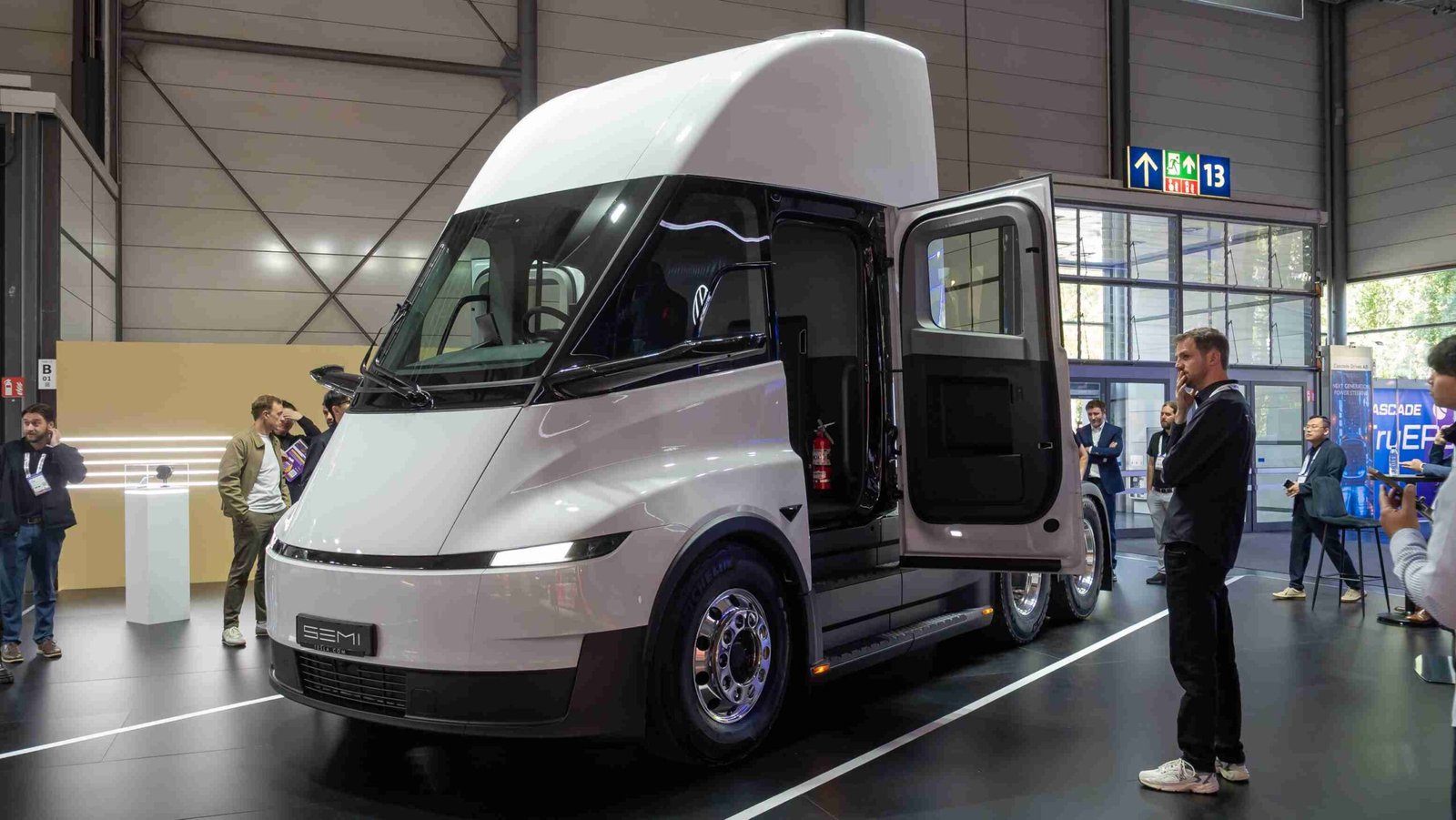
The Tesla Semi 2027 Takeover Has Begun: The Tesla Semi takeover has officially begun, marking a major turning point in the future of electric transportation. After years of development, pilot programs, and limited fleet deployments following its original unveiling in 2017, Tesla is finally moving toward high-volume Semi production and large-scale fleet deliveries. With a new manufacturing facility in Nevada, expanding Mega Charger infrastructure, and major transportation companies adding electric trucks to their fleets, 2027 could become a defining year for the heavy-duty trucking industry.
But Tesla’s latest developments go far beyond electric trucks. The company is also advancing Full Self-Driving (Supervised) V15, preparing its next-generation AI5 computer, and expanding its artificial intelligence capabilities. Meanwhile, Neuralink has demonstrated an impressive brain-computer interface milestone, and The Boring Company is making progress on its Music City Loop project in Nashville.
Let’s explore why these developments could reshape transportation, artificial intelligence, and the future of technology.
Tesla Semi Enters High-Volume Production
The biggest development is Tesla’s transition from limited Semi deployments to high-volume manufacturing. Since the truck’s unveiling in 2017, transportation companies have been waiting for Tesla to deliver electric heavy-duty trucks at meaningful production volumes.
That wait is finally beginning to end.
Tesla started high-volume manufacturing at its new Nevada Semi factory in fall 2026. Fleet deliveries are increasing, with several major transportation companies already receiving their first trucks.
HMD Trucking Receives Its First 50 Tesla Semis
One of the most significant developments involves HMD Trucking, a Chicago-based transportation company operating nearly 700 diesel trucks.
After placing an order in September, HMD received its first 50 Tesla Semis roughly two months later.
Founder and CEO Henry Malucas believes electric trucks could become a major part of the freight industry. His strategy involves installing charging infrastructure directly at company terminals.
Drivers can charge their trucks overnight, travel approximately 500 miles, and return to the terminal without making unnecessary stops at traditional truck stops.
This approach could significantly improve fleet efficiency while reducing fuel expenses and operational interruptions.
TCI Transportation Expands Tesla Semi Adoption
Texas-based TCI Transportation also welcomed its first Tesla Semi at its Arlington location.
The delivery represents progress toward fulfilling a 50-truck order originally placed in 2018. It was reportedly the first Tesla Semi delivered in Texas.
Meanwhile, California is seeing additional deployments. IMC Logistics received its first truck from a 50-unit order, while Watt EV introduced its first Tesla Semis at the Port of Oakland as part of a much larger 370-truck order.
These deliveries demonstrate that commercial interest in electric heavy-duty transportation is expanding.
Tesla Semi Performance Could Challenge Diesel Trucks
Tesla’s strongest argument against traditional diesel trucks is its combination of range, efficiency, and operating costs.
According to Tesla, the top Semi configuration offers:
- Up to 500 miles of driving range when fully loaded.
- Approximately one-third the energy consumption of a comparable diesel truck.
- Fast charging through Tesla’s dedicated Mega Charger network.
- Lower potential energy expenses for fleet operators.
For logistics companies, these advantages could translate into substantial long-term savings.
Electric trucks also eliminate conventional diesel engine maintenance requirements, potentially reducing servicing complexity.
However, the overall financial benefits will depend on electricity prices, vehicle purchase costs, charging infrastructure, and daily operating conditions.
Tesla Mega Charger Network Expands Nationwide
Electric trucks need more than impressive battery technology. They require reliable charging infrastructure capable of delivering enormous amounts of energy in a short period.
Tesla is addressing this challenge through its expanding Mega Charger network.
Each Mega Charger stall can deliver up to 1.2 megawatts of charging power, approximately five times the output of a typical Tesla Supercharger.
New Mega Charger Locations
Several important charging locations are already opening across the United States.
Hodgkins, Illinois: Tesla opened a six-stall Mega Charger location near Chicago to support HMD Trucking’s operations. Tesla says a Semi can recover up to 60% of its range in approximately 30 minutes.
Additional locations are planned around Joliet, Elk Grove Village, Gary, and Center Township.
Mesquite, Texas: Tesla opened its first Texas Mega Charger station at a Fuel City truck stop. The location features eight charging stalls positioned conveniently near the highway.
Georgia and California: Tesla has also expanded megawatt charging availability around Atlanta and Savannah, while California continues supporting growing Semi deployments.
Tesla’s Semi program lead, Dan Priestley, confirmed that megawatt charging is operating in Texas, Georgia, Illinois, and California.
The company’s target is to have more than 30 Mega Charger stations operating across the United States by the end of 2026.
This infrastructure expansion will be essential as Tesla increases production and more commercial fleets transition away from diesel.
Tesla FSD V15 Introduces Major Improvements
While the Semi is transforming commercial transportation, Tesla is also advancing autonomous driving technology.
On November 21, 2026, Tesla began rolling out Full Self-Driving (Supervised) V15 to initial owners. Elon Musk indicated that a broader release for newer Tesla vehicles was expected in December.
According to the episode, Tesla claims the latest version makes driver takeovers approximately 25 times less common.
Early testers have also reported smoother driving behavior, quicker responses, and improvements in everyday navigation.
Tesla Reality View Changes How Drivers See FSD
One of the most interesting additions is Tesla Reality View.
This feature provides a live, realistic visualization of the surrounding road environment generated by the driving AI.
It includes visual indicators such as:
- Turn arrows showing intended driving movements.
- Parking pins highlighting potential parking locations.
- Real-time representations of surrounding road conditions.
- Improved visibility into the vehicle’s intended maneuvers.
Elon Musk compared the experience to GTA in real life.
Other improvements include better parking lot exits, pothole detection, speed-camera deceleration, open parking-space selection, and a new bike rack mode.
These refinements demonstrate Tesla’s continued focus on making automated driving more capable in everyday situations. Drivers must still supervise the system and remain responsible for safe vehicle operation.
AI5 Chip Surprise: Optimus Gets Priority
Another major development involves Tesla’s next-generation AI5 computer.
The AI5 chip is projected to deliver approximately 12 times the computing power of AI4, potentially providing a substantial performance improvement for artificial intelligence applications.
However, Elon Musk indicated a surprising shift in priorities.
Rather than initially prioritizing AI5 for Tesla vehicles, the company plans to introduce the computer to Optimus robots first, with an expected timeframe around April 2027.
Tesla believes its existing AI4 hardware is sufficient for achieving its autonomous driving ambitions.
The episode also highlighted nearly two million unsupervised miles reportedly accumulated by Tesla’s unsupervised robotaxis by the end of September.
This strategy suggests Tesla is balancing its computing resources between autonomous vehicles and humanoid robotics.
Neuralink Patient Plays GTA 6 Using His Mind
Neuralink delivered another remarkable demonstration when it shared footage of a patient playing GTA 6 using only his thoughts.
The participant, identified as Billy, is Neuralink’s 23rd patient. He is 23 years old and lives with tetraplegia following a spinal cord injury.
Before receiving the implant, Billy relied on a mouth stick to operate an iPad.
With Neuralink’s brain-computer interface, he can now control a PlayStation 5 game without physically touching a controller.
How Neuralink Controls Video Games
The technology translates imagined movements into digital commands.
By mapping brain activity to two joysticks and 12 buttons, Billy can perform complicated gaming actions.
The demonstration included driving vehicles, piloting a speedboat, flying an aircraft, and fighting inside GTA 6.
This represents significant progress from Neuralink’s earlier demonstrations involving chess and Civilization 6.
Beyond gaming, Neuralink is also developing Blindsight, an experimental implant intended to restore some visual perception. The technology received FDA Breakthrough Device designation in 2024 and is awaiting further regulatory progress.
Elon Musk has also discussed the possibility of Neuralink technology eventually helping address neck and back pain, although clinical trials for that application have not been announced.
The Boring Company Expands Nashville’s Music City Loop
The final major development involves The Boring Company, which is expanding its underground transportation ambitions in Nashville, Tennessee.
Its Prufrock MB3 tunneling machine is operational and expected to begin tunneling by the end of November 2026 following setup.
The machine uses powerful mechanical grippers to brace against tunnel walls, with each capable of applying approximately one million pounds of force.
Another machine, Prufrock MB4, is expected to arrive in December and begin tunneling in January 2027.
Once operational, Nashville could have four tunneling machines working on the project.
Nashville Airport Loop Gets a Major Agreement
The Boring Company and the Metropolitan Nashville Airport Authority have also signed a 40-year agreement for a Music City Loop station at Nashville International Airport.
The proposed underground transportation system aims to connect downtown Nashville with the airport in less than 10 minutes.
The planned airport station would be approximately 22 feet from the terminal entrance.
The Boring Company intends to fund construction, operations, and maintenance without requiring the airport to pay project costs.
An early 2027 launch is the company’s target, although an exact opening date has not been confirmed.
Conclusion: 2027 Could Be a Defining Year for Elon Musk’s Companies
The latest developments reveal how aggressively Elon Musk’s companies are expanding across multiple industries.
The Tesla Semi is moving toward large-scale production, major freight companies are beginning fleet deployments, and the Mega Charger network is expanding across important transportation corridors.
At the same time, FSD V15 is improving autonomous driving capabilities, AI5 is being prioritized for Optimus, Neuralink is demonstrating increasingly advanced brain-computer interfaces, and The Boring Company is pushing forward with underground transportation infrastructure.
The biggest story is not simply that Tesla is building electric trucks. It is that an interconnected ecosystem of transportation, artificial intelligence, robotics, and infrastructure is beginning to take shape.
If Tesla successfully scales Semi production and charging infrastructure throughout 2027, the electric trucking industry could enter an entirely new era.
FAQs
1. When did Tesla begin high-volume Semi production?
Tesla began high-volume production of the Tesla Semi in fall 2026 at its new manufacturing facility in Nevada, marking a major step toward large-scale commercial deliveries.
2. What is the driving range of the Tesla Semi?
The top Tesla Semi configuration offers up to 500 miles of driving range when fully loaded, making it suitable for long-distance freight transportation.
3. Which company received its first 50 Tesla Semis?
HMD Trucking, a Chicago-based transportation company, received its first 50 Tesla Semis approximately two months after placing its order in September 2026.
4. How many Tesla Semis did Watt EV order?
Watt EV placed an order for 370 Tesla Semis in May 2026 to support freight transportation across the Bay Area and Northern California.
5. How powerful is a Tesla Mega Charger?
Each Tesla Mega Charger stall can deliver up to 1.2 megawatts of charging power, providing significantly faster charging for heavy-duty electric trucks.
6. How long does it take to charge a Tesla Semi?
Tesla says a Semi can recover up to 60% of its driving range in approximately 30 minutes using its Mega Charger infrastructure.
7. How many Tesla Mega Charger stations are planned by the end of 2026?
Tesla expects to have more than 30 Mega Charger stations operating across the United States by the end of 2026.
8. What is Tesla Full Self-Driving V15?
FSD V15 is Tesla’s latest Full Self-Driving (Supervised) software update, featuring improved driving responses, parking, pothole detection, speed-camera deceleration, and Tesla Reality View.
9. What is Tesla Reality View in FSD V15?
Tesla Reality View is a visual feature that displays a realistic representation of the surrounding driving environment, including turn arrows and parking indicators to help drivers understand the vehicle’s intended movements.
10. How much improvement does Tesla claim with FSD V15?
According to the episode, Tesla claims that FSD V15 makes driver takeovers approximately 25 times less common compared with the previous experience.
11. What is Tesla’s AI5 chip, and when will it arrive?
The AI5 chip is Tesla’s next-generation artificial intelligence computer, projected to offer approximately 12 times the computing power of AI4. Elon Musk indicated that Optimus robots would receive priority, with an expected introduction around April 2027.
12. How did a Neuralink patient play GTA 6 using his mind?
Neuralink patient Billy used a brain-computer interface to translate imagined movements into PlayStation 5 controller commands. This allowed him to drive vehicles, operate aircraft, and perform other gaming activities without physically touching a controller.
13. What is Neuralink’s Blindsight project?
Blindsight is Neuralink’s experimental brain implant designed to restore some visual perception for people with blindness. It received FDA Breakthrough Device designation in 2024 and requires further regulatory progress.
14. What is The Boring Company’s Music City Loop project?
The Music City Loop is an underground transportation project in Nashville, Tennessee, designed to connect important destinations through tunnels. The project includes plans for a connection between downtown Nashville and Nashville International Airport.
15. When could the Nashville Music City Loop airport connection open?
The Boring Company is targeting an early 2027 launch for the airport connection. The proposed journey from downtown to the airport would take less than 10 minutes, although an exact opening date has not been confirmed.
Read More:
- SpaceX rejects $738M fed subsidy, betting on Starlink alone
- Tesla removed the most annoying part of Full Self-Driving
- Tesla Model 2 $24,990 Finally Cancelled! Elon Musk REPLACED By A New Model
- End of Apple. Elon Musk’s $179 Tesla Smart Watch is Finally HERE: What Makes It a Game Changer?
- Wow! SpaceX’s Secret Plan for First Foreign Starship Launch Pad is Kind of Mind-Blowing
2 thoughts on “The Tesla Semi 2027 Takeover Has Begun”