
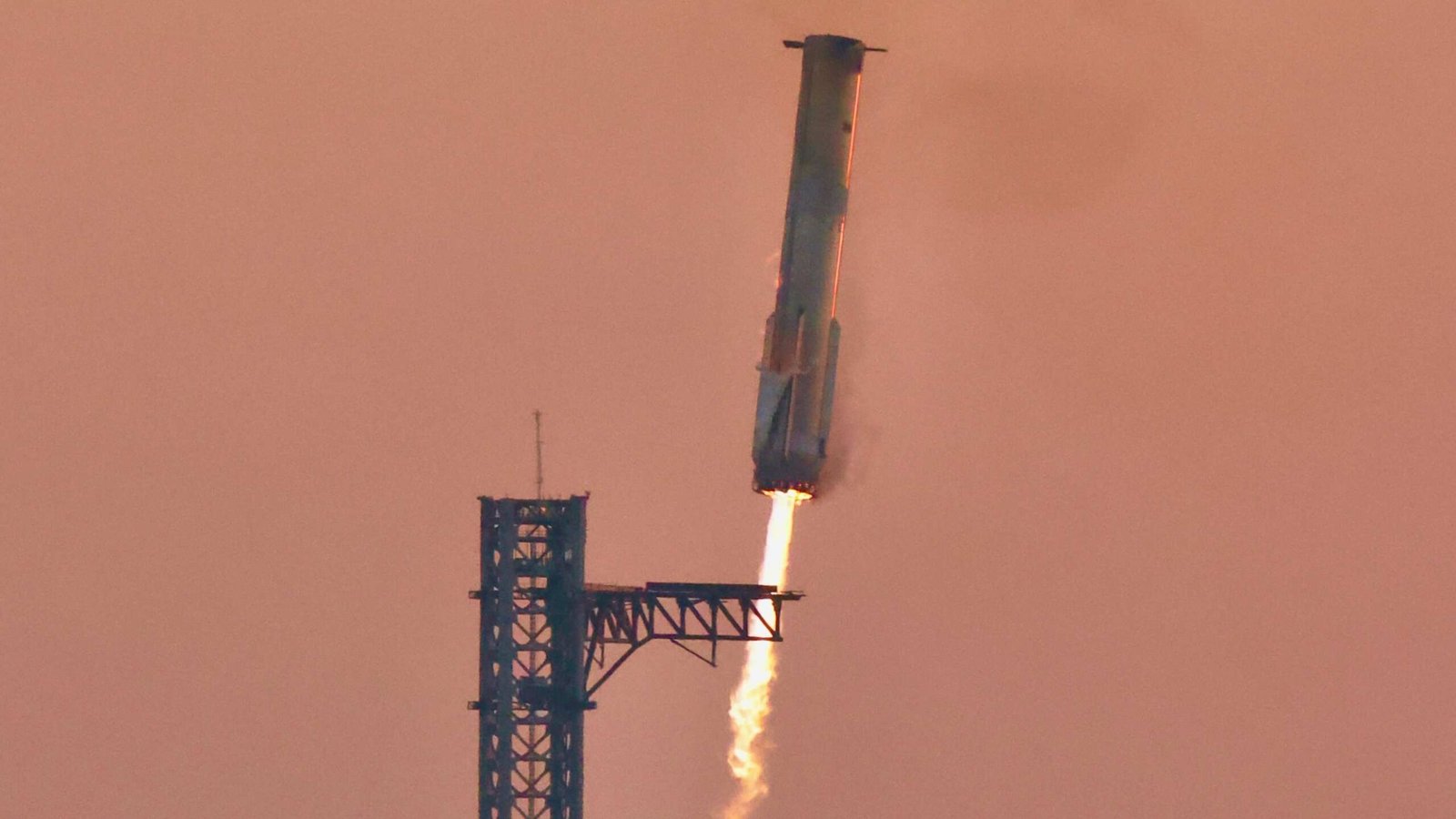
SpaceX revealed Breakthrough Solution for Starship Launch Pad Turnaround In Hours: The development of Starship is no longer focused only on building a fully reusable spacecraft. For SpaceX, the bigger challenge is creating an entire high-frequency space transportation system capable of supporting launches at a pace measured in days or even hours.
While the dramatic recovery of Super Heavy boosters and Starship upper stages attracts most of the attention, another critical part of the equation is happening on the ground. Launch pad turnaround could become one of the biggest limitations on Starship’s launch cadence.
At Starbase, SpaceX has now introduced a specialized modular steel servicing structure designed to make Orbital Launch Mount (OLM) maintenance faster, safer, and more repeatable. The development represents an important step toward transforming Starship launch infrastructure from a manually serviced test environment into a standardized system built for rapid reuse.
Why Starship Launch Pad Turnaround Matters
A reusable rocket is only truly reusable if its supporting infrastructure can keep up with it.
After a Starship flight, the Orbital Launch Mount must undergo inspections and maintenance before another launch can take place. This can include structural inspections, servicing of hydraulic systems, checking hold-down clamps, inspecting plumbing, and maintaining the Quick Disconnect (QD) system that connects the launch infrastructure to the vehicle.
Historically, this type of work can require temporary scaffolding, cranes, mobile platforms, and significant amounts of labor.
That creates a potential mismatch:
- Reusable rocket: designed to fly repeatedly.
- Reusable launch infrastructure: must also be serviced quickly.
- Launch cadence: ultimately depends on whichever component takes the longest to prepare.
If a rocket can be ready within hours but its launch mount requires days of preparation, the vehicle’s theoretical flight rate becomes irrelevant.
The Economics of Pad Turnaround
For a future Starship network operating across Starbase and Florida, infrastructure turnaround becomes even more important.
SpaceX has discussed multiple launch platforms that could eventually support Starship operations. A delay at one pad can potentially affect the broader flight manifest, particularly when missions require closely scheduled launches for satellite deployment, tanker operations, lunar missions, or other high-volume activities.
The goal therefore extends beyond simply repairing a launch pad after every flight. SpaceX needs a repeatable maintenance process that can be performed rapidly and consistently.
SpaceX’s New Modular OLM Servicing Structure
The recently delivered servicing hardware at Starbase consists of two specialized steel framework sections designed to fit around the geometry of the Orbital Launch Mount.
Instead of constructing temporary scaffolding after each major operation, crews can position the modular structures around the launch mount and gain immediate access to critical components.
The system essentially creates a dedicated maintenance environment around the OLM.
Lower Modular Framework
The lower section features a two-tier circular structural ring with support arms extending around the launch mount.
Its design provides access to critical hardware near the base of the OLM, including the hold-down and release clamps.
Integrated ladders allow technicians to reach these areas without depending on temporary access equipment. At the same time, the structure is shaped to avoid interference with moving mechanical components, linkages, and high-pressure plumbing.
This is important because the launch mount is not simply a static platform. It contains numerous mechanical and fluid systems that must remain accessible while the structure itself operates safely around them.
Upper Servicing Platform
The upper section provides access to the top portion of the launch mount.
Built-in staircases and elevated walkways eliminate much of the need for temporary ladders and mobile platforms. Technicians can access areas around the Booster Quick Disconnect system, fueling connections, avionics interfaces, and related equipment.
The result is a more organized maintenance environment with multiple levels of access.
Modular Steel vs. Temporary Scaffolding
The most significant advantage of the new system may be its ability to replace labor-intensive temporary scaffolding.
Traditional scaffolding can require workers to assemble individual sections, install access platforms, and later dismantle everything after maintenance is completed. That process consumes time and labor while potentially limiting the number of technicians who can work simultaneously.
A reusable modular structure changes that equation.
Faster Installation
Instead of building access structures piece by piece, the modular sections can be lifted into position using cranes or specialized handling equipment.
This could reduce setup from multiple days to a much shorter window, depending on the condition of the launch mount and the scope of required maintenance.
Greater Structural Stability
A purpose-built steel framework offers substantially more rigidity than temporary scaffolding.
This can provide maintenance teams with stable working platforms while also reducing some of the operational limitations associated with temporary structures and environmental conditions.
More Workers, More Work Areas
Perhaps the biggest operational benefit is parallel access.
With multiple platforms available, different teams can potentially work on different components simultaneously. One crew could inspect the hold-down clamps while another services the QD system and another performs structural or sensor inspections.
That turns maintenance from a largely sequential process into a parallel workflow.
How the New Starship Pad Workflow Could Work
The introduction of modular servicing equipment creates a more standardized post-flight process.
Step 1: Clear the Launch Area
Following a Starship flight or booster catch operation, safety teams first need to verify that the launch mount area is safe.
This includes environmental monitoring, structural checks, and clearing operational hazards.
Step 2: Position the Servicing Modules
Once the area is cleared, cranes or specialized transport equipment can position the lower framework around the OLM.
The upper section can then be stacked into its designated position.
Step 3: Begin Parallel Maintenance
Maintenance teams can simultaneously inspect several systems.
Lower-level teams can focus on hydraulic hold-down clamps, protective hardware, structural components, and lower plumbing.
Upper-level teams can work around the Booster Quick Disconnect system, seals, insulation, fueling interfaces, and instrumentation.
This simultaneous approach is critical if SpaceX wants to push launch preparation toward increasingly short turnaround windows.
Step 4: Testing and Removal
After inspections and repairs are complete, technicians can conduct pressure tests, sensor checks, and other verification procedures.
Once the launch mount passes its required checks, the modular structures can be lifted away and stored, leaving the OLM ready for subsequent launch preparations.
The Bigger Picture: Building a High-Frequency Starship System
The modular servicing structure is more than another piece of ground equipment. It represents a broader shift in SpaceX’s approach to Starship infrastructure.
The long-term objective is to create an operational system where rockets, launch mounts, ground equipment, and maintenance teams all work according to standardized procedures.
That becomes especially important if Starship eventually performs large numbers of tanker launches.
Tanker Missions Could Drive the Need for Speed
Future lunar and Mars missions could require Starship tankers to repeatedly launch and deliver propellant to an orbital depot.
That means SpaceX could eventually need many Starship launches within relatively short mission windows.
A launch infrastructure system that takes weeks to recover after every flight would make that operational model difficult.
By contrast, modular servicing systems capable of reducing maintenance time from days toward hours could provide the foundation for much higher launch frequency.
Standardization Across Multiple Launch Pads
Another major advantage is standardization.
If similar servicing structures and maintenance procedures can be deployed across multiple Starship launch platforms in Texas and Florida, SpaceX could establish a common operational model.
Instead of every launch site developing its own custom maintenance process, standardized equipment could allow teams to follow similar workflows across the Starship network.
This could improve:
- Maintenance efficiency
- Worker training
- Equipment utilization
- Launch scheduling
- Pad recovery times
- Overall operational consistency
The result would be a launch infrastructure fleet designed around the same philosophy as the Starship vehicle itself: reuse, standardization, and rapid turnaround.
From Experimental Pad to Space Transportation Network
Starship’s ultimate promise is not simply to become a reusable rocket. It is intended to become the foundation of a high-volume space transportation architecture.
Achieving that vision requires solving problems at every level.
The vehicle must survive repeated flights.
The launch mount must survive repeated launches.
Ground systems must be rapidly serviced.
Maintenance crews must work efficiently.
And the entire process must be repeatable enough to support an ambitious flight manifest.
The new modular OLM servicing structure addresses one of those less visible but extremely important challenges.
Conclusion
SpaceX’s move toward modular launch pad servicing could prove just as important to Starship’s long-term success as improvements to the rocket itself.
A fully reusable launch vehicle cannot achieve airline-like or high-frequency operations if its ground infrastructure requires lengthy manual refurbishment after every mission.
By replacing temporary scaffolding with purpose-built, reusable steel servicing platforms, SpaceX is creating a faster and more standardized way to inspect, repair, and prepare the Orbital Launch Mount.
The significance of this development goes beyond Starbase. As Starship operations expand toward multiple launch sites, lunar missions, satellite deployment, and potentially large-scale Mars logistics, launch pad turnaround time will become a defining factor in overall launch cadence.
The future of Starship may therefore depend not only on how quickly SpaceX can launch and catch its rockets, but also on how quickly it can prepare the launch pad for the next one.
FAQs
1. What is the main challenge with Starship launch pad turnaround?
The main challenge is ensuring that the Orbital Launch Mount (OLM) can be inspected, repaired, and prepared for another flight quickly enough to support SpaceX’s ambitious launch cadence. Even if Starship and Super Heavy are rapidly reusable, lengthy pad maintenance could limit the overall flight rate.
2. What is the Orbital Launch Mount?
The Orbital Launch Mount, or OLM, is the major ground structure used to support Starship during launch. It contains critical mechanical, structural, fueling, plumbing, and vehicle-interface systems that must be inspected and maintained after launch operations.
3. Why is launch pad turnaround important for Starship?
Launch pad turnaround is essential because SpaceX aims to conduct frequent Starship launches. If the launch infrastructure takes days or weeks to recover after every mission, it could become the primary bottleneck even if the spacecraft itself is ready to fly again.
4. What new servicing structure did SpaceX bring to Starbase?
SpaceX delivered a two-piece modular steel servicing structure designed to surround portions of the Orbital Launch Mount. The system provides dedicated platforms, stairs, and access areas for technicians performing post-flight inspections and maintenance.
5. How is the modular servicing structure different from scaffolding?
Traditional scaffolding generally requires manual assembly and dismantling. The modular system is purpose-built from rigid steel sections that can be positioned using lifting equipment, potentially reducing setup and teardown time while providing more stable working platforms.
6. What does the lower section of the servicing structure do?
The lower framework provides access around the base of the OLM. Its circular, multi-level design and integrated ladders allow technicians to reach important components such as hold-down clamps, mechanical systems, and lower plumbing.
7. What is the purpose of the upper servicing platform?
The upper section provides maintenance access around the upper portion of the OLM. It allows technicians to work around the Booster Quick Disconnect (BQD), fueling connections, avionics interfaces, and other launch-system components.
8. Can multiple maintenance teams work simultaneously?
Yes. One of the major potential advantages of the modular system is parallel maintenance. Different teams can potentially work on the clamps, QD systems, sensors, plumbing, and other components at the same time rather than waiting for one maintenance task to finish before beginning another.
9. How could modular servicing reduce Starship turnaround time?
The system could reduce turnaround time by eliminating much of the need to construct temporary access structures. Rapid crane placement, built-in access platforms, and parallel maintenance could allow crews to complete more work during the same maintenance window.
10. Why is structural stability important during OLM maintenance?
The OLM contains complex mechanical and fluid systems, so technicians need stable and reliable access. A rigid steel servicing framework can provide more predictable working conditions than temporary structures while supporting multiple maintenance activities.
11. What happens to the servicing structure after maintenance?
Once inspections, repairs, sensor checks, and testing are completed, the modular sections can be lifted away from the launch mount and moved to a storage or staging area. This allows the OLM to return to launch configuration.
12. Could this system support daily Starship launches?
The modular servicing structure could help make higher launch frequencies more practical, but it is only one part of the overall system. Vehicle refurbishment, propellant operations, safety procedures, regulatory requirements, weather, payload processing, and other infrastructure also influence launch cadence.
13. Why does SpaceX need standardized servicing equipment?
Standardization can make operations more efficient across multiple launch sites. If similar equipment and procedures are used at Starbase and future Florida facilities, SpaceX can potentially simplify training, maintenance planning, equipment deployment, and operational procedures.
14. How important is launch pad turnaround for Starship tanker missions?
It could be extremely important. Future lunar and Mars architectures may require multiple tanker flights to deliver propellant to an orbital Starship. Supporting those missions would require launch infrastructure capable of handling a high volume of flights within relatively short periods.
15. Does faster pad turnaround mean Starship can launch every few hours?
Not necessarily. Faster OLM servicing removes one potential bottleneck, but it does not guarantee an hourly or daily launch schedule. Flight hardware readiness, weather, range operations, regulatory approvals, payload preparation, propellant loading, and other factors can still determine the actual launch rate.
16. What does the new servicing structure mean for the future of Starship?
The modular servicing system demonstrates SpaceX’s focus on developing the ground infrastructure needed for rapid reuse. If the approach proves effective, it could help transform Starship operations from occasional launches into a more standardized, high-frequency transportation system capable of supporting large-scale satellite, lunar, and eventually Mars missions.
Read More:
- Tesla Semi 2027 NEW Version Revealed — SHOCKING Upgrades
- Tesla wins three-year standoff against Sweden’s IF Metall union
- Tesla’s driverless Cybercab just passed a big test with State Governor
- Elon Musk teases Tesla Roadster unveiling once again
- Tesla launches Powerwall Lease for affordable home backup
1 thought on “SpaceX revealed Breakthrough Solution for Starship Launch Pad Turnaround In Hours”