
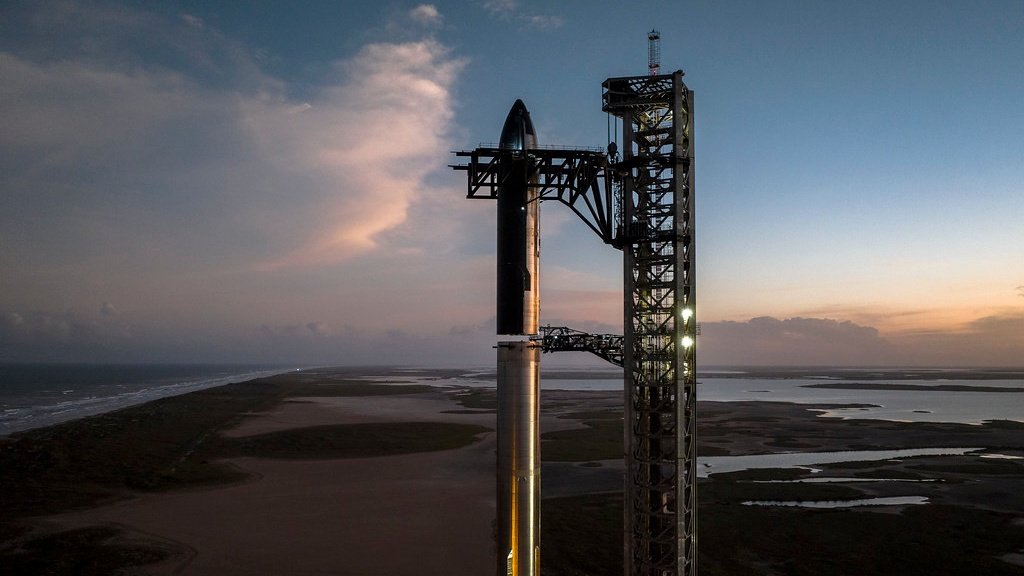
SpaceX Starship Flight 14 Launch This Month Confirmed! Static Fire Test in Days: SpaceX Starship Flight 14 is rapidly approaching a major milestone at Starbase, Texas, as the company prepares for another ambitious test of its next-generation fully reusable rocket system. With static fire testing, vehicle integration, and regulatory preparations moving forward, Flight 14 could become one of the most important missions in the Starship test campaign so far.
Following the achievements of recent Starship flights, SpaceX is now focused on reducing the time between launches while increasing the complexity of each mission. The reported target for Flight 14 is late August 2026, potentially establishing a new turnaround record for the program.
SpaceX Targets a Record Starship Launch Turnaround
One of the biggest stories surrounding Flight 14 is the speed at which SpaceX is preparing the vehicle after the previous mission.
The turnaround between Starship Flight 5 and Flight 6 was approximately 37 days. SpaceX is now targeting a turnaround of around 35 days between Flight 13 and Flight 14.
If achieved, this would demonstrate significant improvements in Starbase’s manufacturing, testing, launch infrastructure, and refurbishment processes.
A faster launch cadence is essential to SpaceX’s long-term Starship strategy. The company ultimately wants Starship to operate more like a reusable transportation system rather than a traditional expendable rocket. That means vehicles must be produced, tested, launched, recovered, inspected, and prepared for another mission in increasingly short timeframes.
Before a launch date can be finalized, SpaceX must also coordinate important regulatory and safety requirements, including Temporary Flight Restrictions (TFRs), NOTAMs, and maritime safety notices.
Ship 41 Static Fire Test Could Be the Next Major Milestone
The Ship 41 (S41) upper stage is at the center of the Flight 14 preparation campaign.
S41 completed cryogenic proof testing before returning to the Mega Bay for engine installation and additional integration work. The vehicle has also received three Raptor Vacuum engines, which are designed to operate efficiently in the vacuum of space.
The next major step is static fire testing at the Massie Test Site.
What Will Ship 41’s Static Fire Test Demonstrate?
A potential full-duration test could involve all six engines installed on the vehicle:
- Three sea-level Raptor engines
- Three Raptor Vacuum engines
- A burn potentially lasting several seconds to approximately 60 seconds
- Validation of engine, plumbing, structural, and control systems
Engineers may also conduct a specialized multi-engine firing designed to provide additional data for the vehicle’s landing and recovery systems.
This testing is particularly important because Flight 14 is expected to push Starship toward increasingly complex orbital and recovery objectives.
Once static fire testing is completed, S41 will need to undergo final inspections, flight-readiness procedures, and other launch-preparation activities.
Booster 21 Moves Forward in Parallel
While Ship 41 undergoes testing at Massie, Booster 21 (B21) is progressing through its own preparation campaign.
The Super Heavy booster has undergone cryogenic testing and received its 33 Raptor engines. Unlike Ship 41, Super Heavy static fire testing takes place directly on the Orbital Launch Mount (OLM) at Starbase.
This allows SpaceX to work on both stages in parallel, an important factor in maintaining the company’s aggressive launch schedule.
The ability to perform multiple processing activities simultaneously could become increasingly important as SpaceX attempts to achieve monthly Starship launches.
S43.1 Simulator Provides a Look at Future Starship Hardware
Flight hardware is not the only equipment receiving attention at Starbase.
A fascinating test article known as S43.1 has also been transported to the Massie Test Site. The vehicle is understood to be a heavily modified Ship nose-cone simulator featuring structural reinforcement, modified catch-pin mounting locations, and internal pressure sensors.
The test article has been placed inside a specialized structural test cage.
Why Is S43.1 Important?
One possible purpose is to simulate the enormous forces experienced when Mechazilla’s Chopstick arms catch a returning Starship.
These tests could help SpaceX understand how the vehicle structure responds to dynamic loads during a tower catch.
The simulator may also support testing related to internal pressure and structural stresses. Such information could become valuable for future Starship configurations, including NASA’s Starship Human Landing System (HLS) and potential orbital tanker or depot variants.
In other words, S43.1 could provide important engineering data for Starship’s future beyond the immediate Flight 14 mission.
Flight 14 Could Push Starship Toward Orbital Recovery
Flight 14 represents a potential evolution in the Starship test program.
Earlier missions focused heavily on proving basic flight operations, stage separation, controlled reentry, and ocean splashdowns. Future missions are expected to increasingly emphasize orbital operations and recovery.
The long-term vision involves Starship launching into orbit, performing operations in space, reentering the atmosphere, and eventually returning to Starbase for recovery.
Mechazilla and Tower Catch Technology
One of SpaceX’s most ambitious goals is recovering Starship and Super Heavy using the launch tower itself.
Instead of relying exclusively on landing legs, the Mechazilla tower system is designed to catch returning vehicles with its large mechanical arms.
Successfully demonstrating this technology would be a major step toward rapid reusability.
Flight 15 Hardware Is Already Taking Shape
SpaceX is not waiting for Flight 14 to finish before preparing the next vehicle pair.
Ship 42 (S42) began assembly in early July 2026, with stacking completed by mid-July. The vehicle has also received its aft aerodynamic flaps and is expected to proceed to additional testing after S41 clears the relevant test infrastructure.
Meanwhile, Booster 22 (B22) began stacking in late June and completed major integration work in early August. Its preparation includes the hot-staging ring and upper extension barrel.
If testing remains on schedule, S42 and B22 could progress toward integrated testing in September.
This creates an ambitious potential sequence:
Flight 12 → Flight 13 → Flight 14 → Flight 15
A successful Flight 15 campaign could potentially give SpaceX three Starship launches in three consecutive calendar months.
Why Starship Flight 14 Matters for NASA’s Artemis Program
The importance of Starship Flight 14 extends far beyond SpaceX’s launch statistics.
NASA has selected a modified version of Starship as the Human Landing System (HLS) for the Artemis lunar exploration program. For that architecture to work, SpaceX must demonstrate capabilities that go far beyond simply launching a large rocket.
One of the most important technologies is in-space cryogenic propellant transfer.
Orbital Refueling Is Critical
A Starship HLS mission will require substantial amounts of propellant. SpaceX’s planned architecture involves launching tanker vehicles and transferring propellant in orbit.
That means the company needs a reliable, repeatable launch cadence.
A monthly launch rate is therefore not simply about breaking turnaround records. It could eventually become the operational foundation for building and maintaining an orbital propellant depot.
The more frequently Starship vehicles can launch, the more practical this architecture becomes.
The Biggest Challenge: Balancing Speed and Reliability
Despite the excitement surrounding Flight 14, rapid development comes with significant risks.
A complex mission involving orbital operations and recovery attempts could experience unexpected problems. An anomaly could lead to additional investigations, regulatory reviews, or launch-pad repairs, potentially affecting subsequent flights.
SpaceX therefore faces a difficult balance between rapid iteration and strict engineering quality control.
Critical systems such as Raptor engines, thermal protection tiles, avionics, propellant systems, hot-staging hardware, and Mechazilla’s recovery mechanisms must all perform as expected.
Starship Flight 14 Could Define the Next Phase of SpaceX
The upcoming Starship Flight 14 launch is more than another test flight. It represents a critical experiment in whether SpaceX can transform Starship from an experimental vehicle into a rapidly reusable orbital transportation system.
The immediate milestones are clear: complete Ship 41 and Booster 21 testing, finalize launch preparations, clear regulatory requirements, and attempt the late-August mission window.
If SpaceX succeeds, the biggest achievement may not be the flight itself. It could be the speed of the entire operation.
A roughly 35-day turnaround would demonstrate that Starship development is accelerating. Follow-on hardware such as Ship 42 and Booster 22 could then keep the momentum going into September.
Ultimately, Flight 14 could help determine how quickly SpaceX can scale Starship operations, how soon orbital refueling becomes practical, and whether the company can maintain the launch cadence required for ambitious lunar and eventually Mars missions.
All eyes are now on Starbase as SpaceX moves toward what could be one of the most consequential Starship tests yet.
FAQs
1. When is SpaceX Starship Flight 14 expected to launch?
SpaceX Starship Flight 14 is targeting a late-August 2026 launch window, subject to successful testing, regulatory approvals, weather, and overall vehicle readiness.
2. What is the main goal of Starship Flight 14?
The mission is expected to test increasingly advanced orbital flight, reentry, and vehicle recovery capabilities, helping SpaceX move closer to routine and rapid Starship operations.
3. What is Ship 41?
Ship 41 (S41) is the Starship upper-stage vehicle being prepared for Flight 14. It has undergone cryogenic testing and is being equipped with Raptor Vacuum and sea-level engines before its final flight preparations.
4. What is a Starship static fire test?
A static fire test involves igniting the vehicle’s engines while the rocket remains secured to a test or launch structure. Engineers use the test to evaluate engine performance, propellant systems, software, plumbing, and other critical hardware before flight.
5. How many engines does Ship 41 have?
Ship 41 is designed to use six Raptor engines: three sea-level Raptors and three Raptor Vacuum engines optimized for operation in space.
6. What is Booster 21?
Booster 21 (B21) is the Super Heavy first-stage booster being prepared to support Starship Flight 14. It is designed to use 33 Raptor engines.
7. Where will Booster 21’s static fire test take place?
Super Heavy static fire testing is conducted at the Orbital Launch Mount (OLM) at Starbase, allowing SpaceX to test the booster while Ship 41 can undergo separate testing at the Massie facility.
8. Could Flight 14 set a Starship turnaround record?
Yes. If the mission launches around the targeted late-August window, SpaceX could achieve a turnaround of roughly 35 days from Flight 13 to Flight 14, potentially beating the previous approximately 37-day record between Flights 5 and 6.
9. What is the S43.1 simulator?
S43.1 is a specialized structural test article based on a modified Starship nose-cone design. It includes structural reinforcement, modified catch-pin locations, and pressure sensors for engineering tests.
10. Why is SpaceX testing S43.1?
The simulator can provide data on structural loads, pressure conditions, and catch-related forces. Such testing may help SpaceX improve future Starship recovery systems and specialized variants.
11. What is Mechazilla?
Mechazilla is SpaceX’s large launch-tower infrastructure designed to handle and recover Starship vehicles. Its mechanical arms, commonly called the Chopsticks, are intended to catch returning vehicles.
12. What vehicles are being prepared for Flight 15?
SpaceX is preparing Ship 42 (S42) and Booster 22 (B22) as potential Flight 15 hardware. Their development demonstrates how SpaceX is working on future missions while Flight 14 preparations continue.
13. Why is a high Starship launch cadence important?
A rapid launch cadence is essential to SpaceX’s vision of fully reusable space transportation. Frequent launches could help demonstrate reliable operations, reduce turnaround times, and support future tanker and orbital-refueling missions.
14. How is Starship Flight 14 connected to NASA’s Artemis program?
Starship is being developed as NASA’s Human Landing System (HLS) for Artemis lunar missions. Demonstrating reliable launches, orbital operations, and eventually propellant transfer will be important for supporting future crewed lunar missions.
15. What happens if Starship Flight 14 experiences a problem?
An unexpected anomaly could lead to additional engineering investigations, regulatory reviews, or launch-site repairs. Such delays could also affect the planned schedule for subsequent Starship flights, making Flight 14 an important test of both vehicle performance and SpaceX’s rapidly evolving launch operations.
Read More:
- NEW TESLA 4680 BATTERY Just Exposed A Hidden Problem Inside Giga Berlin
- Another Tesla SpaceX merger prediction by ARK Invest has Elon Musk talking
- Tesla headlights cause recall of over 20,000 Model 3 and Model Y
- SpaceX AI investment gamble will make it a big winner, firm says
- Tesla has one big financial question to answer for investors: Morgan Stanley