
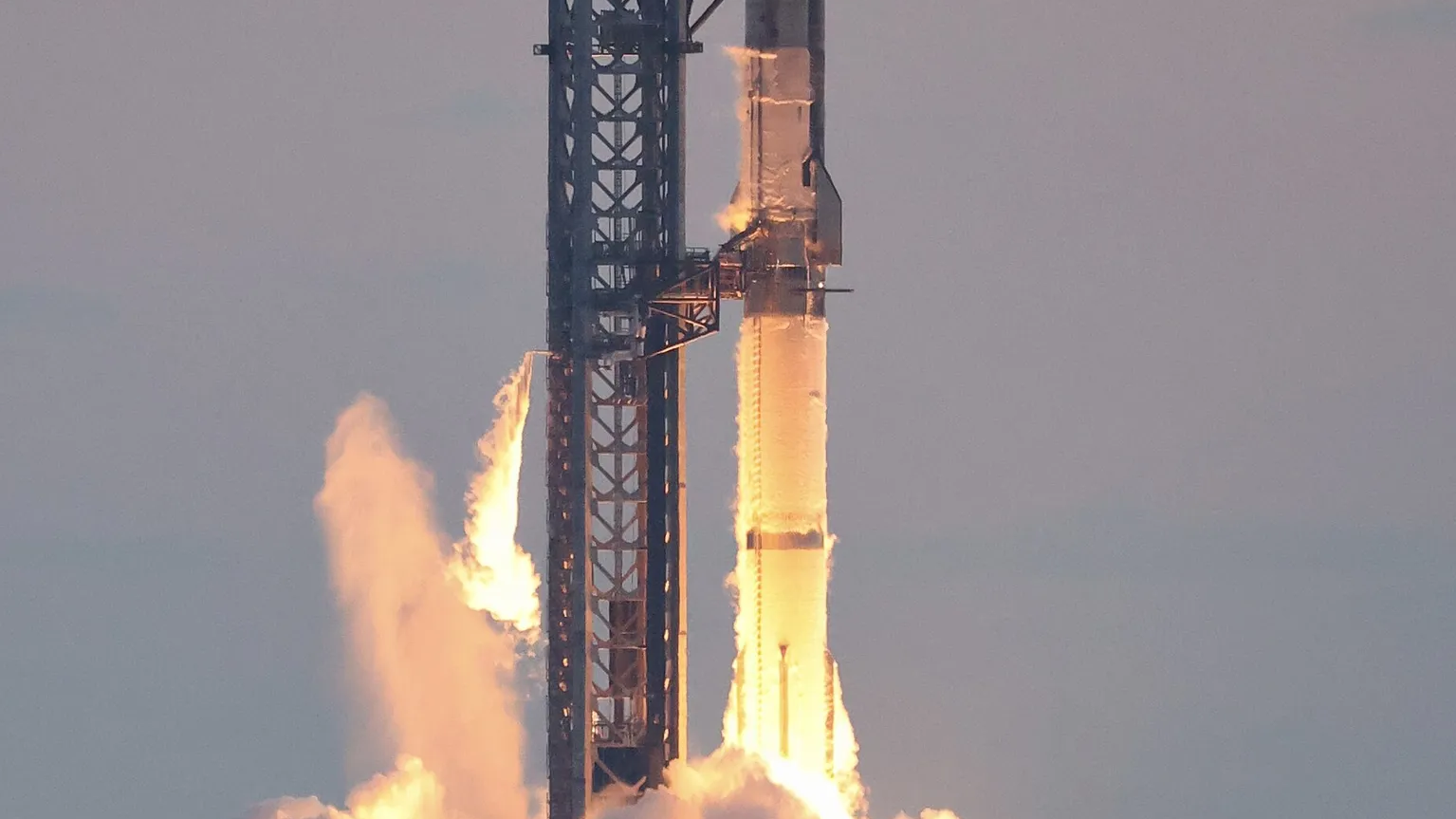
SpaceX Stunned NASA with Big Starship Progress towards 2027 Artemis: SpaceX Starship has taken another significant step toward transforming space exploration, bringing NASA closer to its ambitious goal of returning astronauts to the Moon. While reaching Earth orbit represents a major achievement in aerospace engineering, it is only the beginning of a much more challenging journey. The next phase involves proving that Starship can operate reliably, transfer fuel in space, return safely to Earth, and support complex lunar missions.
Following a successful orbital flight, SpaceX received praise from NASA leadership, highlighting the growing importance of Starship in America’s future lunar exploration plans. With the NASA Artemis program targeting crewed lunar exploration in the coming years, the pressure is mounting on SpaceX to turn its massive rocket into a fully reusable transportation system.
However, three major challenges stand between Starship and its ultimate goal: rapid reusability, orbital propellant transfer, and a high-frequency launch schedule.
SpaceX Starship’s Orbital Success Earns NASA’s Attention
Reaching orbit is one of the most difficult milestones in spaceflight. For SpaceX, Starship’s successful orbital flight demonstrated the enormous potential of the world’s largest and most powerful launch vehicle.
Nevertheless, achieving orbit once is very different from establishing routine and reliable orbital operations. To support future lunar missions, Starship must demonstrate that its entire transportation system can operate safely and repeatedly.
NASA Administrator Praises SpaceX’s Achievement
NASA Administrator Jared Isaacman congratulated SpaceX following the successful mission, recognizing the team’s accomplishment and the importance of making Starship operations routine.
He emphasized the value of safe and responsible development, expressing NASA’s interest in helping SpaceX advance its technology.
This recognition highlights the close relationship between SpaceX and NASA, particularly as the United States prepares for increasingly complex lunar missions.
Starship is expected to play a crucial role in NASA’s lunar exploration architecture by serving as the Human Landing System (HLS), designed to transport astronauts between lunar orbit and the Moon’s surface.
Why Reaching Orbit Is Only the Beginning
Although reaching orbit proves that a spacecraft can travel beyond Earth’s atmosphere and enter a stable orbital trajectory, it does not automatically establish that the vehicle is ready for human spaceflight.
SpaceX must still demonstrate reliable spacecraft recovery, safe orbital refueling, life-support integration, and the ability to conduct multiple launches within a short period.
These capabilities are essential because a lunar landing requires more than a powerful rocket. It demands a coordinated transportation system capable of delivering fuel, moving astronauts, and supporting operations far from Earth.
NASA’s Artemis Program Is Entering a Critical Phase
NASA’s Artemis program aims to establish a sustainable human presence on the Moon while developing technologies that could eventually support crewed missions to Mars.
SpaceX Starship is a central component of this strategy, particularly because traditional launch vehicles cannot deliver all the propellant required for a fully fueled lunar Starship in a single launch.
Under the evolving mission architecture described in the supplied report, Artemis planning emphasizes demonstrating critical spacecraft operations in Earth orbit before attempting increasingly complex lunar missions.
Why Artemis Needs Starship HLS
The Starship Human Landing System is designed to transport astronauts from lunar orbit to the lunar surface and back.
Unlike a conventional lunar lander, Starship HLS is a massive spacecraft that depends on orbital refueling to acquire the propellant needed for its journey.
Before NASA can rely on this system, SpaceX must demonstrate that Starship can rendezvous with other spacecraft, transfer cryogenic fuel, and support the operational requirements of a crewed lunar mission.
Successful orbital operations are therefore a prerequisite for Starship’s lunar ambitions.
Three Major Challenges SpaceX Must Overcome
Despite Starship’s progress, three significant engineering challenges remain before the system can become a reliable transportation solution for NASA’s lunar missions.
1. Recovering Starship and Achieving Full Reusability
SpaceX has demonstrated its ability to catch the Super Heavy booster using the mechanical arms of its launch tower, commonly known as Mechazilla’s chopsticks.
However, recovering the Starship upper stage presents a different set of challenges.
During atmospheric reentry, Starship encounters extreme temperatures and aerodynamic forces. Its structure, thermal protection system, and control mechanisms must withstand these conditions while guiding the vehicle toward a safe recovery.
The spacecraft must also manage changing mass and flight characteristics as propellant is consumed.
Achieving reliable recovery would represent a major breakthrough for Starship reusability.
SpaceX has already demonstrated the economic advantages of reusable rockets through its Falcon 9 program. Applying similar principles to Starship could help reduce launch costs and increase the frequency of missions.
Ultimately, the objective is to develop a system that can be recovered, inspected, prepared, and launched again without extensive rebuilding after every flight.
2. Mastering Orbital Refueling Technology
Orbital propellant transfer is one of the most important technologies required for Starship’s lunar missions.
A Starship HLS cannot simply launch from Earth and travel directly to the Moon with all the propellant it needs. Instead, SpaceX plans to use tanker spacecraft to deliver fuel to an orbital depot.
The lunar spacecraft would then receive propellant from this depot before beginning its journey toward the Moon.
This approach introduces several technical challenges.
First, multiple spacecraft must rendezvous and maintain precise relative positions in orbit. Next, they must connect their transfer systems and move super-cooled liquid oxygen and liquid methane between vehicles.
Because these liquids must remain at extremely low temperatures, controlling heat transfer and minimizing propellant loss are essential.
SpaceX must demonstrate that ship-to-ship cryogenic refueling can work reliably in microgravity.
Without this capability, Starship HLS cannot perform the lunar missions envisioned by NASA.
3. Increasing Launch Frequency and Infrastructure
The third major challenge is scaling up launch operations.
A single lunar landing campaign could require numerous tanker launches to transport enough propellant into orbit. Depending on the final mission architecture, estimates discussed in the supplied report suggest that approximately 10 to 20 tanker flights could be necessary.
Coordinating these launches would require significant improvements in manufacturing, launch operations, ground support, and propellant storage.
SpaceX must also expand its operational capabilities beyond Starbase in Texas.
Launch infrastructure at Kennedy Space Center in Florida is expected to play an important role in supporting future Starship operations, subject to the completion of necessary facilities, approvals, and testing.
The company will need to demonstrate that it can launch, recover, inspect, and prepare vehicles at a much faster pace than conventional space programs typically require.
A reliable and repeatable launch cadence will be essential to making orbital refueling economically and operationally practical.
Starship HLS and the 2027–2028 Artemis Timeline
As Starship development continues, NASA and SpaceX face increasing pressure to demonstrate the technologies required for future lunar exploration.
The program must progress through multiple stages of testing before astronauts can safely depend on the spacecraft.
Developing the Next Generation of Starship
Future Starship configurations are expected to incorporate improvements to propulsion, vehicle structure, thermal protection, and overall operational efficiency.
Upgraded Raptor engines, including the planned Raptor 3 generation, are part of SpaceX’s broader efforts to improve spacecraft performance and simplify the propulsion system.
Meanwhile, development of the Starship Human Landing System involves additional work on crew accommodations, airlocks, life-support systems, and interfaces with other spacecraft.
These features are particularly important because a human-rated lunar lander must support astronauts in an environment where rescue and emergency assistance cannot be provided quickly.
How Much Could Starship HLS Cost?
Developing a spacecraft capable of transporting astronauts to the lunar surface requires substantial financial and engineering resources.
The supplied report cites projections of approximately $4.4 billion to $5.8 billion for Starship HLS development. However, these figures should be treated as reported estimates rather than independently verified final costs.
The overall investment reflects the complexity of building a large spacecraft capable of operating in lunar orbit, transferring astronauts, and supporting surface exploration.
Despite the expense, successful development could provide NASA with a reusable transportation system for future lunar missions.
Will SpaceX Meet NASA’s Lunar Landing Goals?
The Artemis timeline depends on several factors, including Starship’s technical progress, NASA’s readiness reviews, and the availability of supporting spacecraft and infrastructure.
The supplied report identifies late 2027 as a target for important Artemis 3 testing activities, followed by further lunar exploration milestones in 2028.
However, mission schedules remain subject to change, and the dates should not be interpreted as guaranteed launch or landing commitments.
Before astronauts can travel aboard the system, NASA must establish that all critical technologies meet the agency’s safety and performance requirements.
Why Starship Could Transform Future Space Exploration
If SpaceX successfully overcomes these challenges, Starship could fundamentally change how humanity accesses space.
Its combination of large payload capacity, potential full reusability, and orbital refueling could support missions that are difficult or prohibitively expensive with traditional spacecraft.
Beyond the Moon, these capabilities could eventually help transport cargo, equipment, and supplies to Mars.
The technology could also support orbital infrastructure, scientific research, and more ambitious deep-space missions.
However, these possibilities depend on proving that Starship can operate reliably under real-world conditions.
The difference between a successful demonstration and a dependable transportation system will determine Starship’s long-term impact on space exploration.
Conclusion
SpaceX Starship’s orbital success marks an important milestone, but the hardest work may still lie ahead. Recovering the spacecraft, mastering cryogenic propellant transfer, and establishing a high-frequency launch schedule are essential steps toward making lunar missions possible.
For NASA, these developments are critical to the future of the Artemis program and its ambition to return humans to the Moon.
The coming years will test whether SpaceX can transform Starship from an experimental launch vehicle into a dependable, reusable spacecraft capable of supporting complex missions beyond Earth.
If the company succeeds, Starship could become a cornerstone of lunar transportation and a stepping stone toward future human exploration of Mars.
For now, the key question is not simply whether Starship can reach orbit, but whether SpaceX can make orbital operations routine, safe, and sustainable.
FAQs
1. What is SpaceX Starship?
SpaceX Starship is a fully reusable rocket and spacecraft system designed to transport crew and cargo to Earth orbit, the Moon, and eventually Mars. Developed by SpaceX, it is intended to reduce launch costs and support large-scale space exploration.
2. Why is SpaceX Starship’s orbital success important?
Starship’s orbital success demonstrates progress toward developing a powerful launch system capable of supporting future space missions. However, SpaceX must still prove reliable recovery, reusability, orbital refueling, and other capabilities before Starship can support crewed lunar missions.
3. What is NASA’s Artemis program?
NASA’s Artemis program is an initiative to return astronauts to the Moon, conduct scientific research, and establish a foundation for sustained lunar exploration. The program also aims to develop technologies that could support future human missions to Mars.
4. How will SpaceX Starship help NASA return to the Moon?
SpaceX is developing the Starship Human Landing System (HLS) to transport astronauts between lunar orbit and the Moon’s surface. The spacecraft is expected to support NASA’s Artemis missions by providing a large-capacity lunar lander.
5. Who is Jared Isaacman, and what did he say about SpaceX Starship?
Jared Isaacman is NASA’s administrator in the scenario described in the supplied report. He praised SpaceX’s orbital achievement and expressed enthusiasm for making Starship missions routine. His reported comments highlighted the importance of safe, responsible development and continued progress.
6. What are the biggest challenges facing SpaceX Starship?
The three major challenges are spacecraft recovery and reusability, orbital propellant transfer, and increasing launch frequency. SpaceX must overcome these technical and operational hurdles before Starship can reliably support complex lunar missions.
7. What is Mechazilla, and how does it help SpaceX?
Mechazilla is the launch tower system designed to support Starship and Super Heavy operations. Its mechanical arms, often called chopsticks, have been used to catch the Super Heavy booster. Recovering the Starship upper stage presents additional challenges because of its demanding atmospheric reentry.
8. Why is Starship reusability important for future space missions?
Starship reusability could reduce the cost of space transportation by allowing vehicles to fly multiple missions instead of being discarded after launch. Faster turnaround times could also help SpaceX increase launch frequency and support ambitious lunar exploration campaigns.
9. What is orbital refueling, and why does Starship need it?
Orbital refueling involves transferring propellant between spacecraft while they are in orbit. Starship HLS needs this capability because lunar missions require more propellant than the lander can practically carry from Earth’s surface in a single launch.
10. How will SpaceX transfer fuel between Starship spacecraft?
SpaceX plans to use tanker spacecraft to deliver propellant to an orbital depot. The fuel can then be transferred between compatible vehicles using specialized connections and fluid-transfer systems. Demonstrating reliable transfer of cryogenic propellants in microgravity is a critical step toward lunar missions.
11. How many launches could be required for a Starship lunar mission?
The number of launches will depend on the final mission architecture, the amount of propellant required, and the capacity of each tanker. The supplied report discusses estimates of approximately 10 to 20 tanker launches for a lunar landing campaign, but the actual number may vary as the system develops.
12. What role will Kennedy Space Center play in SpaceX Starship development?
Kennedy Space Center in Florida could provide important infrastructure for future Starship launches and support operations on the US East Coast. Launch facilities, ground systems, and propellant storage infrastructure must be developed and qualified before the site can support the intended operational schedule.
13. What is the Starship Human Landing System (HLS)?
The Starship Human Landing System is a lunar lander being developed by SpaceX for NASA’s Artemis program. It is designed to transport astronauts from lunar orbit to the lunar surface and return them to orbit as part of compatible mission architectures.
14. When is NASA planning its next crewed lunar landing?
NASA’s Artemis schedule has evolved as mission requirements and spacecraft development have changed. The supplied report discusses milestones in 2027 and 2028, but these dates should be treated as targets described in the report rather than guaranteed mission dates. Readers should consult NASA’s latest official announcements for current scheduling information.
15. How much could SpaceX Starship HLS development cost?
The supplied report cites projected development costs of approximately $4.4 billion to $5.8 billion for Starship HLS. These figures should be treated as reported estimates, not confirmed final costs, because program expenses and development requirements can change.
16. Could SpaceX Starship eventually take humans to Mars?
Yes, Mars exploration is one of SpaceX Starship’s long-term goals. Its large payload capacity, planned reusability, and potential ability to refuel in orbit could support future crewed missions to Mars. However, major challenges involving life support, radiation protection, long-duration travel, landing, and return journeys must be addressed before such missions become practical.
Read More:
- Elon Musk SHOCKED New Tesla Semi Caught FIRE, Closes Freeway For 10 Hours
- SpaceX President to gift Trump Accounts her SpaceX stock
- FAA Just Delayed Starship Flight 15 despite Tests Completed, Why? No Launch Until
- 2027 Tesla Bot Gen 3 LEARNS 500 INSANE Tasks! AMAZING Upgrade
- Tesla made napping in a Robotaxi easier with its latest update