
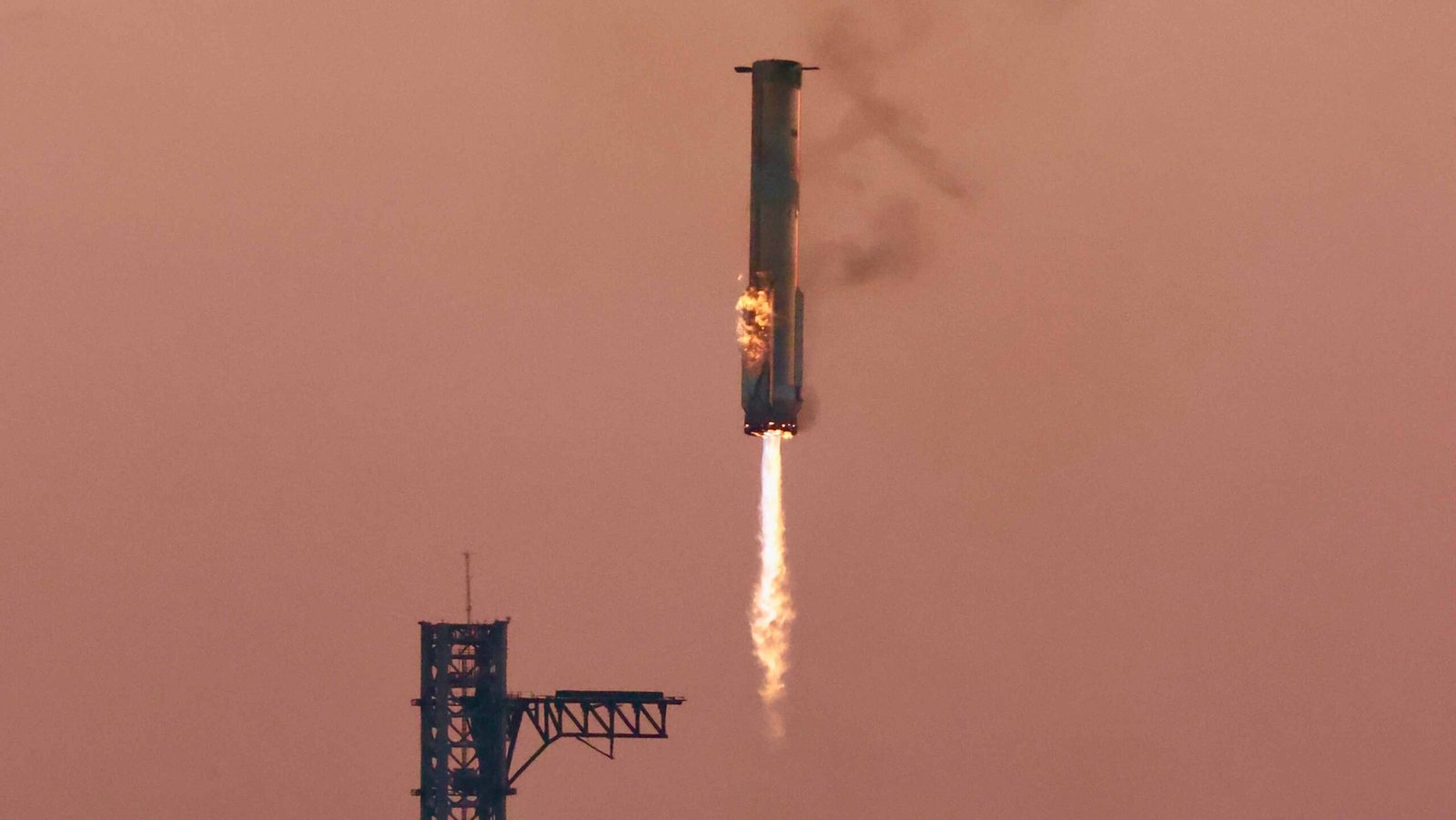
Starship’s NEW STMT looks Unreal and like Allien Technology: SpaceX is pushing the boundaries of aerospace engineering with its ambitious Starship program, designed to transform space transportation and make interplanetary travel more achievable. While the world focuses on the towering Starship spacecraft, the powerful Super Heavy booster, and the revolutionary Mechazilla launch tower, another important innovation is emerging behind the scenes: advanced ground transportation technology.
The newly discussed Starship Transport Stand and Mobile Transporter (STMT) represents an exciting development in the ground infrastructure supporting SpaceX’s operations at Starbase. With its futuristic appearance and highly integrated design, this specialized transport system looks like something straight out of a science-fiction movie.
However, its potential importance goes far beyond its unusual appearance. Moving enormous rockets safely, efficiently, and repeatedly is essential to SpaceX’s goal of developing a fully reusable space transportation system. The STMT concept highlights how improvements in ground logistics could help accelerate the future of Starship development.
Why Starship’s New STMT Technology Matters
Moving a rocket from a manufacturing facility to a testing area or launch pad might appear simple compared with launching it into orbit. In reality, transporting massive aerospace vehicles presents significant engineering challenges.
The combined Starship and Super Heavy stack stands approximately 121 meters (397 feet) tall in its commonly cited configuration. Its enormous size, complex internal systems, and stainless steel structure demand careful handling throughout manufacturing, testing, and launch preparation.
Every movement must account for structural stability, load distribution, ground conditions, and the positioning of the vehicle. Even relatively small alignment errors can complicate operations involving massive support structures and precision lifting equipment.
Traditional heavy transport systems can move enormous loads, but repeated rocket movements require more than raw hauling capacity. SpaceX needs ground equipment that supports precise positioning, reliable stabilization, and efficient turnaround operations.
The STMT concept fits into this broader engineering challenge. By integrating transportation and rocket support functions, this type of equipment could help reduce unnecessary handling steps and improve the movement of Starship hardware across Starbase.
Note: Detailed specifications and performance claims about the STMT should be treated as unconfirmed unless supported by official SpaceX information.
What Makes the Starship STMT Look Like Alien Technology?
The STMT has attracted attention because its described design differs from the conventional image of a heavy industrial trailer. Its integrated support structure, specialized wheel arrangement, and enclosed components create a futuristic appearance that seems perfectly suited to SpaceX’s experimental engineering environment.
But the most interesting question is not simply why it looks unusual. It is how its design could improve rocket transportation.
1. Advanced Suspension and Load Distribution
Transporting a massive rocket component requires careful control over the forces transmitted through its support structure.
A transporter equipped with a high-capacity hydraulic suspension system could help compensate for uneven surfaces and distribute weight across multiple wheel assemblies. Depending on its actual configuration, independently controlled suspension components could also improve leveling and reduce unwanted movement.
These capabilities would be especially valuable when transporting sensitive aerospace hardware across industrial roads and test-site access routes.
The primary objective is to maintain stability while minimizing unnecessary vibration and shock. Rocket vehicles contain complex plumbing, electrical connections, avionics, and other components that must be protected throughout handling.
Effective suspension management could therefore contribute to safer transportation and more predictable positioning.
2. Integrated Transport Stand and Wheel Architecture
One of the most interesting possibilities associated with the STMT concept is the integration of the rocket support stand and mobile transporter.
Conventional operations may involve multiple pieces of equipment to support, lift, transfer, and reposition large structures. Each additional handling stage can require extra time, specialized machinery, and careful coordination.
An integrated system could simplify these operations by combining structural support with mobile transportation capabilities.
Potential advantages include:
- Fewer handling steps during rocket movements.
- Improved positioning accuracy around manufacturing and testing facilities.
- Reduced dependence on certain crane-assisted transfers.
- Better control over the vehicle’s center of gravity during movement.
- More efficient coordination between production, testing, and launch teams.
The actual benefits would depend on the final engineering design and how SpaceX incorporates the equipment into its operations.
3. A Futuristic Design Built Around Practical Needs
The STMT’s unusual appearance also illustrates an important principle of modern aerospace engineering: equipment must be designed around its operating environment.
Starbase is located near the Texas Gulf Coast, where humidity, salt exposure, dust, and industrial debris can create maintenance challenges. Protective enclosures and appropriately designed components can help shield sensitive mechanisms from environmental conditions.
A streamlined structure may also improve access to service points, organize hydraulic and electrical systems, or protect equipment during demanding operations.
Although its appearance may resemble alien technology, the underlying engineering objective is practical: make heavy rocket transportation more reliable, repeatable, and efficient.
How STMT Could Transform Starship Ground Operations
SpaceX’s long-term ambitions require a coordinated system in which manufacturing, testing, transportation, and launch preparation operate as efficiently as possible.
The STMT concept is relevant because rocket transportation connects these separate stages.
Manufacturing at Starfactory
At Starbase, Starship production involves assembling large stainless steel structures and integrating increasingly complex vehicle systems. As manufacturing capacity grows, moving completed sections and vehicles becomes an increasingly important part of factory operations.
A purpose-built transporter could help move hardware between production areas without creating unnecessary delays.
Testing and Vehicle Preparation
Before a Starship vehicle can launch, it must pass through appropriate inspections and testing procedures. Depending on the vehicle and test campaign, hardware may need to move between assembly facilities, pressure-testing areas, cryogenic test sites, and static-fire locations.
Efficient transportation equipment could simplify these transitions while maintaining appropriate handling precautions.
The potential benefit is a more coordinated workflow, allowing teams to focus on testing and vehicle readiness instead of repeatedly arranging complex transfers.
Launch Pad Integration
Once a vehicle is ready for launch operations, transporting it to the launch complex becomes another major logistical task.
SpaceX’s launch infrastructure includes the Orbital Launch Mount and the Mechazilla tower, which uses large mechanical arms to support stacking operations. A transporter must deliver the vehicle in a configuration compatible with the required lifting and integration procedures.
Reliable positioning is essential because the vehicle, support equipment, and lifting systems must work together within carefully controlled operating limits.
An improved transport system could help reduce delays between manufacturing completion, testing, and launch preparation.
Why Ground Logistics Are Essential for Rapid Reusability
The most ambitious Starship vision involves launching, recovering, inspecting, refueling, and launching vehicles again with dramatically reduced turnaround times.
Achieving that objective requires more than powerful engines and advanced heat shields. It also depends on a complete operational ecosystem.
That ecosystem includes factory automation, maintenance facilities, propellant infrastructure, launch towers, recovery equipment, and transportation systems.
If rockets are manufactured quickly but cannot be moved efficiently, the entire production pipeline can become constrained. Similarly, faster launch operations provide limited benefits if inspection, repair, and repositioning remain slow.
This is why ground infrastructure is a critical part of reusable rocket technology.
The STMT concept represents the type of specialized equipment that could support a more integrated Starship production and launch system. Its potential contribution would come from reducing handling complexity and improving coordination, rather than directly increasing rocket performance.
However, actual launch cadence will also depend on regulatory approvals, vehicle reliability, launch-site capacity, refurbishment requirements, and many other factors.
Starbase Is Evolving Into a High-Throughput Spaceport
SpaceX’s Starbase development is about more than building individual rockets. It involves creating an integrated industrial environment capable of manufacturing, testing, launching, and recovering large aerospace vehicles.
As operations expand, every part of the facility must keep pace.
Factory automation helps increase production capacity. Advanced testing infrastructure helps engineers validate vehicle systems. Launch towers and recovery equipment support flight operations. Specialized transporters connect these elements into a functioning industrial network.
This broader approach distinguishes modern reusable launch systems from traditional expendable rocket programs.
Instead of treating each rocket as a vehicle that must be built, launched, and discarded, SpaceX is pursuing a model in which hardware can potentially support repeated missions. That ambition requires equipment designed for repeated use and efficient ground handling.
The STMT concept fits naturally into this vision, demonstrating why seemingly ordinary transportation tasks can become important engineering challenges when the cargo is an orbital-class rocket.
The Future of Starship Transportation Technology
As Starship development continues, ground support equipment will remain an essential part of SpaceX’s engineering progress. Future improvements could focus on automated positioning, more sophisticated load monitoring, better suspension control, and closer integration between manufacturing systems and launch operations.
Whether the STMT ultimately delivers all the potential benefits associated with its futuristic appearance will depend on its verified capabilities and operational performance.
Nevertheless, the broader principle is clear: reusable rockets require reusable infrastructure.
Every successful movement between a factory, test site, and launch pad contributes to a more coordinated transportation system. Better ground logistics can help reduce unnecessary delays, protect valuable hardware, and support the demanding operational requirements of future spaceflight.
The next time Starship or Super Heavy moves across Starbase, the vehicle itself may attract most of the attention. Yet the specialized equipment supporting that journey deserves recognition too.
SpaceX’s long-term ambitions depend not only on reaching space, but also on building the industrial systems needed to make access to space more repeatable. If advanced transport technology helps achieve that goal, it could become one of the less visible—but highly important—elements of the Starship revolution.
Conclusion
The Starship STMT highlights the increasingly important role of ground transportation in modern aerospace engineering. Its integrated design concept, potential load-management capabilities, and role in moving enormous rocket hardware illustrate how specialized infrastructure can support SpaceX’s wider ambitions.
Although specific STMT performance figures and design details require official confirmation, the underlying challenge is real: moving giant rockets safely and efficiently is essential to scaling production and improving launch operations.
Ultimately, the future of Starship will depend on an entire ecosystem of innovations. From Raptor engines and thermal protection systems to robotic factories and advanced mobile transport equipment, every component has a role to play in making rapidly reusable spaceflight a practical reality.
FAQs
1. What is Starship’s new STMT technology?
The Starship Transport Stand and Mobile Transporter (STMT) is described as specialized ground support equipment intended to help move and support large Starship hardware at SpaceX’s Starbase facility. Its potential purpose is to improve transportation efficiency, stability, and positioning during ground operations.
2. Why does the Starship STMT look like alien technology?
The STMT has attracted attention because of its unusual, futuristic appearance and integrated industrial design. Its specialized support structure, wheel arrangement, and protective components give it an appearance unlike that of a conventional heavy-duty trailer.
3. What is the main purpose of the STMT transporter?
The primary objective of this type of transporter is to facilitate the safe and efficient movement of massive rocket hardware between manufacturing facilities, testing areas, and launch infrastructure.
4. How tall is the SpaceX Starship rocket?
The fully stacked Starship and Super Heavy vehicle is approximately 121 meters (397 feet) tall in its commonly cited configuration. Its enormous size makes transportation, stabilization, and launch-site integration challenging engineering tasks.
5. How could the STMT improve Starship transportation?
An integrated transport system could reduce unnecessary handling steps, improve positioning accuracy, and simplify the movement of rocket hardware. Its actual benefits would depend on the transporter’s verified design and operational capabilities.
6. Does the Starship STMT use advanced hydraulic suspension?
Advanced hydraulic suspension is a potential feature of specialized heavy transporters. Such systems can help distribute loads, compensate for uneven surfaces, and improve stability. However, the exact suspension specifications of the STMT require official confirmation.
7. Why is load balancing important when moving Starship?
Load balancing helps distribute a rocket’s weight across the transport system. Proper distribution can improve stability, reduce excessive stress on supporting structures, and help protect sensitive components during transportation.
8. How could the STMT help SpaceX’s Starfactory?
The transporter could help connect manufacturing operations with testing and launch preparation. More efficient movement of completed rocket hardware may reduce logistical delays and support a more coordinated production workflow.
9. What role does the STMT play in Starship testing?
Rocket vehicles may need to move between assembly facilities, pressure-testing areas, cryogenic testing locations, and static-fire facilities. Specialized transport equipment can help facilitate these movements while maintaining appropriate handling procedures.
10. How does the STMT connect with the Mechazilla launch tower?
A transporter could deliver Starship or Super Heavy hardware to the launch complex for integration with SpaceX’s lifting systems. The Mechazilla tower uses large mechanical arms to support vehicle stacking and booster-catching operations. The exact STMT-to-Mechazilla workflow depends on the equipment configuration.
11. Can the STMT eliminate the need for cranes?
An integrated transporter may reduce the need for certain crane-assisted handling operations by combining vehicle support and mobility. However, cranes and other lifting equipment would still be required wherever the operational process demands them.
12. Why is ground infrastructure important for Starship reusability?
Ground infrastructure supports transportation, inspection, maintenance, refueling, and launch preparation. Even a reusable rocket cannot achieve rapid turnaround if ground operations are inefficient or lack sufficient capacity.
13. Could the STMT help SpaceX increase its launch cadence?
Potentially, more efficient transportation could reduce delays between manufacturing, testing, and launch preparation. However, launch cadence also depends on vehicle reliability, refurbishment, regulatory approvals, launch-site capacity, and other operational requirements.
14. Is the Starship STMT’s technology officially confirmed by SpaceX?
The specific design details and performance claims discussed about the STMT should be treated as unconfirmed unless verified through official SpaceX announcements or reliable technical documentation. Its proposed capabilities should not be confused with independently confirmed specifications.
15. What does the Starship STMT mean for the future of space exploration?
The STMT concept highlights how improvements in ground logistics could contribute to more efficient rocket manufacturing and launch operations. Alongside advances in propulsion, thermal protection, and recovery systems, better transportation infrastructure could support SpaceX’s long-term goal of making reusable spaceflight more frequent and affordable.
Read More:
- SpaceX just combined Grok, Cursor, and X into one mega plan
- Tesla Roadster livestream: everything Tesla has revealed before Thursday night
- FAA kicks off review of SpaceX’s bid to fly Starship nearly every day
- Ukraine says Starlink is cutting out its military drones as Poland calls out Elon Musk
- Tesla’s New Motor Changes EVERYTHING! No Rare Earths Needed