
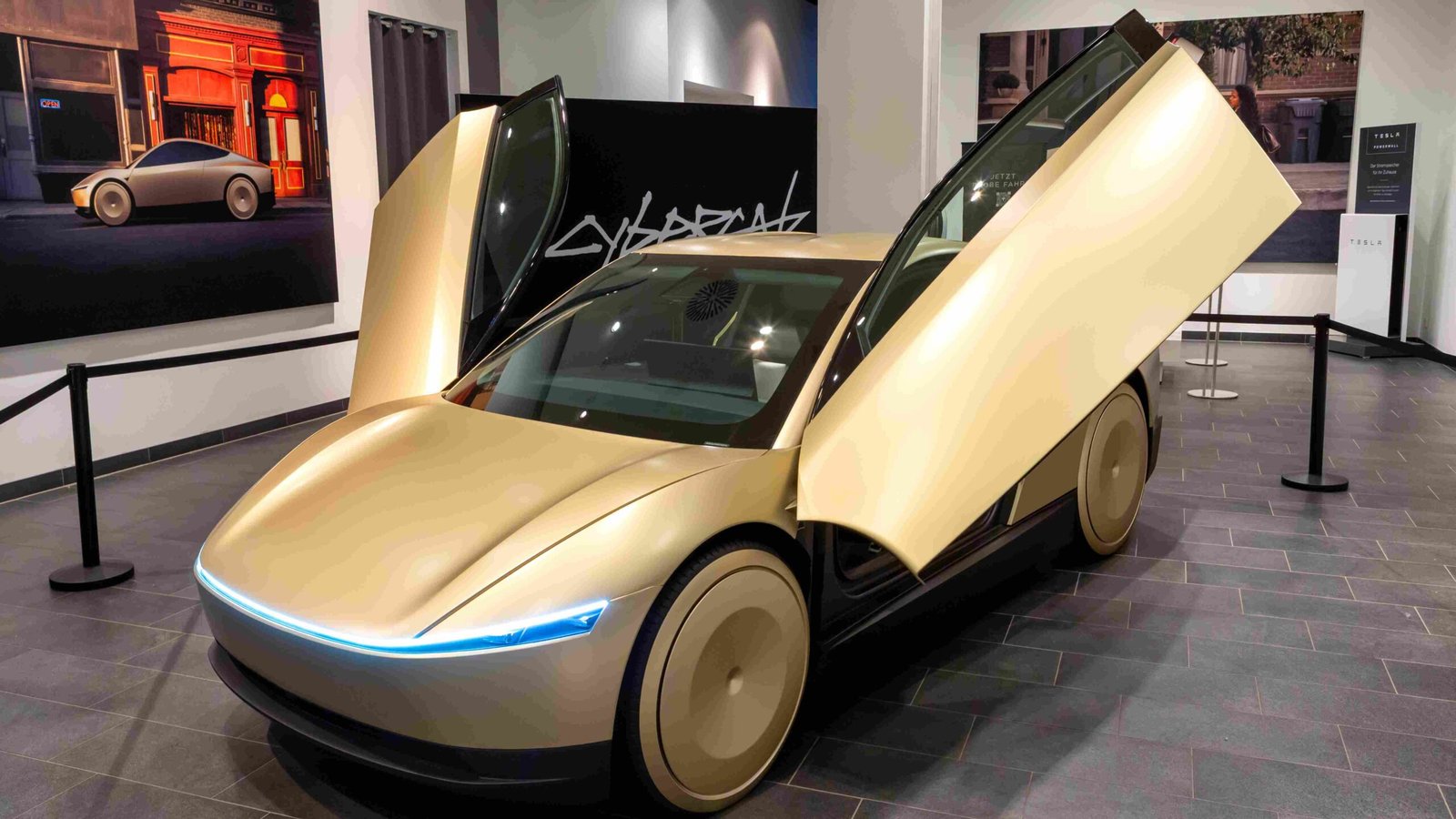
Tesla JUST Confirmed the Cybercab Delay Until Late 2026: Tesla’s Cybercab, the company’s purpose-built autonomous robotaxi, represents one of the biggest transformations in the future of transportation. Designed from the ground up for autonomous operation, the vehicle introduces a new approach to vehicle manufacturing, artificial intelligence, and autonomous mobility. However, despite major progress at Tesla’s Giga Texas factory, the Cybercab rollout has been delayed, with large-scale commercial deployment now expected no earlier than late 2026.
The delay is not caused by manufacturing limitations. Tesla has already demonstrated new production methods and has reportedly assembled more than 100 Cybercab units using advanced manufacturing techniques. The real challenge is the timeline required to validate Full Self-Driving (FSD) Version 15 and achieve the level of safety needed for a fully autonomous vehicle without human controls.
Tesla Cybercab Production Has Entered a New Manufacturing Era
Tesla is approaching vehicle production differently with the Cybercab. Unlike traditional automobiles that rely heavily on stamped metal panels, large factories, and complex paint operations, the Cybercab uses a revolutionary manufacturing process based on Reaction Injection Molding (RIM).
Traditional automotive factories dedicate enormous resources to body stamping and paint shops. These systems require billions of dollars in investment, large factory footprints, high-temperature curing ovens, and extensive environmental controls. In many facilities, stamping and painting operations consume up to 50% of total factory space.
Tesla’s RIM approach removes many of these limitations.
How Reaction Injection Molding Changes Vehicle Manufacturing
Reaction Injection Molding (RIM) uses liquid reactive materials, typically polyols and isocyanates, which are mixed and injected into low-pressure molds. The material rapidly cures into finished composite body panels within minutes.
This process provides several advantages:
- Lower manufacturing costs compared with traditional stamping methods
- Smaller factory footprints
- Faster panel production cycles
- Reduced dependence on expensive paint facilities
Another major innovation is in-mold pigmentation. Instead of applying paint after the body panels are created, Tesla integrates UV-resistant color pigments directly into the composite material before molding.
The result is a finished exterior surface that eliminates the need for traditional painting processes. This reduces VOC emissions, decreases water consumption, removes energy-intensive paint ovens, and can lower component-related greenhouse gas emissions by approximately 35%.
Cybercab Production Is Ready, But Software Is Holding Back Deployment
Although Tesla has made significant manufacturing progress, Cybercab deliveries remain frozen because the vehicle depends entirely on autonomous operation.
The Cybercab is not designed like a normal passenger vehicle. It does not include a steering wheel, pedals, or traditional driver controls, meaning it cannot operate using human supervision as a backup system.
This creates a unique challenge: Tesla cannot simply deliver vehicles and allow drivers to take over when necessary. The vehicle must achieve a high level of autonomous reliability before commercial operation.
FSD Version 15 Is the Biggest Cybercab Deployment Barrier
The primary obstacle is the development and validation of Full Self-Driving Version 15.
Tesla’s autonomous strategy relies heavily on neural networks and camera-based perception rather than traditional approaches involving LiDAR sensors and heavily mapped environments. Because of this, Tesla must prove that its AI system can consistently handle complex driving situations without human intervention.
Current testing fleets in cities such as Austin, Dallas, Houston, and Miami remain limited. These vehicles continue operating under supervised testing conditions rather than full commercial autonomy.
The transition to a large-scale robotaxi fleet depends on unsupervised FSD performance, regulatory approval, and real-world safety validation.
Tesla expects this process to continue into late 2026 or early 2027, making software readiness the true timeline driver for Cybercab deployment.
Tesla Upgrades Cybercab Computing Power for Advanced AI
Autonomous vehicles require enormous computing capability because they must process camera data, predict road behavior, and make driving decisions in real time.
Tesla’s existing Model 3 and Model Y vehicles equipped with Hardware 4 (AI4) computers use dual AI chips paired with approximately 32 GB of RAM. However, Tesla’s future autonomous models require additional memory capacity because larger neural networks can create memory bandwidth limitations.
Cybercab May Feature Upgraded AI Hardware
The Cybercab platform is expected to use an enhanced computing system, potentially offering up to 64 GB of RAM through upgraded AI4 Plus hardware or a dual-board AI4 configuration.
This additional computing capacity allows Tesla to run larger end-to-end neural networks while reducing latency during autonomous decision-making.
Unlike some competitors that use LiDAR systems, high-definition maps, and restricted operating zones, Tesla continues following a vision-only autonomous strategy. The company believes improved AI models and stronger onboard computers can eventually achieve scalable autonomy using camera data alone.
Cybercab Is Designed for Maximum Efficiency, Not Traditional Performance
The Cybercab is built around a different economic model. Instead of optimizing for acceleration, luxury, or passenger features, Tesla designed it around cost per mile, energy efficiency, and fleet utilization.
According to Tesla targets, the Cybercab aims for efficiency of approximately 6.1 miles per kWh, equivalent to around 165 Wh per mile. This would make it significantly more efficient than the Tesla Model 3 Long Range, which typically achieves around 4.0 to 4.5 miles per kWh.
Lightweight Design Improves Robotaxi Economics
The Cybercab’s simplified design contributes heavily to efficiency.
EPA certification information places the vehicle’s curb weight at approximately 3,113 pounds, making it roughly 750 pounds lighter than a Model 3.
The weight reduction comes from several design decisions:
- Removal of manual driving controls
- Simplified interior architecture
- Optimized electric drivetrain
- Front-wheel-drive permanent magnet motor design without rare-earth elements
Lower weight means less energy consumption, reduced operating costs, and improved battery efficiency.
Fleet Utilization Could Make Cybercab More Sustainable
A major advantage of autonomous robotaxis is improved vehicle utilization.
Traditional personal vehicles spend most of their time parked. A Cybercab fleet could operate for many more hours each day, increasing passenger miles generated from each vehicle.
Higher utilization can reduce lifetime emissions per passenger mile, even in regions where electricity generation still includes fossil fuels.
Tesla Cybercab Key Specifications and Future Timeline
Manufacturing Innovation: Reaction Injection Molding (RIM) with in-mold pigmentation
Estimated Weight: Approximately 3,113 pounds
Energy Efficiency Target: 6.1 miles per kWh (around 165 Wh/mile)
Computing System: Upgraded autonomous hardware with potential 64 GB RAM capacity
Autonomy Requirement: Full Self-Driving Version 15 validation
Expected Deployment Window: Late 2026 to early 2027
Final Thoughts: Tesla’s Cybercab Future Depends on AI, Not Manufacturing
Tesla has already solved many of the physical challenges behind the Cybercab. The company has created a new manufacturing process, reduced vehicle complexity, improved efficiency, and developed a platform designed specifically for autonomous transportation.
The remaining challenge is software validation.
The Cybercab’s future depends on whether Tesla’s FSD Version 15 can achieve reliable unsupervised autonomy and satisfy regulatory requirements. If successful, the Cybercab could become one of the first vehicles designed entirely around an autonomous mobility business model.
For now, Tesla’s robotaxi revolution is not waiting on factories. It is waiting on artificial intelligence.
FAQs
1. What is Tesla Cybercab?
Tesla Cybercab is Tesla’s purpose-built autonomous robotaxi designed specifically for self-driving transportation. Unlike traditional Tesla vehicles, it is built without a steering wheel or pedals, allowing it to operate as a fully autonomous vehicle when Tesla’s self-driving technology is ready.
2. Why has Tesla delayed Cybercab deployment?
Tesla’s Cybercab deployment has been delayed primarily because of software validation challenges, not manufacturing problems. The company needs to validate Full Self-Driving (FSD) Version 15 before large-scale autonomous operation can begin.
3. When will Tesla Cybercab be available?
Tesla expects Cybercab commercial deployment to begin around late 2026 to early 2027, depending on the progress of FSD Version 15 testing, regulatory approvals, and safety validation.
4. Is Tesla already manufacturing Cybercab vehicles?
Yes, Tesla has reportedly started low-volume Cybercab production at Giga Texas. More than 100 units have reportedly been assembled using new manufacturing methods, although large-scale fleet deployment has not started.
5. What is preventing Tesla from launching a Cybercab fleet?
The biggest barrier is achieving reliable unsupervised autonomous driving. Because Cybercab lacks traditional driver controls, Tesla must prove that the vehicle can safely operate without human intervention.
6. What is Tesla’s Reaction Injection Molding (RIM) technology?
Reaction Injection Molding (RIM) is a manufacturing process where liquid materials are injected into molds and quickly cured into finished body panels. Tesla uses this approach to reduce manufacturing complexity compared with traditional stamped metal vehicle production.
7. How is Cybercab manufacturing different from traditional cars?
Traditional vehicles require large stamping facilities and paint shops. Cybercab uses RIM composite body panels and in-mold pigmentation, reducing factory space, production complexity, and environmental impact.
8. Does Tesla Cybercab need a paint shop?
No. Tesla’s in-mold pigmentation technology integrates color pigments directly into the body material before molding. This removes the need for conventional paint operations, reducing emissions and production costs.
9. How efficient is the Tesla Cybercab?
Tesla is targeting an efficiency of approximately 6.1 miles per kWh, or about 165 Wh per mile. This is significantly higher than many existing electric vehicles because the Cybercab is optimized for autonomous fleet operation.
10. How much does the Tesla Cybercab weigh?
The Cybercab is expected to weigh around 3,113 pounds, making it approximately 750 pounds lighter than a Tesla Model 3. Its lightweight design improves energy efficiency and reduces operating costs.
11. What is Tesla FSD Version 15?
Full Self-Driving Version 15 (FSD V15) is Tesla’s next-generation autonomous driving software expected to improve decision-making through advanced neural networks. It is a key requirement for Cybercab’s commercial robotaxi operation.
12. Will Tesla Cybercab use LiDAR sensors?
No. Tesla continues to follow a vision-based autonomous driving approach using cameras and artificial intelligence. Unlike some competitors, Tesla does not rely on LiDAR systems for its self-driving strategy.
13. How much computing power does Tesla Cybercab have?
The Cybercab is expected to feature upgraded autonomous computing hardware with potentially up to 64 GB of RAM. This additional memory helps support larger AI models and more complex autonomous driving calculations.
14. Why does Cybercab need more RAM than existing Tesla vehicles?
Advanced self-driving neural networks require significant computing resources. Tesla’s existing vehicles with Hardware 4 typically use around 32 GB of RAM, while Cybercab may require more memory to process larger AI models efficiently.
15. Will Tesla Cybercab have a human driver?
No. The Cybercab is designed as a fully autonomous vehicle and does not include traditional driving controls. During testing phases, Tesla vehicles may operate under supervision, but commercial Cybercab operation depends on unsupervised autonomy.
16. How will Tesla Cybercab reduce transportation costs?
Cybercab is designed for high fleet utilization, meaning vehicles can operate for more hours instead of remaining parked. Lower energy consumption, reduced maintenance, and autonomous operation could decrease the cost per passenger mile.
17. Is Tesla Cybercab cheaper to build than normal cars?
Tesla’s new manufacturing approach is expected to reduce production costs by eliminating expensive stamping equipment, paint facilities, and complex assembly processes.
18. Where is Tesla testing Cybercab technology?
Tesla has been testing autonomous vehicle technology in locations including Austin, Dallas, Houston, and Miami. Current testing remains limited and focused on improving safety and software performance.
19. Could Tesla Cybercab change the future of transportation?
Yes. If Tesla successfully achieves large-scale autonomous operation, Cybercab could transform transportation by enabling widespread robotaxi services, reducing vehicle ownership costs, and increasing mobility access.
20. What is the biggest challenge facing Tesla Cybercab?
The biggest challenge is not manufacturing capacity but proving that AI-powered autonomous driving is safe and reliable at scale. The success of Cybercab depends on FSD Version 15 achieving consistent real-world performance and regulatory approval.
Read More:
- Tesla stock tumbles after earnings, one of its sharpest single-day declines
- SpaceX Starship Flight 13 faces wrath of the Texas skies
- Tesla door handle saga gets its latest chapter and a big change is coming
- Tesla short sellers win big after shares fall after earnings
- Tesla’s Supercharger Diner probably just secured more locations