
Tesla has once again captured global attention with a series of groundbreaking milestones that redefine what is possible in electric vehicles, autonomous driving, and sustainable transportation. From the first fully autonomous coast-to-coast drive in U.S. history to the Model Y claiming the world’s bestselling car title for the third consecutive year, Tesla’s momentum shows no signs of slowing down.
In this in-depth, we’ll explore how Tesla’s Full Self-Driving (FSD) technology finally delivered on a promise nearly a decade in the making, why the Model Y continues to dominate global sales, how the Supercharger network shattered energy delivery records, and why the revamped Tesla Semi with megawatt-level charging could transform the trucking industry forever.
Tesla FSD Achieves the First Fully Autonomous Coast-to-Coast Drive
A Decade-Long Promise Finally Fulfilled
For nearly ten years, Elon Musk has talked about a Tesla driving itself from one coast of the United States to the other without human intervention. In late 2025, that vision finally became reality.
Tesla owner David Moss completed a historic journey from Los Angeles, California, to Myrtle Beach, South Carolina, covering 2,732 miles in just 2 days and 20 hours. What makes this achievement extraordinary is not just the distance—it’s the fact that the entire trip was completed with zero driver interventions.
That means:
- No grabbing the steering wheel
- No tapping the brakes
- No disengaging Full Self-Driving
- No human assistance, even during Supercharging stops
This journey was powered entirely by Tesla FSD Supervised version 14.2.1 (2.1.25), running on a Stealth Grey Tesla Model 3 equipped with the AI4 computer. Remarkably, the software had been installed only 12 days before the trip began.
Why “Zero Interventions” Truly Matters
The Difference Between Assisted and Autonomous Driving
The phrase “zero interventions” is critical when evaluating autonomous driving claims. While the driver remained present—as required by law—there was no moment during the trip where human control was needed.
According to David Moss, there were:
- No close calls
- No uncomfortable situations
- No moments of uncertainty
Tesla’s Vice President of AI Software, Ashok Elluswamy, publicly congratulated Moss, calling it the world’s first fully autonomous coast-to-coast drive. Elon Musk also celebrated the achievement on X, highlighting its significance for the future of autonomy.
From Over-Optimism to Reality: Tesla’s Long Road to Autonomy
Why Elon Musk Was Early—but Not Wrong
Back in October 2016, when Tesla unveiled Autopilot 2.0, Elon Musk predicted that a hands-free coast-to-coast drive would be possible by the end of 2017. That timeline proved overly optimistic, but the underlying vision was sound.
What followed were years of:
- Hardware upgrades across multiple Autopilot generations
- Complete software rewrites
- The removal of radar and ultrasonic sensors
- A shift to a vision-only, neural-network-based system
- Massive investment in AI training infrastructure, including a supercomputer cluster at Gigafactory Texas
- A transition from hand-coded rules to end-to-end machine learning
More than nine years later, Tesla finally delivered on that original promise. This milestone reinforces a familiar pattern: Elon Musk’s predictions are rarely impossible—they’re often just late.
The Physical Turing Test: Why Tesla FSD Feels Human
NVIDIA’s Jim Fan Weighs In
The significance of Tesla’s FSD breakthrough isn’t limited to Tesla fans. Jim Fan, Director of Robotics at NVIDIA, recently shared his personal experience with FSD Version 14, describing it as the first AI system he’s encountered that passes what he calls the “physical Turing test.”
Originally proposed by Alan Turing in 1950, the Turing Test measured whether a machine could communicate in a way indistinguishable from a human. While modern AI already excels at conversation, the real challenge lies in the physical world—where machines must perceive, decide, and act in real time.
Fan described the experience of pressing a button, leaning back, and being unable to tell whether a human or a neural network was driving him home.
“Despite knowing exactly how robot learning works, I still find it magical watching the steering wheel turn by itself.”
Elon Musk responded simply:
“You can sense the sentience maturing.”
When a senior leader from NVIDIA—the company that powers much of the world’s AI infrastructure—makes such a statement, it signals that Tesla’s autonomy is not incremental progress, but a genuine leap forward.
Tesla Model Y: The World’s Bestselling Car for the Third Straight Year
Dominance by Balance, Not Hype
While FSD grabs headlines, Tesla’s electric vehicle business continues to deliver extraordinary results. Elon Musk recently confirmed that the Tesla Model Y is officially the world’s bestselling car by volume for the third consecutive year.
This means:
- It outsold every vehicle from every automaker worldwide
- It maintained leadership despite intense global competition
- It succeeded even during a challenging production year
In early 2025, Tesla temporarily paused Model Y production to retool factories for a refreshed version, impacting first-quarter sales. Despite that setback, Tesla still delivered over 1.63 million vehicles globally in 2025, with 418,000 deliveries in Q4 alone.
Why the Model Y Continues to Win
The Model Y’s success comes down to balance:
- Excellent real-world range
- Competitive pricing
- Quick acceleration
- Modern software and OTA updates
- Top safety ratings
- Spacious interior suitable for families
Few competitors manage to combine all these qualities at scale—especially in competitive markets like China.
Tesla also expanded the lineup with:
- Model Y L – a six-seat, extended wheelbase version launched in China
- Model Y Standard – a more affordable entry-level option
These variants broaden the Model Y’s appeal while strengthening Tesla’s global footprint.
Tesla Supercharger Network Sets a Massive Energy Record
6.7 Terawatt-Hours Delivered in One Year
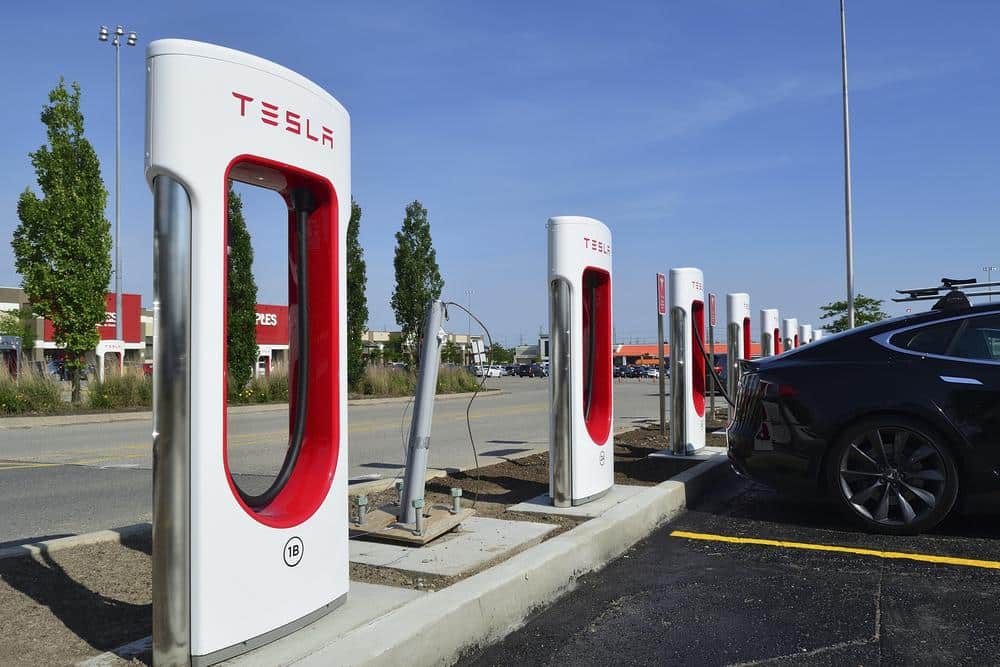
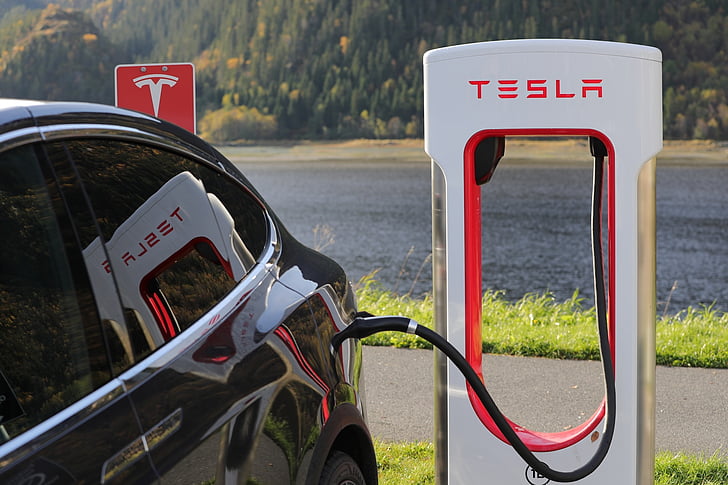
As Tesla’s fleet grows, so does the importance of its charging infrastructure. In 2025, Tesla’s Supercharger network delivered a record 6.7 terawatt-hours of energy.
To put that into perspective:
- 1 terawatt-hour can power approximately 100,000 homes for an entire year
- Tesla operates over 75,000 Supercharger stalls worldwide
- Outside of China, Tesla delivered more fast-charging energy than all other networks combined
Even after internal restructuring within the Supercharger team, the network continued expanding—cementing its role as the backbone of the global EV transition.
The Revamped Tesla Semi and the Era of Megawatt Charging
Electric Trucking Reimagined
Tesla’s most ambitious commercial vehicle—the Tesla Semi—is finally nearing large-scale production. But the version set to roll out in 2026 is not the same truck first unveiled in 2017.
The revamped Tesla Semi features:
- A full-width front light bar
- Shorter side windows
- Optimized camera placement for FSD
- Improved aerodynamics
- Easier repairs
- Lower production costs through shared components with Tesla cars
According to Tesla Semi lead Dan Priestley, the redesign focuses on efficiency, scalability, and cost reduction.
1.2 Megawatt Charging: A Game Changer for Freight
The most important update came from an official Tesla video showing the Semi charging at up to 1.2 megawatts using a Megacharger.
For context:
- Home chargers operate at a few kilowatts
- Most public fast chargers top out at a few hundred kilowatts
- 1+ megawatt charging fundamentally changes logistics
At these power levels:
- Long-haul trucks can recover hundreds of miles of range during mandatory driver rest periods
- Charging becomes part of existing downtime, not an added delay
- Electric trucking becomes economically competitive at scale
Tesla’s Nevada Semi Factory, targeting 50,000 units per year, could soon be operating at full capacity for years to come.
Conclusion: Tesla’s Momentum Is Reshaping the Future
From autonomous driving breakthroughs to record-breaking vehicle sales, from a global charging network unmatched in scale to a revolutionary electric semi truck, Tesla’s progress in 2025 marks a turning point.
The first truly autonomous coast-to-coast drive shows that unsupervised autonomy is no longer science fiction. The Model Y’s global dominance proves that EVs can win on practicality, not just innovation. And the Tesla Semi’s megawatt charging hints at a future where electric transport powers not just cars—but the entire global supply chain.
Tesla isn’t just building vehicles. It’s building the infrastructure, intelligence, and ecosystem that will define transportation for decades to come.
FAQs
1. What is Tesla’s first autonomous coast-to-coast drive?
Tesla’s autonomous coast-to-coast drive refers to a 2,732-mile journey across the United States completed using Tesla Full Self-Driving (FSD) with zero driver interventions. The driver remained present but never had to take control of the vehicle.
2. Who completed Tesla’s autonomous coast-to-coast drive?
The historic drive was completed by Tesla owner David Moss, who traveled from Los Angeles, California, to Myrtle Beach, South Carolina in a Tesla Model 3.
3. Which Tesla model and hardware were used for the trip?
The journey was completed in a Stealth Grey Tesla Model 3 equipped with Tesla’s AI4 computer and running FSD Supervised version 14.2.1 (2.1.25).
4. What does “zero interventions” mean in Tesla FSD?
Zero interventions means the driver never had to touch the steering wheel, brake, accelerator, or disengage FSD at any point during the trip—even in complex driving situations.
5. Is Tesla Full Self-Driving completely autonomous now?
Tesla FSD has demonstrated human-level driving capability in real-world conditions, but it is still classified as Supervised, meaning a driver must remain alert and ready to take control if required by law.
6. How long did the autonomous coast-to-coast trip take?
The entire journey took 2 days and 20 hours, covering 2,732 miles across multiple states and driving conditions.
7. Why is this milestone important for autonomous driving?
This achievement shows that end-to-end AI driving systems can handle long-distance, real-world travel consistently, bringing fully autonomous vehicles much closer to everyday reality.
8. What is the “physical Turing test” mentioned in relation to Tesla FSD?
The physical Turing test measures whether a machine can perform physical tasks—like driving—in a way that is indistinguishable from a human, without observers being able to tell the difference.
9. What did NVIDIA’s Jim Fan say about Tesla FSD?
Jim Fan, NVIDIA’s Director of Robotics, stated that Tesla FSD Version 14 felt indistinguishable from a human driver, calling it the first AI system he experienced that passed the physical Turing test.
10. Why is the Tesla Model Y the world’s bestselling car?
The Tesla Model Y offers a rare balance of range, performance, affordability, safety, software features, and interior space, making it appealing to buyers worldwide for three consecutive years.
11. How many vehicles did Tesla deliver in 2025?
Tesla delivered over 1.63 million vehicles globally in 2025, with the Model Y and Model 3 accounting for the majority of those sales.
12. What record did Tesla’s Supercharger network set in 2025?
In 2025, Tesla’s Supercharger network delivered a record 6.7 terawatt-hours of energy, more fast-charging energy than all other networks combined outside of China.
13. How many Tesla Supercharger stalls are there worldwide?
Tesla currently operates more than 75,000 Supercharger stalls globally, supporting both Tesla vehicles and other EV brands.
14. What is new about the revamped Tesla Semi?
The updated Tesla Semi features improved aerodynamics, lower production costs, enhanced efficiency, redesigned cameras for FSD, and easier repairs, making it more practical for large-scale commercial use.
15. What is megawatt charging, and why does it matter for trucks?
Megawatt charging allows the Tesla Semi to charge at up to 1.2 megawatts, enabling long-haul electric trucks to regain hundreds of miles of range during mandatory rest breaks.
16. When will Tesla Semi production scale up?
Tesla plans to begin meaningful Tesla Semi production in 2026, with the Nevada Semi Factory targeting a capacity of up to 50,000 trucks per year.
Read More:
- Break it! Elon Musk’s SpaceX Insane Secret Starship Goals in 2026 Shocked NASA
- Tesla Sweden uses Megapack battery to bypass unions’ Supercharger blockade
- Tesla Model Y and Model 3 named safest vehicles tested by ANCAP in 2025
- Tesla AI5 chip nears completion, Elon Musk teases 9-month development cadence
- The Tesla Robovan is Actually Real
- Rocket Lab Announced Big Progress on Boldest Rocket to Outpace Blue Origin even SpaceX