
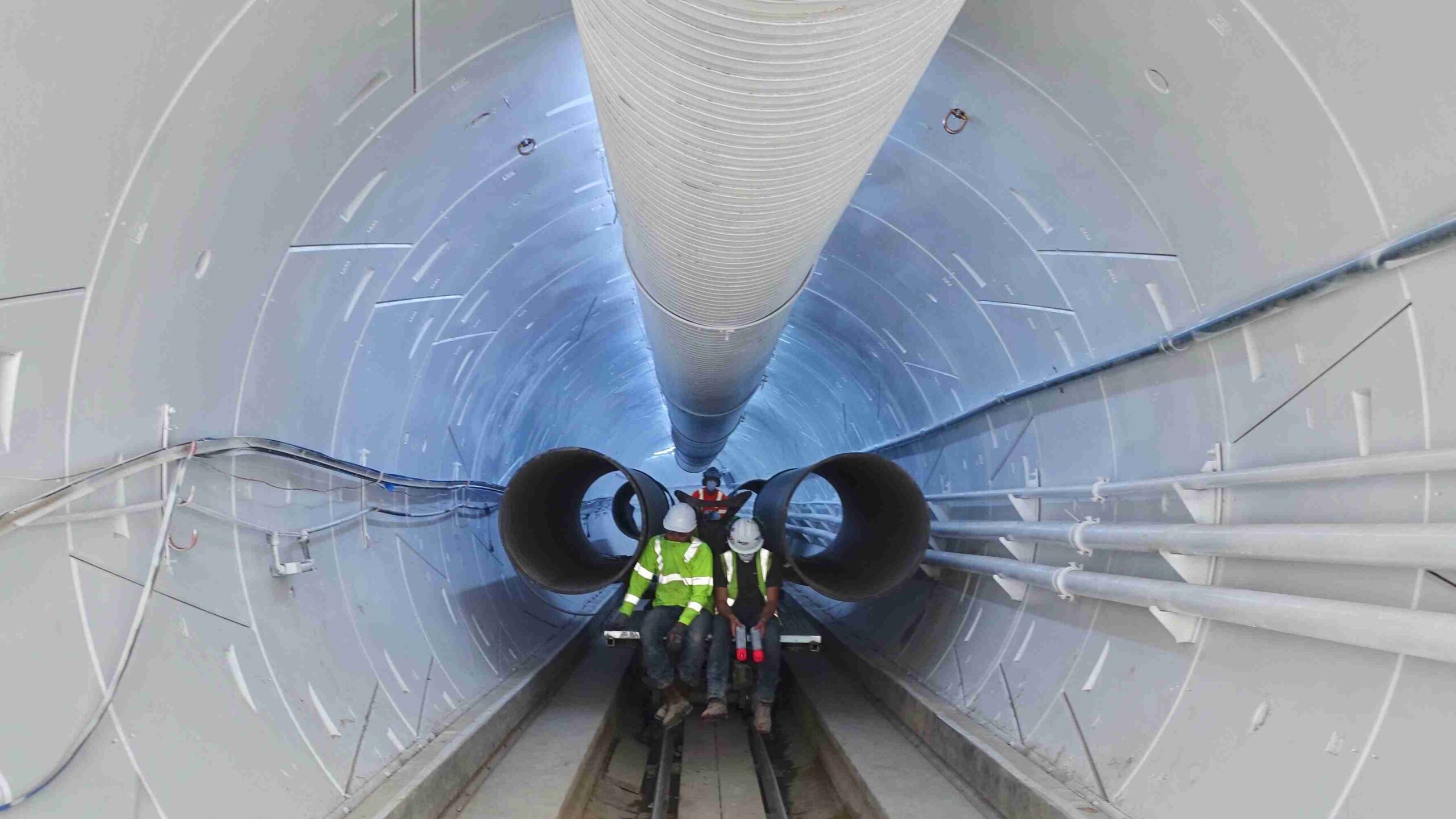
The Boring Company is Building an Underground Factory: The worlds of infrastructure, transportation, and industrial engineering are undergoing a radical transformation. For decades, tunneling projects and heavy-duty logistics systems relied on outdated mechanical processes, fragmented workflows, and diesel-powered operations. Today, companies led by Elon Musk are introducing a completely different philosophy — treating infrastructure like a software-driven manufacturing system instead of a slow-moving construction project.
From the rapid tunnel expansion projects in Nashville and Las Vegas to the revolutionary engineering behind the Tesla Semi truck, the future is increasingly centered around automation, continuous operations, and integrated machine intelligence.
The biggest signal of this transition comes from The Boring Company and its next-generation tunnel boring machine, Prufrock. Rather than accepting the limitations of traditional tunnel construction, the company has redesigned the entire process into what can best be described as an underground factory.
The End of Traditional Tunnel Construction
For more than a century, tunnel boring projects followed a repetitive and highly inefficient cycle. Conventional Tunnel Boring Machines (TBMs) would drill forward a short distance, stop completely, wait for workers to install tunnel lining, then pause again while excavated debris was removed.
The process looked like this:
- Dig a few feet
- Stop operations
- Install concrete support rings
- Stop again
- Remove debris
- Restart drilling
This “stop-and-start” approach slowed projects dramatically and increased labor costs, safety risks, and maintenance requirements.
The Prufrock machine from The Boring Company changes everything.
Instead of operating like a slow industrial tool, Prufrock functions like a continuous underground production system.
Prufrock: Turning Tunnels into a Continuous Factory
One of the most revolutionary concepts behind Prufrock is its ability to combine multiple tunnel operations into a single uninterrupted workflow.
Traditional TBM vs Prufrock
| Feature | Traditional TBMs | Prufrock System |
|---|---|---|
| Excavation | Stop-and-start | Continuous |
| Tunnel Lining | Installed separately | Installed simultaneously |
| Debris Removal | Periodic hauling | Continuous conveyor |
| Machine Direction | Forward only | Bidirectional |
| Power Source | Diesel-heavy systems | Electric operations |
| Maintenance | Long shutdowns | Rapid inspection cycles |
This redesign effectively transforms tunneling into a high-speed industrial assembly line underground.
The 10-Mile Conveyor System in Nashville
A major example of this innovation is taking place in the Music City Loop project in Nashville.
The project aims to connect downtown Nashville directly to the airport using underground transit tunnels. One of the biggest challenges in tunnel engineering is handling excavated rock, commonly known as muck.
When drilling through hard Tennessee limestone, tunnel boring machines generate enormous amounts of pulverized rock. In conventional systems, delays in debris removal can slow or even trap the machine.
Prufrock solves this problem using a dynamic conveyor architecture.
How the Conveyor Works
As the cutter head drills through rock:
- Pulverized limestone immediately falls onto a conveyor belt.
- The conveyor continuously transports debris away from the cutter head.
- As the tunnel grows longer, the conveyor extends with it.
- No shutdown cycle is required for waste removal.
By the completion of the first phase of the Music City Loop, this integrated conveyor system is expected to stretch nearly 10 miles underground.
This is a massive engineering breakthrough because it removes one of the largest bottlenecks in tunnel construction.
Zpit Protocol: Zero People in Tunnel
Another groundbreaking innovation from The Boring Company is the Zpit protocol, which stands for Zero People in Tunnel.
Historically, tunnel projects required large underground crews operating in dangerous environments filled with:
- Diesel fumes
- Dust
- Noise
- Vibration
- Heavy machinery hazards
The Prufrock system dramatically reduces human presence underground by automating major operational functions.
Benefits of the Zpit System
Improved Safety
Removing workers from confined underground environments significantly lowers accident risks.
Cleaner Operations
Because the system operates primarily on electricity instead of diesel engines, the tunnel remains cleaner and quieter.
Faster Construction
Automation removes delays caused by crew coordination and shift changes.
Continuous Workflow
The machine can maintain a far more consistent excavation pace.
This is a clear example of how modern infrastructure is shifting toward software-controlled industrial automation.
Bidirectional Tunnel Boring Changes Everything
One of the most fascinating engineering advantages of Prufrock is its ability to reverse direction.
Traditional TBMs are effectively one-way machines. They push forward using enormous hydraulic systems braced against completed tunnel walls. Once deep underground, reversing them is extremely difficult.
In many projects, old TBMs are simply abandoned underground because retrieval costs are too high.
Prufrock introduces a completely different architecture.
Why Bidirectional Capability Matters
Because the machine uses an independent crawler-style traction system, it can:
- Reverse cleanly for inspections
- Exit tunnels after project completion
- Reduce maintenance downtime
- Avoid costly underground disassembly
This capability dramatically improves equipment utilization rates.
Instead of being treated like disposable infrastructure, the TBM becomes a reusable industrial asset.
The Monster and the “Porpoising” Deployment Method
In Las Vegas, The Boring Company recently showcased the transport and deployment system for Prufrock 2.
The machine’s core section weighs approximately 465,000 pounds, while the transport platform known as The Monster weighs another 140,000 pounds.
Together, the system exceeds 600,000 pounds of rolling mass.
But the real innovation is not size — it is deployment speed.
What Is Porpoising?
Traditional tunneling projects require massive launch pits excavated before drilling even begins. These pits are expensive, time-consuming, and highly disruptive.
Prufrock eliminates this requirement through a technique called Porpoising.
The Process
- The machine arrives on a transport trailer.
- The trailer tilts downward.
- Prufrock drills directly into the earth from street level.
- At the destination, the machine tunnels upward back to the surface.
- It drives directly onto another waiting trailer.
This dramatically reduces startup costs and deployment complexity.
The Goal: One Mile of Tunnel Per Week
Perhaps the most ambitious objective from The Boring Company is its target tunneling speed.
The company aims to achieve:
1 Mile of Tunnel Per Week
That would represent roughly a 6x improvement over traditional industry benchmarks.
Achieving this milestone would completely reshape:
- Urban transit development
- Underground freight systems
- Utility infrastructure
- High-speed transportation networks
Cities could expand underground transportation far faster and at significantly lower cost.
Tesla Semi: Reinventing Heavy-Duty Trucking
While The Boring Company is reinventing tunneling, Tesla is redesigning the heavy logistics industry through the Tesla Semi.
Traditional Class 8 trucks were designed entirely around diesel engines. Their structure, cooling systems, frame geometry, and cabin placement all revolved around massive combustion powertrains.
Tesla started from scratch.
Aerodynamics First, Everything Else Second
One of the key engineering philosophies behind the Tesla Semi is aerodynamic efficiency.
Reducing drag creates a cascading chain of benefits.
The Aerodynamic Cascade
- Lower drag reduces energy consumption.
- Lower energy demand reduces battery size requirements.
- Smaller battery requirements reduce vehicle weight.
- Lower weight decreases structural stress.
- Reduced stress improves overall system efficiency.
This compounding effect is why the Tesla Semi looks dramatically different from conventional diesel trucks.
The vehicle was engineered as a fully integrated EV platform rather than a diesel truck converted into an electric vehicle.
Structural Integration and Unibody Engineering
Traditional semi trucks rely on heavy ladder-frame chassis systems.
Tesla instead integrated:
- Battery pack
- Structural rails
- Electric drive units
- Chassis framework
into a unified architecture.
This approach resembles modern unibody passenger cars.
Why This Matters
Reduced Weight
Fewer redundant structural components are needed.
Increased Rigidity
The platform becomes stronger and stiffer.
Better Safety
Integrated structures distribute impact forces more effectively.
Improved Efficiency
Lower weight directly improves range and energy consumption.
Tesla also eliminated the need for vibration isolation systems because there is no massive diesel engine shaking the front cab.
As a result, the driver cabin can mount directly to the frame structure.
EPTO: Eliminating Diesel Refrigeration Units
One of the smartest innovations in the Tesla Semi program is EPTO, or Electric Power Take-Off.
This system addresses a hidden inefficiency in global logistics.
The Problem with Traditional Reefer Trucks
Refrigerated trailers — commonly called reefers — transport perishable goods like:
- Food
- Medicine
- Dairy products
- Frozen cargo
Conventional reefers rely on a secondary diesel engine mounted at the front of the trailer.
These systems:
- Burn fuel continuously
- Create noise pollution
- Require separate maintenance
- Increase operational costs
Most reefer systems consume over one gallon of diesel per hour simply while idling.
Tesla’s Direct-Power Reefer System
Tesla bypasses the auxiliary diesel engine completely.
Using the Semi’s EPTO connection, power flows directly from the truck’s high-voltage battery pack into the refrigeration system.
Key Advantages
| Traditional Reefer | Tesla EPTO System |
|---|---|
| Separate diesel engine | Direct electric connection |
| Constant fuel consumption | Battery-powered cooling |
| Loud operation | Quiet operation |
| Additional maintenance | Simplified architecture |
| Emissions while parked | Zero tailpipe emissions |
The Tesla Semi can provide approximately 25 kW of continuous electrical power to refrigeration systems.
Because the long-range Semi includes an enormous 822 kWh battery pack, refrigeration becomes a relatively minor energy demand.
This enables long-distance cold-chain logistics without burning diesel fuel.
Actually Smart Summon (ASS) and Parking Lot Automation
Tesla’s innovation is not limited to heavy transport.
The company recently updated its Actually Smart Summon (ASS) feature as part of Full Self-Driving Version 14.3.
The feature now supports parking lot speeds up to 8 mph, making it significantly more practical in real-world environments.
Why Parking Lots Are So Difficult
Parking lots are among the most chaotic driving environments because they contain:
- Unpredictable pedestrians
- Tight visibility
- Random vehicle movement
- Unmapped spaces
- Frequent obstructions
Traditional autonomous systems struggled heavily in these conditions.
Tesla transitioned from older sensor-heavy systems toward a vision-only neural network architecture.
Evolution of Smart Summon
| Year | Capability |
|---|---|
| 2016 | Basic garage movement |
| 2019 | Early parking lot navigation |
| 2024 | Neural network vision tracking |
| 2026 | Faster real-world usability |
The result is a system that behaves more naturally and confidently in complex environments.
Software Is Becoming the Core of Infrastructure
The most important takeaway from all these developments is philosophical.
Companies like Tesla and The Boring Company are no longer treating infrastructure as static mechanical hardware.
Instead, they view infrastructure as:
A Software-Controlled Machine System
This shift changes everything.
The New Industrial Philosophy
Continuous Operations
Systems are designed to avoid downtime entirely.
Automation First
Human labor shifts toward supervision instead of repetitive physical tasks.
Reusable Infrastructure
Machines become modular reusable assets instead of one-time-use equipment.
Electrification
Diesel-powered industrial systems are being replaced by electric architectures.
Data Integration
Sensors, software, and AI continuously optimize operations in real time.
Final Thoughts
The technologies emerging from The Boring Company and Tesla represent more than incremental engineering improvements. They signal a complete restructuring of how humanity builds transportation systems, logistics networks, and urban infrastructure.
Prufrock’s continuous tunneling model could drastically reduce the cost and time required to build underground transit systems. Tesla Semi’s integrated electric platform may redefine long-haul freight economics. Meanwhile, autonomous software systems like Actually Smart Summon demonstrate how AI-driven automation is steadily becoming practical in everyday environments.
The larger pattern is impossible to ignore:
- Infrastructure is becoming automated.
- Heavy machinery is becoming software-defined.
- Industrial systems are becoming fully electric.
- Construction is evolving into continuous manufacturing.
The future envisioned by Elon Musk’s companies is no longer theoretical. It is already being deployed beneath cities, across highways, and inside logistics networks around the world.
FAQs
1. What is The Boring Company building in Nashville?
The Boring Company is developing the Music City Loop in Nashville, an underground tunnel transportation system designed to connect downtown Nashville with the airport using high-speed tunneling technology.
2. What is the Prufrock tunnel boring machine?
Prufrock is an advanced Tunnel Boring Machine (TBM) developed by The Boring Company. Unlike traditional TBMs, it performs continuous excavation, automated tunnel lining installation, and debris removal simultaneously.
3. How is Prufrock different from traditional TBMs?
Traditional TBMs operate in a stop-and-start process, while Prufrock functions like a continuous underground factory. It minimizes downtime by combining excavation, tunnel lining, and debris transport into one seamless system.
4. What is the Music City Loop project?
The Music City Loop is a planned underground transportation tunnel in Nashville that aims to improve urban mobility and reduce traffic congestion between key city locations and the airport.
5. What is the Zpit protocol?
The Zpit (Zero People in Tunnel) protocol is an operational system that minimizes human presence underground by automating major tunneling tasks, improving safety, efficiency, and cleanliness.
6. Why is continuous tunneling important?
Continuous tunneling significantly reduces construction delays, lowers labor costs, improves machine efficiency, and accelerates infrastructure development compared to conventional methods.
7. What is “Porpoising” in tunnel construction?
Porpoising is a deployment method where the tunnel boring machine digs directly into the ground from the surface and later tunnels back upward to exit, eliminating the need for expensive launch pits.
8. What is “The Monster” transport platform?
“The Monster” is a massive heavy-haul transport platform used to move the Prufrock 2 machine across cities, including recent operations in Las Vegas.
9. Why can traditional TBMs not reverse easily?
Most traditional TBMs rely on hydraulic systems braced against tunnel walls, making them structurally unidirectional. Many are difficult to retrieve and are sometimes abandoned underground after projects end.
10. What makes Prufrock bidirectional?
Prufrock uses an independent traction and crawler-based propulsion system, allowing it to reverse for inspections, maintenance, and project completion without major dismantling.
11. What is Tesla Semi?
The Tesla Semi is a fully electric Class 8 heavy-duty truck designed for long-haul freight transportation with high efficiency and low operating costs.
12. Why is the Tesla Semi more aerodynamic than diesel trucks?
Tesla designed the Semi from a clean-sheet EV platform, optimizing airflow and reducing drag. This improves energy efficiency and lowers battery and structural weight requirements.
13. What is EPTO in the Tesla Semi?
EPTO stands for Electric Power Take-Off. It allows the Tesla Semi to supply electricity directly from its battery pack to refrigerated trailers, eliminating the need for separate diesel-powered refrigeration engines.
14. How much power can the Tesla Semi provide to refrigerated trailers?
The Tesla Semi can deliver up to 25 kW of continuous electrical power to refrigeration systems through the EPTO connection.
15. What is Actually Smart Summon (ASS)?
Actually Smart Summon is a parking-lot autonomous driving feature in Tesla vehicles that allows cars to navigate parking areas and drive toward their owners using AI-based vision systems.
16. Why are parking lots difficult for autonomous vehicles?
Parking lots contain unpredictable pedestrians, limited visibility, random vehicle movement, and unstructured layouts, making them one of the most complex driving environments for AI systems.
17. What is the bigger vision behind Tesla and The Boring Company?
Both companies aim to transform infrastructure and transportation into software-driven, automated, electric systems that operate continuously with higher efficiency, lower emissions, and reduced costs.
Read More:
- SpaceX reveals reason for Starship v3 stand down, announces next launch date
- Zuckerberg’s Meta taps Musk’s Tesla for massive clean energy project
- Tesla Bot Gen 3 AI5 Upgrade Finally Destroy Robot Industry
- Giga Texas SHOCKED Cybercab Production Line MAX Speed
- SpaceX just filed for the IPO everyone was waiting for
1 thought on “The Boring Company is Building an Underground Factory”