
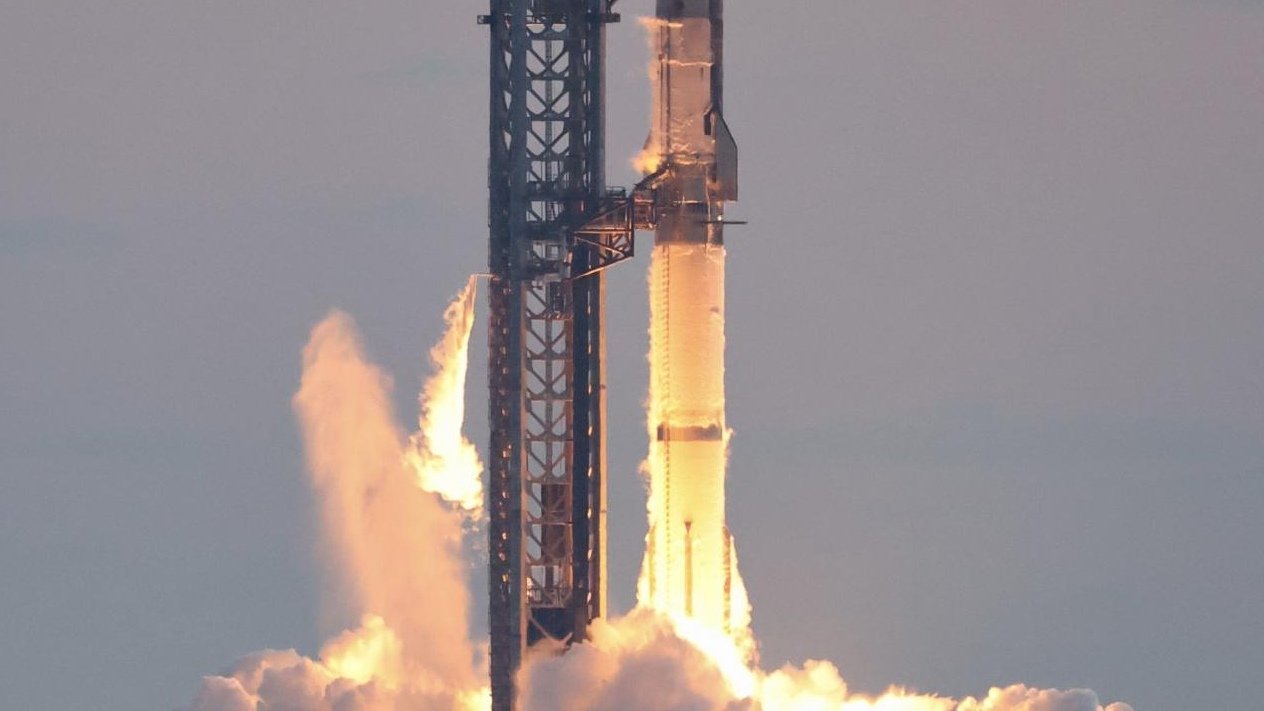
What Actually Happened On SpaceX’s FOURTEENTH Starship Test Flight: SpaceX’s Starship Flight 14 marked a major step in the development of the world’s largest reusable launch vehicle. Unlike earlier missions focused primarily on suborbital testing, Flight 14 was designed around orbital insertion, operational payload deployment, and controlled return from orbit.
The mission also demonstrated how Starship can continue operating even when individual engines experience problems. Despite Raptor engine dropouts on both the Super Heavy booster and Ship 41, the vehicle completed several major objectives that could reshape the future of large-scale satellite deployment.
Starship Flight 14 Begins With an Early Morning Liftoff
Flight 14 began with an early morning launch from Starbase in South Texas. The timing was closely connected to the mission profile, which was expected to last for several hours and include orbital operations before the vehicle returned to Earth.
The flight used Ship 41, mounted on the Starship V3 Super Heavy booster. The massive vehicle lifted away from the launch pad after all 33 Raptor engines on the booster ignited.
Around T+1 minute 20 seconds, one Raptor engine experienced a loss of thrust. However, the booster continued climbing because Starship’s propulsion architecture is designed with substantial engine redundancy.
A Record-Breaking Starlink Payload
One of the most significant aspects of Flight 14 was its payload. Ship 41 carried 26 Starlink V3 satellites, with a combined mass of approximately 50 metric tons.
That represented an enormous increase in payload capability compared with previous SpaceX missions. The satellites were also designed to provide dramatically greater communications capacity than earlier Starlink generations.
Each Starlink V3 satellite was described as capable of delivering nearly 1 terabit of data throughput. At full operational capacity, Starship could eventually deploy much larger batches of these satellites, potentially making the vehicle a central component of SpaceX’s satellite-launch strategy.
Super Heavy Booster Survives Multiple Engine Problems
After the ascent phase, Starship reached hot-stage separation, with Ship 41 continuing upward while Super Heavy began preparing for its return.
The booster performed its boost-back maneuver, attempting to reignite its Raptor engines. Another engine in the middle ring failed during this phase.
Even with the loss, Super Heavy retained control with the remaining engines. This demonstrated an important characteristic of the V3 booster: the ability to continue a mission despite individual propulsion failures.
Controlled Ocean Splashdown
Flight 14 did not include an attempt to catch Super Heavy using the Mechazilla launch tower arms. Instead, the booster was intentionally directed toward a controlled ocean splashdown.
During its final descent, the booster progressively reduced its engine count, eventually using only a small number of Raptors for the landing maneuver.
Although not every engine successfully reignited, Super Heavy maintained control and completed its planned soft ocean landing. This provided additional flight data for future recovery systems and potential tower catches.
Ship 41 Makes the Critical Orbital Insertion
The most important moment of Flight 14 came after separation.
Ship 41 continued its ascent using a combination of sea-level Raptor engines and vacuum-optimized Raptor Vacuum engines. During the orbital insertion burn, however, one Rvac engine failed.
This created a critical decision point for SpaceX’s flight controllers.
Choosing Orbital Insertion Instead of a Passive Return
The vehicle effectively had two broad options: continue toward a safer suborbital trajectory or attempt the more ambitious orbital insertion maneuver.
SpaceX chose to continue.
The center Raptor was successfully reignited, providing additional velocity to Ship 41. That extra acceleration converted the trajectory into an orbital path.
Ship 41 reached an altitude of approximately 277 kilometers and a velocity of roughly 26,400 km/h.
For Starship, this represented a historic milestone: the vehicle successfully demonstrated full Earth orbit.
26 Starlink V3 Satellites Deployed From Orbit
After reaching orbit, Ship 41 transitioned into its payload deployment phase.
Approximately 36 minutes after launch, the spacecraft opened its payload bay and began releasing the 26 Starlink V3 satellites.
The deployment occurred while Starship traveled over the southern portion of Africa and continued across the Indian Ocean.
A New Era for Starship Payload Operations
The satellite deployment was more than simply another demonstration. It showed how Starship could potentially function as a large-scale orbital freighter.
The satellites were released sequentially, with onboard cameras capturing the deployment process.
The successful release of such a large payload demonstrated the potential for Starship to eventually carry significantly larger satellite batches than existing SpaceX launch vehicles.
If Starship eventually reaches its projected payload capacity, it could fundamentally change how SpaceX approaches Starlink constellation expansion.
Starship Performs Its De-Orbit Burn
After completing the satellite deployment, SpaceX had another important decision to make.
Ship 41 could potentially remain in orbit longer to collect additional data, including information about cryogenic propellant boil-off. However, engine uncertainties made an early return more practical.
The spacecraft therefore prepared for its de-orbit maneuver.
Controlled Re-Entry Begins
During the next orbital pass, a center Raptor engine reignited to perform the de-orbit burn.
The maneuver reduced the spacecraft’s orbital velocity and placed Ship 41 on a trajectory toward the Pacific Ocean.
The vehicle then entered Earth’s atmosphere while maintaining its characteristic belly-flop orientation.
Its aerodynamic flaps played an important role in controlling the spacecraft during the intense re-entry phase.
The Final Landing Burn and Ocean Splashdown
As Ship 41 approached the Pacific Ocean north of Hawaii, the spacecraft began its final landing sequence.
The center Raptor engines reignited, allowing Starship to transition from its horizontal re-entry attitude into a vertical landing orientation.
The vehicle then descended toward the ocean.
Although the spacecraft ultimately experienced a destructive impact after splashdown, the controlled trajectory and landing maneuver represented a major achievement for the mission.
For the Starship program, demonstrating a targeted return from orbital flight provided critical information about the vehicle’s thermal protection, aerodynamic control, propulsion, and guidance systems.
Why Starship Flight 14 Matters
Flight 14 brought together several capabilities that previously existed largely as individual development goals.
| Flight Phase | Key Achievement | Why It Matters |
|---|---|---|
| Payload | 26 Starlink V3 satellites | Demonstrates heavy orbital payload capability |
| Ascent | Engine-out tolerance | Shows propulsion redundancy |
| Orbit | Approximately 277 km | Demonstrates orbital insertion |
| Deployment | Starlink V3 release | Moves toward operational satellite missions |
| Re-entry | Controlled atmospheric return | Tests orbital recovery systems |
| Landing | Targeted ocean splashdown | Provides data for future recovery attempts |
From Test Vehicle to Orbital Transport System
The significance of Flight 14 is not simply that Starship reached space and returned.
The mission demonstrated an integrated chain of capabilities: launch, stage separation, orbital insertion, satellite deployment, de-orbit, atmospheric re-entry, and controlled descent.
That combination moves Starship closer to its long-term role as a reusable heavy-lift transportation system.
What Comes Next for Starship?
The next stage of Starship development will likely focus on making these capabilities increasingly reliable and repeatable.
Future missions can build on Flight 14’s data by improving Raptor reliability, heat-shield performance, orbital operations, payload deployment, and booster recovery.
The ultimate objective is not a single successful orbital demonstration. SpaceX’s broader strategy is to develop Starship into a rapidly reusable launch platform capable of carrying satellites, cargo, and eventually crew.
For Starlink in particular, the enormous payload capacity of Starship could eventually allow SpaceX to deploy satellites at a scale that would be difficult to achieve using smaller launch vehicles.
Conclusion: Flight 14 Changes the Starship Development Story
Starship Flight 14 represented a major transition in the program’s development. Despite multiple engine issues, Ship 41 successfully demonstrated orbital insertion, heavy payload deployment, de-orbit operations, and controlled atmospheric return.
The mission showed why engine redundancy and flight-control systems are so important for an enormous reusable spacecraft.
More importantly, Flight 14 provided a glimpse of what Starship is ultimately intended to become: not simply a test vehicle, but a high-capacity orbital transportation system capable of repeatedly moving massive payloads between Earth and space.
The path toward full reusability and routine commercial operations remains a substantial engineering challenge, but Flight 14 demonstrated several of the fundamental capabilities required to get there.
FAQs
1. What was SpaceX Starship Flight 14?
Starship Flight 14 was a major test mission designed to demonstrate orbital insertion, Starlink V3 satellite deployment, de-orbit operations, and controlled atmospheric re-entry.
2. What was the main objective of Flight 14?
The main objectives were to demonstrate full Earth orbit, deploy a large operational payload, test orbital operations, and successfully return Ship 41 toward a targeted ocean landing zone.
3. How many Starlink V3 satellites did Starship Flight 14 carry?
Flight 14 carried 26 Starlink V3 satellites, with a combined payload mass of approximately 50 metric tons according to the supplied mission description.
4. What made the Flight 14 payload significant?
The approximately 50-ton payload represented a major demonstration of Starship’s potential for heavy orbital transportation and large-scale satellite deployment.
5. Did Starship Flight 14 reach orbit?
Yes. Ship 41 achieved orbital insertion, reaching an altitude of approximately 277 kilometers and a velocity of around 26,400 km/h.
6. Did Starship experience any engine failures during Flight 14?
Yes. The mission experienced Raptor engine dropouts on both the Super Heavy booster and Ship 41. Despite these problems, the vehicle continued its planned mission operations.
7. What happened to the Super Heavy booster?
The Super Heavy booster completed its boost-back and controlled descent sequence before performing a targeted ocean splashdown rather than attempting a Mechazilla tower catch.
8. What happened when an Rvac engine failed on Ship 41?
One Raptor Vacuum engine failed during the orbital insertion burn. SpaceX continued the mission by successfully using another engine to provide the additional velocity needed for orbital insertion.
9. Why was the orbital insertion decision important?
Continuing toward orbit demonstrated Starship’s ability to adapt to an in-flight engine problem while maintaining mission objectives. It also provided valuable data about orbital propulsion and flight control.
10. How were the Starlink V3 satellites deployed?
Ship 41 opened its payload bay and sequentially released the 26 Starlink V3 satellites while traveling over the southern portion of Africa and the Indian Ocean.
11. What happened after the satellites were deployed?
After payload deployment, SpaceX performed an early de-orbit burn. Ship 41 then entered Earth’s atmosphere and used its aerodynamic control surfaces to maintain its re-entry attitude.
12. Where did Ship 41 return to Earth?
The spacecraft was directed toward the Pacific Ocean north of Hawaii, where it performed its final descent and ocean splashdown sequence.
13. Did Ship 41 successfully complete its landing maneuver?
Ship 41 performed a controlled re-entry and landing sequence, including the transition from belly-flop orientation to vertical descent. The spacecraft ultimately experienced a destructive impact after splashdown.
14. Why is Starship Flight 14 important for future SpaceX missions?
Flight 14 demonstrated several important capabilities together, including orbital insertion, heavy payload deployment, de-orbit operations, atmospheric re-entry, and controlled descent. These are important building blocks for future reusable Starship missions.
15. What could Starship Flight 14 mean for future Starlink launches?
If Starship’s demonstrated capabilities become reliable and repeatable, its large payload capacity could allow SpaceX to deploy substantially larger batches of Starlink satellites per mission, supporting the long-term expansion of the constellation.
Read More:
- Tesla Roadster event gets delayed due to unfavorable weather
- Watch Tesla’s “guardian angel” FSD feature take over for collision evasion
- Tesla showrooms picked clean ahead of Q3 end as demand looks strong
- Tesla Roadster’s new patent preps white-knuckle speeds, keeping it grounded
- SpaceX Confirmed a Massive Goals for Flight 14 Beyond What We Expected