
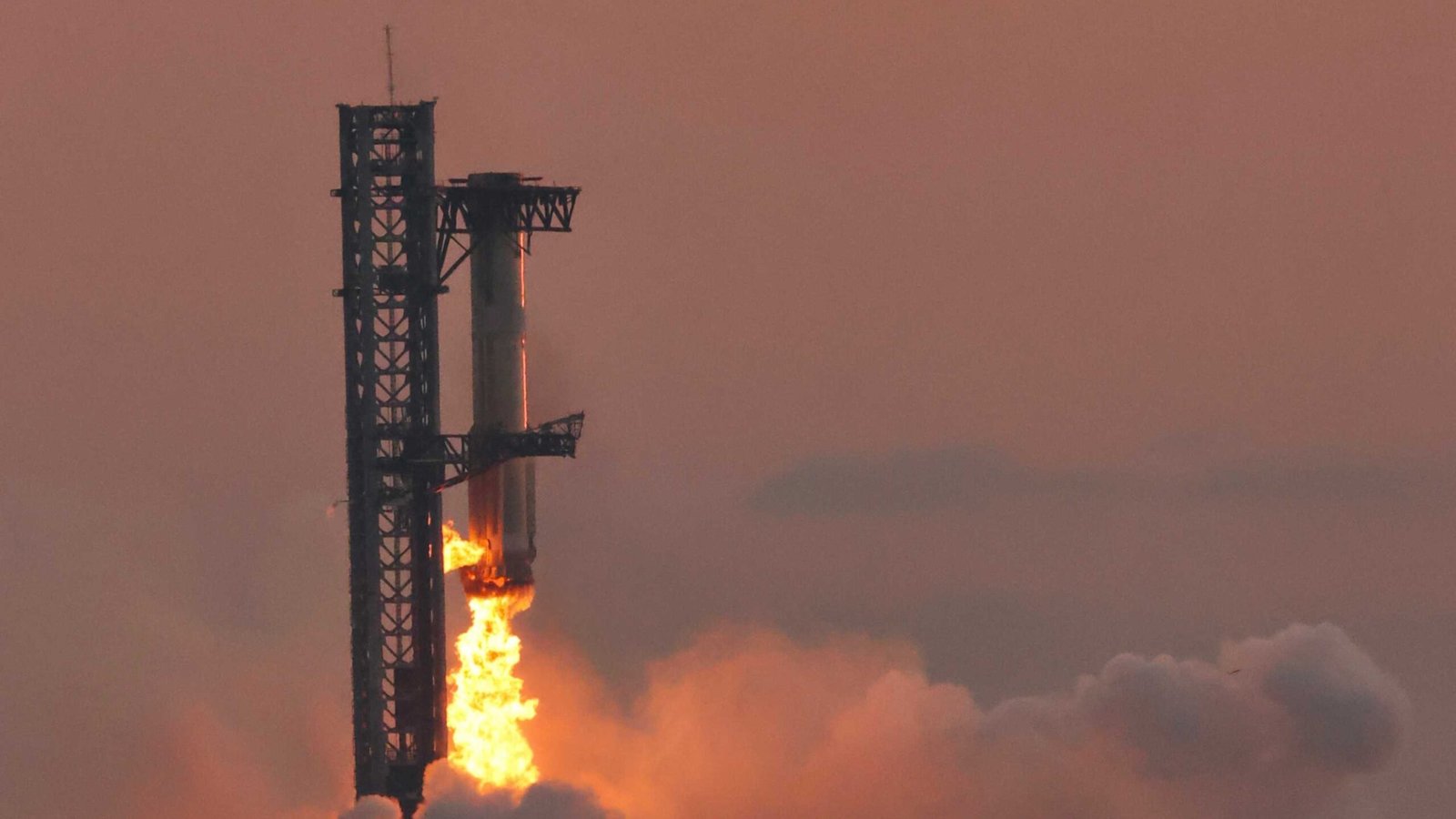
What SpaceX Starship Flight 13 just Did Shocked whole Industry. Musk Declared: The SpaceX Starship Flight 13 mission has become one of the most remarkable achievements in modern aerospace history. With an unprecedented combination of high-stress flight testing, successful payload deployment, in-space engine relight, precision guidance, and a historic soft splashdown, Flight 13 demonstrated capabilities that could reshape the future of space exploration, satellite deployment, and interplanetary travel.
For years, Elon Musk has promised that Starship would revolutionize spaceflight. Flight 13 is perhaps the strongest evidence yet that SpaceX is rapidly moving toward that vision. Every major objective of the mission was completed successfully, proving that Starship is becoming a fully reusable spacecraft capable of supporting future NASA Artemis missions, Mars exploration, and next-generation Starlink deployments.
SpaceX Flight 13 Begins with a Perfect Liftoff
The mission launched from Starbase, Texas, where the enormous Super Heavy Booster ignited all 33 Raptor engines flawlessly. Producing more than 16 million pounds of thrust, the launch became one of the most powerful demonstrations of rocket engineering ever witnessed.
Within seconds, telemetry confirmed that every engine was operating at normal chamber pressure. The massive rocket cleared the launch tower and began its planned ascent over the Gulf of Mexico without any abnormalities.
This perfect ignition alone represented a significant engineering milestone because previous test flights experienced occasional engine shutdowns. Achieving 33 out of 33 engine ignition showcased the growing maturity and reliability of SpaceX’s propulsion system.
Pushing Beyond the Max Q Stress Limit
Starship Endures Its Toughest Aerodynamic Test
One of the primary goals of Flight 13 was expanding the Maximum Dynamic Pressure (Max Q) envelope.
Unlike traditional launch profiles that reduce aerodynamic stress, SpaceX intentionally exposed Starship to significantly higher forces during ascent. Engineers wanted to determine whether the vehicle’s stainless-steel structure, welds, and internal framework could withstand more demanding flight conditions.
The results exceeded expectations.
Even under the highest aerodynamic loads ever experienced by a Starship prototype, both the Super Heavy booster and the upper stage maintained complete structural integrity. This successful stress test strengthens confidence that Starship can safely handle increasingly ambitious missions.
Hot Staging Demonstrates Advanced Rocket Engineering
Precision Stage Separation
At approximately two and a half minutes into flight, Starship executed its signature Hot Staging maneuver.
Instead of separating first and igniting the upper stage afterward, SpaceX ignited all six Raptor engines on the Starship upper stage while it was still attached to the booster. Simultaneously, the booster throttled down most of its engines before performing a controlled flip away from the upper stage.
This sophisticated maneuver improves efficiency and allows Starship to retain more fuel for orbital operations.
The flawless execution proved that SpaceX has mastered one of the most technically challenging rocket separation techniques currently in operation.
Super Heavy Booster Performs Precision Ocean Landing
Following stage separation, the Super Heavy Booster began its return sequence.
Using 13 Raptor engines, it performed a boostback burn to reverse its downrange momentum before beginning a controlled descent toward an offshore splashdown zone.
Throughout re-entry, three titanium grid fins actively guided the booster through the atmosphere.
As it approached the ocean surface, SpaceX carefully transitioned from 13 engines to five and finally three engines to reduce speed with incredible precision.
The booster completed a soft splashdown, successfully validating the same landing profile that will eventually be used for future Mechazilla tower catches.
Starlink V3 Deployment Marks a New Era
Flight 13 Successfully Deploys Next-Generation Satellites
While the booster returned to Earth, the Starship upper stage continued toward its planned suborbital trajectory.
One of the mission’s biggest accomplishments was the first operational demonstration of Starlink Version 3 satellites.
Using SpaceX’s innovative PEZ dispenser, Starship deployed demonstration payloads into space.
The improvements are remarkable.
Each Starlink V3 satellite is designed to deliver up to 1 Terabit per second (Tbps) of download capacity—many times greater than previous generations.
Even more impressive, a single Starship launch could deploy enough V3 satellites to provide approximately 20 times the network capacity of a standard Falcon 9 Starlink mission.
This dramatically lowers launch costs while greatly expanding global internet coverage.
Revolutionary Heat Shield Inspection in Orbit
A Major Step Toward Rapid Reusability
Flight 13 also tested a completely new method of inspecting Starship while still in space.
After satellite deployment, high-intensity lighting illuminated the spacecraft’s underside while cameras mounted on the departing payloads captured detailed images of the 18,000 ceramic heat shield tiles.
This innovative inspection system allows engineers to verify the health of the heat shield before atmospheric re-entry.
The ability to inspect Starship in orbit could dramatically reduce operational risk for future long-duration missions to the Moon and Mars.
Successful In-Space Raptor Engine Relight
A fully reusable spacecraft must be capable of restarting its engines in space.
During Flight 13, SpaceX conducted an in-space Raptor engine relight over the Indian Ocean.
Telemetry confirmed clean ignition, stable chamber pressure, and a successful shutdown exactly as planned.
This achievement is extremely important because future orbital missions require reliable engine restarts for orbital maneuvering, deorbit burns, and eventually orbital refueling operations.
Without this capability, missions supporting NASA’s Artemis program or future Mars expeditions would not be possible.
Starlink Delivers High-Speed Mission Telemetry
Another breakthrough came from Starship’s communication system.
Instead of relying primarily on traditional ground stations, Flight 13 transmitted continuous video and engineering data directly through the Starlink constellation.
Mission control received data streams at approximately 240 Mbps, allowing engineers to monitor nearly every phase of the flight in real time.
Perhaps most impressively, communication continued even during hypersonic re-entry, avoiding the lengthy signal blackouts historically experienced by spacecraft entering Earth’s atmosphere.
Hypersonic Re-entry Proves Flight Control System
Controlled Flight at Mach 25
Re-entering Earth’s atmosphere remains one of the most difficult phases of any space mission.
Traveling at approximately Mach 25, Starship encountered extreme temperatures generated by atmospheric friction.
The spacecraft relied on its four large aerodynamic flaps to continuously adjust its attitude while descending through the atmosphere.
These automated guidance systems successfully maintained stability despite intense aerodynamic forces and plasma surrounding the vehicle.
Near the end of the descent, three sea-level Raptor engines ignited simultaneously, rotating Starship from its famous belly-flop orientation into a vertical landing position.
The engines gradually throttled from three to one before completing a remarkably gentle splashdown.
Historic Soft Splashdown in the Indian Ocean
Starship Remains Structurally Intact
Perhaps the most surprising achievement of Flight 13 occurred after landing.
For the first time, Starship completed a soft ocean splashdown while remaining structurally intact and floating upright.
Even after enduring launch stresses, hypersonic re-entry, and ocean impact, the spacecraft continued transmitting live high-definition video back to mission control through Starlink.
Engineers also observed outstanding performance from Starship’s Thermal Protection System (TPS).
Out of approximately 18,000 heat shield tiles, only a handful appeared to be missing.
Considering the intense conditions experienced during flight, this represents one of the strongest validations of Starship’s heat shield design to date.
Why Flight 13 Changes the Future of Space Exploration
Flight 13 successfully demonstrated nearly every technology required for a fully reusable heavy-lift spacecraft.
Among the mission’s biggest accomplishments were:
- Perfect 33-engine Raptor ignition
- Expanded Max Q structural testing
- Successful Hot Staging separation
- Precision Super Heavy booster recovery profile
- Deployment of next-generation Starlink V3 satellites
- Orbital heat shield inspection
- Successful in-space Raptor engine relight
- Continuous Starlink-powered telemetry
- Controlled hypersonic re-entry
- Historic intact soft splashdown
Collectively, these milestones move SpaceX significantly closer to achieving rapid rocket reusability, reducing launch costs, enabling large-scale satellite deployment, and preparing for future Moon and Mars missions.
Final Thoughts
SpaceX Starship Flight 13 may ultimately be remembered as the mission that transformed Starship from an experimental prototype into a practical spacecraft ready for the next generation of exploration.
By proving advanced capabilities including Hot Staging, high-stress structural performance, orbital payload deployment, engine relight, heat shield durability, and an intact ocean landing, SpaceX demonstrated that many of the remaining technical barriers to fully reusable spaceflight are rapidly disappearing.
As Elon Musk continues pushing toward a future of affordable orbital transportation and human settlement beyond Earth, Flight 13 stands as one of the most important milestones yet—bringing humanity one step closer to routine space travel and the dream of reaching Mars.
FAQs
1. What is SpaceX Starship Flight 13?
SpaceX Starship Flight 13 is the latest test mission of SpaceX’s fully reusable Starship rocket system. The mission successfully demonstrated advanced technologies including Hot Staging, Starlink V3 satellite deployment, in-space engine relight, and a historic soft splashdown in the Indian Ocean.
2. Why is Starship Flight 13 considered a major achievement?
Flight 13 achieved several important milestones, including 33/33 Raptor engine ignition, expanded Max Q structural testing, successful Hot Staging, orbital payload deployment, controlled re-entry, and an intact splashdown, making it one of SpaceX’s most successful Starship test flights.
3. What is Hot Staging in Starship?
Hot Staging is a stage separation technique where the upper-stage engines ignite before the booster completely separates. This increases efficiency and allows Starship to carry more payload into space.
4. How many Raptor engines powered Starship Flight 13?
The Super Heavy Booster launched with 33 Raptor engines, while the Starship upper stage used 6 Raptor engines, giving the launch system a total of 39 engines.
5. What payload did Starship Flight 13 carry?
The mission carried Starlink Version 3 (V3) demonstration satellites, showcasing SpaceX’s next-generation satellite deployment capabilities.
6. What makes Starlink V3 satellites different?
Starlink V3 satellites are designed to provide up to 1 Terabit per second (Tbps) of downlink capacity and allow Starship to deploy significantly more internet bandwidth per launch than previous Starlink versions.
7. Did Starship Flight 13 successfully restart its engines in space?
Yes. Flight 13 successfully completed an in-space Raptor engine relight, proving Starship can perform orbital maneuvers and future deorbit burns required for deep-space missions.
8. How fast did Starship travel during re-entry?
During atmospheric re-entry, Starship traveled at approximately Mach 25, or about 27,000 km/h, while enduring extreme heat and aerodynamic forces.
9. How did Starship survive atmospheric re-entry?
Starship relied on its 18,000 ceramic heat shield tiles and actively controlled aerodynamic flaps to protect the spacecraft from temperatures exceeding 1,400°C (2,500°F) during re-entry.
10. Where did Starship Flight 13 land?
After completing its mission, the Starship upper stage performed a soft splashdown in the Indian Ocean, remaining structurally intact and continuing to transmit telemetry.
11. What is the purpose of the Super Heavy Booster?
The Super Heavy Booster provides the enormous thrust needed to launch Starship into space. After separation, it performs controlled maneuvers and is designed for rapid reuse on future missions.
12. Why is Flight 13 important for NASA’s Artemis program?
The successful engine relight, heat shield performance, and precision flight control provide valuable data for future missions supporting NASA’s Artemis lunar program and eventual human exploration of Mars.
13. How did SpaceX maintain communication during the mission?
SpaceX used the Starlink satellite network to transmit live video and telemetry at speeds of up to 240 Mbps, greatly reducing communication blackouts during flight and re-entry.
14. What was the biggest success of Starship Flight 13?
The mission’s biggest achievement was successfully combining payload deployment, orbital engine relight, heat shield inspection, controlled hypersonic re-entry, and an intact soft splashdown in a single flight.
15. What does Starship Flight 13 mean for the future of space travel?
Flight 13 brings SpaceX closer to achieving fully reusable spaceflight, dramatically lowering launch costs while enabling larger payloads, lunar missions, Mars exploration, and expanded global satellite internet services.
Read More:
- Tesla stock tumbles after earnings, one of its sharpest single-day declines
- SpaceX Starship Flight 13 faces wrath of the Texas skies
- Tesla door handle saga gets its latest chapter and a big change is coming
- Tesla short sellers win big after shares fall after earnings
- Tesla’s Supercharger Diner probably just secured more locations
1 thought on “What SpaceX Starship Flight 13 just Did Shocked whole Industry. Musk Declared”