
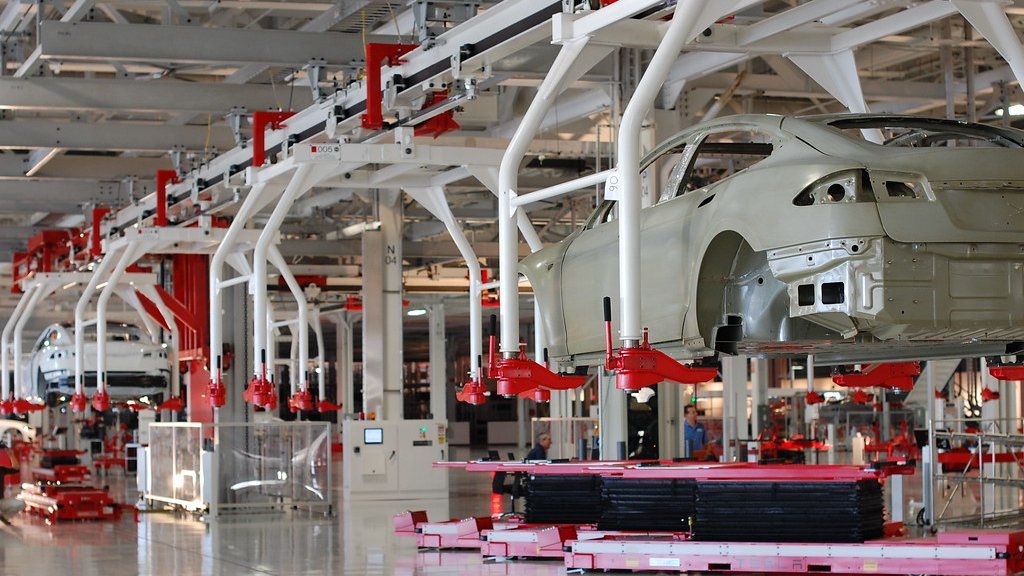
Massive Tesla Giga Press 4.0 Detroys All Welding Robots: Tesla has never been afraid to challenge traditional automotive manufacturing, but its latest innovation could completely redefine how electric vehicles are built. The company’s Generation 4 Giga Press represents one of the biggest manufacturing breakthroughs in modern automotive history. Instead of relying on hundreds of welding robots, complex sheet metal assemblies, and labor-intensive production lines, Tesla is moving toward a future where massive structural components are produced in a single die-casting process.
This revolutionary manufacturing strategy is expected to power Tesla’s next-generation vehicles, including the highly anticipated Cybercab Robotaxi, while significantly reducing production costs, factory space requirements, and manufacturing time.
In this article, we’ll explore how the Tesla Giga Press 4.0, Gigacasting technology, Cybercab architecture, molded-in-color body panels, and automated robotaxi depots could transform the global automotive industry.
What is Tesla Giga Press 4.0?
The Tesla Giga Press 4.0 is the next evolution of Tesla’s revolutionary Gigacasting technology. Unlike conventional vehicle manufacturing, which requires assembling hundreds of stamped steel components using robotic welding systems, the Giga Press creates enormous structural vehicle sections in one casting cycle.
Tesla initially introduced Gigacasting for the Model Y, partnering with Italian manufacturer IDRA Group to commercialize 6,000-ton and later 9,000-ton die-casting machines.
Now, Tesla is reportedly developing a 50,000-ton Giga Press, representing an unprecedented leap in automotive manufacturing.
Tesla Giga Press Evolution
| Vehicle | Clamping Force |
|---|---|
| Model Y | 6,000 tons |
| Cybertruck | 9,000 tons |
| Industry Competitors | 12,000–16,000 tons |
| Tesla Giga Press 4.0 | Target: 50,000 tons |
This enormous increase in casting capacity could allow Tesla to manufacture much larger structural components in a single operation than ever before.
Why Tesla is Replacing Welding Robots
Traditional automotive factories depend heavily on robotic welding systems. Thousands of individual metal panels are stamped, positioned, welded, inspected, and transferred throughout the production line.
Tesla wants to eliminate much of this complexity.
Instead of joining hundreds of separate pieces together, the company casts an entire structural section as one unified aluminum component.
Benefits of Eliminating Welding Robots
- Fewer production steps
- Reduced factory floor space
- Lower labor costs
- Less equipment maintenance
- Faster vehicle assembly
- Improved structural rigidity
- Lower capital investment
This “unboxed manufacturing” approach simplifies assembly while increasing manufacturing efficiency.
How the 50,000-Ton Giga Press Works
The proposed Generation 4 Giga Press operates through an advanced high-pressure aluminum die-casting process.
Step 1: Aluminum Preparation
Tesla uses a sophisticated dual-furnace system.
The primary furnace melts raw aluminum ingots and recycled aluminum at temperatures approaching 850°C.
A secondary holding furnace maintains molten aluminum between 750°C and 850°C inside a sealed nitrogen environment to minimize oxidation.
Before casting, the molten metal passes through:
- Argon degassing systems
- 25-micron silicon carbide filters
These processes remove hydrogen gas, impurities, and microscopic contaminants that could weaken the casting.
Step 2: Mold Preparation
Before every casting cycle, robotic systems apply approximately 35 ml of soybean-based lubricant across the steel mold.
Next, the mold chamber is vacuum sealed to eliminate trapped air.
This significantly reduces:
- Internal porosity
- Air pockets
- Structural defects
- Micro-cracking
Step 3: High-Pressure Injection
A powerful hydraulic piston injects molten aluminum into the die cavity under extreme pressure while the mold remains locked by 50,000 tons of clamping force.
This allows molten aluminum to completely fill the massive mold within seconds.
Step 4: Cooling and Quenching
After solidification, the casting exits the mold at approximately 400°C.
It is immediately submerged into a rapid cooling bath that lowers its temperature to roughly 50°C, improving tensile strength and dimensional stability.
The die itself is cooled back to approximately 185°C before beginning another production cycle.
Step 5: Automated Quality Inspection
Every finished casting undergoes advanced non-destructive testing (NDT) including:
- Automated X-ray scanning
- Structural integrity verification
- Dimensional inspection
- Defect detection
This ensures every structural component meets Tesla’s strict quality standards before moving further down the assembly line.
Cybercab: Designed Around Gigacasting
Tesla’s upcoming Cybercab has been engineered specifically to maximize the advantages of Gigacasting.
Unlike conventional passenger vehicles, the Cybercab eliminates:
- Steering wheel
- Pedals
- Traditional driver controls
Removing these components allows Tesla to simplify both the electrical architecture and structural design.
Cybercab vs Model 3
| Feature | Model 3 | Cybercab |
| Weight | 3,800–4,000 lbs | 3,113 lbs |
| Battery | 60–75 kWh | 48 kWh |
| Range | Similar | 290–300 miles |
| Energy Efficiency | 4–4.5 mi/kWh | Over 6.1 mi/kWh |
| Underbody Components | Around 200 | Around 80 |
By reducing approximately 200 structural parts to only 80, Tesla cuts hundreds of pounds from the vehicle while simplifying manufacturing.
The Cybercab is expected to weigh roughly 700 pounds less than a comparable Model 3.
Less weight means:
- Lower energy consumption
- Smaller battery requirements
- Lower manufacturing costs
- Longer driving range
Molded-in-Color Technology Eliminates Paint Shops
One of Tesla’s most ambitious manufacturing innovations may not involve metal at all.
Traditional automotive paint shops are among the most expensive sections of any vehicle factory.
They require:
- Massive paint booths
- Primer stations
- Basecoat lines
- Clearcoat ovens
- Drying tunnels
- Extensive emissions controls
Tesla’s patents describe a Reaction Injection Molding (RIM) process where color pigments are blended directly into the body panel material during manufacturing.
Advantages of Molded-in-Color Panels
- No paint shop required
- Zero paint-related VOC emissions
- Shorter manufacturing time
- Lower factory energy consumption
- Reduced greenhouse gas emissions
- Consistent high-gloss finish
Instead of spending hours painting and curing vehicle bodies, finished exterior panels emerge directly from the molding machine.
This dramatically simplifies production while reducing environmental impact.
Automated Robotaxi Service Hubs
Tesla’s vision extends beyond manufacturing.
To support a future fleet of autonomous Robotaxis, Tesla is designing fully automated service depots capable of cleaning and maintaining vehicles without human intervention.
Automated Depot Features
Interior Cleaning Robots
Robotic arms equipped with interchangeable tools automatically:
- Vacuum floors
- Remove trash
- Clean displays
- Wipe door handles
- Polish interior surfaces
Lost and Found Detection
Artificial intelligence systems identify forgotten personal belongings.
Items are cataloged and stored automatically for customer retrieval.
UV Cabin Sanitization
Between passenger trips, UV-C lighting sterilizes the cabin without chemical cleaning agents.
Autonomous Car Wash
Robotaxis drive themselves through automated washing systems before returning to service.
This minimizes downtime while maximizing fleet utilization.
Why Tesla’s Manufacturing Strategy Matters
Tesla’s manufacturing innovations are about much more than building electric cars faster.
By combining:
- Gigacasting
- Unboxed manufacturing
- Reaction Injection Molding
- Automated quality inspection
- Robotaxi maintenance infrastructure
Tesla aims to completely redesign automotive production economics.
Factories become:
- Smaller
- Less expensive
- More energy efficient
- Highly automated
- Capable of producing vehicles at unprecedented speed
If the 50,000-ton Tesla Giga Press reaches commercial production, it could become one of the most significant manufacturing breakthroughs since the introduction of the moving assembly line.
Final Thoughts
The Tesla Giga Press 4.0 represents far more than a larger die-casting machine—it symbolizes a complete reimagining of vehicle manufacturing. By replacing hundreds of welded components with single-piece structural castings, eliminating traditional paint shops through molded-in-color technology, and integrating automated Robotaxi service hubs, Tesla is pursuing an end-to-end production system focused on efficiency, scalability, and lower costs.
If Tesla successfully delivers its 50,000-ton Giga Press and scales its unboxed manufacturing strategy, the company could establish a new benchmark for high-volume electric vehicle production. While many details remain subject to future implementation, these innovations demonstrate Tesla’s ambition to reshape not only how EVs are designed, but also how they are manufactured, maintained, and deployed at scale.
FAQs
1. What is the Tesla Giga Press 4.0?
The Tesla Giga Press 4.0 is Tesla’s proposed next-generation gigacasting machine capable of generating up to 50,000 tons of clamping force. It is designed to produce massive structural vehicle components in a single casting process, reducing the need for traditional welding and assembly.
2. Why is Tesla replacing welding robots?
Tesla aims to replace hundreds of welding robots with large single-piece aluminum castings. This simplifies manufacturing, lowers production costs, reduces factory space, and speeds up vehicle assembly.
3. How does Gigacasting improve vehicle production?
Gigacasting replaces numerous stamped and welded parts with one unified casting. This reduces assembly complexity, improves structural strength, lowers weight, and shortens production time.
4. How much clamping force does the new Giga Press have?
Tesla’s proposed Generation 4 Giga Press is expected to deliver around 50,000 tons of clamping force, significantly larger than the 6,000-ton and 9,000-ton machines used for earlier Tesla vehicles.
5. What vehicles will use the Tesla Giga Press 4.0?
The Cybercab Robotaxi is expected to be one of the first vehicles built using Tesla’s advanced Gigacasting technology, although future Tesla models may also adopt the manufacturing process.
6. What is Tesla’s Unboxed Manufacturing process?
Unboxed Manufacturing is Tesla’s production strategy that builds major vehicle sections separately before combining them later in assembly. This approach reduces factory complexity and increases manufacturing efficiency.
7. How does Tesla prevent defects during aluminum casting?
Tesla uses a dual-furnace melting system, argon degassing, advanced filtration, vacuum-assisted molds, and automated X-ray inspections to minimize porosity, cracks, and structural defects.
8. What is the Cybercab?
The Tesla Cybercab is Tesla’s upcoming autonomous electric vehicle designed without a steering wheel or pedals. It is optimized for robotaxi services and highly efficient mass production.
9. How efficient is the Tesla Cybercab?
Tesla expects the Cybercab to achieve over 6.1 miles per kWh with an estimated 48 kWh battery pack, providing approximately 290–300 miles of driving range under favorable conditions.
10. What is molded-in-color technology?
Molded-in-color technology integrates color pigments directly into body panels during manufacturing, eliminating the need for traditional automotive paint shops and reducing energy consumption.
11. Why does Tesla want to eliminate paint shops?
Paint shops are among the most expensive and energy-intensive parts of vehicle manufacturing. Removing them reduces production costs, factory size, VOC emissions, and manufacturing time.
12. What are the benefits of single-piece castings?
Single-piece structural castings offer greater rigidity, fewer parts, lower vehicle weight, improved crash performance, simplified assembly, and reduced manufacturing costs.
13. How will Tesla’s automated robotaxi depots work?
Tesla plans to use robotic systems for vacuuming interiors, cleaning windows, sanitizing cabins with UV-C light, detecting lost items, and automatically washing Robotaxis between passenger trips.
14. Will Gigacasting reduce the cost of electric vehicles?
Yes. By reducing the number of components, manufacturing steps, factory equipment, and labor requirements, Gigacasting has the potential to significantly lower the production cost of future electric vehicles.
15. Is the Tesla Giga Press 4.0 currently in production?
Tesla has demonstrated earlier generations of the Giga Press, but the proposed 50,000-ton Generation 4 Giga Press has not yet been confirmed for mass production.
16. Why is the Tesla Giga Press 4.0 considered revolutionary?
The Tesla Giga Press 4.0 represents a major shift in automotive manufacturing by combining massive die-casting, simplified assembly, reduced reliance on welding robots, lower production costs, and faster manufacturing cycles, potentially setting a new standard for high-volume EV production.
Read More:
- What SpaceX Starship Flight 13 just Did Shocked whole Industry. Musk Declared
- Tesla stock tumbles after earnings, one of its sharpest single-day declines
- SpaceX Starship Flight 13 faces wrath of the Texas skies
- Tesla door handle saga gets its latest chapter and a big change is coming
- Tesla short sellers win big after shares fall after earnings
2 thoughts on “Massive Tesla Giga Press 4.0 Detroys All Welding Robots”