
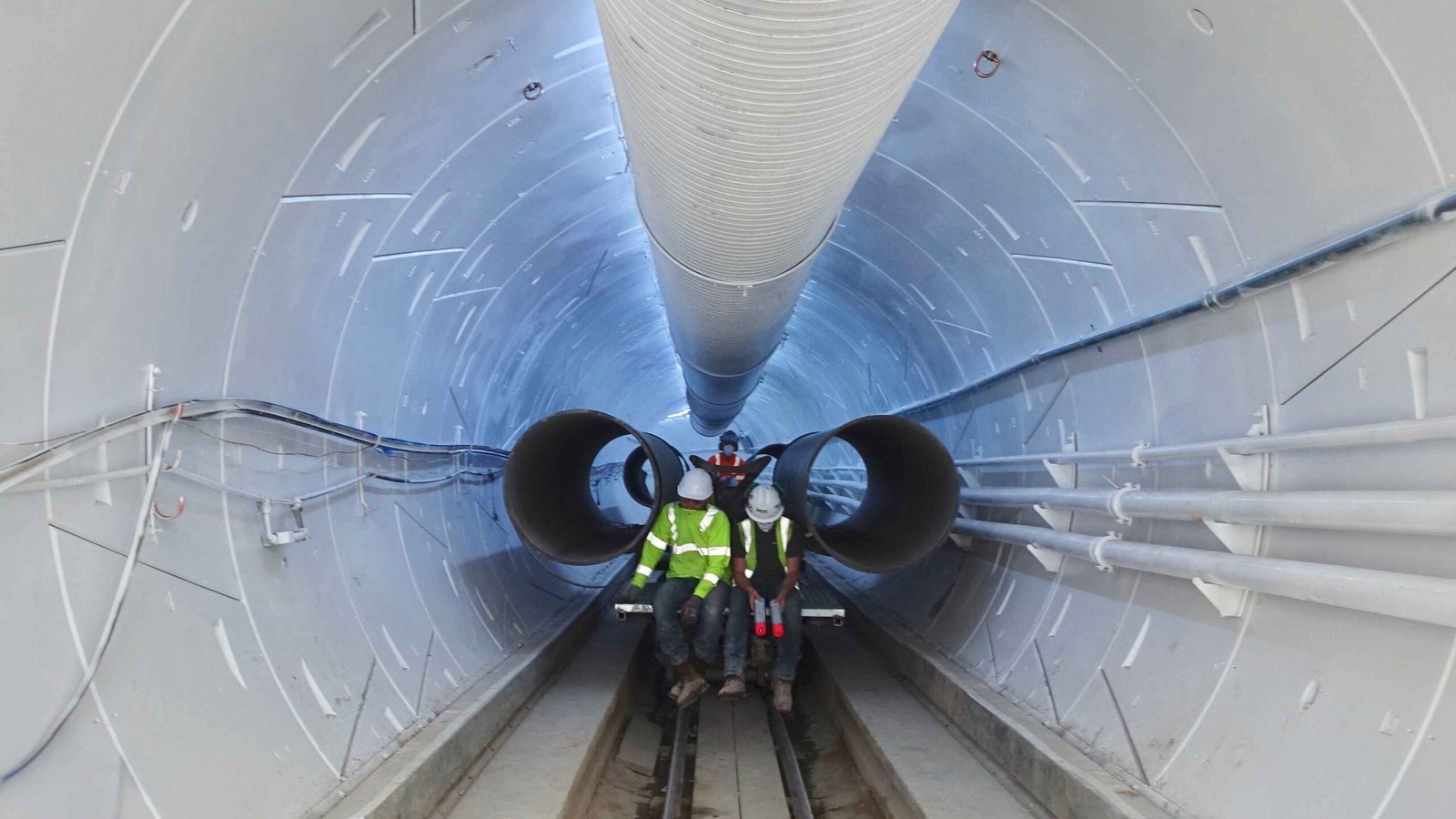
The Boring Company’s New Hyperloop Is INSANE: The future of high-speed transportation may be taking a very different path from the futuristic vision imagined more than a decade ago. The Boring Company is reportedly rethinking the original Hyperloop concept, moving away from an extremely complex near-vacuum system toward a more practical high-speed underground transportation network.
The revised concept, described in the source as a “precursor hyperloop,” could target speeds above 200 mph while using subterranean tunnels and high-speed autonomous electric vehicles. Rather than attempting to maintain a massive vacuum tube over an entire route, the approach focuses on simplifying the infrastructure while retaining much of the potential time-saving benefit.
From 700+ MPH Hyperloop to a 200+ MPH Underground System
The Original Hyperloop Vision
When Elon Musk released the original Hyperloop white paper in 2013, the concept captured enormous attention. The proposed transportation system envisioned passenger pods traveling through near-vacuum tubes at speeds exceeding 700 mph.
The basic idea was revolutionary: reduce air resistance dramatically and allow specially designed passenger capsules to travel at extremely high speeds through enclosed tubes.
However, turning that theoretical concept into a commercially viable transportation system presented enormous challenges.
According to the supplied source, third-party efforts to commercialize this version of Hyperloop encountered significant engineering, cost, and safety barriers. One prominent effort, Virgin Hyperloop, eventually shut down operations by late 2023.
A More Practical Hyperloop Approach
The Boring Company’s revised strategy is described as a precursor hyperloop.
Instead of maintaining an 80-mile vacuum environment, the proposed system would use underground tunnels with high-speed electric vehicles.
The supplied comparison presents a major change:
- 2013 concept: 700+ mph
- 2013 infrastructure: Vacuum tube
- 2013 vehicles: Pod capsules
- 2026 approach: 200+ mph
- 2026 infrastructure: Subterranean tunnels
- 2026 vehicles: High-speed autonomous EVs
This represents a fundamental engineering tradeoff: sacrificing some theoretical top speed in exchange for potentially simpler infrastructure.
The Austin-to-San Antonio Hyperloop Corridor
An 80-Mile Underground Route
One of the most interesting parts of the concept is the proposed Austin-to-San Antonio corridor in Texas.
The source describes an approximately 80-mile subterranean route connecting the two rapidly expanding metropolitan areas.
Today, highway travel between Austin and San Antonio can take approximately 2.5 hours, depending on traffic and conditions.
The proposed underground system could target speeds above 200 mph, with the source estimating a potential journey time of approximately 24 to 30 minutes.
That would represent a dramatic reduction in travel time.
Why Abandoning the Vacuum Could Matter
The most important engineering change may not be the vehicle itself.
It is the decision to avoid requiring an 80-mile vacuum seal.
Maintaining a near-vacuum over such a huge transportation corridor introduces additional requirements involving sealing, structural integrity, maintenance and infrastructure complexity.
The precursor approach attempts to eliminate those requirements.
The source argues that removing the vacuum requirement could significantly reduce maintenance risks, structural challenges and capital costs, while still providing substantial speed improvements.
Why Underground Transportation Changes the Equation
Traditional transportation systems are heavily constrained by surface congestion.
Highways have limited capacity, urban roads become increasingly crowded, and expanding road infrastructure can require substantial amounts of land.
An underground network approaches the problem differently.
Instead of adding another highway lane above ground, tunnels can create an additional transportation layer beneath existing infrastructure.
The Boring Company’s concept therefore focuses less on achieving the theoretical maximum speed and more on creating a system that could potentially operate within a practical regional transportation environment.
The Bigger Tesla Manufacturing Connection
The supplied source also connects the Hyperloop discussion with Tesla’s manufacturing strategy, particularly the 1.7-million-square-foot Gigafactory Semi facility in Nevada.
Although the Hyperloop and Tesla Semi address completely different transportation problems, the source identifies a similar theme: engineering simplification.
For Tesla Semi production, the goal is described as reducing manufacturing complexity and lowering the total cost of ownership for commercial fleet operators.
Removing the Traditional Paint Shop
One of the most notable manufacturing changes is the reported elimination of a conventional liquid paint shop.
Instead, the Semi uses powder coating, a process also associated with industrial Megapack battery enclosures.
According to the source, the Semi cabs can be produced in white, allowing fleet operators to apply custom wraps after delivery.
This is another example of removing a traditionally complex process from a manufacturing system.
Rear-Entry Cab Assembly
Tesla’s Semi manufacturing process is also described as using an open rear section of the cab during assembly.
Rather than forcing workers to install major interior components through narrow driver-side doors, seats, dashboards and wiring can be installed through the rear before final closure.
The result is a manufacturing process designed around easier component access and assembly efficiency.
Aerodynamics Matter
The source also highlights the Semi’s aerodynamic development.
Despite being a massive Class 8 commercial vehicle, the standalone Tesla Semi is described as having a lower drag coefficient than the Bugatti Chiron.
For an electric truck, aerodynamic efficiency is particularly important because reducing drag can lower energy consumption during highway operation.
Tesla Semi Operating Costs
Diesel vs. Electric
Commercial trucking is heavily influenced by operating economics.
The supplied source presents estimated operating costs of approximately:
- Diesel semi: ~$1.00 per mile
- Tesla Electric Semi: ~$0.34 per mile
- Estimated difference: ~66% per mile
These figures are presented as estimates in the source rather than universal real-world costs. Actual fleet economics can vary depending on electricity prices, diesel prices, charging infrastructure, routes, payloads, maintenance and other operating conditions.
The source also describes a projected production capacity of up to 1,000 trucks per week, connecting manufacturing scale with the potential economics of commercial fleet electrification.
A Common Engineering Philosophy
Simplification Instead of Maximum Complexity
The Hyperloop concept and Tesla Semi factory may appear unrelated, but the supplied material identifies a common direction.
The original Hyperloop concept pursued extraordinary speed through near-vacuum transportation.
The revised precursor concept instead targets 200+ mph underground transportation without requiring an 80-mile vacuum tube.
Likewise, Tesla’s Semi factory reportedly removes traditional manufacturing processes where they are not considered essential, including the conventional liquid paint shop.
The broader theme is operational viability.
Building Systems That Can Scale
The source’s comparison also includes the next-generation Tesla Roadster, describing its original performance target and proposed cold-gas thruster integration.
Together, these projects illustrate different approaches to transportation engineering: underground high-speed transit, efficient commercial trucking and extreme-performance electric vehicles.
What Makes the New Hyperloop Concept Different?
The most significant difference is its willingness to compromise on the original Hyperloop’s theoretical specifications.
A 700+ mph vacuum system sounds spectacular, but achieving that performance across a large transportation corridor requires extraordinary infrastructure.
A 200+ mph subterranean system is less extreme on paper, but the source presents it as potentially easier to maintain and deploy.
That distinction could be crucial.
The future of transportation is not necessarily determined by whichever concept has the highest theoretical speed. It also depends on cost, reliability, maintenance, construction complexity and scalability.
Conclusion
The Boring Company’s new Hyperloop direction represents a major shift from the futuristic 700+ mph vacuum-tube concept introduced in 2013 toward a more practical 200+ mph underground transportation system.
The proposed Austin-to-San Antonio corridor demonstrates how this approach could target dramatically shorter regional travel times while avoiding the complexity of maintaining a long-distance vacuum environment.
At the same time, Tesla’s Semi manufacturing strategy highlights another form of engineering simplification, from powder-coated panels to modular assembly and aerodynamic optimization.
If the source’s proposed figures and targets are achieved, these projects would demonstrate a broader transportation philosophy: simplify the system, reduce unnecessary complexity and focus on infrastructure that can operate at scale.
FAQs
1. What is The Boring Company’s new Hyperloop concept?
The new concept is described as a “precursor hyperloop” that would use underground tunnels and high-speed autonomous electric vehicles rather than the original near-vacuum tube design.
2. How fast could the new Boring Company Hyperloop travel?
The proposed system is described as targeting speeds of more than 200 mph, significantly above conventional highway transportation.
3. Is the new Hyperloop still based on the original 700+ mph concept?
Not exactly. The original 2013 Hyperloop concept envisioned passenger pods traveling through near-vacuum tubes at more than 700 mph. The newer approach described in the source focuses on 200+ mph subterranean transportation.
4. What is the proposed Austin-to-San Antonio Hyperloop route?
The source describes an approximately 80-mile underground transportation corridor connecting Austin and San Antonio, Texas.
5. How long could the Austin-to-San Antonio trip take?
The proposed system could potentially reduce the journey to approximately 24 to 30 minutes, compared with highway journeys that can take up to about 2.5 hours depending on traffic.
6. Why would The Boring Company avoid a vacuum tube?
Avoiding an 80-mile vacuum seal could reduce the maintenance, structural and infrastructure complexity associated with maintaining a long-distance near-vacuum transportation system.
7. Does the new Hyperloop use underground tunnels?
Yes. The revised concept described in the source uses subterranean tunnels rather than the fully sealed vacuum-tube infrastructure associated with the original Hyperloop proposal.
8. What vehicles would operate inside the new Hyperloop?
The source describes the system as using high-speed autonomous electric vehicles traveling through underground corridors.
9. What happened to the original Hyperloop concept?
The original concept faced substantial engineering, cost and safety challenges. The supplied source notes that third-party commercialization efforts, including Virgin Hyperloop, eventually ended operations by late 2023.
10. How is the new Hyperloop different from traditional highways?
Instead of transporting vehicles on congested surface roads, the proposed system would place transportation underground, creating a separate high-speed corridor beneath existing infrastructure.
11. What does the Tesla Semi factory have to do with this story?
The source connects The Boring Company’s transportation strategy with Tesla’s approach to engineering and manufacturing simplification. Both are presented as examples of focusing on practical systems that can potentially operate at scale.
12. What manufacturing innovation is highlighted at Tesla’s Semi factory?
One major change is the reported elimination of the traditional liquid paint shop in favor of powder coating for the Semi’s panels.
13. How does Tesla assemble the Semi’s interior?
The source describes a rear-entry cab assembly process, allowing major interior components such as seats, dashboards and wiring to be installed through the rear of the cab during production.
14. Why is aerodynamics important for the Tesla Semi?
Aerodynamics can reduce air resistance and therefore help lower energy consumption during highway driving. The supplied source states that the standalone Tesla Semi has a lower drag coefficient than the Bugatti Chiron.
15. What operating-cost figures are given for the Tesla Semi?
The source presents estimated operating costs of approximately $0.34 per mile for the Tesla Electric Semi compared with about $1.00 per mile for a diesel semi, representing an estimated difference of roughly 66%. Actual costs can vary based on operating conditions.
16. What is the main idea behind The Boring Company’s new Hyperloop?
The central idea is to move away from the most technically demanding aspects of the original Hyperloop and pursue a potentially more practical 200+ mph underground transportation system. The source frames this as a shift toward operational viability, lower complexity and scalability.
Read More:
- Tesla Optimus Gen 3 shows off a cleaner, factory-ready design in new app discovery
- Tesla App now shows you what your Supercharger will look like upon arrival
- Tesla leaks Semi customers ahead of handover event
- Tesla Cybercab gets initial tie-in to localized, in-house cathode plant
- New Tesla Semi Mass Production Line LEAKED CHANGE Everything