
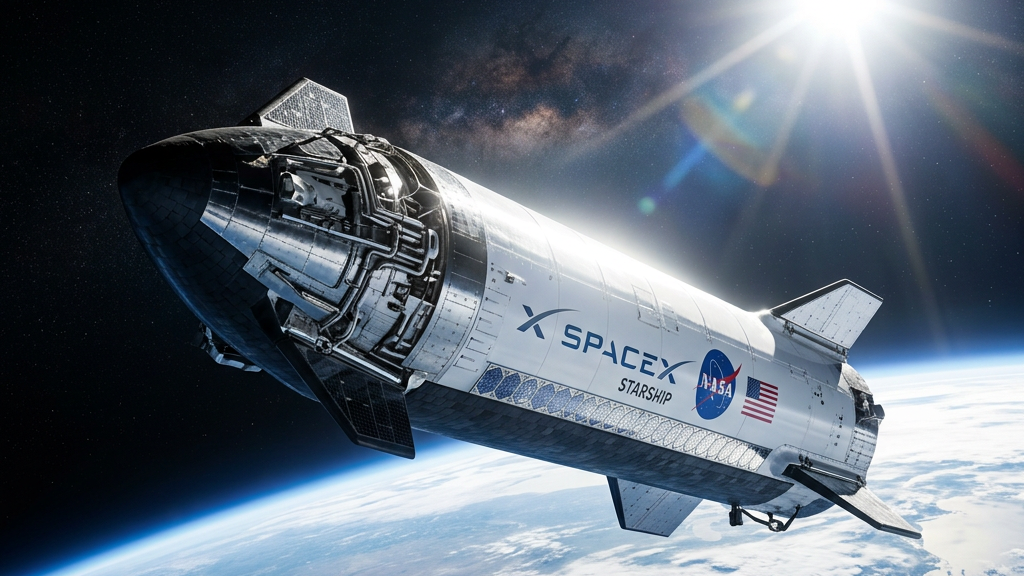
Elon Musk Revealed Secret Behind Starship Orbital Flight totally Humiliated Haters: For years, SpaceX Starship faced intense criticism because its early test flights often ended in spectacular explosions, hard landings, or vehicle losses. To outside observers, these events could look like failures. But behind every test was a deliberate engineering strategy: learn quickly, identify weaknesses, and improve the next vehicle.
The ultimate objective was never simply to make Starship fly. Elon Musk and SpaceX have repeatedly emphasized a much bigger ambition—developing a fully reusable spacecraft capable of launching frequently, carrying enormous payloads, and eventually supporting missions to the Moon and Mars.
As Starship progressed toward orbital operations, the reasoning behind its seemingly unconventional development approach became clearer. Each test helped SpaceX tackle one of the most difficult problems in aerospace: building a large, rapidly reusable orbital transportation system.
Why SpaceX Delayed Full Orbital Flights
One of the biggest questions surrounding Starship’s early development was why SpaceX did not immediately attempt a conventional orbital mission.
The answer was risk management and progressive testing.
Early flights used controlled trajectories that allowed SpaceX to gather valuable data without unnecessarily placing an uncontrolled spacecraft into orbit. A low-perigee trajectory could also ensure that a vehicle experiencing a serious failure would naturally return to Earth’s atmosphere rather than becoming long-term orbital debris.
This approach allowed engineers to test increasingly complex systems while maintaining control over the overall mission profile.
Mastering Hot Staging
Another major milestone was hot staging.
Instead of waiting for the Super Heavy booster to completely separate before igniting the Starship’s upper-stage engines, the Starship engines can begin firing while the stages are still close together. Exhaust is directed through a specially designed section between the vehicles.
Hot staging is technically demanding because it exposes the booster-stage interface to enormous thermal and aerodynamic forces. Successfully demonstrating this technology was therefore an important step toward making the complete Starship architecture work.
Testing the Thermal Protection System
Reaching space is only one part of an orbital mission.
A spacecraft must also survive high-temperature atmospheric re-entry. Starship’s thermal protection system uses thousands of heat-shield components designed to protect the stainless-steel vehicle from extreme heating.
That meant SpaceX needed real flight data on thermal protection, aerodynamic control, structural loads, and re-entry behavior before attempting increasingly ambitious missions.
The Crucial Orbital Insertion Burn
One of Starship’s most important technical achievements was demonstrating the ability to perform a precise orbital insertion maneuver.
After Super Heavy separation, the upper stage follows its planned trajectory before performing an engine burn designed to modify its velocity and flight path.
A simplified sequence looks like this:
       [Super Heavy Booster Separation]
                     │
                     ▼
            [Hot-Staging Phase]
                     │
                     ▼
        [Suborbital Coast Trajectory]
                     │
                     ▼
       [Raptor Vacuum Engine Burn]
                     │
                     ▼
        [Target Orbital Trajectory]
The significance of this maneuver extends beyond simply reaching orbit.
Precision Engine Operation
Starship’s Raptor engines use liquid methane and liquid oxygen, commonly called methalox. Operating these propellants reliably during spaceflight requires precise management of propulsion, tank pressure, guidance, and engine startup.
Demonstrating controlled engine operation in the space environment provides critical information for future missions involving longer-duration orbital operations.
Autonomous Trajectory Control
Orbital missions also require highly accurate guidance.
Once a spacecraft reaches space, its velocity and direction determine its future trajectory. Even small errors can significantly change where a vehicle travels.
Starship therefore needs sophisticated flight computers, navigation systems, engine control, and aerodynamic guidance to manage missions involving payload deployment, orbital maneuvering, and eventual re-entry.
Starship Changes the Payload Equation
Reaching orbit is important, but the bigger story is what Starship could potentially transport once the system becomes operational.
Traditional launch vehicles generally operate within relatively constrained payload-volume and payload-mass limits. Starship’s exceptionally large architecture is designed around the idea of transporting much larger payloads.
Its large diameter could enable the transportation of spacecraft components that would otherwise need to be launched in multiple pieces and assembled in orbit.
| Parameter | Conventional Heavy-Lift Rocket | Starship Concept |
|---|---|---|
| Vehicle Architecture | Conventional expendable or partially reusable stages | Fully reusable architecture goal |
| Payload Volume | Relatively limited | Extremely large internal volume |
| Payload Types | Satellites and spacecraft | Large satellites, habitats and infrastructure |
| Orbital Refueling | Generally limited | Designed around in-space refueling |
| Long-Term Goal | Commercial and government launches | Earth orbit, Moon and Mars missions |
Building Larger Space Structures
One of Starship’s most interesting possibilities is the ability to launch large structures in fewer pieces.
Future space stations, scientific observatories, solar-power systems, and deep-space habitats could potentially benefit from a vehicle with a much larger payload volume.
Instead of designing every component around the dimensions of a smaller rocket fairing, engineers could have significantly more freedom.
That could change how humanity designs infrastructure beyond Earth.
Rapid Launch Cadence Is the Real Goal
Getting Starship into orbit is only one milestone.
For SpaceX, the larger objective is rapid reusability.
A truly reusable transportation system needs more than a successful launch. The booster and spacecraft must return, be inspected, prepared, refueled, and launched again without lengthy refurbishment.
This is where SpaceX’s launch infrastructure becomes critical.
Mechazilla and Tower Operations
At Starbase, SpaceX has developed the enormous launch tower and mechanical systems commonly associated with Mechazilla.
The concept is designed around an integrated process in which launch vehicles can eventually be stacked, launched, caught, and prepared for another mission.
Catching the booster and Starship at the launch site could reduce the need for traditional landing legs and simplify post-flight handling.
If the system achieves its intended level of reliability, turnaround time could become dramatically shorter.
Orbital Refueling Unlocks Moon and Mars Missions
One of the biggest technical requirements for ambitious Starship missions is in-space propellant transfer.
A single Starship launching from Earth cannot simply carry unlimited propellant. For missions requiring substantial payloads beyond Earth orbit, Starship is expected to use other Starships as orbital tankers.
The basic concept is straightforward:
[Earth Launch]
      ↓
[Starship Reaches Orbit]
      ↓
[Orbital Tanker Launches]
      ↓
[Propellant Transfer]
      ↓
[Fully Fueled Starship]
      ↓
[Moon / Mars Mission]
This architecture could allow a Starship launched from Earth to receive additional propellant before departing for a deep-space destination.
That capability is especially important for ambitious lunar and Mars missions.
From Experimental Vehicle to Reusable Transportation System
The most important lesson from Starship’s development is that SpaceX did not treat every failed test as the end of the program.
Instead, each flight generated engineering information.
A destroyed vehicle could reveal weaknesses in engines, tanks, flight control, thermal protection, staging, or structural design. Engineers could then incorporate those lessons into the next vehicle.
This philosophy is fundamentally different from developing a rocket where every flight is expected to be nearly perfect from the beginning.
The Remaining Challenges
Despite major progress, Starship still faces substantial engineering challenges before achieving the ultimate vision of rapid and reliable full reusability.
These include:
- Reliable orbital re-entry
- Thermal protection durability
- Booster and ship recovery
- Launch-tower catching operations
- Rapid refurbishment
- Orbital propellant transfer
- High-frequency launch operations
- Long-duration spacecraft reliability
Solving these problems is far more difficult than simply reaching orbit once.
The Bigger Picture for Starship
The story behind Starship’s orbital development is ultimately a story about iterative engineering.
What appeared to critics as repeated failures provided SpaceX with real-world data that computer simulations alone could not fully reproduce. Every launch, landing attempt, engine test, and structural experiment helped refine the architecture.
The ultimate objective remains extraordinary: create a large, reusable space transportation system capable of moving people and cargo between Earth orbit and destinations such as the Moon and Mars.
If SpaceX can eventually combine orbital reliability, reusable thermal protection, rapid booster recovery, orbital refueling, and high launch cadence, Starship could become much more than another launch vehicle.
It could represent a new approach to space transportation—one built around reusability, scale, and frequent flight.
The early explosions were never the destination. They were part of the process of discovering how to make the system work.
FAQs
1. Why did SpaceX delay full orbital flights with Starship?
SpaceX used suborbital and controlled trajectories during early testing to reduce risk while collecting important data on propulsion, flight control, staging, and thermal protection.
2. What was the main reason for Starship’s early test flights?
The early flights were designed to test individual technologies and identify failures quickly. SpaceX could then use the collected data to improve subsequent vehicles.
3. What is hot staging on Starship?
Hot staging is a technique in which Starship’s upper-stage engines begin firing while the vehicle is still closely connected to the Super Heavy booster. This allows the upper stage to continue its mission immediately after staging.
4. Why is Starship’s heat shield so important?
The heat shield protects Starship from the extreme temperatures generated during atmospheric re-entry. Reliable thermal protection is essential if the spacecraft is to become fully reusable.
5. What is orbital insertion?
Orbital insertion is the process of performing a precise engine burn that gives a spacecraft the velocity and trajectory required to enter its intended orbit.
6. What engines does Starship use?
Starship uses SpaceX Raptor engines, which burn liquid methane and liquid oxygen (methalox). Different Raptor configurations are designed for atmospheric and vacuum operations.
7. Why is Starship’s orbital insertion burn important?
It demonstrates that Starship can accurately control its velocity, trajectory, and propulsion system in the space environment, which is essential for future orbital missions.
8. How could Starship change satellite launches?
Starship’s large payload capacity and internal volume could allow it to launch larger satellites and multiple spacecraft in a single mission, potentially changing the economics of orbital deployment.
9. How large is Starship compared with traditional rockets?
Starship has an exceptionally large vehicle diameter and payload architecture compared with many conventional launch systems. Its design is intended to provide substantially greater payload volume and capacity.
10. What is orbital refueling?
Orbital refueling involves transferring propellant from one spacecraft to another while both are in space. Starship is designed around this capability for missions requiring large amounts of energy beyond low Earth orbit.
11. Why does Starship need orbital refueling for Mars missions?
A Starship carrying substantial cargo to Mars would need large quantities of propellant. Refueling in Earth orbit could allow the spacecraft to depart for Mars with a much larger useful payload.
12. What is Mechazilla?
Mechazilla is the nickname associated with SpaceX’s large launch-tower mechanical system at Starbase. It is designed to support operations such as stacking and eventually catching Starship and Super Heavy vehicles.
13. What does SpaceX mean by rapid reusability?
Rapid reusability means being able to launch, recover, inspect, refuel, and relaunch a spacecraft or booster with minimal refurbishment and downtime.
14. What challenges remain before Starship becomes fully reusable?
Major challenges include reliable re-entry, heat-shield durability, vehicle recovery, launch-tower catching, orbital refueling, refurbishment, and high-frequency operations.
15. How did Starship’s failed tests help SpaceX?
Failed tests provided valuable real-world engineering data. SpaceX could identify weaknesses in engines, structures, flight control, staging, and thermal systems and incorporate improvements into later vehicles.
16. What is the ultimate goal of the Starship program?
The long-term goal is to develop a fully reusable, high-capacity space transportation system capable of carrying people and cargo to Earth orbit, the Moon, Mars, and potentially other destinations.
Read More:
- Elon Musk teases TSMC as potential Terafab partner
- SpaceX just locked up a NASA record no other U.S. spacecraft can touch
- Five things that are keeping Tesla Full Self-Driving supervised
- SpaceX reveals how its 1 Million AI satellite network will work and prevent space collisions
- Starship Flight 15 May Not Launch This Month Due To… S40 Came to Gulf