
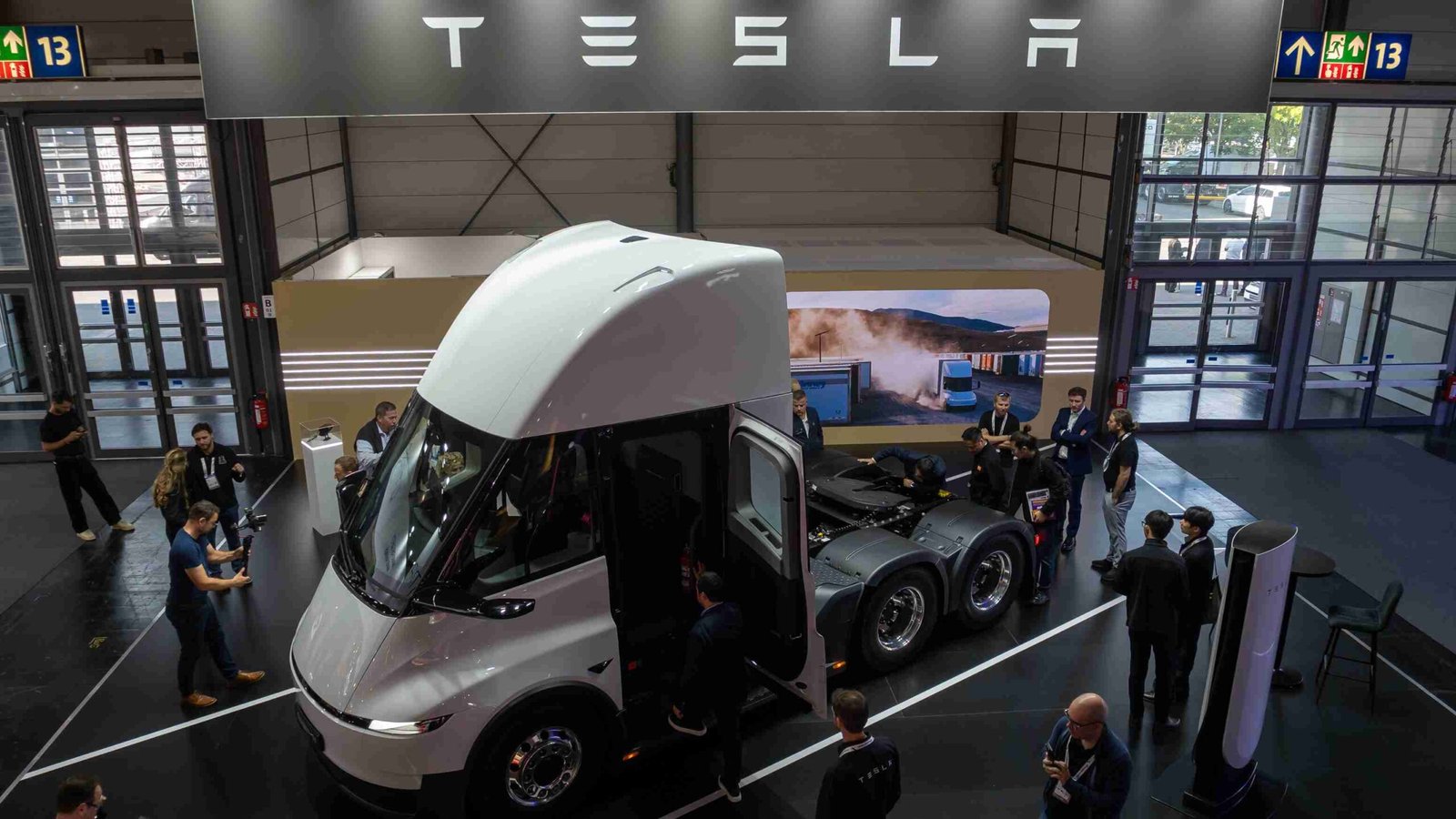
Everything About Elon Musk’s Tesla Semi 2027 Revealed: The Tesla Semi 2027 represents one of the most ambitious attempts to transform the global heavy-duty transportation industry. For decades, diesel-powered Class 8 trucks have dominated long-haul freight, moving enormous quantities of goods across highways while consuming substantial amounts of fuel and generating significant emissions.
Tesla is approaching the problem differently. Instead of improving the traditional diesel powertrain, the company designed the Tesla Semi around an all-electric architecture, combining powerful electric motors, aerodynamic efficiency, regenerative braking, large battery packs, and ultra-fast charging.
As Tesla works toward higher-volume production, the Semi could become an important part of the transition toward zero-emission commercial transportation.
Tesla Semi 2027: A New Era for Heavy-Duty Trucks
The fundamental idea behind the Tesla Semi is straightforward: replace the diesel engine, transmission, and associated mechanical systems with a highly efficient electric powertrain.
But creating an electric truck capable of carrying heavy loads over hundreds of miles requires considerably more than simply installing a large battery.
Tesla has focused on improving almost every part of the vehicle, from its tri-motor powertrain and streamlined body to its charging system and driver-focused cabin.
The result is intended to be a truck that can combine performance, efficiency, lower operating costs, and reduced emissions.
Powerful Tri-Motor Electric Powertrain
One of the most important features of the Tesla Semi is its three-motor configuration.
The electric motors are derived from Tesla’s high-performance vehicle technology and are designed to provide precise torque management to the rear axles. Unlike a conventional diesel truck that depends on a complex transmission with multiple gears, electric motors can deliver substantial torque almost instantly.
Impressive Acceleration and Hill-Climbing
According to the specifications described in the source material, an unloaded Tesla Semi can accelerate from 0 to 60 mph in approximately 20 seconds.
More importantly, the Semi is designed to maintain highway speeds while carrying a heavy freight load. With a gross combination weight of up to 82,000 pounds, the electric powertrain provides the torque necessary to tackle challenging gradients.
This capability could be particularly valuable for freight operators traveling through mountainous regions where maintaining speed has a direct impact on delivery schedules and energy consumption.
Regenerative Braking
The Tesla Semi also benefits from regenerative braking.
When the driver slows down, the electric motors can operate as generators. Instead of allowing all of the vehicle’s kinetic energy to disappear as heat through traditional friction brakes, some of that energy can be converted back into electricity and stored in the battery.
This system also provides strong deceleration and engine-braking characteristics, potentially reducing mechanical brake wear and maintenance costs.
Aerodynamic Design and Long-Range Efficiency
A major challenge for any electric truck is energy consumption. A Class 8 tractor pulling a heavy trailer requires enormous amounts of energy, particularly at highway speeds.
Tesla addresses this challenge through aggressive aerodynamic optimization.
A Streamlined Truck
The Tesla Semi features a noticeably smoother and more streamlined shape than traditional heavy-duty trucks. The source material cites a coefficient of drag of approximately 0.36, helping reduce aerodynamic resistance at highway speeds.
This matters because aerodynamic drag becomes increasingly important as speed increases.
Instead of simply adding an enormous battery to overcome inefficiency, Tesla’s strategy is to make the entire truck more efficient.
The claimed efficiency is less than 2 kWh per mile under full-load conditions, although actual energy consumption can vary depending on speed, terrain, weather, payload, and other operating conditions.
300-Mile and 500-Mile Range
Range is one of the biggest questions surrounding electric freight transportation.
The Tesla Semi has been associated with two major range targets: approximately 300 miles and 500 miles depending on configuration.
A 500-mile electric truck could be particularly important for long-distance freight because it would allow operators to cover substantial portions of common routes without frequent charging stops.
Fleet operators can also potentially structure charging around predictable schedules, allowing trucks to recharge at distribution centers, freight terminals, and dedicated charging locations.
Megawatt Charging Could Change Electric Trucking
Large batteries create another challenge: charging time.
A passenger EV can often charge relatively quickly because its battery is comparatively small. A heavy-duty electric truck requires dramatically more energy.
Tesla’s answer is Megawatt-class charging technology.
Charging During Driver Rest Periods
The Megawatt Charging System is designed to deliver charging power exceeding 1 MW under appropriate conditions.
The source material describes a charging scenario in which the Semi can recharge from 0% to approximately 70% in around 30 minutes.
For commercial fleets, this is especially significant because charging can potentially be integrated with legally required driver rest periods.
Instead of thinking of charging as wasted downtime, fleet operators could coordinate charging, driver breaks, loading, and unloading into a single operational schedule.
A Driver-Centered Tesla Semi Cabin
Tesla has also redesigned the traditional truck cabin.
The most noticeable feature is the central driving position. Rather than sitting on the left side like a conventional North American truck driver, the driver sits centrally within the cabin.
Better Visibility
A central seating position can provide a more balanced view of the road and potentially reduce certain blind spots.
The Semi also uses large digital displays instead of relying entirely on conventional analog instruments.
Two screens positioned around the steering wheel provide information and controls for vehicle operation, navigation, cameras, and other functions.
This creates a cabin that feels substantially different from traditional diesel trucks.
Advanced Windshield Design
The Semi’s windshield is also designed for the harsh conditions associated with highway freight transportation.
An impact-resistant design can help reduce damage from road debris and potentially lower downtime caused by windshield replacement.
For commercial operators, even seemingly small improvements can matter because vehicle downtime directly affects revenue.
Tesla Semi Economics: Why Fleets Could Make the Switch
Technology alone will not determine whether electric trucks succeed.
For fleet operators, the most important calculation is Total Cost of Ownership (TCO).
A truck that costs more initially could still be financially attractive if it delivers significantly lower energy and maintenance costs over its operational lifetime.
Tesla Semi vs Diesel Semi
| Category | Diesel Class 8 Truck | Tesla Semi |
|---|---|---|
| Powertrain | Internal combustion engine | Electric motors |
| Energy source | Diesel fuel | Electricity |
| Maintenance | High | Potentially lower |
| Braking | Mechanical + engine braking | Regenerative + friction braking |
| Energy efficiency | Around 6–6.5 MPG | Under 2 kWh/mile claimed |
| Emissions | Tailpipe emissions | Zero tailpipe emissions |
| Charging/Fueling | Fast diesel refueling | Megawatt-class charging |
Electric powertrains have fewer moving parts than conventional combustion systems. There is no engine oil, traditional exhaust system, or multi-speed transmission requiring the same type of routine service.
The source material estimates potential fuel and operating savings of more than $200,000 over three years in certain high-mileage applications. Actual savings, however, would depend on electricity prices, diesel prices, mileage, payload, maintenance, financing, and charging infrastructure.
Tesla’s Push Toward Mass Production
The next major challenge is manufacturing.
Early Tesla Semis were produced in relatively limited quantities near Gigafactory Nevada. Scaling from pilot production to tens of thousands of commercial trucks annually requires an entirely different manufacturing strategy.
Tesla’s planned production architecture focuses on a dedicated, high-volume manufacturing operation capable of eventually reaching a target of approximately 50,000 Semi units per year.
Vertical Integration
Tesla’s manufacturing philosophy emphasizes vertical integration.
Battery systems, electric motors, power electronics, structural components, and other major systems can be integrated into a tightly coordinated production process.
This could help Tesla control costs while increasing production speed.
The company’s broader battery and manufacturing expertise could also give the Semi program an advantage as Tesla attempts to scale commercial vehicle production.
The Future of Electric Freight
The Tesla Semi 2027 could represent an important turning point for the trucking industry.
Its combination of long-range capability, powerful electric motors, regenerative braking, aerodynamic efficiency, megawatt charging, and potentially lower operating costs addresses many of the biggest challenges facing electric heavy-duty transportation.
However, widespread adoption will depend on more than vehicle specifications. Tesla will need to scale production, expand charging infrastructure, improve battery economics, and demonstrate reliable performance across demanding commercial routes.
If those pieces come together, electric Class 8 trucks could move from limited fleet deployments into mainstream freight operations.
The biggest significance of the Tesla Semi may therefore not be the truck itself. It could be the beginning of a broader transformation in how the world’s freight, logistics, and transportation networks operate—replacing diesel-powered long-haul vehicles with increasingly efficient electric machines.
FAQs
1. What is the Tesla Semi 2027?
The Tesla Semi 2027 is an all-electric Class 8 heavy-duty truck designed for freight and long-distance transportation. It replaces the traditional diesel powertrain with electric motors and a large battery pack.
2. How far can the Tesla Semi travel on one charge?
The Tesla Semi is associated with 300-mile and 500-mile range configurations. Actual range can vary depending on payload, speed, terrain, weather, and driving conditions.
3. How powerful is the Tesla Semi?
The Semi uses a tri-motor electric powertrain designed to deliver substantial instant torque. This allows the truck to accelerate effectively and maintain highway speeds under heavy loads.
4. How fast can the Tesla Semi accelerate?
According to the specifications in the source material, an unloaded Tesla Semi can accelerate from 0 to 60 mph in about 20 seconds.
5. Can the Tesla Semi carry a full heavy load?
Yes. The Semi is designed for heavy-duty freight operations, with the source material describing operation at gross combination weights of up to 82,000 pounds.
6. What is the Tesla Semi’s energy efficiency?
The source material claims the Semi can achieve less than 2 kWh per mile under full-load conditions. Actual efficiency depends on factors such as speed, terrain, weather, and payload.
7. What is Megawatt Charging for the Tesla Semi?
Megawatt Charging is a high-power charging technology designed specifically for heavy-duty electric vehicles. The system can provide charging power exceeding 1 MW, dramatically reducing charging time compared with conventional EV chargers.
8. How quickly can the Tesla Semi charge?
The source material describes a charging scenario where the Semi can go from 0% to approximately 70% in around 30 minutes under suitable conditions.
9. Does the Tesla Semi use regenerative braking?
Yes. The Semi uses regenerative braking, allowing its electric motors to recover some kinetic energy during deceleration and return it to the battery.
10. Why does the Tesla Semi have a central driver’s seat?
The central driving position is intended to improve visibility and provide a more balanced view of the road. It also gives the cabin a different layout from traditional left-hand-drive commercial trucks.
11. Does the Tesla Semi have traditional dashboard gauges?
No. The Semi uses large digital displays around the steering wheel for vehicle information, navigation, cameras, controls, and other functions.
12. Is the Tesla Semi cheaper to operate than a diesel truck?
It has the potential to be. Electricity costs, reduced maintenance, regenerative braking, and fewer moving powertrain components can lower operating expenses. Actual savings depend on local energy prices, mileage, charging costs, and maintenance requirements.
13. How much can fleets potentially save with the Tesla Semi?
The source material estimates potential fuel and operating savings exceeding $200,000 over three years in certain high-mileage applications. Real-world savings will vary between fleets.
14. Where will the Tesla Semi be manufactured?
Tesla has been developing dedicated Semi production capacity in Nevada, moving from earlier low-volume production toward a purpose-built manufacturing approach intended to support much higher output.
15. How many Tesla Semis could Tesla eventually produce each year?
The production plans described in the source material target an eventual capacity of approximately 50,000 Tesla Semis per year. Achieving that level will depend on manufacturing expansion, supply-chain scaling, and demand.
Read More:
- Elon Musk teases TSMC as potential Terafab partner
- SpaceX just locked up a NASA record no other U.S. spacecraft can touch
- Five things that are keeping Tesla Full Self-Driving supervised
- SpaceX reveals how its 1 Million AI satellite network will work and prevent space collisions
- Starship Flight 15 May Not Launch This Month Due To… S40 Came to Gulf