
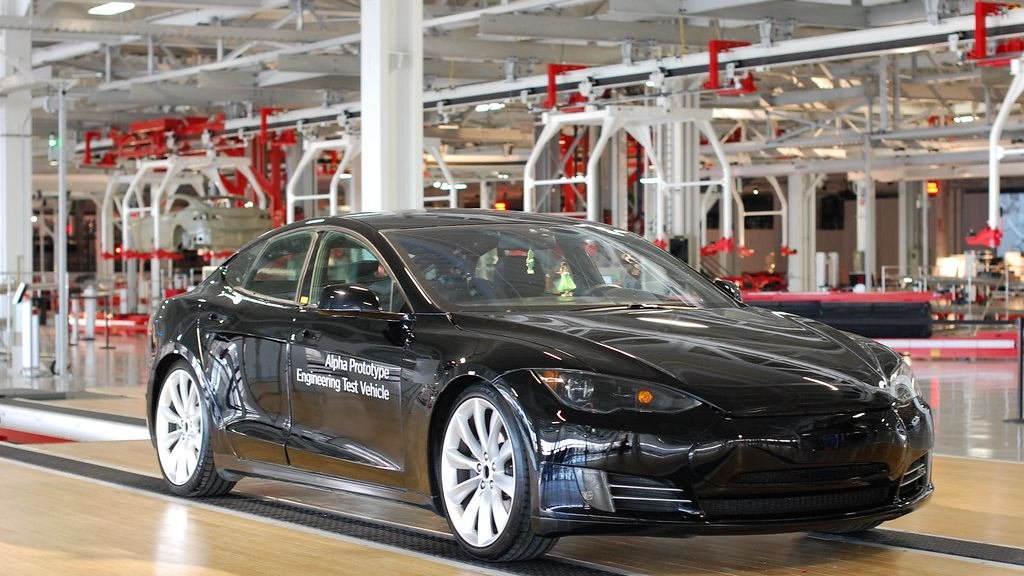
Tesla’s NEXT-GEN 50,000-Ton Giga Press Makes NEW Cars 7X Faster: Inside the advanced manufacturing facilities of Tesla Giga Texas, a major transformation in automotive production is taking shape. Elon Musk’s vision for the future of car manufacturing goes beyond electric vehicles, artificial intelligence, and autonomous driving. It focuses on completely rethinking how automobiles are designed, assembled, and produced at scale.
At the center of this strategy is Giga casting technology, combined with Tesla’s innovative unboxed manufacturing process. Reports about a next-generation 50,000-ton Giga Press have attracted significant attention because a machine of this scale could potentially simplify vehicle production even further. However, Tesla has not publicly confirmed the exact specifications of such a machine, and claims that it makes cars seven times faster should be treated as an unverified headline rather than an established production result.
The real breakthrough is the possibility of manufacturing vehicles with fewer components, fewer assembly steps, reduced factory complexity, and lower production costs. Tesla’s Cybercab is an important example of how this approach could reshape the automotive industry.
How Traditional Car Manufacturing Creates Bottlenecks
Hundreds of Components in a Single Vehicle
Traditional automotive manufacturing relies on hundreds of stamped metal components to create a vehicle’s structural body. These parts must be positioned, welded, bonded, bolted, inspected, and transported through numerous production stations.
Every additional component introduces another connection, tolerance requirement, and potential source of manufacturing defects. When thousands of vehicles move through a factory, even small inconsistencies can result in delays, rework, and increased costs.
Conventional production lines also require extensive tooling, robotic welding equipment, material-handling systems, and quality-control stations. These processes are reliable when properly optimized, but they can make factories expensive and complicated to expand.
Tesla’s Giga Press technology aims to address this challenge by consolidating multiple structural components into large, precisely engineered aluminum castings.
Why Giga Casting Matters
Giga casting uses enormous clamping forces to hold a mold together while molten aluminum is injected into it under high pressure. Once the metal solidifies, the resulting component can replace numerous smaller stamped and welded parts.
Tesla has already demonstrated large-scale casting technology in vehicles such as the Model Y and Cybertruck. The company’s broader manufacturing strategy seeks to extend these benefits to new vehicle platforms, including the purpose-built Tesla Cybercab robotaxi.
The objective is straightforward: fewer individual components can mean fewer joining operations, less equipment, and a more streamlined manufacturing process.
The 50,000-Ton Giga Press: What Makes It Different?
Replacing Hundreds of Traditional Parts
The reported 50,000-ton machine has generated interest because of the potential scale of its casting capability. However, the precise specifications and production applications described in online discussions have not been officially verified by Tesla.
Some estimates suggest that a single large casting could replace approximately 200 to 300 traditional body components. These figures should be understood as reported estimates rather than a confirmed Cybercab parts count.
Even without relying on a specific component number, the engineering advantage is significant. Consolidating multiple structural pieces into one casting can eliminate many individual welds, reduce the number of assembly stations, and simplify the vehicle’s underlying architecture.
This could also reduce the amount of factory floor space required for certain body-shop operations.
How the Technology Could Reduce Manufacturing Costs
The potential savings extend beyond the price of the metal itself.
A simpler structural design may reduce:
- Manufacturing labor associated with joining individual parts.
- Factory equipment requirements for stamping and welding.
- Material handling between production stations.
- Assembly time and opportunities for process-related defects.
- Production complexity across large manufacturing facilities.
However, these benefits depend on the cost of the casting equipment, tooling life, energy consumption, material utilization, and the percentage of parts that pass inspection without rework.
The biggest advantage will come when Tesla combines high-speed production with consistently high manufacturing quality.
Tesla’s Unboxed Manufacturing Process Explained
A New Approach to Vehicle Assembly
The Giga Press is only one component of Tesla’s manufacturing strategy. At its March 2023 Investor Day, Tesla introduced its unboxed manufacturing concept, which aims to reorganize vehicle assembly around large modules rather than a single, continuously assembled vehicle body.
In a conventional factory, a vehicle often progresses through a largely linear sequence of assembly stations. Tesla’s proposed approach allows major sections to be manufactured separately and simultaneously before they are combined during final assembly.
This parallel production strategy could reduce waiting times and improve access to components during installation.
How Parallel Assembly Improves Efficiency
The unboxed process could allow factory teams and robotic systems to work on several vehicle sections at once.
For example:
- Interior components, including seats and trim, can be installed in accessible structural sections.
- Electrical wiring and electronics can be integrated before separate modules are joined.
- Battery systems can be prepared alongside other major vehicle assemblies.
- Structural modules can move through their own production processes simultaneously.
Once the major sections are ready, they can be brought together during final integration.
Importantly, this approach does not eliminate every welding operation, manual task, or quality inspection. Instead, it changes how manufacturing steps are organized to reduce unnecessary complexity.
For the Cybercab, this could be particularly valuable because a vehicle designed specifically for autonomous transportation can be engineered around a dedicated production architecture.
Giga Casting Cycle Times, Quality Control, and Risks
Why Faster Machines Do Not Automatically Mean Faster Cars
A Giga Press’s clamping force alone cannot determine how quickly a factory produces complete vehicles. The total casting cycle includes mold preparation, molten-metal injection, solidification, cooling, part removal, inspection, and transfer to the next production stage.
The factory must coordinate all these steps with the rest of the assembly line.
First-pass yield, machine uptime, and consistent cycle times are essential for achieving lower production costs.
The Challenge of Casting Defects
Large integrated castings introduce specific engineering challenges. Potential defects include trapped gas, incomplete mold filling, internal porosity, and thermal distortion.
A defect in a small component may be relatively inexpensive to correct. A defect in a large structural casting could require extensive rework or rejection of the entire part.
Consequently, Tesla must balance production speed with stringent quality-control procedures. Faster cycles provide limited financial benefits if rejection rates rise or equipment frequently stops for maintenance.
Repairability and Crash Damage
There is another important trade-off. Consolidating multiple components into one large casting can simplify manufacturing, but significant damage to an integrated structural section may be more expensive to repair than damage to an individually replaceable component.
Vehicle safety, crash performance, repair costs, and insurance implications must therefore remain part of the engineering equation.
The most successful manufacturing design will balance production efficiency with long-term ownership costs.
Tesla Cybercab Production Timeline and Manufacturing Targets
Tesla’s Cybercab represents a major test of whether its next-generation manufacturing strategy can work at commercial scale.
In January 2026, Elon Musk reportedly warned that early Cybercab production would be painfully slow before the company attempted to increase output. This reflects a familiar challenge in automotive manufacturing: introducing a new design and production process often requires extensive testing and refinement.
The supplied timeline describes pilot production at Giga Texas by mid-2026, followed by a July 2026 update that continued to list the Cybercab in the pilot phase rather than confirming full-volume production during the year.
These milestones should be distinguished from independently verified production figures.
Key Cybercab Manufacturing Figures
| Metric | Reported Figure or Status | Why It Matters |
|---|---|---|
| Installed production capacity | More than 125,000 Cybercabs annually | Indicates the potential scale of the planned production system |
| Daily production equivalent | Approximately 340 vehicles | Illustrates the implied output if annual capacity is spread across 365 days |
| Early fleet sightings | Approximately 100–300 units reported | Suggests vehicle activity, but does not establish sustained factory output |
| Planned capital expenditure | More than $20 billion across Cybercab, Semi, and robotics, according to the supplied source | Reflects the broader manufacturing investment described |
| Main production challenge | Battery cells and component readiness | Highlights the importance of supply-chain coordination |
These figures require careful interpretation. Installed capacity is not the same as actual production, and vehicles seen outside a factory do not independently establish a sustained production rate.
Battery availability, component quality, assembly efficiency, and demand will all influence the final output.
Commercializing the Tesla Cybercab Beyond the Factory
Manufacturing large numbers of vehicles is only one part of Tesla’s robotaxi ambitions. The Cybercab is designed around autonomous transportation, making commercial deployment another major challenge.
A successful robotaxi operation requires more than vehicles rolling off an assembly line. It also needs dependable autonomous-driving performance, regulatory approvals, fleet management, charging infrastructure, maintenance systems, and customer support.
Different cities and jurisdictions may impose different requirements on driverless vehicles. Tesla must demonstrate that its vehicles can operate safely and reliably under the conditions permitted in each market.
Mass production and autonomous fleet deployment must advance together if the Cybercab is to become a commercially successful transportation platform.
Conclusion: Can Tesla Transform the Future of Car Manufacturing?
Tesla’s next-generation manufacturing strategy could challenge traditional automotive production by reducing the number of components, simplifying assembly, and allowing multiple vehicle sections to be built in parallel.
The combination of Giga casting, unboxed manufacturing, and purpose-built Cybercab engineering offers a compelling alternative to conventional vehicle production. If Tesla can achieve high casting yields, reliable equipment uptime, efficient battery integration, and sustained factory output, the resulting cost advantages could be substantial.
Nevertheless, the reported 50,000-ton Giga Press specifications and claims that the system makes cars seven times faster remain unverified. The decisive evidence will come from demonstrated production rates, manufacturing costs, product quality, and real-world commercial deployment.
Ultimately, Tesla’s biggest potential advantage may not be a single enormous machine. It may be the complete manufacturing system built around it—a system designed to produce vehicles with fewer parts, fewer process steps, and less overall complexity.
FAQs
1. What is Tesla’s NEXT-GEN 50,000-Ton Giga Press?
Tesla’s reported 50,000-ton Giga Press refers to a potential next-generation casting machine designed to simplify vehicle manufacturing by producing large structural components from molten aluminum. However, Tesla has not publicly confirmed the exact specifications of this machine.
2. How does Tesla’s Giga Press technology work?
The Giga Press injects molten aluminum into a specially designed mold under high pressure. After the metal solidifies, the machine produces a large structural component that can replace multiple smaller stamped and welded parts.
3. Can Tesla’s 50,000-Ton Giga Press make cars seven times faster?
The claim that Tesla’s next-generation Giga Press makes cars seven times faster has not been officially verified. Actual production speed depends on casting cycle times, assembly processes, machine uptime, component availability, and quality-control performance.
4. How many car parts can a Tesla Giga Press replace?
Some estimates suggest that a large integrated casting could replace approximately 200 to 300 traditional body components. The exact number depends on the vehicle design, and no confirmed Cybercab-specific figure has been publicly established.
5. What is Tesla’s unboxed manufacturing process?
Tesla’s unboxed manufacturing process is an approach in which major vehicle sections are assembled separately and simultaneously before being combined during final assembly. The goal is to reduce production complexity, improve access to components, and potentially lower manufacturing costs.
6. Why is Tesla using Giga casting for the Cybercab?
The Tesla Cybercab is designed specifically for autonomous transportation. Using large structural castings could reduce the number of components, simplify assembly, and support a more efficient manufacturing process for this purpose-built robotaxi.
7. Where is Tesla’s Cybercab manufactured?
Tesla’s Cybercab manufacturing program is associated with Gigafactory Texas in Austin, Texas. The facility is central to Tesla’s efforts to develop and scale production of its autonomous two-seat vehicle.
8. What are the main advantages of Tesla’s Giga Press?
The main potential advantages include fewer structural components, fewer joining operations, reduced tooling requirements, simplified assembly, and lower manufacturing complexity. Actual cost savings depend on production efficiency, casting quality, and equipment utilization.
9. What are the biggest challenges of Giga casting technology?
Major challenges include casting defects, internal porosity, incomplete mold filling, thermal distortion, and expensive tooling. Manufacturers must maintain high first-pass yield and reliable machine uptime to achieve the expected cost benefits.
10. Does Giga casting eliminate all welding in Tesla vehicles?
No. Giga casting does not eliminate every welding or joining operation. Vehicles still require structural integration, electrical wiring, battery installation, glass placement, interior assembly, and comprehensive quality inspections.
11. What is the reported annual production capacity of Tesla Cybercab?
The supplied source reports planned installed capacity exceeding 125,000 Cybercabs per year. This represents a reported capacity figure rather than proof of actual annual production, which depends on production readiness and supply-chain performance.
12. Why could battery supply affect Tesla Cybercab production?
Battery cells are essential components of electric vehicles. Even if Tesla’s body shop and casting equipment operate efficiently, limited battery supplies or delayed components can prevent the company from reaching its intended vehicle production targets.
13. Are Tesla’s large structural castings difficult to repair?
They can be. Although large castings simplify manufacturing, significant structural damage may be more complicated or expensive to repair than damage to individual replaceable components. Repairability depends on the location and severity of the damage and the manufacturer’s approved repair procedures.
14. What role does the Giga Press play in Tesla’s future manufacturing strategy?
The Giga Press supports Tesla’s broader strategy of creating simpler vehicle structures and more efficient factories. Combined with parallel assembly and the unboxed manufacturing process, it could help Tesla reduce production steps and improve manufacturing scalability.
15. Will Tesla’s NEXT-GEN Giga Press revolutionize the automotive industry?
It could significantly influence automotive manufacturing if Tesla demonstrates high-volume production, low defect rates, reduced costs, and consistent vehicle quality. However, the long-term impact will depend on measurable results rather than machine size or unverified claims about production speed.
Read More:
- Elon Musk reveals why Boring Co’s biggest East Coast project never happened
- The Boring Company’s latest Tesla tunnel truck mod “fits like a glove”
- SpaceX just launched its secret Starfall saucer again
- SpaceX reports its second earnings today: here’s what to expect
- IT’S HERE! New Tesla MODEL 2 2026 Senior Edition! 48V + Octovalve + gigacasting, used cars crash