
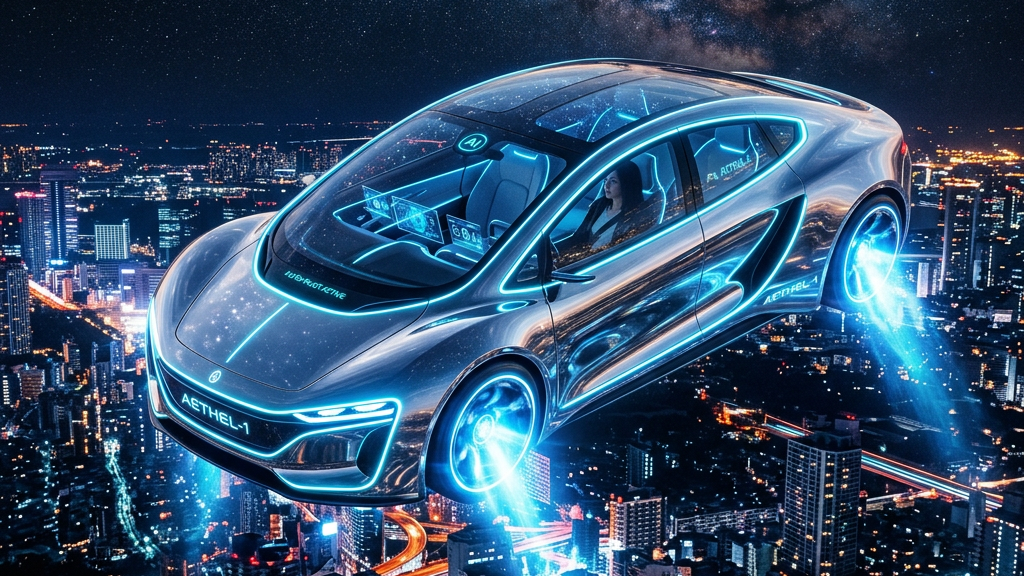
Elon Musk CONFIRMS Tesla’s First Flying Taxi Prototype “SkyCab”: Imagine a future where you step outside your home, open the Tesla app, and summon a fully autonomous flying taxi that carries you above crowded highways and busy city streets. Instead of sitting in traffic for an hour, you could potentially reach your destination through a short aerial journey. This futuristic vision is inspiring discussions about the next generation of transportation, especially as Tesla’s autonomous driving technology and SpaceX’s aerospace engineering expertise continue to attract attention.
One concept capturing the imagination of technology enthusiasts is the Tesla SkyCab, a hypothetical flying taxi inspired by Tesla’s Cybercab robotaxi and advances in electric vertical takeoff and landing (eVTOL) aircraft. However, it is important to clarify that Tesla has not officially confirmed a commercial flying taxi called SkyCab. The idea remains speculative rather than an established Tesla product.
Could Elon Musk’s transportation vision eventually extend beyond roads? Let’s explore the technology, engineering challenges, and possibilities behind a future Tesla Flying Taxi.
1. The Tesla Roadster Connection: Could SpaceX Technology Inspire Flying Cars?
The next-generation Tesla Roadster has attracted considerable attention because of discussions surrounding a potential SpaceX technology package. The concept has been associated with specialized thrusters intended to improve performance, although the precise capabilities and production configuration require confirmation.
Rocket-assisted propulsion and sustained flight, however, are fundamentally different engineering challenges. A system designed to deliver short bursts of thrust does not automatically provide the continuous lift required to keep a vehicle airborne.
Nevertheless, these concepts encourage an interesting question: could technologies developed for high-performance electric vehicles and aerospace applications eventually contribute to a dedicated flying taxi?
A practical aerial vehicle would require a completely different design, including flight-control computers, lift-generating propulsion systems, redundant safety mechanisms, and aviation-certified components.
Rather than simply adding thrusters to an existing car, engineers would need to develop an aircraft designed specifically for safe and efficient flight.
2. Tesla Cybercab: The Foundation of Autonomous Urban Mobility
Tesla’s Cybercab represents a vision for autonomous passenger transportation. Its purpose-built design emphasizes a minimalist interior, two-passenger capacity, and a transportation model built around automated ride-hailing.
Unlike conventional vehicles, a robotaxi designed without traditional driving controls depends on sophisticated software and sensing systems to understand its environment and navigate safely.
Tesla’s work on artificial intelligence, electric motors, battery systems, and vehicle manufacturing could provide useful foundations for future mobility technologies.
How Could Cybercab Technology Support a SkyCab?
A hypothetical Tesla SkyCab could draw inspiration from several areas of autonomous vehicle development:
- AI-powered navigation: Software could help plan routes and respond to changing traffic conditions.
- Computer vision: Cameras and other appropriate sensors could help interpret the surrounding environment.
- Electric powertrains: Experience with motors, inverters, and battery management could inform electric aircraft development.
- Automated passenger services: A digital booking platform could potentially coordinate reservations, payments, and journey planning.
- Mass manufacturing: Tesla’s manufacturing experience could offer lessons for producing complex electric vehicles at scale.
However, autonomous driving software cannot simply be transferred to an aircraft. Flying introduces additional requirements involving altitude, wind, weather, airspace separation, and emergency flight procedures.
3. Tesla SkyCab Design: From Road Wheels to Electric Flight
A conventional Cybercab is engineered to travel on roads, where its wheels support the vehicle and the road surface carries most of its weight. A flying taxi must generate enough lift to remain airborne throughout its journey.
This difference would fundamentally change the vehicle’s architecture.
What Would a Flying Cybercab Look Like?
A speculative SkyCab might feature a compact passenger cabin, an aerodynamic exterior, multiple electric lift fans, and an advanced flight-control system.
Instead of relying on conventional wheels and suspension as its primary mobility systems, the aircraft would use carefully positioned propulsion units to lift and maneuver through the air.
Potential design elements could include:
- Electric ducted fans or propellers to generate vertical lift.
- Redundant motors to improve resilience if a propulsion component fails.
- Lightweight structural materials to reduce overall aircraft mass.
- High-capacity batteries to supply energy during takeoff, cruising, and landing.
- Advanced flight computers to coordinate propulsion and stabilize the aircraft.
- Emergency landing systems designed to respond to unexpected technical problems.
The most important challenge would be balancing passenger capacity, flight range, battery weight, and safety. Every additional kilogram increases the lift required, potentially affecting energy consumption and operating range.
4. Electric Vertical Takeoff and Landing Technology
The most relevant technological category for a potential electric flying taxi is eVTOL, short for electric vertical takeoff and landing.
Unlike conventional airplanes that generally require a runway, eVTOL aircraft are designed to take off and land vertically. Depending on their configuration, they may use multiple rotors, ducted fans, tilting propulsion units, or other lift-generating systems.
Why eVTOL Could Matter for Urban Transportation
Vertical takeoff could make aerial transportation more flexible in densely populated areas where suitable runways are unavailable.
A future SkyCab concept might use designated landing locations on rooftops, at transportation hubs, or in specially developed urban facilities.
However, electric flight requires substantial energy. An aircraft must continuously generate enough lift to counter gravity, and its battery must also support navigation systems, environmental controls, and other onboard equipment.
Battery energy density remains a major consideration because aircraft generally benefit from carrying as little mass as possible. Even with advances in battery technology, a flying taxi would need a carefully engineered balance between range, passenger capacity, charging time, and operating costs.
Noise, maintenance, weather tolerance, and safe landing procedures would also influence whether such a service could become practical.
5. Autonomous Flying Taxis and Three-Dimensional Traffic Management
Autonomous driving systems primarily navigate a two-dimensional road network, although they must also account for elevation changes and complex surroundings. An autonomous aircraft must manage movement through three-dimensional airspace.
It would need to evaluate its position, altitude, speed, surrounding aircraft, weather conditions, and available landing locations.
How Could a Future SkyCab Network Operate?
A hypothetical urban transportation network could combine ground-based robotaxis with aerial vehicles.
Ground transportation: Autonomous cars could handle neighborhood trips, shopping journeys, and shorter distances.
Aerial transportation: Certified flying taxis could potentially connect airports, business districts, and designated passenger terminals.
Integrated booking: A shared digital platform might allow passengers to coordinate ground and aerial journeys within one reservation.
For example, a passenger could travel by road to an aerial mobility hub, board an electric aircraft for a cross-city journey, and use another vehicle for the final part of the trip.
This system could eventually offer an alternative for certain congested routes. Nevertheless, its success would depend on aircraft availability, infrastructure, operating costs, weather conditions, and regulatory approval.
6. Tesla and SpaceX: How Their Expertise Could Intersect
Tesla and SpaceX operate in different industries, but their technical capabilities overlap in areas such as advanced materials, electronics, software, and complex manufacturing.
| Company | Relevant Expertise |
|---|---|
| Tesla | Electric motors, battery systems, power electronics, artificial intelligence, and vehicle manufacturing |
| SpaceX | Aerospace engineering, propulsion research, structural analysis, and flight-system development |
| Potential Collaboration | Knowledge exchange in materials, control systems, manufacturing methods, and engineering design |
These areas of expertise could inform future transportation research. However, the existence of overlapping technical capabilities does not establish that the companies are developing a flying taxi together.
A commercial aircraft would require extensive testing and certification beyond the capabilities needed to manufacture a road vehicle or demonstrate an experimental propulsion system.
7. Major Challenges Facing the Tesla Flying Taxi
Although the SkyCab concept is exciting, several major obstacles would need to be addressed before autonomous flying taxis could become a widespread transportation option.
Aviation Safety and Certification
Aircraft operating above populated areas must meet stringent safety requirements. Regulators would need to evaluate the vehicle’s structure, propulsion systems, flight controls, emergency procedures, and operating limitations.
In the United States, the Federal Aviation Administration (FAA) plays a central role in aircraft certification and aviation safety.
Battery Range and Charging
Flying consumes substantial energy, and batteries add weight. Engineers would need to develop a power system capable of supporting useful journeys while preserving appropriate safety reserves.
Infrastructure and Noise
Urban flying taxis would require suitable takeoff and landing locations, charging facilities, maintenance services, and systems for managing passenger movement.
Noise from electric propulsion systems could also affect where and when aircraft could operate.
Cost and Accessibility
A flying taxi would need to be economically viable for operators and passengers. Aircraft acquisition, maintenance, insurance, charging infrastructure, and certification could all influence ticket prices.
Consequently, a flying taxi might initially serve specialized routes rather than replace conventional cars for everyday transportation.
8. The Future of Urban Mobility: Will SkyCab Become Reality?
The broader vision behind autonomous transportation is to make journeys safer, more convenient, and potentially more efficient. Electric vehicles, robotaxis, and eVTOL aircraft represent different approaches to that goal.
A future Tesla SkyCab could theoretically combine autonomous passenger services with electric vertical flight. Yet the concept would require a dedicated aircraft design, extensive safety validation, reliable energy systems, and a practical urban operating network.
For now, Tesla’s Cybercab is a ground-based autonomous transportation concept, while the SkyCab remains speculative. No confirmed commercial launch date, production specification, or official Tesla announcement establishes it as a real product.
If future developments make autonomous eVTOL transportation safe, affordable, and scalable, flying taxis could become one part of a broader mobility ecosystem.
The most significant transformation would not simply be a car that can fly. It would be a transportation network capable of connecting roads, airspace, autonomous vehicles, and passenger services into a coordinated system.
That possibility remains an intriguing vision of the future, but turning it into everyday reality will require considerably more than futuristic design and advanced propulsion.
FAQs
1. What is the Tesla SkyCab?
The Tesla SkyCab is a speculative concept for a future autonomous flying taxi inspired by Tesla’s Cybercab robotaxi and electric vertical takeoff and landing (eVTOL) technology. Tesla has not officially confirmed a commercial flying taxi named SkyCab.
2. Has Elon Musk officially confirmed Tesla’s first flying taxi prototype?
There is no verified official confirmation that Elon Musk has announced a Tesla flying taxi prototype called SkyCab. The concept remains speculative and should not be confused with a confirmed Tesla product.
3. What is the connection between Tesla Cybercab and SkyCab?
The Tesla Cybercab is designed for autonomous ground transportation. A hypothetical SkyCab could build on ideas such as artificial intelligence, electric powertrains, and automated passenger services while adding specialized aircraft technology for vertical flight.
4. Could the Tesla SkyCab fly without a human pilot?
A future SkyCab could theoretically use autonomous flight technology to navigate without a human pilot onboard. However, this would require sophisticated flight-control software, reliable sensors, airspace coordination, and regulatory approval.
5. How would a Tesla flying taxi take off and land?
A potential SkyCab would likely use electric vertical takeoff and landing (eVTOL) technology. Multiple electric rotors or ducted fans could generate the lift needed to rise vertically and descend at designated landing locations.
6. Could the Tesla Roadster’s SpaceX technology help develop a flying taxi?
The next-generation Tesla Roadster has been associated with discussions about a potential SpaceX technology package. However, short-duration thrust and sustained aircraft flight require different engineering systems. Any connection to a commercial SkyCab remains unconfirmed.
7. What technology would the Tesla SkyCab use?
A hypothetical SkyCab could require electric propulsion, high-capacity batteries, flight-control computers, advanced navigation, redundant safety systems, and lightweight materials. Its final technology would depend on the aircraft design Tesla might choose if it ever pursued such a project.
8. How many passengers could the Tesla SkyCab carry?
The passenger capacity of a Tesla SkyCab has not been announced because no official vehicle specifications are available. A future design would need to balance passenger capacity with battery weight, flight range, and safety requirements.
9. How fast could the Tesla SkyCab travel?
There is no confirmed top speed for the SkyCab. Its potential speed would depend on the aircraft configuration, propulsion system, operating altitude, energy capacity, and aviation regulations.
10. What would be the expected flight range of the Tesla SkyCab?
The Tesla SkyCab’s flight range is unknown. Electric aircraft range depends on battery energy density, passenger load, aircraft weight, weather conditions, cruising speed, and the energy reserves required for safe operation.
11. Could the Tesla SkyCab reduce traffic congestion?
Flying taxis could potentially reduce travel times on selected congested routes by moving some passengers through the air. However, their overall impact would depend on fleet size, ticket prices, landing infrastructure, airspace capacity, and connections to ground transportation.
12. Would the Tesla SkyCab use Tesla’s Full Self-Driving technology?
Tesla’s Full Self-Driving (FSD) technology is developed for road vehicles. Some underlying AI and computer-vision expertise could be relevant to autonomous aircraft, but a flying taxi would require specialized aviation software and flight-safety systems rather than simply using existing FSD software.
13. What role could SpaceX play in developing a Tesla flying taxi?
SpaceX has expertise in aerospace engineering, propulsion, materials, and flight systems. These capabilities could be relevant to future aircraft research, but no confirmed Tesla–SpaceX SkyCab development partnership has been established.
14. What are the biggest challenges facing the Tesla SkyCab?
Major challenges include battery energy density, flight safety, autonomous navigation, aviation certification, noise restrictions, infrastructure costs, and emergency landing procedures. Solving these challenges would be essential before a flying taxi could operate widely over populated areas.
15. When will the Tesla SkyCab be released, and how much will it cost?
There is no confirmed release date or price for a Tesla SkyCab. Tesla has not officially announced a commercial product by that name, so any specific launch timeline or price would be speculative.
16. Will flying taxis become the future of transportation?
Flying taxis could eventually complement electric cars, autonomous robotaxis, trains, and public transportation. Their adoption will depend on improvements in electric aviation, safety, affordability, and urban infrastructure. Whether Tesla develops a SkyCab remains uncertain, but autonomous aerial mobility continues to be an area of technological interest.
Read More:
- Elon Musk reveals why Boring Co’s biggest East Coast project never happened
- The Boring Company’s latest Tesla tunnel truck mod “fits like a glove”
- SpaceX just launched its secret Starfall saucer again
- SpaceX reports its second earnings today: here’s what to expect
- IT’S HERE! New Tesla MODEL 2 2026 Senior Edition! 48V + Octovalve + gigacasting, used cars crash