
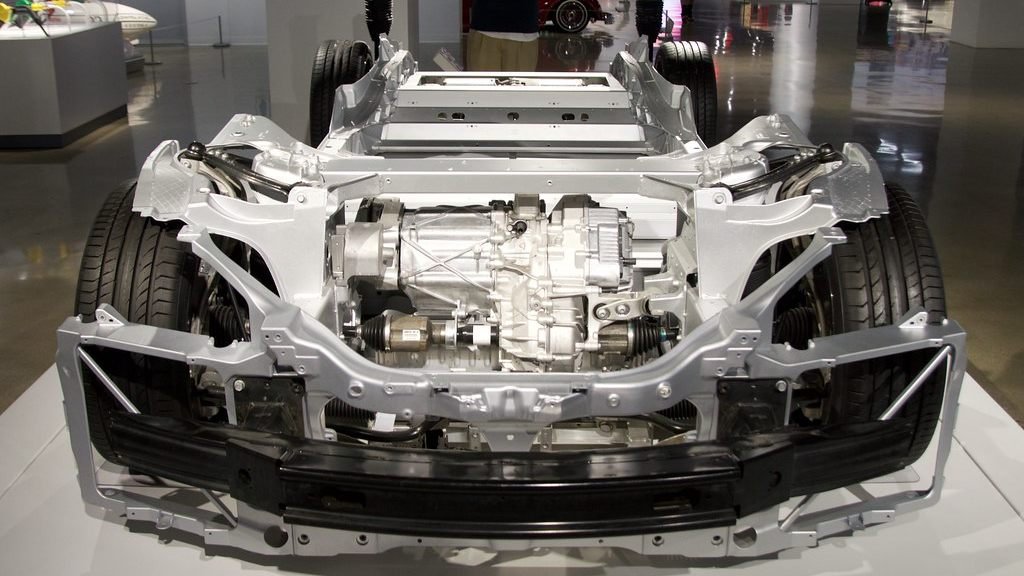
Tesla’s NEW Motor Is a BOMBSHELL! EV Rivals completely OUTCLASSED: The electric vehicle industry has spent billions of dollars improving battery technology, charging infrastructure, and vehicle design. However, one critical component has often received less attention than batteries: the electric motor. While battery packs dominate EV headlines, the motor, inverter, cooling system, and transmission play equally important roles in determining a vehicle’s performance, efficiency, weight, cost, and reliability.
Now, a reported next-generation Tesla drive unit known as the “Halo Drive” is attracting attention because of its ambitious engineering targets. According to the claims surrounding the design, this compact motor weighs just 46 pounds, delivers up to 480 horsepower, operates without rare earth permanent magnets, achieves more than 97% peak efficiency, and eliminates 108 components compared with a conventional drive unit.
If these specifications are independently verified and successfully translated into mass production, the technology could challenge established assumptions about electric motor design. Here is a closer look at the reported Tesla Halo Drive, its potential engineering breakthroughs, and what it could mean for the future of electric vehicles.
Tesla Halo Drive: A New Direction for EV Motor Technology
For years, automakers have focused on increasing battery energy density and reducing charging times. Yet improving the electric motor can also make EVs more affordable, efficient, and easier to manufacture.
The reported Tesla Halo Drive aims to address several challenges simultaneously. Its proposed architecture combines a compact motor design, a rare-earth-free electromagnetic system, and simplified component integration.
Rather than relying exclusively on conventional permanent magnet technology, the concept reportedly uses an electrically excited rotor. This approach could allow engineers to adjust the magnetic field according to driving conditions while reducing dependence on materials with concentrated global supply chains.
However, the Halo Drive specifications remain reported figures that require independent confirmation. Tesla’s official technical documentation and verified production data would be needed to establish whether the system performs as claimed.
The Rare Earth Problem: Why Tesla Could Eliminate Permanent Magnets
One of the biggest challenges facing the electric motor industry is its dependence on rare earth elements.
High-performance permanent magnet motors commonly use materials such as neodymium, praseodymium, dysprosium, and terbium. These elements help produce strong magnetic fields in compact motors, supporting high torque and excellent efficiency.
China’s Influence on the Rare Earth Supply Chain
China plays a major role in global rare earth mining, separation, refining, and permanent magnet manufacturing. This concentration creates potential risks for automakers, including export restrictions, geopolitical tensions, supply shortages, and price fluctuations.
For manufacturers producing millions of electric vehicles, material availability can directly influence production costs and long-term planning.
Although alternative motor technologies already exist, permanent magnet designs remain attractive because of their high power density and efficiency.
A motor that delivers comparable performance without rare earth permanent magnets could provide Tesla with greater supply chain flexibility and reduce exposure to volatile material markets.
How a Rare Earth-Free Motor Could Work
Instead of relying on permanent magnets, an electrically excited motor generates its magnetic field through energized copper windings.
This arrangement offers a potential advantage: the magnetic field can be adjusted during operation. Engineers can optimize the field for different driving conditions, potentially reducing electrical losses at high speeds.
The challenge is achieving this flexibility without introducing excessive weight, heat, manufacturing complexity, or additional energy consumption.
Axial Flux Architecture: A Different Way to Generate Power
The second major innovation attributed to the Halo Drive is its reported axial flux motor architecture.
Most conventional automotive electric motors use radial flux designs. In these motors, the rotor spins inside or around the stator, with magnetic flux passing predominantly across the radial gap between them.
Axial flux motors take a different approach.
Disk-Shaped Design and Torque Advantages
An axial flux motor arranges its active electromagnetic components in a disk-like configuration. Magnetic flux travels primarily along the axis of rotation, allowing the motor to achieve a relatively thin profile.
This geometry can offer several benefits:
- Compact packaging: A flatter design may fit into applications where space is limited.
- High torque density: Active electromagnetic forces can act at relatively large distances from the central axis.
- Potential weight savings: An optimized design may reduce the amount of material required for a given performance target.
- Flexible integration: Compact dimensions could help engineers rethink the arrangement of motors and other drivetrain components.
These advantages make axial flux technology attractive for electric cars, performance vehicles, aircraft, and industrial equipment.
The Engineering Challenges Behind Axial Flux Motors
Despite their promise, axial flux motors are difficult to manufacture reliably at automotive scale.
Strong magnetic forces can pull or push opposing components together. Engineers must maintain precise air gaps, manage bearing loads, control vibration, and prevent excessive heat buildup.
Manufacturing tolerances are especially important because even small dimensional changes can affect performance and reliability.
For a vehicle expected to operate for many years, Tesla would need to demonstrate that the design can withstand repeated acceleration, high rotational speeds, temperature changes, and long-term wear.
Contactless Energy Transfer: The Key to a Brushless Rotor
Eliminating permanent magnets creates another engineering challenge: how to supply electricity to a rotating rotor.
The reported Halo Drive addresses this problem through an electrically excited wound rotor and a contactless energy transfer system.
Why Conventional Brushes and Slip Rings Can Be a Problem
Some electrically excited motors use brushes and slip rings to transfer current to rotating components. Although this method can work effectively, physical contact introduces wear, friction, maintenance requirements, and potential reliability concerns.
For modern EVs, automakers generally want drive units that operate for years with minimal servicing.
A contactless system could help address these limitations.
How a Contactless Rotary Transformer Works
A rotary transformer transfers electrical energy between stationary and rotating components through electromagnetic coupling rather than direct electrical contact.
In principle, this resembles wireless charging: energy crosses a small physical gap through a changing magnetic field.
The reported Halo Drive concept describes a gap of approximately 1 millimeter between the relevant components. Maintaining efficient energy transfer across such a gap while the rotor spins at high speed would require careful electromagnetic, thermal, and mechanical engineering.
The source material also attributes approximately 3.5 years of development, 40 design attempts, and more than 2,000 failed tests to the development process. These figures should be treated as unverified claims unless supported by reliable technical documentation.
If the contactless system proves durable and efficient, it could eliminate a major wear point while enabling precise control over rotor excitation.
Tesla Halo Drive Specifications: What the Numbers Could Mean
The reported specifications are impressive, but understanding them requires more than looking at headline figures.
| Reported specification | Potential significance |
|---|---|
| 46-pound weight | Could reduce drivetrain mass if it represents a complete, production-ready drive unit. |
| 480 horsepower | Equivalent to approximately 358 kW of power output. |
| More than 97% efficiency | Could reduce energy losses under the conditions where this efficiency is achieved. |
| No rare earth permanent magnets | Could reduce dependence on rare earth magnet supply chains. |
| 108 fewer components | Could simplify assembly, inventory, and potential maintenance requirements. |
Is 480 Horsepower From a 46-Pound Motor Realistic?
The claimed combination of 480 horsepower and 46 pounds implies an extraordinary power-to-weight ratio.
However, the most important question is what the weight measurement includes. A bare motor is not equivalent to a complete drive unit containing the inverter, housing, cooling system, bearings, and reduction gearing.
A fair comparison would require the same measurement boundaries for competing products, alongside information about peak power duration, continuous output, operating temperature, and durability.
What Does More Than 97% Efficiency Mean?
Electric motor efficiency describes how much electrical energy is converted into useful mechanical output rather than lost, primarily as heat.
If the reported efficiency exceeds 97% under specified operating conditions, it would indicate low energy losses at that operating point. However, peak efficiency is not the same as efficiency throughout a drive cycle.
Real-world performance depends on speed, torque, temperature, inverter losses, cooling demands, and other factors.
A comprehensive efficiency map would therefore be more informative than a single headline percentage.
Eliminating 108 Components: A Manufacturing Advantage?
The reported reduction of 108 components could be as important as the motor’s power output.
Every component can add manufacturing steps, assembly time, inventory requirements, and possible failure points. Simplifying the drivetrain may help reduce production costs and improve manufacturing consistency.
Fewer parts, however, do not automatically guarantee lower costs or greater reliability. New components may require more expensive materials, tighter tolerances, or sophisticated manufacturing equipment.
The ultimate advantage would depend on production volume, assembly complexity, serviceability, and long-term performance.
How the Halo Drive Could Affect Tesla and Its EV Rivals
If the reported design becomes commercially viable, its impact could extend beyond Tesla.
Competitors may explore similar rare-earth-free motors, axial flux architectures, and contactless rotor excitation systems. Suppliers could also face greater pressure to develop compact, efficient drive units that use fewer materials and manufacturing steps.
For consumers, the potential benefits include lighter vehicles, improved energy efficiency, lower production costs, and potentially greater driving range. However, these outcomes would depend on how successfully the technology integrates with the battery, inverter, thermal management system, and overall vehicle platform.
The reported specifications alone do not establish that rival EV powertrains have been outclassed. Independent testing and comparable production data would be necessary to determine the actual competitive advantage.
Conclusion: Is Tesla’s Halo Drive the Future of Electric Motors?
Tesla’s reported Halo Drive presents an ambitious vision for next-generation EV powertrain engineering. Its proposed combination of axial flux geometry, rare-earth-free rotor excitation, contactless energy transfer, and component reduction targets several important challenges in electric vehicle manufacturing.
The reported figures—46 pounds, 480 horsepower, more than 97% efficiency, and 108 fewer components—would be significant if independently validated under clearly defined testing conditions.
For now, the technology should be viewed as a promising but unverified development rather than a confirmed production breakthrough. Official technical disclosures, independent efficiency testing, complete drive-unit weight measurements, and evidence of high-volume manufacturing will determine whether it can deliver on its ambitious claims.
If the design ultimately proves reliable, affordable, and scalable, it could encourage a new wave of innovation in electric motors and reshape how automakers approach the next generation of electric vehicles.
FAQs
- What is Tesla’s Halo Drive motor?
The Tesla Halo Drive is a reportedly next-generation electric motor concept designed to improve power density, efficiency, and manufacturing simplicity while eliminating the need for rare earth permanent magnets. Its specifications have not been independently verified.
- How much horsepower does the Tesla Halo Drive reportedly produce?
The reported Halo Drive is claimed to produce 480 horsepower, equivalent to approximately 358 kW. Independent testing would be needed to confirm this output and establish whether it represents peak or continuous power.
- How much does the Tesla Halo Drive weigh?
The reported motor weighs approximately 46 pounds. However, it is unclear whether this figure includes the inverter, housing, cooling system, and reduction gearing.
- Does the Tesla Halo Drive use rare earth magnets?
According to the reported design, the Halo Drive operates without rare earth permanent magnets. Instead, it reportedly uses an electrically excited rotor to generate a controllable magnetic field.
- What are the benefits of a rare-earth-free electric motor?
A rare-earth-free motor could reduce dependence on materials such as neodymium, praseodymium, dysprosium, and terbium. It could also help automakers manage supply chain risks, material price fluctuations, and geopolitical uncertainty.
- What is an axial flux motor?
An axial flux motor uses a disk-shaped configuration in which magnetic flux travels primarily along the motor’s rotational axis. This design can provide a compact shape and high torque density compared with some conventional radial flux motors.
- How is an axial flux motor different from a radial flux motor?
A radial flux motor typically uses cylindrical rotor and stator arrangements, with magnetic flux crossing a radial gap. An axial flux motor uses disk-like components and magnetic flux directed along the rotational axis, potentially allowing a thinner motor package.
- How does the Halo Drive reportedly generate a magnetic field without permanent magnets?
The reported design uses an electrically excited wound rotor. Electrical current passes through copper windings to create a magnetic field that can be adjusted according to operating conditions.
- What is a contactless rotary transformer?
A contactless rotary transformer transfers electrical energy between stationary and rotating components through electromagnetic coupling. It can supply power to a rotating rotor without relying on conventional brushes or direct electrical contacts.
- Why is contactless energy transfer important for electric motors?
Contactless energy transfer can reduce friction-related wear, eliminate brush maintenance, and improve the reliability of electrically excited motors. Its practical benefits depend on transfer efficiency, heat management, manufacturing precision, and long-term durability.
- Is the Tesla Halo Drive reportedly more than 97% efficient?
The reported specifications claim more than 97% efficiency. However, peak efficiency does not mean the motor maintains that level under every driving condition. Independent testing across different speeds and torque levels is needed to verify the claim.
- What does eliminating 108 components mean for Tesla?
The reported reduction of 108 components could simplify assembly, reduce inventory requirements, and lower the number of potential failure points. Actual manufacturing savings would depend on production costs, component complexity, and reliability testing.
- Could the Tesla Halo Drive improve electric vehicle range?
Potentially, yes. If the motor reduces energy losses and drivetrain weight, it could help improve electric vehicle efficiency and driving range. The actual improvement would depend on the complete vehicle design and real-world driving conditions.
- Could Tesla use the Halo Drive in future electric vehicles?
If the reported technology is developed successfully, it could potentially be considered for future Tesla electric cars or other electric powertrain applications. However, there is insufficient verified information to confirm which vehicles, if any, will use this motor.
- Will the Tesla Halo Drive make competing EV motors obsolete?
Not necessarily. Competing motors offer different advantages in cost, durability, efficiency, power density, and manufacturing scalability. The Halo Drive would need to demonstrate its performance through independent testing and mass-production results before its competitive position could be established.
- Is the Tesla Halo Drive officially confirmed, and when could it launch?
The specifications described in reports about the Halo Drive have not been independently verified here, and a confirmed production launch date is not established. Official Tesla announcements, technical documentation, and verified production vehicles would be needed to confirm its status and availability.
Read More:
- Tesla has a Cybercab problem nobody saw coming
- Tesla Cybercab’s unorthodox paint process explained
- Starlink is ‘biggest competitive advantage,’ but it’s temporary, United CEO says
- Starship B22 Static Fire Completed, Ready for First Booster V3 Catching in Weeks
- BIG Delivery NOW! Tesla Cybercab December Timeline REVEALED