
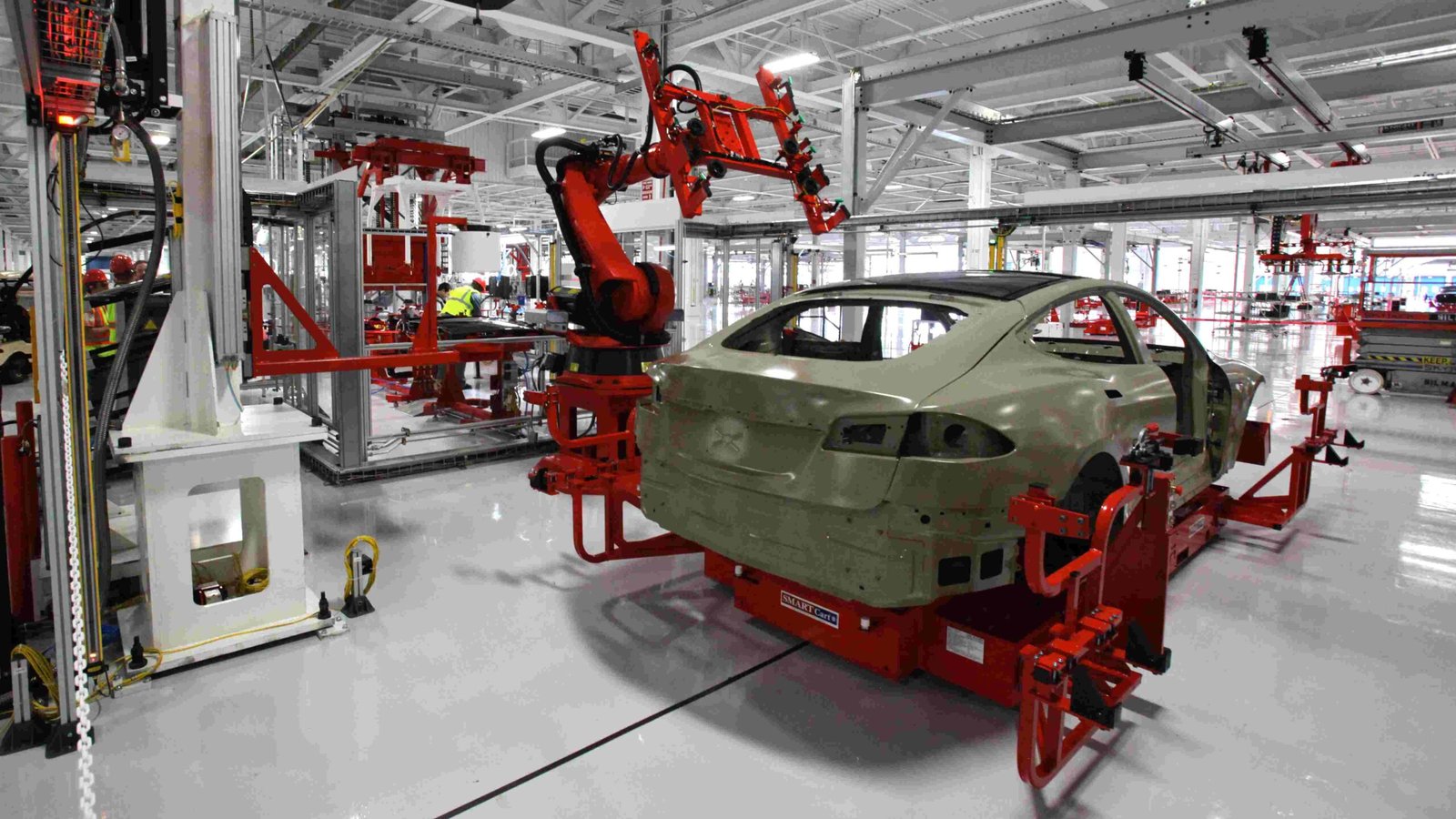
INSIDE Tesla’s NEW 4.0 Assembly Production Line! MASSIVE UPGRADE: Tesla is preparing to revolutionize automotive manufacturing with its next-generation 4.0 Assembly Production Line, an ambitious production system designed to build vehicles in just 10 seconds, with a long-term target of only 5 seconds per vehicle. At the center of this manufacturing transformation is the futuristic Tesla Cyber Cab, which is helping the company rethink how vehicles are designed, assembled, and produced at Gigafactory Texas.
Unlike traditional automotive factories that depend on long, sequential assembly lines, Tesla’s redesigned Unboxed Manufacturing System focuses on parallel production, large aluminum castings, simplified vehicle architecture, and advanced automation. The strategy aims to reduce factory space by approximately 40%, lower labor costs by around 30%, and shorten assembly lines by nearly half.
If Tesla successfully achieves these ambitious targets, its new manufacturing approach could establish a completely different standard for the global automotive industry.
H2: Why Tesla Is Rebuilding Traditional Car Manufacturing
For decades, automotive manufacturers have relied on a similar production process. Hundreds of individual metal components are stamped, welded together, painted, and transported through different factory departments before becoming a finished vehicle.
The process usually begins in the stamping department, where metal sheets are shaped into body panels. These components then move into the body shop, where robotic equipment welds them together to create the vehicle structure.
Afterward, the body enters the paint shop before reaching final assembly. At this stage, manufacturers install wiring, windows, seats, dashboards, doors, braking systems, heating, and cooling equipment.
Although this approach has supported large-scale automobile production, it creates several manufacturing challenges.
Sequential Production Creates Bottlenecks
Traditional assembly lines depend heavily on individual production stations. If one station experiences a delay, the following operations can also slow down.
This creates bottlenecks that limit the speed of the entire factory.
Large Factories Require More Space
Conventional manufacturing requires extensive floor space for stamping equipment, welding robots, paint facilities, material storage, and transportation systems.
Tesla wants to eliminate unnecessary production stages and reduce the distance between manufacturing operations.
Traditional Cycle Times Limit Production Speed
Certain Model Y assembly operations have been associated with cycle times of approximately 34 seconds. Tesla believes that simply making existing production lines faster is not enough.
Instead, the company is redesigning the manufacturing process from the ground up.
H2: Tesla’s Unboxed Manufacturing System Changes Everything
One of the biggest innovations behind Tesla’s 4.0 production strategy is its Unboxed Manufacturing System.
Rather than constructing an entire vehicle around a single body shell, Tesla divides the vehicle into multiple independent sections. These sections can be manufactured simultaneously before being connected during the final production process.
The major modules include:
- Front structural section
- Rear structural section
- Left and right side sections
- Roof structure
- Structural battery pack
- Interior and seating components
This approach allows multiple manufacturing operations to happen in parallel instead of waiting for one stage to finish before beginning another.
Parallel Assembly Improves Manufacturing Efficiency
In traditional factories, workers and robots often install components after the vehicle body has passed through several production stages.
Tesla’s unboxed approach allows interior components and seating to be installed earlier, while individual vehicle sections remain accessible.
This provides robots and workers with better access from multiple directions.
As a result, Tesla can potentially reduce complicated assembly operations, eliminate unnecessary movements, and make production lines significantly shorter.
The company is targeting approximately 50% shorter assembly lines, which could help reduce factory construction costs and improve manufacturing flexibility.
H2: Massive Aluminum Castings Reduce Hundreds of Components
Another important part of Tesla’s manufacturing upgrade is its use of large-scale aluminum casting technology.
Instead of manufacturing dozens of small metal components and welding them together, Tesla uses enormous casting machines to create larger structural pieces in a single operation.
The company has discussed casting equipment approaching 50,000 tons of clamping force.
This technology can simplify vehicle structures by reducing the number of individual components, welding operations, and assembly requirements.
How Tesla’s Aluminum Casting Process Works
The casting process involves several important stages.
1. Aluminum Melting
Aluminum is heated to approximately 850°C until it becomes molten. Impurities are removed before the material is transferred into a holding furnace operating around 750°C to 850°C.
2. High-Pressure Injection
The molten aluminum is injected into a specially designed mold under enormous pressure. The mold determines the shape of the structural component.
3. Cooling and Solidification
After injection, the casting cools and solidifies. Although the temperature decreases, the finished component can remain extremely hot, approaching 400°C during parts of the cooling process.
4. Recycling and Quality Inspection
Excess aluminum is collected for recycling, helping reduce material waste. Finished castings can also undergo X-ray inspections to identify internal defects that cannot be detected through ordinary visual checks.
This process helps Tesla simplify vehicle construction while maintaining the structural precision required for mass production.
H2: Tesla Wants to Eliminate Traditional Paint Shops
Tesla is also exploring a different approach to vehicle exterior panels.
Traditional automotive factories use extensive paint shops to apply multiple layers of coatings to vehicle bodies. These operations consume energy, require specialized equipment, and can generate volatile organic compound emissions.
Tesla’s proposed solution involves reaction injection molding, using polyurethane materials to produce exterior panels with color integrated throughout the material.
Color-Molded Panels Offer Several Advantages
Because the color extends through the material, minor scratches may be less noticeable than scratches on conventional painted surfaces.
This could be particularly useful for the Cyber Cab, which is designed for future autonomous ride-hailing operations.
Fleet operators need vehicles that can remain attractive while minimizing maintenance costs and downtime.
Pre-colored replacement panels could also simplify repairs because damaged components may not require conventional repainting.
By reducing or eliminating certain paint shop operations, Tesla could potentially save factory space, energy, and production time.
H2: Tesla’s Rare-Earth-Free Drive Unit Is Another Major Upgrade
The manufacturing transformation extends beyond the vehicle body.
Tesla is also developing a rare-earth-free electric drive unit designed to reduce dependence on materials such as neodymium and dysprosium.
These elements are commonly used in permanent-magnet electric motors. However, their supply chains can create cost and availability challenges for automotive manufacturers.
By eliminating rare earth elements, Tesla wants to develop a more sustainable and supply-chain-independent electric powertrain.
Smaller and Lighter Electric Motors
According to the reported specifications, Tesla’s redesigned drive unit could be approximately 18% smaller and 25% lighter than its predecessor.
The design reportedly incorporates a simplified bar-wound stator and optimized lubrication.
These improvements are intended to reduce complexity while supporting faster manufacturing.
Tesla is also targeting a production cycle of approximately 10 seconds per drive unit.
If achieved at scale, this could help the company manufacture electric powertrains more efficiently while reducing production costs.
H2: Tesla Cyber Cab Is the Perfect Vehicle for the New Factory
The Tesla Cyber Cab is central to this manufacturing strategy because its design is much simpler than that of a conventional passenger vehicle.
It features two seats and is designed without a traditional steering wheel or conventional pedals.
Its simplified architecture reportedly requires fewer than half the parts of a Model 3.
Fewer components mean fewer assembly operations, less material handling, and potentially fewer opportunities for manufacturing delays.
The Cyber Cab’s design also supports Tesla’s broader autonomous transportation ambitions.
By combining vehicle simplification with unboxed production, Tesla wants to create a manufacturing system that can produce large numbers of vehicles with fewer resources.
H2: Tesla’s New 4.0 Production Line: Key Targets
| Manufacturing Category | Reported Target or Specification |
|---|---|
| Initial vehicle production cycle | 10 seconds |
| Long-term production goal | 5 seconds |
| Factory space reduction | Approximately 40% |
| Labor cost reduction | Approximately 30% |
| Assembly line reduction | Approximately 50% |
| Manufacturing speed ambition | Up to 5 times faster |
| Casting machine capability | Approaching 50,000 tons |
| Drive unit size reduction | Approximately 18% |
| Drive unit weight reduction | Approximately 25% |
| Drive unit production cycle | Approximately 10 seconds |
H2: Can Tesla Really Build a Vehicle Every Five Seconds?
Tesla’s long-term ambition of producing a vehicle every five seconds is extremely ambitious.
Achieving this target would require significant improvements across robotic automation, component manufacturing, material handling, quality inspection, and final assembly.
The biggest challenge is ensuring that every production module operates reliably and consistently at extremely high speeds.
Even a small manufacturing defect or equipment failure could disrupt the entire production system.
Tesla must also demonstrate that its new casting technology, molded panels, and rare-earth-free motors can deliver the durability and quality expected from mass-produced vehicles.
Importantly, the reported production figures represent design targets and manufacturing ambitions, not independently verified results from sustained full-scale production.
H2: The Future of Automotive Manufacturing
Tesla’s 4.0 Assembly Production Line represents a major shift in how the company approaches vehicle manufacturing.
Instead of relying on traditional production methods, Tesla is combining unboxed assembly, massive aluminum castings, color-molded panels, simplified vehicle architecture, and rare-earth-free motors into one integrated manufacturing strategy.
The Cyber Cab is more than a new autonomous vehicle. It is also an opportunity for Tesla to demonstrate how a simpler vehicle can be manufactured using fewer components, less factory space, and potentially less labor.
If the company successfully delivers on its ambitious production targets, the impact could extend far beyond Tesla.
Other automakers may eventually need to rethink their own manufacturing strategies to compete with faster, more flexible, and more cost-efficient production systems.
For now, the biggest question is whether Tesla can turn its impressive manufacturing vision into consistent, high-volume production. The answer could shape the future of the entire automotive industry.
FAQs
1. What is Tesla’s new 4.0 Assembly Production Line?
Tesla’s new 4.0 Assembly Production Line is an advanced manufacturing system designed to produce vehicles faster using unboxed assembly, massive aluminum castings, automation, and simplified vehicle architecture.
2. What is Tesla’s target vehicle production time?
Tesla is targeting an initial production cycle of 10 seconds per vehicle, with a long-term ambition of reducing the cycle to just 5 seconds.
3. What is Tesla’s Unboxed Manufacturing System?
The Unboxed Manufacturing System is a production method that divides a vehicle into multiple independent sections. These sections are manufactured simultaneously and assembled together during the final production process.
4. Why is Tesla using the Cyber Cab for its new manufacturing strategy?
The Tesla Cyber Cab features a simplified design with two seats and no traditional steering wheel or conventional pedals. Its architecture reportedly requires fewer than half the parts of a Model 3, making it suitable for faster and more efficient manufacturing.
5. How much factory space could Tesla save with its new production system?
Tesla’s redesigned manufacturing approach targets approximately 40% less factory space compared with conventional production methods.
6. How much could Tesla reduce manufacturing labor costs?
Tesla is targeting approximately 30% lower labor costs through simplified vehicle architecture, parallel assembly, and advanced automation.
7. How does parallel assembly improve Tesla’s production efficiency?
Parallel assembly allows different vehicle sections, including the front structure, rear structure, roof, and battery pack, to be manufactured simultaneously. This reduces waiting time and minimizes production bottlenecks.
8. What are Tesla’s massive aluminum casting machines used for?
Tesla uses large aluminum casting machines to manufacture major vehicle structures as single components instead of assembling dozens of smaller stamped and welded parts.
9. How powerful are Tesla’s new aluminum casting machines?
Tesla has discussed casting machines approaching 50,000 tons of clamping force, allowing large structural components to be produced through high-pressure aluminum casting.
10. How does Tesla’s color-molded exterior panel technology work?
Tesla is exploring reaction injection molding using polyurethane, allowing color to be integrated throughout the exterior panel material instead of relying entirely on traditional surface paint.
11. Why does Tesla want to reduce or eliminate traditional paint shops?
Reducing paint shop operations could lower energy consumption, factory space requirements, production costs, and VOC emissions. Pre-colored panels could also make repairs easier for autonomous ride-hailing fleets.
12. What is Tesla’s rare-earth-free drive unit?
Tesla’s rare-earth-free drive unit is an electric motor design intended to eliminate materials such as neodymium and dysprosium, reducing dependence on concentrated rare-earth supply chains.
13. How much smaller and lighter is Tesla’s redesigned drive unit?
According to the reported specifications, the redesigned drive unit is approximately 18% smaller and 25% lighter than its predecessor.
14. How quickly does Tesla want to manufacture its new electric drive units?
Tesla is targeting a production cycle of approximately 10 seconds per drive unit, supported by a simplified bar-wound stator and optimized lubrication system.
15. How much faster could Tesla’s new manufacturing system become compared with traditional production?
Tesla’s manufacturing strategy reportedly targets production speeds of up to five times faster than traditional automotive manufacturing, although this remains an ambitious target rather than a verified full-scale result.
16. When could Tesla’s new 4.0 Assembly Production Line transform the automotive industry?
If Tesla successfully implements its manufacturing strategy at scale, it could influence the automotive industry through faster production, lower manufacturing costs, smaller factories, fewer vehicle components, and improved automation. However, its long-term success will depend on achieving consistent production quality and reliability.
Read More:
- Elon Musk FINALLY Revealed NEW Tesla Hydrogen Car
- 2027 Tesla Model 2 $15,990 Finally Here! Elon Musk Confirms New Chassis Changing All Industry
- No Catch, No Landing! SpaceX’s BIZARRE Plan for Starship Flight 16
- The Tesla Semi 2027 Takeover Has Begun
- SpaceX rejects $738M fed subsidy, betting on Starlink alone
1 thought on “INSIDE Tesla’s NEW 4.0 Assembly Production Line! MASSIVE UPGRADE”