
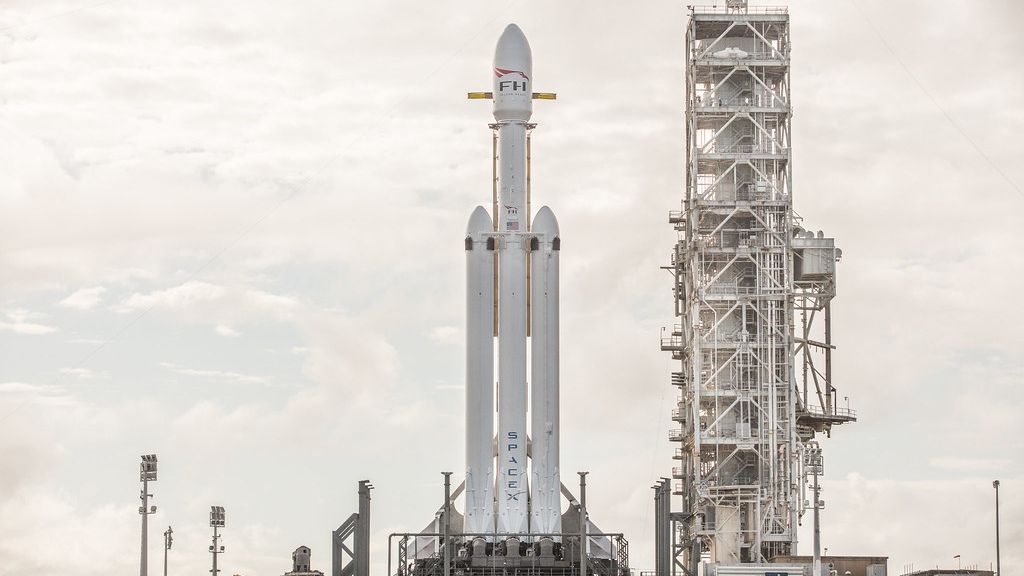
The aerospace industry is once again holding its breath as one of the most powerful rockets ever built makes a dramatic return. After nearly 18 months of silence, the Falcon Heavy is back on the launchpad, ready to remind the world why it once dominated heavy-lift missions. But this isn’t just a comeback story—it’s a signal of something much bigger unfolding behind the scenes.
While Florida prepares for a thunderous liftoff, South Texas is rapidly evolving into a futuristic production hub that could redefine space travel forever. From cutting-edge infrastructure to ambitious goals like producing 10,000 ships per year, this moment represents a turning point not only for SpaceX but for humanity’s future beyond Earth.
The Return of Falcon Heavy: A Giant Awakens
After a long hiatus, the Falcon Heavy has returned, standing tall once again against the Florida skyline. Often referred to as the “older sibling” of newer rockets, its comeback carries both nostalgia and renewed purpose.
The last time this rocket launched, the Starship program was still in its early stages. Since then, SpaceX has advanced through multiple generations of spacecraft design. Yet despite all that progress, the Falcon Heavy still holds a critical role in missions that demand unmatched power and reliability.
This return is more than symbolic—it’s strategic. It shows that even as newer technologies emerge, proven systems remain essential in bridging today’s capabilities with tomorrow’s ambitions.
Mission Overview: Viasat-3 F3 and Global Connectivity
Completing a Global Vision
The Falcon Heavy’s mission is clear: deliver the Viasat-3 F3 satellite into orbit. This satellite is not just another payload—it’s a crucial piece of a global network designed to bring high-speed internet to underserved regions.
With previous launches covering the Americas and the Middle East, this mission focuses on the Asia-Pacific region, effectively completing a worldwide connectivity grid.
Why This Matters
In today’s digital age, internet access is no longer a luxury—it’s a necessity. Expanding connectivity means:
- Enabling education in remote regions
- Supporting economic growth
- Enhancing communication infrastructure
- Bridging the digital divide
The Falcon Heavy’s return directly contributes to this transformation, proving that space technology plays a vital role in everyday life on Earth.
Launch Day Breakdown: A High-Tech Ballet
A Falcon Heavy launch is not just an event—it’s a carefully orchestrated sequence of precision engineering.
T-Minus 90 Minutes: Fueling Begins
The process starts with loading RP-1, a refined kerosene fuel, into the rocket’s first stage. This step sets the foundation for everything that follows.
T-Minus 45 Minutes: Liquid Oxygen Loading
Next comes liquid oxygen (LOX), stored at an extremely cold -300°F. Timing is critical here. Load it too early, and it evaporates. Load it too late, and you risk delays.
This delicate balance is why engineers treat LOX with extreme care—it’s both essential and unpredictable.
Engine Chill: Preventing Thermal Shock
Before ignition, the engines undergo a chilling process to match the temperature of the super-cooled fuel. Without this step, the sudden temperature difference could cause catastrophic damage.
Ignition: 27 Engines Roar to Life
At liftoff, all 27 Merlin engines ignite simultaneously, generating an immense amount of thrust. The result is a spectacle of power that shakes the ground and lights up the sky.
The Changing Landscape of Booster Recovery
One of the most iconic aspects of Falcon Heavy launches has been its synchronized booster landings. However, this mission marks a shift in how SpaceX approaches recovery.
Side Boosters: Still Returning Home
The two side boosters are expected to return safely to landing zones, showcasing the precision and reusability that SpaceX is known for.
The End of Drone Ship Glory?
In a surprising move, SpaceX has reduced its reliance on drone ships for Falcon missions. One of its key landing platforms is being reassigned to support the Starship program.
This change signals a shift in priorities—away from older systems and toward the next generation of space travel.
Center Core: A Sacrificial Role
Unlike previous missions, the center core in this launch will not be recovered. Instead, it will be expended after completing its task.
While this may seem like a step backward, it actually reflects mission requirements. Sometimes, maximizing payload capacity outweighs the benefits of reusability.
Starbase: The Birthplace of the Future
While Falcon Heavy commands attention in Florida, something even more revolutionary is happening in South Texas.
Starbase is no longer just a testing ground—it’s becoming a high-speed production facility designed for scale.
Rapid Hardware Development
Booster 20: Ready for Action
The completion of Booster 20 marks a significant milestone. Its final section has been delivered, signaling readiness for upcoming operations.
Ship 41: A Historic First
Ship 41 is expected to achieve something never done before—being caught mid-air by mechanical arms known as Mechazilla.
If successful, this will redefine how rockets are recovered, eliminating the need for landing legs and reducing turnaround time.
Ship 40: Awaiting Testing
Another vehicle, Ship 40, is currently undergoing preparations for cryogenic and engine testing. Each of these ships represents incremental progress toward a fully operational fleet.
Fuel Infrastructure Transformation
Observers have noticed intense activity around Starbase’s fuel systems. Large tanks are being relocated, possibly to support operations in other regions or to make way for larger, more advanced storage units.
This isn’t random—it’s preparation for the next phase of rocket evolution.
Why Bigger Tanks Matter
The latest booster designs require significantly more fuel. In fact, recent tests have demonstrated record-breaking fueling times, indicating improvements in efficiency and scalability.
A Tribute to Hubble: 36 Years of Discovery
Amid all the excitement, the space community recently celebrated the 36th anniversary of the Hubble Space Telescope.
A Stunning New Perspective
A high-resolution image captured from just 34.8 miles away revealed incredible details of Hubble’s structure, including:
- Its cylindrical body
- Reflective surfaces
- Solar arrays
This image serves as a reminder of how far we’ve come in space observation.
Still Going Strong
Despite its age, Hubble continues to deliver groundbreaking discoveries. Scientists remain optimistic that it will keep operating well into the next decade.
The Bigger Picture: Toward 10,000 Ships Per Year
Perhaps the most ambitious idea emerging from this moment is the concept of mass-producing spacecraft.
A New Industrial Revolution
The goal of producing up to 10,000 ships annually may sound unrealistic today, but it reflects a shift in thinking:
- Rockets as reusable vehicles, not disposable tools
- Space travel as routine, not rare
- Infrastructure built for scale, not experimentation
Refueling the Future
Advanced tanker versions of spacecraft are expected to carry massive amounts of propellant. This enables complex missions, such as lunar and interplanetary travel, with fewer launches.
Why This Moment Matters
The return of Falcon Heavy is not just about one rocket—it’s about transition.
- From experimental to operational
- From limited launches to high-frequency missions
- From Earth-focused technology to interplanetary ambition
This moment bridges the gap between what spaceflight has been and what it is about to become.
What Comes Next?
As the Falcon Heavy prepares for liftoff, several key questions emerge:
- Will the launch go flawlessly after such a long gap?
- How quickly will Starship take over heavy-lift duties?
- Can infrastructure keep up with ambitious production goals?
The answers will shape the next decade of space exploration.
Final Thoughts
The Falcon Heavy’s return is both a celebration and a turning point. It reminds us of the incredible engineering achievements that brought us here, while also pointing toward a future that feels almost science fiction.
With Starbase evolving at an unprecedented pace and ambitious goals on the horizon, we are witnessing the early stages of something transformative.
This isn’t just about rockets anymore. It’s about building the foundation for a civilization beyond Earth.
And if the vision of 10,000 ships per year becomes reality, then today’s launch may one day be remembered as the moment everything truly began.
FAQs
1. What is the Falcon Heavy rocket?
The Falcon Heavy is one of the most powerful heavy-lift rockets ever built, designed to carry large payloads into orbit and beyond.
2. Why is this Falcon Heavy launch significant?
This launch marks the rocket’s return after 18 months, signaling renewed focus on heavy-lift missions.
3. What is the Viasat-3 F3 satellite?
The Viasat-3 F3 satellite is part of a global internet network aimed at delivering high-speed connectivity to the Asia-Pacific region.
4. When is the Falcon Heavy launching?
The mission is scheduled for April 27, 2026, at 10:21 a.m. Eastern Time.
5. How many engines does Falcon Heavy have?
The Falcon Heavy uses 27 Merlin engines, generating massive thrust during liftoff.
6. What fuel does Falcon Heavy use?
It uses RP-1 (refined kerosene) and liquid oxygen (LOX) as its primary fuels.
7. Why is liquid oxygen so important?
LOX is critical for combustion but must be kept at extremely low temperatures, making it both essential and challenging to handle.
8. Will all boosters be recovered in this mission?
No, only the side boosters will return. The center core will be expended after completing its mission.
9. What happened to SpaceX drone ships?
Some drone ships are being reassigned to support the Starship program, reducing their use in Falcon missions.
10. What is Starbase?
Starbase is SpaceX’s advanced launch and production facility in South Texas, focused on building next-generation spacecraft.
11. What is special about Ship 41?
Ship 41 may become the first rocket to be caught mid-air by Mechazilla, a revolutionary recovery system.
12. What is Mechazilla?
Mechazilla is a mechanical arm system designed to catch rockets during landing, improving efficiency and reducing turnaround time.
13. Why are fuel tanks being moved at Starbase?
The relocation supports upgrades for larger rockets and improved fueling infrastructure for future missions.
14. What is the goal of producing 10,000 ships per year?
The goal reflects SpaceX’s vision of mass-producing spacecraft to make space travel routine.
15. How does this launch impact global connectivity?
It helps expand high-speed internet access to underserved regions, especially in the Asia-Pacific.
16. What role does Hubble play today?
The Hubble Space Telescope continues to deliver scientific discoveries and is expected to operate well into the next decade.
Read More:
- How NASA Will Send a Nuclear Powered Rocket to Mars
- Tesla Roadster NEW Bombshell | Elon Musk Finally LAUNCH!
- UPDATE: SpaceX’s Falcon Heavy that launched a Tesla into space is back on a mission
- Tesla expands Robotaxi in a way that was long anticipated
- Starship Flight 12 Secret Plan revealed Destroyed the entire rocket industry
1 thought on “SpaceX Falcon Heavy is Launching TODAY: Wake Up after 1,5 Years is Beyond You Expected”