
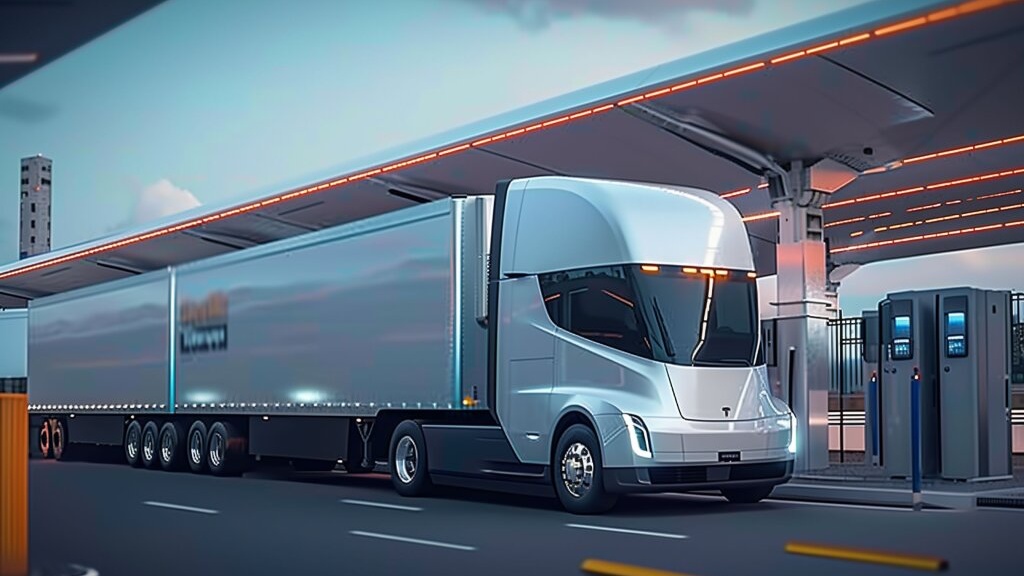
Tesla Semi’s Next Upgrade Will Change Truck Safety Forever: The commercial trucking industry powers the global economy by transporting billions of tons of goods every year. However, it also faces some of the most dangerous road safety challenges. Heavy-duty Class 8 trucks, weighing more than 33,000 pounds, require exceptional control, especially on icy, snowy, or wet roads.
One of the biggest dangers for truck drivers has always been jackknifing—a terrifying situation where the trailer swings sideways and folds toward the cab, often leading to catastrophic accidents.
Tesla is now aiming to change that forever.
During a 2026 demonstration, Tesla Semi Director Dan Priestley showcased a fully loaded 1,072-horsepower Tesla Semi maintaining remarkable stability on ice. According to Tesla, its advanced technology can reduce the risk of jackknifing by up to 70%, marking one of the biggest breakthroughs in commercial vehicle safety.
In this article, we’ll explore how the Tesla Semi achieves this incredible feat, why electric trucks have a major engineering advantage over diesel trucks, the lessons learned from Tesla’s first fatal Semi crash, and what lies ahead for autonomous freight transportation.
What Is Jackknifing and Why Is It So Dangerous?
Understanding the Physics Behind Truck Jackknifing
A jackknife accident happens when the tractor loses traction while the trailer continues moving forward. The trailer then pushes against the cab, causing both sections to fold into an acute angle similar to a folding pocketknife.
This typically occurs during:
- Ice-covered highways
- Snowy roads
- Heavy rain
- Sudden emergency braking
- Sharp cornering
When road friction drops dramatically, drivers often have only fractions of a second to regain control.
For traditional diesel trucks, recovery is incredibly difficult because their systems react after the vehicle begins sliding.
Tesla’s solution is completely different.
Tesla’s Mechatronic Advantage
Why Electric Trucks Respond Faster Than Diesel Trucks
The biggest advantage of the Tesla Semi isn’t simply its electric motors.
It’s the combination of software, high-speed sensors, and independent motor control working together as a single intelligent system.
Unlike conventional trucks that rely primarily on braking systems, Tesla continuously analyzes:
- Wheel speed
- Steering angle
- Yaw rate
- Lateral acceleration
- Tire slip
- Vehicle stability
These measurements are processed hundreds of times every second.
Instead of waiting until the truck loses control, Tesla predicts instability before it becomes dangerous.
That predictive capability is what gives the Semi its remarkable stability.
Real-World Winter Testing
Tesla Didn’t Use an Empty Trailer
One criticism often aimed at vehicle demonstrations is that manufacturers test with empty trailers that are much easier to control.
Tesla addressed this criticism directly.
During its winter tests, the Semi carried:
- Heavy concrete blocks positioned above the kingpin
- Steel bars distributed throughout the trailer
- A realistic commercial freight load
This setup simulated real hauling conditions rather than ideal laboratory testing.
Because the Tesla Semi is designed for a Gross Combination Weight Rating (GCWR) of up to 82,000 pounds, maintaining control with a fully loaded trailer demonstrates the effectiveness of its safety systems under real-world operating conditions.
Tesla Vehicle Dynamics Control (VDC)
The Secret Behind the 70% Reduction in Jackknifing
Traditional diesel trucks rely on Electronic Stability Control (ESC) and Anti-lock Braking Systems (ABS).
These systems work by:
- Detecting wheel slip.
- Applying the brakes.
- Attempting to regain traction.
While effective, they’re fundamentally reactive.
Brakes only remove speed.
They cannot intelligently redistribute engine power.
Tesla’s Vehicle Dynamics Control (VDC) works differently.
Instead of relying solely on braking, the Semi uses instantaneous torque vectoring.
Because each rear electric motor can be controlled independently, the truck can:
- Increase power to one side
- Reduce power on the opposite side
- Balance vehicle rotation
- Prevent the slide before it grows
This happens almost instantly.
Tesla claims its electric drivetrain reacts up to 40 times faster than conventional diesel powertrains.
That difference is crucial when driving on ice, where traction changes within milliseconds.
Why Electric Motors Offer Superior Stability
Torque Vectoring Changes Everything
Electric motors provide instant torque.
Unlike diesel engines, they don’t need gear changes or delayed mechanical responses.
This allows Tesla’s software to make tiny adjustments continuously without the driver even noticing.
Benefits include:
- Improved lane stability
- Reduced trailer sway
- Better cornering control
- Enhanced traction
- Lower jackknifing risk
This software-driven approach represents a major shift from traditional heavy truck engineering.
Tesla Semi’s First Fatal Crash
Human Error Remains the Biggest Challenge
Despite its advanced safety technology, the Tesla Semi was involved in its first fatal accident near Dayton, Nevada.
According to preliminary investigations, the truck was being operated manually.
Authorities believe the driver may have fallen asleep before the collision.
The truck struck two stationary passenger vehicles waiting at a traffic signal, resulting in two fatalities and one serious injury.
The incident highlighted an important reality:
Even the most advanced vehicle cannot eliminate every risk if the driver becomes incapacitated.
Was Tesla Full Self-Driving Involved?
Clearing Up the Confusion
Following the crash, many questioned whether Tesla’s autonomous software had failed.
Investigators quickly clarified that:
- Tesla Semi does not currently offer Full Self-Driving (FSD) for commercial fleets.
- The truck was under 100% manual driver control.
- Tesla continues internal testing of future autonomous trucking technologies.
Although some experimental Tesla Semis have been spotted testing autonomous systems in California, those vehicles remain part of closed development programs.
Commercial customers still operate their trucks manually with standard driver-assistance features.
Automatic Emergency Braking Under Investigation
Why Didn’t the Truck Stop Automatically?
The Nevada accident shifted attention toward Automatic Emergency Braking (AEB).
Modern AEB systems use:
- Forward-facing cameras
- Radar sensors
- Collision prediction software
If a driver fails to react, the vehicle should automatically apply maximum braking force.
However, Tesla has not publicly disclosed many technical details regarding the Semi’s AEB capabilities.
Unknown specifications include:
- Maximum detection distance
- Performance under 80,000-pound loads
- Braking thresholds
- Sensor fusion algorithms
Investigators continue analyzing telemetry data to determine whether the system attempted emergency braking or whether other factors limited its effectiveness.
AI Driver Fatigue Monitoring
The Next Major Safety Upgrade
Driver fatigue remains one of the leading causes of trucking accidents.
According to safety studies, thousands of fatal crashes each year involve drowsy driving.
Many fleet operators already use AI-powered monitoring systems capable of detecting:
- Eye closure
- Yawning
- Head nodding
- Microsleep
- Driver distraction
Tesla introduced driver drowsiness monitoring for passenger vehicles in 2023.
However, the company has not confirmed whether identical AI monitoring systems are active in production Tesla Semi trucks.
Many fleet operators now consider this one of the most anticipated future upgrades.
Tesla’s Massive Production Expansion
Building 50,000 Electric Trucks Per Year
Tesla’s Nevada manufacturing facility is preparing for large-scale production.
The company’s long-term goal is to manufacture 50,000 Tesla Semis annually.
Industry analysts currently expect yearly deliveries between 5,000 and 15,000 trucks during the production ramp.
One of Tesla’s greatest advantages is its over-the-air software ecosystem.
Every truck continuously sends:
- Performance data
- Sensor information
- Driving statistics
- Safety event logs
This allows Tesla engineers to improve safety systems through regular software updates without requiring physical modifications.
The Future of Autonomous Freight Transportation
Software Is Becoming the New Safety Standard
The Tesla Semi demonstrates that the future of trucking extends far beyond electric power.
Its microsecond torque vectoring, advanced Vehicle Dynamics Control, and software-based stability systems represent a significant leap beyond traditional diesel engineering.
Yet, the future of trucking safety will depend on combining multiple technologies, including:
- AI driver monitoring
- Automatic Emergency Braking
- Predictive traction control
- Autonomous driving systems
- Real-time software updates
Together, these innovations could dramatically reduce accidents while improving efficiency across the freight industry.
Conclusion
The Tesla Semi is proving that electric commercial trucks can offer far more than lower emissions and lower operating costs. Its intelligent Vehicle Dynamics Control, lightning-fast torque vectoring, and software-driven traction management demonstrate how modern engineering can significantly reduce the risk of dangerous jackknife accidents.
However, advanced technology alone cannot eliminate every hazard. Human factors such as driver fatigue, distraction, and delayed reactions remain major causes of crashes. That’s why future safety improvements—including AI-powered driver monitoring, enhanced Automatic Emergency Braking, and eventually autonomous driving—will play an equally important role.
As Tesla scales production and continuously improves its software through over-the-air updates, the Tesla Semi is positioned to become a benchmark for the next generation of commercial trucking. If these innovations continue to perform as promised, they could reshape freight transportation and establish a new global standard for truck safety, making highways safer for drivers and everyone sharing the road.
FAQs
1. What is the Tesla Semi?
The Tesla Semi is Tesla’s all-electric Class 8 commercial truck designed for long-haul freight transportation. It combines high performance, advanced safety systems, and zero tailpipe emissions.
2. What causes a truck to jackknife?
A jackknife accident occurs when the truck’s tractor loses traction while the trailer continues moving forward, causing the trailer to swing sideways and form an acute angle with the cab.
3. How does the Tesla Semi reduce the risk of jackknifing?
The Tesla Semi uses Vehicle Dynamics Control (VDC) and instant torque vectoring to continuously adjust power to each drive axle, helping maintain traction and stability before a skid develops.
4. What is torque vectoring?
Torque vectoring is a technology that independently controls the power sent to each wheel or axle, improving traction, cornering, and vehicle stability, especially on slippery roads.
5. How is Tesla’s VDC different from traditional ABS and ESC?
Traditional ABS (Anti-lock Braking System) and Electronic Stability Control (ESC) react after wheel slip occurs by applying the brakes. Tesla’s VDC predicts instability and adjusts motor torque almost instantly, preventing many skids before they happen.
6. Why are electric trucks more stable than diesel trucks?
Electric trucks respond much faster because electric motors can instantly increase or decrease torque without waiting for gear changes or engine response, allowing quicker corrections during slippery driving conditions.
7. How much weight can the Tesla Semi carry?
The Tesla Semi is engineered for a Gross Combination Weight Rating (GCWR) of up to 82,000 pounds, making it suitable for heavy commercial freight operations.
8. Did Tesla test the Semi with a full load?
Yes. Tesla demonstrated the Semi using a heavily loaded trailer with concrete blocks and steel bars to simulate realistic commercial freight rather than testing with an empty trailer.
9. Does the Tesla Semi currently support Full Self-Driving (FSD)?
No. Tesla does not currently offer Full Self-Driving (FSD) for commercial Tesla Semi fleet customers. The trucks are operated manually with standard driver-assistance features.
10. What happened in the Tesla Semi’s first fatal crash?
According to preliminary investigations, the truck was under manual control, and authorities believe driver fatigue may have contributed to the collision. The crash was not attributed to Tesla’s autonomous driving software.
11. What is Automatic Emergency Braking (AEB)?
Automatic Emergency Braking (AEB) is a safety system that detects potential collisions and automatically applies the brakes if the driver does not react in time.
12. Does the Tesla Semi have AI driver monitoring?
Tesla has not officially confirmed whether production Tesla Semi trucks include the same AI-based driver drowsiness monitoring system used in some of its passenger vehicles.
13. Why is driver fatigue a major concern in trucking?
Driver fatigue can slow reaction times, reduce awareness, and increase the risk of serious accidents. It remains one of the leading causes of fatal crashes involving commercial vehicles.
14. How many Tesla Semi trucks does Tesla plan to build annually?
Tesla aims to eventually produce up to 50,000 Tesla Semi trucks per year at its Nevada manufacturing facility as production scales.
15. Can Tesla improve the Semi after customers purchase it?
Yes. The Tesla Semi supports over-the-air (OTA) software updates, allowing Tesla to improve safety features, performance, and system functionality without requiring dealership visits.
16. Why is the Tesla Semi considered a breakthrough in truck safety?
The Tesla Semi combines electric powertrain technology, predictive Vehicle Dynamics Control, high-speed torque vectoring, and continuous software improvements to significantly enhance stability and reduce the likelihood of dangerous accidents like jackknifing.
Read More:
- NASA Seriously WARNING Big Problems in Starship Refueling! Here’s How SpaceX Solves
- The secret behind Tesla’s Cybercab Gold goes well beyond just the color
- Next-Gen Tesla Giga Press 4.0 Deleted All Welding Robots
- SpaceX Starship Flight 13’s New Launch Date Revealed! Test & Launch in Days, Is It Feasible
- SpaceX’s newest logo confirms everything about what it’s become