
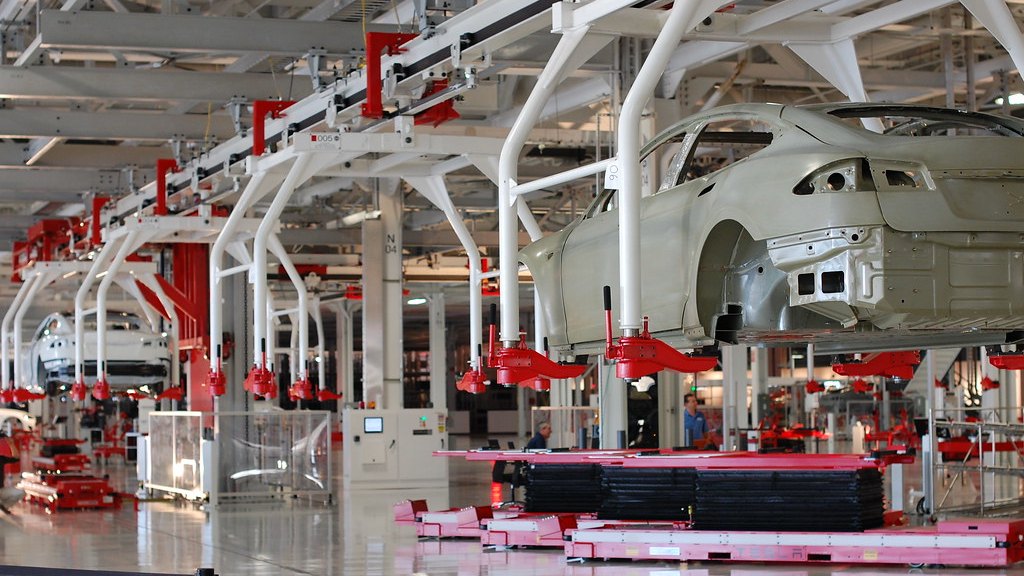
Next-Gen Tesla Giga Press 4.0 Deleted All Welding Robots: The global automotive industry is entering a new era where manufacturing innovation is becoming just as important as vehicle performance. For over a century, automakers built vehicles by assembling hundreds of stamped metal parts using thousands of welds, bolts, rivets, and robotic welding stations. While this method proved reliable, it also created complex production lines, higher costs, heavier vehicles, and longer manufacturing times.
Tesla is now changing that traditional formula with its revolutionary Giga Press 4.0 technology. Instead of joining hundreds of individual parts together, Tesla is replacing them with large single-piece aluminum castings, dramatically reducing the need for welding robots, assembly stations, and factory floor space.
In 2026, Tesla reportedly removed nearly half of its robotic welding arms from its production lines, not because production slowed down, but because Giga Press 4.0 had made many of those robots unnecessary. This breakthrough is expected to play a key role in manufacturing future Tesla vehicles, including the highly anticipated Cybercab.
The Evolution of Tesla’s Giga Casting Technology
Tesla’s journey toward gigacasting began during the development of the Model Y. Engineers identified one of the biggest manufacturing challenges—the vehicle’s rear underbody consisted of dozens of stamped metal components welded together.
Every weld introduced potential issues such as:
- Additional vehicle weight
- Structural weak points
- Manufacturing complexity
- Longer production time
- Higher labor and equipment costs
To solve this problem, Tesla proposed something that many industry experts believed was impossible—manufacturing the entire rear underbody as one massive aluminum casting.
Most machinery manufacturers rejected the idea because producing such a large cast component required an entirely new generation of high-pressure die-casting machines. However, Italian manufacturer Idra Group accepted the challenge and developed the world’s first Giga Press, forever changing automotive manufacturing.
How Giga Press Changed Vehicle Production
The original Giga Press transformed Tesla’s assembly process by replacing hundreds of separate metal components with only a few large structural castings.
This innovation delivered several major advantages.
1. Significant Weight Reduction
Replacing dozens of steel components with a single cast aluminum structure reduces overall vehicle weight. A lighter electric vehicle requires less energy to move, resulting in longer driving range, improved efficiency, and better overall performance.
2. Improved Structural Strength
A single-piece casting creates a much stronger chassis because there are far fewer joints and welds. This improves:
- Vehicle rigidity
- Crash safety
- Ride quality
- Handling performance
- Long-term durability
3. Smaller Factory Footprint
Traditional production lines require hundreds of robotic welders operating simultaneously. By eliminating many individual components, Tesla significantly reduces the number of robots needed, allowing factories to become smaller, faster, and more efficient.
The Automotive Industry Is Following Tesla
Tesla’s success with gigacasting has inspired nearly every major automaker to invest in similar technology.
Several leading manufacturers are now developing their own large-scale casting systems, including:
- General Motors
- Hyundai
- Volvo
- Zeekr
- XPeng
Some companies are investing in 16,000-ton gigacasting machines, hoping to narrow the manufacturing gap with Tesla.
However, Tesla appears to be preparing for an even bigger leap.
Tesla’s Ambitious Giga Press 4.0
While competitors are deploying machines capable of casting one large vehicle component at a time, Tesla has hinted at a conceptual 50,000-ton Giga Press 4.0.
If fully developed, this next-generation machine could produce structural components for five vehicles simultaneously.
This would completely redefine automotive manufacturing.
Instead of lengthy production cycles measured in minutes, Tesla aims to reduce manufacturing time to an astonishing 5-second casting cycle.
Such production speeds would enable factories to manufacture vehicle structures faster than ever before while requiring minimal human involvement.
Because of the enormous hydraulic forces involved, most operations would be handled entirely through advanced automation.
How Tesla Giga Press 4.0 Works
Although the machine itself is enormous, the casting process relies on remarkable engineering precision.
Melting and Refining Aluminum
The process begins inside large industrial furnaces where aluminum ingots and recycled production scrap are heated to approximately 850°C until fully molten.
Once melted, impurities are removed before the aluminum is transferred into an insulated holding furnace maintained between 750°C and 850°C.
This ensures a stable and consistent molten alloy.
Chemical Purification
Molten aluminum reacts quickly with oxygen, which can weaken finished components.
Tesla prevents oxidation by filling the holding furnace with nitrogen gas.
The molten metal is then purified using argon gas and advanced filtration systems that remove microscopic contaminants and trapped gases, producing an exceptionally clean aluminum alloy.
Mold Preparation
Before casting begins, robotic arms coat the massive steel mold with a specialized lubricant.
This coating prevents molten aluminum from sticking to the mold surfaces.
A powerful vacuum system then removes air from inside the mold cavity to eliminate internal air pockets that could weaken the final component.
High-Speed Injection
Once preparation is complete, a hydraulic piston forces molten aluminum into every section of the mold at extremely high speed.
Timing is critical.
If aluminum enters too quickly, trapped air creates internal porosity.
If it moves too slowly, the metal begins cooling before the mold fills completely.
Tesla’s automation precisely controls every fraction of a second.
Rapid Cooling and Inspection
After solidification, the finished casting leaves the mold at nearly 400°C.
Robotic handling systems immediately place the casting into a specialized cooling bath, reducing its temperature to around 50°C.
This rapid cooling strengthens the aluminum structure while minimizing warping.
Finally, automated trimming removes excess material, which is recycled back into production.
Every completed casting undergoes high-energy X-ray inspection to detect microscopic defects before entering vehicle assembly.
Cybercab and Tesla’s Unboxed Manufacturing Strategy
Tesla’s Cybercab is expected to become the ultimate demonstration of Giga Press 4.0.
Unlike traditional automobiles that contain hundreds of structural components, Cybercab may require only around 80 major structural parts.
This manufacturing philosophy is known as Unboxed Manufacturing.
Instead of building a vehicle piece by piece on a long assembly line, Tesla manufactures large sections independently before combining them into the finished vehicle.
The benefits include:
- Faster production
- Lower manufacturing costs
- Fewer welds
- Higher structural rigidity
- Reduced maintenance
- Improved production scalability
For autonomous vehicles designed to operate almost continuously, this simplified structure could significantly improve durability while reducing maintenance expenses over the vehicle’s lifetime.
Tesla Is Also Eliminating the Paint Shop
Tesla’s manufacturing revolution extends beyond casting technology.
The company is also working to remove one of the most expensive sections of every automobile factory—the paint shop.
Traditional automotive painting requires:
- Large paint booths
- Multiple coating stages
- High-temperature curing ovens
- Massive energy consumption
- Strict environmental controls
Tesla’s solution involves molded-in-color body panels.
Instead of painting completed panels, Tesla integrates the vehicle’s final color directly into the manufacturing material during production.
The panel exits the molding process already finished with its permanent color and glossy surface.
This innovation eliminates multiple manufacturing steps while reducing production costs, factory size, and environmental impact.
Why Giga Press 4.0 Could Transform the Automotive Industry
Tesla’s Giga Press 4.0 represents much more than a larger casting machine.
It introduces a completely new manufacturing philosophy centered on part consolidation, automation, and factory simplification.
By replacing hundreds of welded components with giant structural castings, Tesla reduces weight, increases strength, lowers production costs, and dramatically accelerates manufacturing speed.
Combined with Unboxed Manufacturing and molded-in-color technology, Tesla is redesigning how modern automobiles are built from the ground up.
As more automakers adopt large-scale gigacasting, the future of vehicle manufacturing may involve fewer robots, fewer parts, smaller factories, and significantly faster production lines.
For the automotive industry, Giga Press 4.0 is not simply an upgrade—it is the beginning of a manufacturing revolution that could define the next generation of electric vehicles.
FAQs
1. What is Tesla Giga Press 4.0?
Tesla Giga Press 4.0 is the company’s next-generation high-pressure die-casting system designed to manufacture large structural vehicle components as single aluminum castings. It reduces production complexity, speeds up manufacturing, and minimizes the need for welding robots.
2. Why did Tesla remove welding robots from its factories?
Tesla reduced the number of welding robots because Giga Press 4.0 replaces hundreds of smaller metal parts with large single-piece castings. This eliminates many welding operations while improving manufacturing efficiency.
3. How does Giga Press 4.0 improve vehicle production?
Giga Press 4.0 streamlines production by reducing the number of parts, shortening assembly time, lowering manufacturing costs, improving structural strength, and increasing factory productivity.
4. What is gigacasting in automotive manufacturing?
Gigacasting is a manufacturing process that uses massive high-pressure die-casting machines to produce large sections of a vehicle, such as the front or rear underbody, from a single piece of molten aluminum.
5. Which Tesla vehicles use gigacasting technology?
Tesla first introduced gigacasting in the Model Y and is expected to expand the technology to future vehicles, including the upcoming Cybercab and other next-generation electric vehicle platforms.
6. What are the benefits of single-piece aluminum castings?
Single-piece castings reduce vehicle weight, improve chassis rigidity, enhance crash safety, minimize manufacturing defects, lower production costs, and simplify vehicle assembly.
7. How does Tesla’s Giga Press 4.0 work?
The system melts aluminum, removes impurities, injects molten metal into a giant steel mold under high pressure, rapidly cools the casting, trims excess material, and performs automated X-ray inspections before assembly.
8. What is Tesla’s Unboxed Manufacturing process?
Unboxed Manufacturing is Tesla’s innovative production method that builds large vehicle sections independently before combining them into a complete vehicle. This approach reduces assembly time and increases production efficiency.
9. How fast can Tesla Giga Press 4.0 manufacture vehicle components?
Tesla has indicated that future Giga Press systems could achieve production cycles of approximately 5 seconds per casting, significantly increasing manufacturing throughput.
10. Why is aluminum used instead of steel in gigacasting?
Aluminum is lighter than steel, offers excellent strength-to-weight performance, improves electric vehicle efficiency, resists corrosion, and is highly recyclable, making it ideal for large structural castings.
11. What is the purpose of nitrogen and argon gas during casting?
Nitrogen protects molten aluminum from oxidation, while argon removes dissolved gases and impurities. Together, they help produce cleaner, stronger, and more durable cast components.
12. How does Tesla inspect cast parts for quality?
Tesla uses automated high-energy X-ray inspection systems to detect hidden defects, air pockets, and microscopic cracks before structural components are installed in vehicles.
13. Will Giga Press technology reduce the cost of electric vehicles?
Yes. By reducing the number of parts, simplifying assembly, minimizing labor, and shortening production time, gigacasting has the potential to significantly lower electric vehicle manufacturing costs.
14. Which automakers are adopting gigacasting technology?
Several major automakers, including General Motors, Hyundai, Volvo, Zeekr, and XPeng, are investing in large-scale gigacasting systems to improve electric vehicle production.
15. What is Tesla’s molded-in-color technology?
Molded-in-color technology integrates the vehicle’s exterior color directly into the body panel during manufacturing. This eliminates traditional paint shops, reduces energy consumption, and lowers production costs.
16. Why is Tesla Giga Press 4.0 considered a manufacturing revolution?
Tesla Giga Press 4.0 combines massive aluminum castings, advanced automation, faster production cycles, fewer components, and simplified assembly into a single manufacturing system. This approach could reshape how electric vehicles are designed and built worldwide.
Read More:
- SpaceX Starship Flight 13’s New Launch Date Revealed! Test & Launch in Days, Is It Feasible
- SpaceX’s newest logo confirms everything about what it’s become
- California snubs Tesla in its newly passed EV incentive that favors Rivian and Lucid
- Tesla app update makes Robotaxi ownership make a lot more sense
- Elon Musk Clarified the $7,999 Tesla Tiny House 2026