
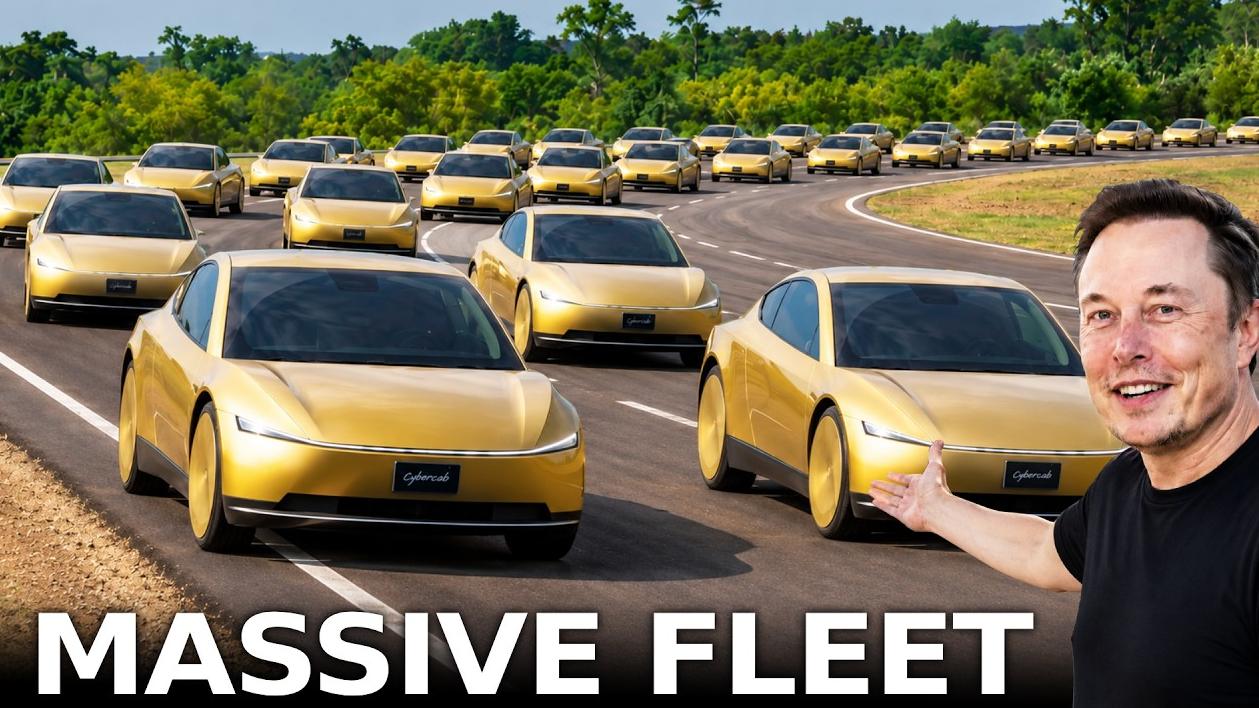
Tesla Cybercab Robotaxi Massive UPDATE, Next-Gen Production: Tesla Cybercab is no longer just a futuristic concept. The company’s ambitious vision of a fully autonomous, driverless transportation network is rapidly becoming a reality. With production activity accelerating at Gigafactory Texas, Tesla is moving closer to launching its purpose-built Robotaxi, known as the Cybercab.
Unlike conventional electric vehicles that were later adapted for self-driving technology, the Cybercab has been engineered from the ground up as a fully autonomous vehicle. It eliminates traditional driver controls, reduces manufacturing complexity, and promises exceptional energy efficiency while lowering transportation costs.
With a target launch in late 2026 and an expected starting price of under $30,000, the Cybercab could revolutionize both personal mobility and commercial ride-hailing services.
Massive Cybercab Production Ramp at Giga Texas
Tesla has significantly increased Cybercab production at Gigafactory Texas. Recent aerial footage shows approximately 245 gold-colored Cybercabs parked at the facility, with reports suggesting production could quickly scale toward 1,000 vehicles.
This rapid expansion marks an important milestone as Tesla transitions from prototype development to large-scale manufacturing.
Key Production Highlights
- 245 Cybercabs already assembled at Giga Texas
- Production expected to scale toward 1,000 units
- Vehicles currently undergoing pre-production validation
- Employee shuttle program already using 100+ Cybercabs
- Steering wheel-free Cybercabs spotted being transported across California for expanded testing
Tesla is using these early production vehicles to refine assembly processes, gather operational data, and validate manufacturing efficiency before full-scale commercial production begins.
Tesla Cybercab: A Purpose-Built Robotaxi
Unlike most autonomous vehicle projects that modify existing cars, the Tesla Cybercab was designed exclusively for driverless transportation.
Minimalist Cabin Design
The interior removes nearly every traditional driving component.
Key features include:
- 2-passenger seating
- No steering wheel
- No accelerator pedal
- No brake pedal
- No gear selector
- Large 21-inch touchscreen for passenger interaction
Everything inside the cabin is designed around the passenger rather than the driver.
How the Cybercab Passenger Experience Works
Tesla aims to make using the Cybercab as effortless as ordering a ride through a smartphone app.
Automatic Entry
Passengers simply approach the vehicle, and the doors automatically open.
Touchscreen Controls
The large 21-inch display allows riders to:
- Monitor trip progress
- Adjust climate settings
- Control entertainment
- View navigation
- Request an emergency stop if necessary
Completely Autonomous Driving
After passengers enter, the Cybercab:
- Pulls away automatically
- Detects pedestrians
- Responds to traffic conditions
- Chooses the best route
- Delivers passengers safely without human intervention
The entire experience is centered around convenience and automation.
Engineering Innovations That Reduce Cost and Weight
One of Tesla’s biggest achievements is simplifying the vehicle by removing unnecessary mechanical components.
Weight Reduction
The Cybercab weighs approximately 3,113 pounds, making it around 700–750 pounds lighter than the Tesla Model 3.
This dramatic reduction comes from eliminating:
- Steering column
- Pedal assemblies
- Instrument cluster
- Manual control systems
- Traditional side mirrors
- Extra wiring
Fewer parts mean:
- Lower manufacturing costs
- Improved reliability
- Easier maintenance
- Better efficiency
Powertrain and Performance
Despite its compact size, the Cybercab delivers practical performance.
Specifications
- 219 HP front-wheel-drive electric motor
- 48 kWh structural battery pack
- Estimated 290–300 miles of driving range
- Payload capacity of approximately 617 pounds
By moving the drive unit to the front, Tesla also creates additional cargo space in the rear while simplifying vehicle construction.
Industry-Leading Energy Efficiency
Perhaps the most impressive aspect of the Cybercab is its remarkable efficiency.
Battery Optimization
Traditional electric cars often carry oversized battery packs because owners occasionally need maximum range.
Robotaxis operate differently.
Instead of maximizing range, Tesla focuses on:
- Smaller batteries
- Faster charging
- Continuous operation
- Lower operating costs
The result is a much more efficient transportation platform.
Efficiency Comparison
| Vehicle | Energy Consumption |
|---|---|
| Typical Electric Sedan | ~280 Wh/mile |
| Tesla Model 3 / Model Y | ~230 Wh/mile |
| Tesla Cybercab (Target) | ~165 Wh/mile |
Tesla expects the Cybercab to achieve over 6.1 miles per kWh, making it nearly twice as efficient as many existing electric vehicles.
This level of efficiency directly reduces electricity costs while extending battery lifespan.
Affordable Pricing Could Disrupt Ride-Hailing
Tesla plans to launch the Cybercab with a starting price below $30,000.
This aggressive pricing opens opportunities for:
- Individual owners
- Commercial fleet operators
- Autonomous taxi businesses
- Shared mobility companies
Combined with low operating costs, the Cybercab could dramatically reduce the cost per mile of urban transportation.
Tesla’s Full Self-Driving Software Continues to Improve
Hardware alone cannot create autonomous driving.
Tesla continues improving its Full Self-Driving (FSD) software through extensive testing.
Real-World Testing
The Cybercab fleet operating around Gigafactory Texas allows Tesla engineers to:
- Test autonomous navigation
- Collect driving data
- Improve AI decision-making
- Validate driverless operation
Since the Cybercab has no manual controls, the software must perform every driving task independently.
Personalized Autonomous Driving
Tesla is also developing personalized driving behavior.
Passengers will eventually be able to save preferences directly within their Tesla account.
These preferences may include:
- Smooth acceleration
- More cautious following distance
- Faster routing
- Preferred driving style
Whenever a passenger enters a Cybercab, the vehicle automatically adapts to those stored preferences.
This creates a more comfortable and customized riding experience.
Automated Cleaning and Fleet Maintenance
Managing thousands of autonomous taxis requires fully automated maintenance.
Tesla has developed robotic systems to keep Cybercabs clean without human labor.
Interior Cleaning Robot
The automated cleaning system includes robotic arms capable of:
- Vacuuming carpets
- Collecting trash
- Cleaning touchscreens
- Wiping windows
- Sanitizing surfaces
- Recovering forgotten personal belongings
Lost items can be securely stored until claimed by passengers.
Autonomous Washing and UV Sanitization
Cybercabs will also clean themselves externally.
Features include:
- Automatic drive-through wash stations
- Self-routing to maintenance hubs
- High-intensity UV cabin sanitization
- Fast disinfection between rides
This allows vehicles to stay clean while minimizing downtime.
Revolutionary Manufacturing with Reaction Injection Molding (RIM)
Tesla is introducing Reaction Injection Molding (RIM) to simplify vehicle production.
Instead of painting body panels after manufacturing, pigments are mixed directly into the molded material.
Benefits of RIM
- Eliminates traditional paint shops
- Reduces production time from hours to minutes
- Removes 100% of paint-related VOC emissions
- Cuts supply-chain greenhouse gas emissions by approximately 35%
- Produces durable, color-integrated body panels
This innovative manufacturing process lowers costs while improving environmental sustainability.
Why the Tesla Cybercab Matters
The Cybercab represents much more than another electric vehicle.
It combines:
- Purpose-built autonomous engineering
- Industry-leading efficiency
- Lower manufacturing costs
- Automated fleet operations
- Advanced AI-powered driving
- Innovative production technology
If Tesla successfully delivers on its goals, the Cybercab could redefine how cities approach transportation, ride-hailing, and vehicle ownership.
With production rapidly expanding at Gigafactory Texas, improving Full Self-Driving software, robotic maintenance systems, and highly efficient manufacturing processes, Tesla appears to be laying the foundation for one of the most significant transformations in modern mobility.
Final Thoughts
Tesla’s Cybercab Robotaxi is shaping up to be one of the company’s most ambitious products yet. From its steering wheel-free design and highly efficient 48 kWh battery to automated cleaning systems and next-generation manufacturing, every aspect has been engineered to reduce costs while maximizing operational efficiency.
As Tesla moves toward its planned 2026 launch, the Cybercab has the potential to transform autonomous transportation and make driverless ride-hailing more affordable, sustainable, and accessible than ever before.
FAQs
1. What is the Tesla Cybercab Robotaxi?
The Tesla Cybercab Robotaxi is a fully autonomous electric vehicle designed specifically for driverless transportation. Unlike traditional cars, it has no steering wheel, pedals, or manual driving controls.
2. When will the Tesla Cybercab be released?
Tesla plans to launch the Cybercab in late 2026, although the exact release timeline may vary depending on regulatory approvals and production progress.
3. How much will the Tesla Cybercab cost?
Tesla has announced a target starting price of under $30,000, making it one of the most affordable autonomous electric vehicles planned for production.
4. Does the Tesla Cybercab have a steering wheel?
No. The Cybercab is designed as a completely driverless vehicle, eliminating the steering wheel, brake pedal, accelerator pedal, and gear selector.
5. How many passengers can the Tesla Cybercab carry?
The Cybercab features a two-seat cabin, providing comfortable seating for two passengers along with space for their luggage.
6. What is the driving range of the Tesla Cybercab?
Tesla estimates the Cybercab will deliver approximately 290–300 miles (467–483 km) of driving range on a single charge.
7. What battery does the Tesla Cybercab use?
The Cybercab is expected to use a 48 kWh structural battery pack, optimized for efficiency rather than maximum battery size.
8. How energy efficient is the Tesla Cybercab?
Tesla targets an efficiency of over 6.1 miles per kWh, or around 165 Wh per mile, making it one of the most energy-efficient electric vehicles ever developed.
9. Where is the Tesla Cybercab being manufactured?
The Cybercab is currently being produced and tested at Gigafactory Texas (Giga Texas), where Tesla is rapidly expanding manufacturing capacity.
10. How does passengers interact with the Cybercab?
Passengers use a large 21-inch touchscreen to control climate settings, navigation, media, trip information, and other ride-related features.
11. Will the Tesla Cybercab support Full Self-Driving (FSD)?
Yes. The Cybercab is built around Tesla’s Full Self-Driving (FSD) software, which is responsible for handling all driving tasks without human intervention.
12. How will Tesla clean and maintain Cybercab fleets?
Tesla is developing automated maintenance systems, including robotic interior cleaning, autonomous car washes, and UV cabin sanitization to keep Cybercab fleets clean between rides.
13. What makes the Tesla Cybercab different from other autonomous vehicles?
Unlike many autonomous vehicles that are modified versions of existing cars, the Cybercab is purpose-built for driverless operation, resulting in lower weight, fewer components, higher efficiency, and reduced manufacturing costs.
14. What manufacturing technology does Tesla use for the Cybercab?
Tesla plans to manufacture Cybercab body panels using Reaction Injection Molding (RIM), a process that integrates color directly into the material, eliminating traditional paint shops and reducing environmental impact.
15. Why is the Tesla Cybercab important for the future of transportation?
The Tesla Cybercab has the potential to transform urban mobility by combining fully autonomous driving, low operating costs, high energy efficiency, and affordable pricing, making driverless transportation more accessible for both individuals and commercial ride-hailing fleets.
Read More:
- Ron DeSantis calls out media bias in Tesla crash coverage
- Tesla Reveals Major New Optimus Robot Update
- SpaceX Even Ready for Flight 14 Double Catching for the First Time Next Month Shocked China
- SpaceX Starship Flight 13 aborted at Zero and Musk just told us what broke
- SpaceX announces new Starship 13 test flight target date
1 thought on “Tesla Cybercab Robotaxi Massive UPDATE, Next-Gen Production”