
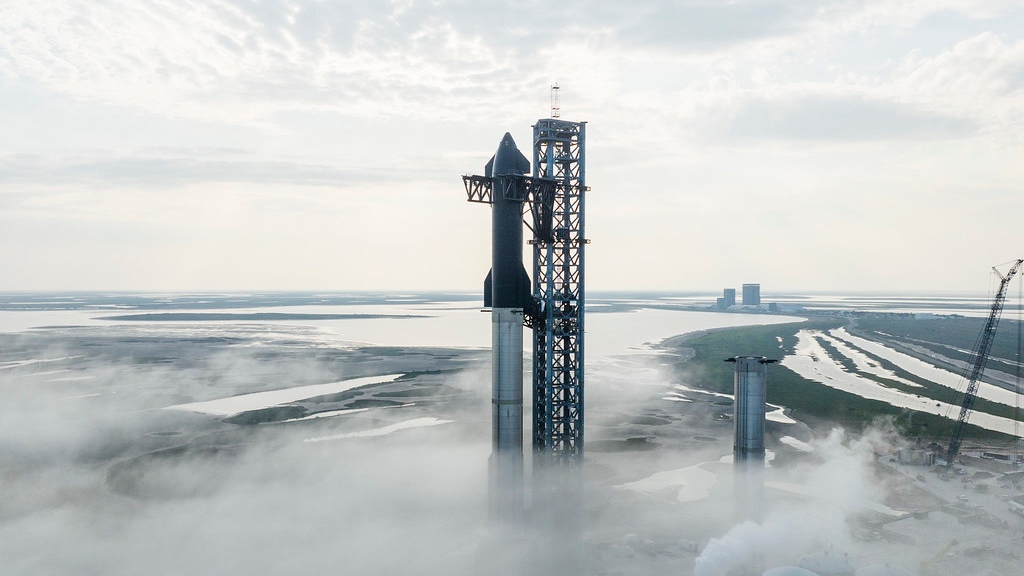
SpaceX Even Ready for Flight 14 Double Catching for the First Time Next Month Shocked China: SpaceX is once again capturing global attention as preparations continue for its next major Starship mission. While the aerospace industry watches the final stages of Flight 13, engineers are already focusing on Flight 14, a mission expected to push the boundaries of reusable spaceflight. If successful, this launch could mark the first time SpaceX demonstrates both a true orbital Starship mission and the recovery of a next-generation Super Heavy booster using the company’s giant launch tower.
Unlike previous test flights, Flight 14 aims to move beyond proving individual technologies. Instead, it is expected to showcase how different parts of the Starship system can work together as a reusable transportation platform capable of supporting future satellite deployments, lunar missions, and eventually human journeys to Mars.
Why SpaceX Flight 14 Is One of the Most Important Starship Missions
Flight 14 represents a significant step in the evolution of Starship, the world’s largest and most powerful rocket system. Previous missions mainly focused on validating launch performance, hot staging, and controlled re-entry. Flight 14 is expected to combine multiple complex objectives into a single mission.
Some of the mission’s major goals include:
- Achieving a stable Earth orbit
- Testing orbital spacecraft operations
- Deploying the first operational payload from Starship
- Recovering the Super Heavy booster using Mechazilla
- Collecting data for future fully reusable missions
If these milestones are achieved, SpaceX will move much closer to making rapid and affordable access to space a reality.
Flight 14 Hardware Is Already Moving Through Testing
One reason SpaceX continues to impress the aerospace industry is its ability to build and test multiple rockets simultaneously. While one vehicle prepares for launch, engineers are already assembling and validating hardware for future flights.
Ship 41 Nears Final Integration
The upper-stage vehicle expected to fly on Flight 14 has already completed several important development milestones.
Engineers have finished assembling its stainless-steel structure and completed cryogenic pressure testing to verify that the tanks can safely withstand the extreme temperatures and pressures experienced during launch. The vehicle is now receiving its full set of Raptor engines, including both sea-level and vacuum-optimized versions.
The next major milestone will be a static fire test, where all engines are briefly ignited while the vehicle remains secured to the launch stand.
Booster 21 Continues Assembly
Meanwhile, Booster 21 is progressing through final assembly before entering its own testing campaign.
The massive first stage will eventually undergo:
- Cryogenic pressure testing
- Engine installation
- 33-engine static fire testing
- Launch readiness inspections
Completing these tests successfully would prepare the booster for one of the most ambitious recovery attempts ever attempted.
A True Orbital Mission Changes Everything
Previous Starship flights reached extremely high speeds but remained on carefully planned suborbital trajectories. This design ensured that if anything went wrong, the spacecraft would naturally re-enter Earth’s atmosphere without becoming uncontrolled space debris.
Flight 14 is expected to take the next step by attempting true orbital insertion.
What Is Orbital Insertion?
For a spacecraft to remain in orbit, it must achieve sufficient speed while raising the lowest point of its flight path above Earth’s atmosphere.
Before committing to orbit, Starship’s onboard computers are expected to verify several critical systems, including:
- Engine performance
- Propellant levels
- Tank pressures
- Power systems
- Guidance and navigation accuracy
Only if these systems remain healthy throughout ascent would the spacecraft continue with the final orbital burn.
Successfully reaching orbit would represent one of the biggest milestones in the history of the Starship program.
Starship Could Deploy Its First Operational Payload
One of the most exciting possibilities for Flight 14 is the first commercial payload deployment from Starship.
Although SpaceX has not officially announced the payload, industry observers expect the mission could carry a batch of Starlink satellites.
Successfully deploying satellites from Starship would demonstrate capabilities beyond those of existing launch vehicles by allowing much larger payloads to reach orbit in a single mission.
This capability is important for:
- Expanding satellite internet services
- Launching larger commercial spacecraft
- Supporting future deep-space missions
- Reducing launch costs through full reusability
Operating in Orbit Brings New Technical Challenges
Once Starship reaches orbit, engineers must demonstrate that the spacecraft can operate effectively in the space environment.
Managing Fuel in Zero Gravity
Unlike on Earth, liquids do not naturally settle at the bottom of fuel tanks in space.
Instead, liquid methane and liquid oxygen float throughout the tank, making engine restarts much more difficult.
Flight 14 is expected to evaluate systems designed to control propellant movement and maintain stable fuel delivery during orbital operations.
This technology is essential for future missions involving:
- Orbital refueling
- Moon landings
- Mars transportation
- Long-duration space travel
The Return Through Earth’s Atmosphere Will Be the Ultimate Test
Returning from a stable orbit is far more demanding than re-entering from a suborbital flight.
As Starship descends back toward Earth, it will experience:
- Extreme aerodynamic heating
- Intense plasma surrounding the spacecraft
- Heavy structural loads
- Significant stress on its thermal protection system
The heat shield must remain intact throughout the descent to protect the stainless-steel structure underneath.
Rather than attempting a landing at Starbase, the spacecraft is expected to complete a controlled splashdown in the Pacific Ocean, allowing engineers to collect valuable flight data while minimizing operational risk.
Mechazilla Could Attempt Its First Catch of a Version 3 Booster
While the upper stage completes its orbital mission, attention will return to Texas, where the Super Heavy booster may attempt a precision return to the launch site.
How Mechazilla Works
Instead of landing on traditional landing legs, SpaceX designed the giant launch tower—commonly known as Mechazilla—to catch the returning booster using enormous mechanical arms.
This recovery method could dramatically reduce refurbishment time and enable rapid reuse of the world’s largest rocket booster.
What’s New About Booster 21?
The latest Super Heavy design introduces several improvements, including:
- Updated aerodynamic control surfaces
- Integrated recovery hardware
- More powerful Raptor engines
- Simplified overall design
These changes are intended to improve both reliability and turnaround time between launches.
A successful tower catch would provide valuable evidence that these upgrades are working as intended.
Why Flight 14 Matters for the Future of Space Exploration
Flight 14 is more than another rocket test.
The mission combines technologies that are fundamental to SpaceX’s long-term vision:
- Reusable launch systems
- Frequent orbital transportation
- Large-scale satellite deployment
- Lunar exploration
- Future Mars missions
Each successful demonstration reduces technical uncertainty and brings fully reusable space transportation closer to everyday reality.
Instead of focusing on individual achievements, Flight 14 seeks to show how multiple advanced systems can function together during one mission.
Conclusion
SpaceX Flight 14 could become one of the most important milestones in the history of the Starship program. By attempting a stable orbital mission, demonstrating orbital spacecraft operations, potentially deploying commercial payloads, and recovering a next-generation Super Heavy booster, the company hopes to prove that fully reusable heavy-lift spaceflight is within reach.
Although every major test flight carries technical risks, Flight 14 has the potential to reshape the future of space transportation. If the mission succeeds, it would provide another major step toward routine orbital launches, rapid rocket reuse, and the long-term goal of supporting human exploration beyond Earth.
FAQs
1. What is SpaceX Flight 14?
SpaceX Flight 14 is the next major planned Starship test mission designed to demonstrate true orbital flight, advanced spacecraft operations, and the recovery of a next-generation Super Heavy booster.
2. When is SpaceX Flight 14 expected to launch?
Based on the current testing schedule and regulatory progress, Flight 14 is expected to launch no earlier than August 2026, although the date could change depending on final preparations.
3. Why is Flight 14 considered a major milestone?
The mission is expected to combine several important objectives, including orbital insertion, payload deployment, and booster recovery, bringing SpaceX closer to fully reusable space transportation.
4. Will Flight 14 attempt a true Earth orbit?
Yes. Unlike previous Starship flights that followed suborbital trajectories, Flight 14 is expected to attempt a stable low Earth orbit, provided all vehicle systems perform as planned.
5. What makes orbital flight different from suborbital flight?
A suborbital flight naturally falls back to Earth after engine shutdown, while a true orbital flight remains in space until the spacecraft performs a controlled de-orbit burn.
6. What payload could Starship carry on Flight 14?
SpaceX has not officially confirmed the payload, but many industry observers believe the mission could deploy Starlink satellites as its first operational orbital payload.
7. What is zero-gravity propellant management?
It is the process of controlling liquid methane and liquid oxygen inside Starship’s tanks while in space, ensuring the engines can restart safely during orbital operations.
8. Why is propellant management important?
Successful propellant management is essential for future orbital refueling, Moon missions, Mars missions, and long-duration space exploration.
9. What is Mechazilla?
Mechazilla is SpaceX’s giant launch tower equipped with mechanical “chopstick” arms that are designed to catch returning Super Heavy boosters instead of using traditional landing legs.
10. Will Booster 21 attempt a tower catch?
If mission conditions allow, Booster 21 is expected to attempt a return to Starbase for a precision catch by the Mechazilla launch tower.
11. What improvements does Booster 21 include?
Booster 21 is expected to feature upgraded Raptor 3 engines, improved aerodynamics, stronger recovery hardware, and design refinements aimed at increasing reliability and reusability.
12. Will Starship land back at Starbase during Flight 14?
No. Current expectations suggest the upper-stage Starship will perform a controlled Pacific Ocean splashdown after completing its orbital mission and atmospheric re-entry.
13. Why won’t Starship return to the launch site yet?
Returning from a stable orbit involves much higher speeds and thermal loads than previous flights. SpaceX is expected to gather additional flight data before attempting a launch-site landing.
14. How will Flight 14 help future Moon and Mars missions?
The technologies being tested—including orbital flight, engine restarts, payload deployment, and rapid rocket reuse—are critical for future missions to the Moon and eventually Mars.
15. What are the biggest risks during Flight 14?
The mission faces challenges such as achieving stable orbit, managing cryogenic propellants in space, surviving high-speed atmospheric re-entry, and successfully recovering the Super Heavy booster.
16. Why is the aerospace industry closely watching Flight 14?
Because Flight 14 has the potential to demonstrate that Starship is evolving from an experimental rocket into a fully reusable orbital transportation system, which could significantly reduce launch costs and transform the future of space exploration.
Read More:
- SpaceX Starship FULL STACKED to Launch For Its 13th Time in Hours! Critical Moments Coming
- 2027 Next-Gen Giga Press 4.0: The Biggest Upgrade Yet
- NTSB findings on fatal Tesla crash tell a very different story
- Tesla has to fix a big problem with its old headlights, NHTSA says
- Elon Musk secretly acquires $1B energy company to power the AI future