
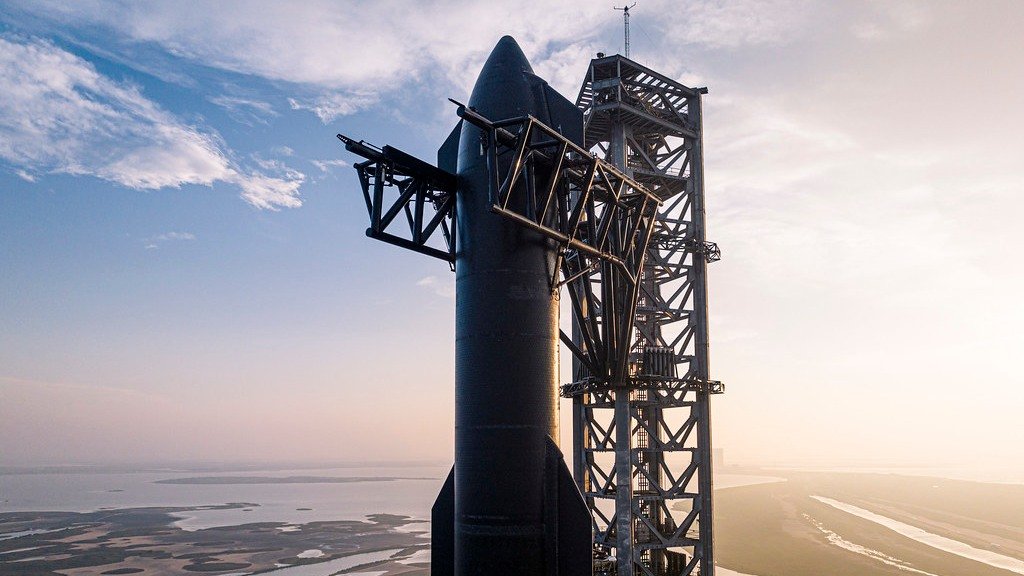
SpaceX’s new Starship HLS Interior Design to Land on the Moon in 2028, but Super Heavy Booster: SpaceX’s Starship Human Landing System (HLS) is transforming the concept of lunar exploration with an unprecedented combination of size, reusable architecture, and living space. Designed for NASA’s Artemis program, Starship HLS represents a major departure from the compact spacecraft used during the Apollo era.
While traditional lunar spacecraft prioritized minimum mass and limited crew accommodations, Starship HLS is being developed as a large-scale lunar habitat and landing vehicle. At the same time, the enormous Super Heavy booster is undergoing aerodynamic and structural development to support the ambitious launch architecture.
SpaceX Starship HLS Interior Design: A New Era of Lunar Habitation
NASA’s selection of SpaceX Starship HLS for Artemis marked an important shift in lunar landing technology. Instead of relying on a small, disposable lander, NASA’s lunar architecture incorporates a spacecraft designed around large internal volume and reusability.
During an Artemis update, SpaceX Vice President of Build and Flight Reliability Jessica Jensen confirmed that construction of the first flight-fidelity Starship HLS cabin had progressed beyond early mockups.
The cabin is intended to be outfitted with critical systems including avionics, electrical power, life support, and other functional hardware. This engineering article will help SpaceX evaluate the interior configuration and systems required for future human missions.
The flight-fidelity cabin is particularly important because spacecraft interiors must be tested for much more than appearance. Engineers need to validate human factors, equipment placement, life-support integration, thermal performance, and crew operations before astronauts fly.
Starship HLS Offers More Than 1,000 Cubic Meters of Space
One of the most striking features of Starship HLS is its sheer size.
The vehicle stands at more than 50 meters tall and has an outer diameter of approximately 9 meters. A substantial portion of the upper vehicle is dedicated to crew and operational space, positioned above the large cryogenic propellant tanks.
According to the design information in the source material, Starship HLS could provide more than 1,000 cubic meters of pressurized volume.
For comparison, the approximate pressurized volumes are:
- Apollo Command Module: about 6 m³
- Orion spacecraft: about 9 m³
- International Space Station: about 916 m³
- Starship HLS: 1,000+ m³
This enormous volume could fundamentally change how astronauts live and work on the Moon. Instead of spending an entire lunar mission inside a cramped capsule, crews could have dedicated areas for sleeping, exercise, hygiene, science, food preparation, mission operations, and recreation.
Six-Level Starship HLS Interior Architecture
The proposed Starship HLS interior can be understood as a six-level vertical habitat. Each level serves a different purpose, allowing SpaceX to organize the enormous cylindrical interior efficiently.
Level 1: ECLSS, Utilities and Surface Access
The lowest habitable level functions as the spacecraft’s technical and logistics center. It can accommodate environmental control and life-support equipment, power systems, thermal-management hardware, cargo, and EVA equipment.
A major feature is the connection to the surface elevator, which allows astronauts and equipment to travel between the spacecraft and the lunar surface.
This arrangement could make it easier to keep lunar dust away from the main living areas.
Level 2: Galley, Dining and Hydroponics
Level 2 focuses on everyday crew living. The proposed area includes a galley and dining space, with equipment designed for food preparation in reduced gravity.
The concept also incorporates hydroponic or aeroponic plant-growth systems. Growing fresh food could provide nutritional benefits while also supporting research into sustainable life-support systems for future long-duration missions.
Level 3: Exercise and Hygiene
Maintaining astronaut health is critical during extended lunar missions. Level 3 is designed around exercise and hygiene facilities.
Exercise equipment such as treadmills, cycle ergometers, and resistance-training systems could help counter muscle loss and bone-density degradation associated with reduced gravity.
The level would also include specialized sanitation equipment, including vacuum toilets and water-recycling systems, designed to prevent free-floating water droplets inside the spacecraft.
Level 4: Private Crew Quarters
Crew privacy becomes increasingly important as missions become longer.
The fourth level is envisioned as a dedicated area for individual crew sleeping quarters. Compact staterooms or sleeping pods can be arranged around the vehicle’s perimeter while preserving central circulation space.
Potential features include personal lighting, ventilation, communication equipment, sound insulation, and individual work areas.
Level 5: Observation and Common Area
The fifth level can serve as a communal and observation deck, giving astronauts a place to work together and observe the lunar environment.
Large reinforced windows could provide views of the Moon and surrounding space while supporting scientific observation and crew well-being.
Because lunar missions expose spacecraft to extreme environments, any viewing system would require substantial thermal, micrometeoroid, and radiation protection.
Level 6: Command and Mission Operations
At the top of the habitable section is the proposed command and mission operations area.
This space would support spacecraft monitoring, telemetry, navigation, communications, and other mission-critical activities. Its position near the upper section of the vehicle would provide a logical location for flight operations and crew coordination.
Starship HLS Dual-Airlock and Lunar Surface Access
Another important part of the Starship HLS design is its airlock architecture.
A higher docking interface can support crew transfers between Starship HLS and spacecraft such as NASA’s Orion, while a lower airlock can support surface EVA operations.
The separation of orbital crew transfer and lunar surface activities could help improve operational efficiency and reduce the amount of lunar regolith carried into the primary living areas.
The spacecraft’s elevator system is equally important. Rather than forcing astronauts to climb down a conventional ladder from the vehicle, the elevator provides a dedicated route between the elevated habitat and the lunar surface.
Solar Power and Long-Duration Lunar Operations
Starship HLS must operate in an environment dramatically different from Earth. The Moon has long periods of sunlight and darkness, creating major challenges for power generation and thermal management.
Deployable solar arrays are expected to provide electrical power, while onboard batteries can store energy for periods when sunlight is unavailable.
Reliable power is essential for maintaining life support, thermal-control systems, communications, avionics, and other critical spacecraft functions.
Super Heavy Booster: The Giant Rocket Behind Starship
The Starship HLS cannot reach the Moon without an equally ambitious launch system. That role belongs to the Super Heavy booster.
NASA and SpaceX are also evaluating future Super Heavy configurations, including Version 3 (V3). The upgraded design incorporates changes to its engine arrangement, protection systems, grid fins, and interstage architecture.
The booster is expected to use Raptor 3 engines, while aerodynamic improvements are being evaluated for its return and recovery.
NASA Ames Wind Tunnel Testing
NASA’s Ames Research Center has conducted wind-tunnel testing using a 1.2% scale model of the Super Heavy V3 configuration.
Testing across transonic and supersonic conditions allows engineers to study aerodynamic forces, stability, and other characteristics during flight.
These results are particularly important because Super Heavy is intended to return toward the launch area for controlled recovery and tower catch operations.
Starship HLS and the Artemis 2028 Roadmap
The development of Starship HLS involves several major milestones, including orbital refueling demonstrations, uncrewed lunar testing, and eventual crewed operations.
Orbital refueling is especially important because Starship’s lunar missions require substantial propellant capability. Demonstrating reliable transfer of cryogenic propellants between vehicles is therefore a critical part of the overall architecture.
An uncrewed Starship HLS lunar landing demonstration is planned before astronauts are committed to a lunar landing. The broader roadmap points toward an Artemis III crewed lunar mission around 2028, subject to program schedules and successful completion of the required testing.
Conclusion: Starship HLS Could Redefine Lunar Exploration
The development of the Starship HLS interior illustrates how dramatically lunar spacecraft are evolving. Instead of designing a tiny capsule where astronauts spend most of their mission in confined quarters, SpaceX is pursuing a large, reusable lunar habitat with substantial room for living, science, exercise, storage, and mission operations.
The flight-fidelity cabin, life-support integration, airlock systems, solar-power architecture, and surface elevator are all important pieces of this ambitious design.
At the same time, the Super Heavy booster remains essential to the entire Starship architecture. Its next-generation engines, aerodynamic testing, and recovery systems must work reliably before Starship can become a practical transportation system for lunar missions.
If the development and testing milestones are successfully completed, Starship HLS could provide NASA’s Artemis astronauts with one of the largest crewed spacecraft environments ever designed for lunar exploration, opening the door to longer and more capable human missions on the Moon.
FAQs
1. What is SpaceX Starship HLS?
SpaceX Starship HLS (Human Landing System) is a lunar-landing version of Starship being developed to transport NASA astronauts from lunar orbit to the Moon’s surface as part of the Artemis program.
2. When will Starship HLS land astronauts on the Moon?
The current roadmap discussed in the source material targets Artemis III around 2028 for a crewed lunar landing, following required testing and an uncrewed Starship HLS landing demonstration.
3. How large is the Starship HLS?
Starship HLS is designed to be more than 50 meters tall with an outer diameter of approximately 9 meters, making it significantly larger than traditional lunar landing vehicles.
4. How much interior space does Starship HLS have?
The design described in the source material provides more than 1,000 cubic meters of pressurized habitable volume, giving astronauts considerably more living and working space than earlier lunar spacecraft.
5. How many levels does Starship HLS have?
The proposed interior architecture divides the habitable area into six primary levels, covering utilities, dining, exercise, crew quarters, communal areas, and mission operations.
6. What is the Starship HLS flight-fidelity cabin?
The flight-fidelity cabin is an engineering article being built to closely represent the interior of the operational spacecraft. It allows engineers to evaluate equipment integration, crew ergonomics, life-support systems, and other critical interior functions.
7. What is inside the Starship HLS cabin?
The planned interior includes areas for crew accommodations, life support, exercise, hygiene, food preparation, cargo, mission operations, and EVA activities.
8. Does Starship HLS have sleeping quarters?
Yes. The proposed design includes individual crew accommodation areas intended to provide astronauts with private sleeping and personal spaces during extended lunar missions.
9. How will astronauts get from Starship HLS to the Moon’s surface?
Astronauts are expected to use a surface elevator system connecting the elevated Starship HLS habitat to the lunar surface. This approach provides direct access for crew and equipment.
10. Does Starship HLS use airlocks?
The architecture described includes a dual-airlock concept. A higher docking interface can support crew transfers, while a lower airlock is intended for lunar surface EVA operations.
11. How will Starship HLS generate electricity on the Moon?
Starship HLS is expected to use deployable solar arrays to generate electricity, supported by onboard energy-storage systems. Reliable power is essential for life support, communications, thermal control, and avionics.
12. Why does Starship HLS need orbital refueling?
Starship HLS requires a substantial amount of propellant for its lunar mission. Orbital refueling allows the spacecraft to receive additional cryogenic propellant before traveling to the Moon, making the overall architecture possible.
13. What is the Super Heavy booster?
Super Heavy is the massive first-stage booster designed to launch Starship into space. It provides the enormous thrust required to lift the Starship vehicle from Earth.
14. What is Super Heavy V3?
Super Heavy V3 is a next-generation configuration featuring upgrades such as Raptor 3 engines, revised engine protection, larger grid fins, and changes to the interstage design.
15. Is NASA testing the Super Heavy booster design?
NASA and SpaceX have conducted aerodynamic research involving scale-model wind-tunnel testing at NASA Ames Research Center. These tests help engineers understand aerodynamic forces and stability during flight and recovery.
16. Why is Starship HLS important for Artemis?
Starship HLS could give NASA astronauts a much larger lunar landing and habitation platform than previous spacecraft. Its large interior volume, reusable architecture, surface-access systems, and potential for extended operations could support the next generation of human lunar exploration.
Read More:
- Inside Tesla’s secretive $10 Billion “Project Crystal Sun” filing
- The real reason Elon Musk wants every car connected to space
- INSANE 95% Uptime! Tesla Semi 2.0 Is Ready For 2027
- Take A Look Inside SpaceX’s $3 Billion Starfactory
- Starship Ship 40 Recovery in a Bad Situation, Can’t Bring It Back Home! What Comes Next