
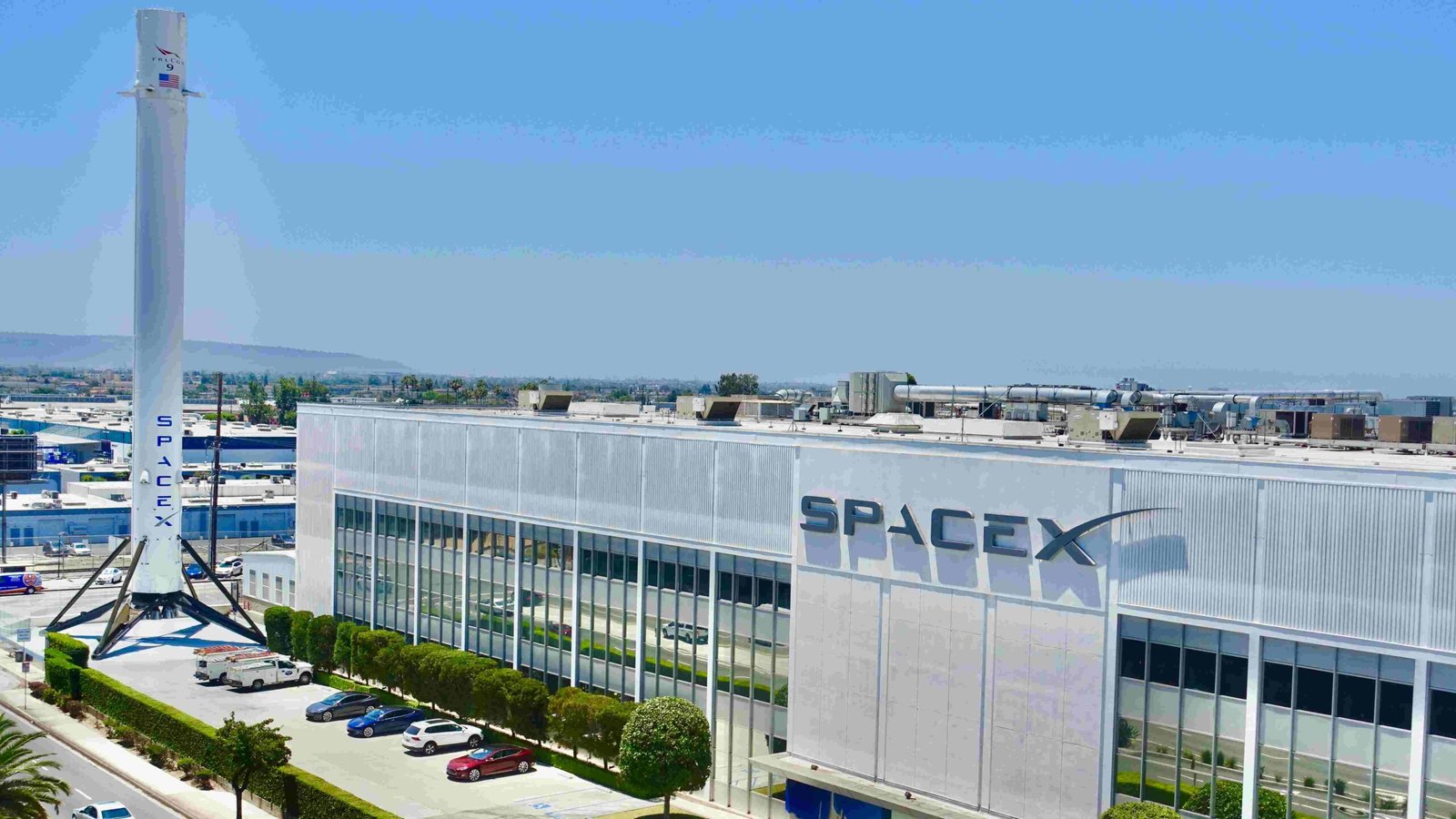
Take A Look Inside SpaceX’s $3 Billion Starfactory: For decades, rocket manufacturing was considered an artisan craft. Aerospace companies built rockets using custom-machined components, hand welding, complex supply chains, and lengthy integration processes. SpaceX is challenging that model at Starbase, Texas, with the Starfactory—a massive manufacturing facility designed to transform rocket production into something closer to automotive mass manufacturing.
The ambition is extraordinary: SpaceX has designed the Starfactory around a potential production rate of up to 365 Starships per year, or roughly one complete vehicle every day. Achieving that goal requires a radical combination of automation, advanced metallurgy, robotics, hydroforming, and parallel assembly.
Here’s how SpaceX is attempting to build the world’s largest rocket at an unprecedented scale.
SpaceX Starfactory: From Steel Coil to Starship
Unlike many modern rockets that rely heavily on expensive composites, Starship begins with something surprisingly conventional: stainless steel.
SpaceX uses large rolls of steel approximately 4 millimeters thick and 1.8 meters wide. These sheets eventually become the enormous structural skin and propellant tanks of Starship and Super Heavy.
Why Stainless Steel?
SpaceX originally experimented with carbon fiber for Starship but moved toward stainless steel because of its combination of cost, strength, heat resistance, and manufacturability.
The material must survive several extreme environments.
- Cryogenic temperatures: Starship’s tanks hold liquid oxygen and methane at extremely low temperatures. Stainless steel becomes stronger in cryogenic conditions.
- Re-entry heating: During atmospheric re-entry, Starship encounters extreme temperatures, making heat-resistant stainless steel valuable.
- Corrosion resistance: Starbase’s coastal environment exposes vehicles to humid, salty air.
- Weldability: The material must be suitable for fast, repeatable robotic welding and forming.
This custom approach to rocket metallurgy is central to SpaceX’s strategy of making Starship cheaper and faster to manufacture.
Automated Welding and High-Pressure Hydroforming
Turning flat steel into a nearly 9-meter-wide rocket requires specialized industrial machinery.
The manufacturing process broadly follows this path:
Steel coils → precision cutting → forming → robotic welding → ring stacking → larger vehicle sections
The basic building block is the large cylindrical Starship ring. Automated equipment cuts steel to precise dimensions before bending and welding it into circular sections.
These rings are then stacked into larger sections. Instead of relying primarily on human welders, SpaceX uses robotic welding systems for major structural joints.
Hydroforming Creates Complex Rocket Shapes
Flat sheets aren’t suitable for Starship’s domes and aerodynamic nose sections. SpaceX therefore uses hydroforming, a manufacturing technique that uses extremely high-pressure fluid to force metal against a mold.
Pressures can reach tens of thousands of PSI, allowing relatively thin stainless-steel sheets to be transformed into complex curves with high dimensional accuracy.
This is particularly important for manufacturing tank domes and nose cone structures while maintaining the speed required for high-volume production.
Linear Adjacent Flow: A New Way to Build Rockets
Traditional rocket assembly is largely sequential. A vehicle moves through different stages of integration, with components added one after another.
SpaceX is taking a different approach at Starfactory.
The facility uses a production philosophy often described as Linear Adjacent Flow, inspired by manufacturing concepts developed in the automotive industry.
Instead of building one enormous rocket from bottom to top, Starship is divided into major sub-assemblies that can be manufactured simultaneously.
Three Major Starship Sections
The factory can work on several sections at the same time:
- Top Section: Nose cone, header tanks, forward flaps, and payload systems.
- Middle Section: Main methane and oxygen propellant tanks.
- Bottom Section: Aft structure, engine systems, flaps, and associated plumbing.
This parallel approach can reduce bottlenecks because multiple teams and machines work simultaneously rather than waiting for one section to be completed.
The Overhead Crane Network
Moving something nearly nine meters wide through a conventional factory would be difficult. Starfactory addresses this with a network of large overhead bridge cranes.
These cranes can lift enormous partially completed sections and move them between adjacent manufacturing areas. Rotating assembly fixtures then allow technicians and robots to access different portions of the vehicle without constantly repositioning the entire structure.
Starfactory vs. Traditional Aerospace Manufacturing
The biggest difference is the philosophy behind the factory.
Traditional aerospace programs often depend on large networks of contractors and suppliers. Components may be manufactured in different states or countries before being shipped to a final assembly location.
SpaceX is attempting to bring much of the process together at Starbase.
| Feature | Traditional Aerospace | SpaceX Starfactory |
|---|---|---|
| Production model | Low-volume manufacturing | High-volume manufacturing |
| Assembly | Primarily sequential | Parallel sub-assemblies |
| Logistics | Large external supply chain | Highly integrated facility |
| Vehicle philosophy | Often expendable | Designed around reusability |
| Target cadence | Low production rate | Potentially one vehicle per day |
The objective isn’t simply to build rockets faster. It is to create an industrial system capable of producing reusable spacecraft at scale.
Inside Starship’s Top Section
One of the clearest examples of this manufacturing philosophy is the Starship upper section.
Multiple components can be produced independently before being integrated.
Nose Cone and Heat Shield
Hydroformed stainless-steel panels are welded together to create the nose cone. The structure then receives components required for its thermal protection system (TPS).
Starship’s heat shield consists of thousands of hexagonal ceramic tiles designed to protect the stainless-steel structure during atmospheric re-entry.
SpaceX has also developed automated manufacturing capabilities for these tiles, supporting the high production rates envisioned for Starship.
Header Tanks and Flight Controls
Small header tanks are installed inside the forward section to store landing propellant. At the same time, electric actuators and mechanical systems are integrated for Starship’s aerodynamic flaps.
Building these components as independent sub-assemblies allows SpaceX to complete work simultaneously rather than forcing technicians to install everything after the entire vehicle has been stacked.
The Gigabay: Starship’s Final Assembly Hall
After the major sections are completed, they move into the enormous Gigabay at Starbase.
The structure rises roughly 116 meters (380 feet) and provides the vertical clearance necessary to assemble Starship and Super Heavy vehicles.
Inside, cranes and specialized platforms allow workers to stack the major vehicle sections vertically.
Final integration can include:
- Connecting propellant feed systems
- Installing electrical and avionics connections
- Completing structural inspections
- Performing pressure testing
- Installing additional thermal protection
- Integrating engines and other flight hardware
The Gigabay essentially functions as the final assembly area for SpaceX’s rapidly expanding Starship production system.
Raptor Engines and Final Integration
One major component is manufactured outside Starfactory: the Raptor engine.
Raptor production is handled elsewhere by SpaceX before engines undergo extensive testing. After qualification, engines are transported to Starbase for vehicle integration.
Starship uses six Raptor engines, while the Super Heavy booster is designed around an array of 33 engines.
The engine integration process represents one of the final stages before a vehicle enters testing and launch operations.
Why Does SpaceX Want to Build 365 Starships a Year?
Producing hundreds of spacecraft annually sounds excessive until Starship’s planned missions are considered.
A reusable Super Heavy booster could potentially fly repeatedly because it returns to Earth after only a short flight. A Starship upper stage, however, could spend significantly longer in space or travel on lunar and interplanetary missions.
Starlink and Orbital Infrastructure
Large-scale Starlink deployment could require frequent Starship launches because the vehicle is designed to carry significantly more mass than conventional launch vehicles.
NASA Artemis and Lunar Missions
SpaceX’s Starship Human Landing System concept also depends on orbital refueling. Multiple tanker Starships could be required to transfer propellant to a lunar lander before its journey to the Moon.
The Mars Mission
Mars presents an even bigger logistical challenge. Earth and Mars reach favorable launch positions roughly every 26 months.
A future Mars campaign would therefore require launching a large fleet of spacecraft during a relatively short window. That makes manufacturing capacity just as important as launch capability.
The Future of Rocket Manufacturing
SpaceX’s Starfactory represents a fundamental change in how rockets could be manufactured.
Instead of treating spacecraft as individually crafted aerospace artifacts, SpaceX is attempting to make Starship a mass-produced reusable vehicle.
Custom stainless steel, automated welding, hydroforming, parallel assembly, overhead cranes, robotic systems, and the massive Gigabay all serve one objective: increase production while reducing the cost and time required to build each spacecraft.
If SpaceX succeeds, the impact could extend far beyond Starbase. A factory capable of producing Starships at automotive-like scale could fundamentally change the economics of orbital launch, lunar exploration, satellite deployment, and eventually human missions to Mars.
The Starfactory is therefore more than a rocket factory. It is SpaceX’s attempt to build the industrial foundation for a future in which access to space depends less on how many rockets humanity can afford to build—and more on how quickly those rockets can be manufactured, fueled, launched, and reused.
FAQs
1. What is SpaceX’s Starfactory?
SpaceX’s Starfactory is a large-scale rocket manufacturing facility at Starbase, Texas, designed to dramatically increase the production rate of Starship and Super Heavy vehicles. It uses automation, robotics, advanced metal forming, and parallel assembly techniques to manufacture spacecraft more efficiently.
2. How much did SpaceX’s Starfactory cost?
The Starfactory is widely associated with an investment of approximately $3 billion, reflecting SpaceX’s effort to create a high-volume manufacturing system for Starship and future space missions.
3. Where is SpaceX’s Starfactory located?
The Starfactory is located at SpaceX’s Starbase complex in South Texas, near Boca Chica and the Gulf Coast. Its location places manufacturing, vehicle testing, launch operations, and other spacecraft infrastructure within the same broader facility.
4. How many Starships can the Starfactory produce?
SpaceX has designed its manufacturing system with an ambitious target of up to 365 Starships per year. That would theoretically represent a production cadence of approximately one Starship per day, although actual production rates can vary as the program develops.
5. Why does SpaceX use stainless steel for Starship?
SpaceX uses stainless steel because it offers a useful combination of strength, heat resistance, durability, cost, and manufacturability. The material also performs well at the extremely cold temperatures associated with Starship’s cryogenic propellants.
6. What is hydroforming in Starship manufacturing?
Hydroforming is a metal-forming process that uses extremely high-pressure fluid to shape stainless-steel sheets against a mold. SpaceX can use this technique to create complex curved structures such as tank domes and aerodynamic components.
7. How does SpaceX automate Starship welding?
SpaceX uses robotic welding equipment for many of Starship’s major structural welds. Automated systems can provide consistent weld paths and repeatable manufacturing processes, reducing the amount of manual work required for large cylindrical sections.
8. What is Linear Adjacent Flow?
Linear Adjacent Flow is a manufacturing approach associated with SpaceX’s Starfactory in which different parts of a Starship are manufactured simultaneously in nearby production areas. Instead of building the entire rocket sequentially, the top, middle, and bottom sections can progress through manufacturing in parallel.
9. What is the Gigabay at Starbase?
The Gigabay is a massive high-bay structure at Starbase used for major Starship and Super Heavy assembly and integration activities. Its enormous height allows SpaceX to work with fully stacked vehicles vertically while using large cranes and elevated work platforms.
10. How tall is the Starfactory Gigabay?
The Gigabay is approximately 116 meters (380 feet) tall, providing the vertical clearance required to assemble and handle the enormous Starship and Super Heavy vehicles.
11. How many engines does Starship use?
A Starship upper stage is designed to use six Raptor engines. The Super Heavy booster is designed with 33 Raptor engines, giving the complete launch system a total of 39 engines when fully configured.
12. Where are Starship’s Raptor engines manufactured?
Raptor engines are manufactured separately from the main Starfactory production process. SpaceX produces and tests the engines at other facilities before transporting qualified engines to Starbase for installation into Starship and Super Heavy vehicles.
13. Why does SpaceX want to manufacture so many Starships?
SpaceX’s long-term plans require a large fleet of spacecraft for Starlink, lunar missions, orbital infrastructure, and potentially Mars missions. Because Starship upper stages may spend significant periods in space or undertake missions that do not immediately return to Earth, SpaceX could require many more ships than boosters.
14. How could Starship support NASA’s Artemis missions?
SpaceX’s Starship Human Landing System (HLS) is intended to support NASA’s Artemis lunar exploration program. The architecture involves launching and transferring propellant to the lunar lander in Earth orbit before it travels to the Moon, potentially requiring multiple tanker flights.
15. Could the Starfactory change the future of spaceflight?
Yes. If SpaceX achieves its intended production rates and successfully operates a rapidly reusable Starship system, the Starfactory could help transform rocket manufacturing from low-volume aerospace production into high-volume industrial manufacturing. This could potentially reduce launch costs and enable more frequent missions to Earth orbit, the Moon, and eventually Mars.
Read More:
- Starship Ship 40 Recovery in a Bad Situation, Can’t Bring It Back Home! What Comes Next
- Major Tesla Bot Gen 3 Production UPDATE
- The Boring Company’s newest tunnel vehicle runs on Tesla parts and no one is driving it
- Elon Musk Reveals NEW Mars Timeline
- Elon Musk’s Terafab UPDATE Finally OutChip Entire The World