
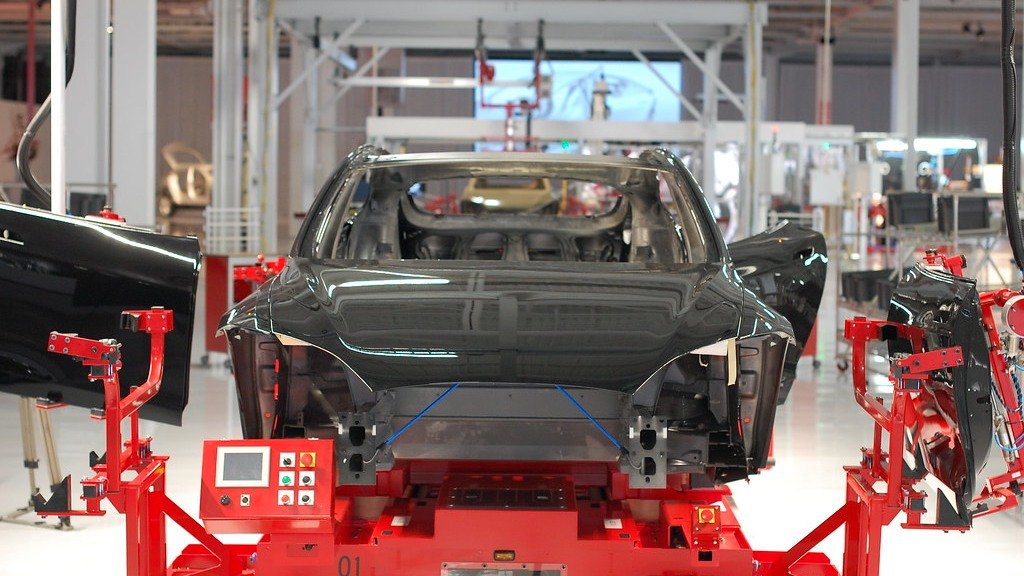
Massive 50.000T Giga Press Built Next-Gen Tesla Car APPEAR: The automotive industry is entering a new era of manufacturing, and Tesla’s massive Giga Press technology could fundamentally change how cars are built. For decades, vehicle production has depended on thousands of stamped metal components, robotic welding stations, complex assembly lines, and extensive factory infrastructure.
Tesla’s approach is different: build fewer, larger structural components and eliminate as many assembly steps as possible.
The evolution from roughly 6,000-ton and 9,000-ton casting machines toward a reported 50,000-ton-class Giga Press represents an enormous increase in manufacturing ambition. The objective is not simply to create a bigger machine, but to rethink the architecture of an entire vehicle.
What Is a 50,000-Ton Giga Press?
A common misconception is that a 50,000-ton Giga Press pushes aluminum into a shape with 50,000 tons of crushing force. In reality, the number primarily refers to the machine’s clamping force.
During high-pressure die casting, molten aluminum is injected into a steel mold at extremely high speed and pressure. The force generated inside the mold attempts to push the two die halves apart. The hydraulic clamping system must therefore hold the mold closed throughout the injection process.
Why Clamping Force Matters
As the size of a casting increases, the internal surface area of the mold also increases. That means significantly greater force can be generated when molten aluminum enters the cavity.
If the clamping force is insufficient, the die can separate slightly, producing metal flash, dimensional inaccuracies, and potentially dangerous molten-metal leakage.
A 50,000-ton-class machine therefore provides the enormous clamping capacity needed for much larger structural castings.
This is the key to Tesla’s mega-casting strategy: increase the size of the casting while reducing the number of individual components that must later be assembled.
How Tesla Mega Casting Works
Producing a massive aluminum structural casting requires precise control over temperature, pressure, vacuum, cooling, and material quality.
1. Aluminum Melting and Refining
The process begins with aluminum alloy being heated until it becomes molten. The metal must remain within a carefully controlled temperature range before injection.
Modern casting systems can use separate melting and holding stages to maintain thermal consistency. Degassing and filtration are also critical because hydrogen and microscopic inclusions can create internal defects or porosity.
2. Mold Preparation and Vacuum
Before injection, the enormous steel die is prepared with a specialized release lubricant. The mold then closes and a vacuum system removes air from the cavity.
This step is extremely important. Trapped air can create voids and reduce the mechanical performance of a structural casting.
3. High-Speed Aluminum Injection
Once the vacuum reaches the required level, a hydraulic shot system drives molten aluminum into the mold.
The injection speed must be carefully controlled. If the aluminum moves too slowly, it can begin solidifying before the cavity is completely filled. If the flow becomes excessively turbulent, it can introduce defects.
This makes real-time monitoring and precise control essential to successful high-pressure die casting.
4. Cooling and Ejection
After filling, the aluminum rapidly transfers heat into the mold. Internal cooling channels help control the solidification process and minimize distortion.
Once sufficiently solidified, automated equipment removes the casting from the die. Excess runners and flash can then be trimmed, with recyclable aluminum potentially returned to the production process.
5. Automated Quality Inspection
A structural vehicle component cannot be judged solely by its appearance.
Advanced manufacturing systems can use non-destructive testing, dimensional inspection, and imaging technologies to identify internal defects before the component enters vehicle assembly.
This quality-control stage becomes increasingly important as a single casting replaces dozens of independently manufactured parts.
From Hundreds of Parts to One Mega Casting
The biggest advantage of Giga Casting is part consolidation.
Traditional automotive manufacturing can involve dozens or even hundreds of individual components in a major body structure. Those pieces must be stamped, transported, positioned, welded, inspected, and assembled.
Tesla’s Model Y demonstrated the potential of this approach by consolidating a large number of rear structural components into a single aluminum casting. Thatcham Research later reported that the Model Y’s one-piece rear floor section consolidated around 70 individual components.
The result is a radically simplified manufacturing chain.
Instead of:
Stamping → transporting → aligning → welding → inspecting → repeating
the process moves closer to:
Casting → trimming → inspection → vehicle assembly
Why Part Reduction Matters
Every eliminated component can potentially remove:
- Stamping dies
- Additional manufacturing equipment
- Welding operations
- Robotic arms
- Assembly fixtures
- Inspection stations
- Material handling
- Inventory requirements
- Logistics complexity
The goal is therefore not merely a faster casting cycle. It is to remove entire categories of manufacturing operations.
Does Mega Casting Make Tesla Cars Harder to Repair?
One of the biggest criticisms of large structural castings has been repairability.
The concern is understandable: if a traditional vehicle has dozens of separate structural components, localized damage may allow technicians to replace only the damaged section. A giant casting appears to create the possibility that a relatively small accident could require replacement of a much larger structure.
However, real-world research has challenged the idea that mega castings are automatically more expensive to repair.
What Thatcham Research Found
In 2025, Thatcham Research published results from a two-year study involving crash testing, damage assessment, repair evaluation, and real-world claims data related to Tesla Model Y mega-cast structures.
The organization found that mega-cast structures can be cheaper to repair than traditional steel structures when repairability is incorporated into the original design. Its testing found partial replacement costs for the Model Y were £2,167 lower than the comparable Model 3 structure, while full replacement saved £519 in the tested comparison.
This is an important distinction.
Mega casting does not automatically make a vehicle easier to repair. Instead, engineering the casting with replaceable sections, appropriate repair procedures, and affordable replacement parts can make a major difference.
Why the Cybercab Could Push Casting Even Further
Tesla’s next-generation manufacturing strategy is closely associated with the Cybercab and other future vehicle platforms.
A much larger casting machine does not necessarily mean a larger car component. Instead, it provides the ability to cast a larger surface area or multiple components during the same manufacturing cycle.
This could enable two different strategies.
Single-Shot Structural Casting
One possibility is producing an extremely large integrated structural component in a single operation, reducing downstream joining processes.
Multi-Part Casting
Another approach is using the enormous die area to manufacture several structural components within a highly optimized production cycle.
Both strategies have the same fundamental objective: reduce the number of manufacturing steps required to build a vehicle.
Could Tesla Eventually Eliminate the Paint Shop?
Tesla’s manufacturing ambitions extend beyond casting.
Traditional automotive paint shops are among the most complicated and energy-intensive sections of a vehicle factory. They require paint booths, filtration systems, curing ovens, material handling, and multiple coating stages.
Future manufacturing concepts could potentially use molded-in colors, composite materials, or alternative surface-finishing technologies to reduce dependence on conventional paint processes.
If such technologies become viable at high volume, manufacturers could eliminate another major factory bottleneck.
The Future of Automotive Manufacturing
The significance of the 50,000-ton Giga Press concept is not simply the machine’s extraordinary size.
Its real importance lies in the manufacturing philosophy behind it.
Tesla is attempting to move automotive production away from a system based on thousands of individual parts and joining operations toward a system based on large integrated structures, automation, advanced materials, and fewer assembly steps.
The success of this strategy will depend on many factors, including casting quality, equipment reliability, repairability, material science, production economics, and the ability to scale the technology consistently.
Nevertheless, the direction is clear.
The future of automotive manufacturing may not be about building cars faster with more robots. It may be about designing cars that require fewer robots, fewer parts, and fewer manufacturing steps in the first place.
If Tesla can successfully scale massive die casting alongside its broader manufacturing strategy, the 50,000-ton Giga Press could become one of the most important symbols of the industry’s transition from traditional assembly-line manufacturing to highly integrated vehicle production.
FAQs
1. What is Tesla’s 50,000-ton Giga Press?
Tesla’s 50,000-ton Giga Press refers to an extremely large high-pressure die-casting machine designed to manufacture large automotive structural components. Its 50,000-ton rating primarily describes the machine’s clamping force, which keeps the mold securely closed during aluminum injection.
2. What does 50,000 tons of clamping force mean?
The 50,000-ton figure does not mean the machine simply crushes metal with 50,000 tons of force. It describes the hydraulic force used to keep the two halves of the casting die together while molten aluminum is injected at high pressure.
3. Why does Tesla need such a large Giga Press?
A larger Giga Press allows Tesla to manufacture larger structural castings and potentially consolidate many individual components into fewer parts. This can reduce welding, assembly, tooling, and material-handling requirements.
4. How does a Giga Press make a car?
Molten aluminum is prepared, filtered, and injected into a specially designed steel mold. The mold is held closed using enormous clamping force. After the aluminum solidifies, automated equipment removes the casting, trims excess material, and sends the finished component for inspection.
5. What metal does Tesla use in its Giga Press?
Tesla’s mega-casting process primarily uses aluminum alloys because aluminum combines relatively low weight with useful strength, corrosion resistance, and excellent casting characteristics.
6. How hot is the aluminum during casting?
Molten aluminum used in high-pressure die casting can be maintained at temperatures around 850°C (1,562°F), depending on the alloy and specific production process. Precise temperature control is essential for consistent casting quality.
7. Can a Giga Press replace thousands of robots?
Large-scale casting can eliminate many manufacturing operations that would otherwise require robotic welding and assembly equipment. Tesla has indicated that its casting strategy can significantly reduce the number of robots and manufacturing steps required for certain vehicle structures.
8. How many parts can Tesla’s mega casting replace?
The exact number varies by vehicle structure and design. Tesla’s Model Y casting strategy consolidated dozens of individual components, while future vehicle platforms could potentially achieve much greater levels of part consolidation.
9. Does mega casting make Tesla cars cheaper to manufacture?
Mega casting has the potential to lower manufacturing costs by reducing component counts, welding operations, tooling, factory space, labor requirements, and logistics. However, the actual cost savings depend on the complete manufacturing and vehicle design.
10. Is a Tesla mega casting difficult to repair?
Large structural castings can present different repair challenges compared with traditional multi-piece structures. However, repairability can be incorporated into the casting design, allowing certain damaged sections to be repaired or replaced according to manufacturer-approved procedures.
11. Is Tesla’s Model Y rear casting cheaper to repair?
Research by Thatcham Research found that certain Model Y mega-casting repairs could be less expensive than comparable repairs to a traditional multi-piece structure. Its 2025 study reported lower costs for both partial and full structural repair in the tested comparisons.
12. What is the Cybercab’s connection to the Giga Press?
The Tesla Cybercab is part of Tesla’s next-generation vehicle strategy, making it a potential application for more advanced manufacturing techniques. A very large casting machine could enable Tesla to produce larger structural components or multiple components within highly optimized production cycles.
13. Why would a small Cybercab need a huge 50,000-ton machine?
The size of the vehicle is not the only factor determining the required clamping force. A massive machine can provide enough die area and pressure containment to produce very large structural castings or potentially manufacture multiple components during one cycle.
14. Could Tesla eliminate the traditional automotive paint shop?
Tesla has explored manufacturing concepts that could reduce dependence on conventional paint processes. Molded-in colors, advanced polymers, composites, and alternative finishing technologies could potentially reduce factory space, energy consumption, and processing time if successfully scaled.
15. Will the 50,000-ton Giga Press change the automotive industry?
If Tesla successfully scales extremely large casting technology, it could encourage other automakers to rethink vehicle architecture and factory design. The broader shift would be from assembling thousands of individual parts toward manufacturing vehicles from fewer, larger, and more integrated components.
Read More:
- Inside Tesla’s secretive $10 Billion “Project Crystal Sun” filing
- The real reason Elon Musk wants every car connected to space
- INSANE 95% Uptime! Tesla Semi 2.0 Is Ready For 2027
- Take A Look Inside SpaceX’s $3 Billion Starfactory
- Starship Ship 40 Recovery in a Bad Situation, Can’t Bring It Back Home! What Comes Next