
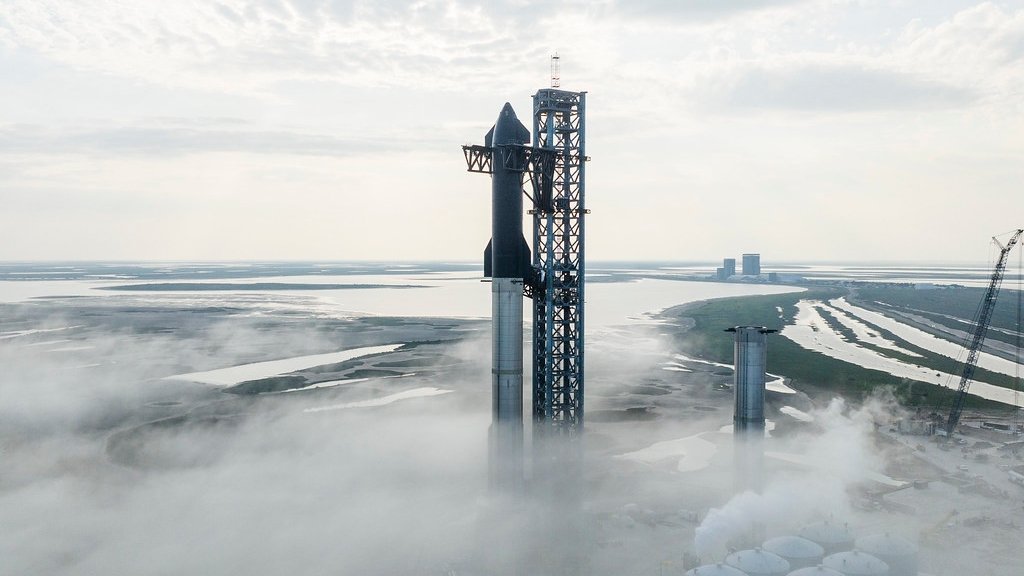
SpaceX’s Starship Ship 40 (S40) recovery operation has become one of the most challenging maritime recovery efforts in the company’s ambitious reusable-rocket program. After splashing down in the Indian Ocean, the massive stainless-steel spacecraft is facing rough seas, strong ocean currents, and major logistical hurdles that could make bringing it safely back to land extremely difficult.
At the same time, the commercial space industry is moving rapidly on several other fronts. A Falcon 9 upper stage has impacted the Moon, providing scientists with a rare opportunity to study lunar impact physics, while China’s LandSpace Zhuque-3 is preparing for another attempt at recovering an orbital-class booster.
Together, these developments highlight how quickly the global space industry is evolving toward reusable rockets, rapid recovery, and increasingly complex orbital operations.
Starship S40 Recovery Faces Major Problems in the Indian Ocean
Following the splashdown of Starship Ship 40, SpaceX recovery teams began working to keep the enormous vehicle afloat and prepare it for towing.
The approximately 52-meter (170-foot) Starship presents a completely different recovery challenge from conventional spacecraft. Rather than simply lifting a capsule from the ocean, recovery crews must stabilize a huge stainless-steel vehicle while protecting its structure and remaining hardware from seawater and waves.
SpaceX reportedly deployed 13 heavy-duty inflatable buoyancy bags around S40. Five were positioned on the port side, five on the starboard side, two around the forward nose section, and one near the aft Raptor area.
Why Ocean Conditions Are Making Recovery Difficult
The biggest problem is not simply keeping S40 afloat. It is moving the vehicle through the ocean.
Strong westward currents have reportedly reduced towing progress to roughly 1–2 knots, dramatically extending the time required to reach Australia. A direct maritime journey toward Dampier, Western Australia, could potentially take weeks under unfavorable conditions.
Large swells and tropical weather also create additional risks. The longer S40 remains in the ocean, the greater the potential for structural stress, seawater intrusion, corrosion, and damage to internal components.
Elon Musk has also acknowledged the difficult conditions, describing the recovery outlook as unfavorable because of the combination of rough seas and weather risks.
SpaceX Must Choose Between Salvage and Scuttling
The situation leaves SpaceX with an important decision: continue the difficult recovery attempt or abandon the vehicle at sea.
Several possible strategies could be considered.
Option 1: Continue Ocean Towing
The simplest approach is to continue using a recovery tug such as the Norman Ranger to tow S40 toward Australia.
However, the extremely slow towing speed could turn the operation into a weeks-long maritime mission. Continuous exposure to salt water could also increase the risk of corrosion and structural degradation.
The longer the journey takes, the more difficult it becomes to guarantee that S40 will arrive in a condition suitable for detailed inspection.
Option 2: Use a Heavy Transport Barge
A more ambitious solution would involve transferring Starship onto a heavy transport barge.
The reported Dong Bang Giant No. 2, a vessel with a capacity of approximately 12,000 tons, could provide a platform capable of transporting the spacecraft while reducing direct exposure to seawater.
This approach could take one to two months, depending on the route and operational circumstances, but it has one major advantage: keeping the vehicle relatively dry could preserve valuable hardware for engineering analysis.
For SpaceX, recovering damaged components from S40 could provide important information about Starship’s thermal protection system, structure, engines, tanks, and flight performance.
Option 3: Controlled Scuttling
If weather conditions deteriorate or recovery becomes too dangerous, SpaceX could ultimately decide to abandon and intentionally sink the vehicle.
Although this would eliminate the logistical burden of transporting S40 home, it would also mean losing access to the physical hardware.
That would be a significant disadvantage because post-flight inspections can reveal information that telemetry alone cannot provide.
Why SpaceX Wants to Catch Starship at the Tower
The difficulties surrounding S40 demonstrate one of the biggest reasons SpaceX is pursuing tower-based Starship catches.
Instead of allowing the spacecraft to splash down and then spending weeks recovering it, SpaceX wants future Starship missions to return directly to the launch site.
The concept involves the Mechazilla chopstick arms catching the spacecraft during its return to the launch tower.
Ocean Recovery vs. Tower Catch
Ocean recovery involves:
Splashdown → Water exposure → Buoyancy stabilization → Rigging → Towing → Maritime transport → Inspection
A successful tower catch could instead look like:
Re-entry → Controlled descent → Mechazilla catch → Immediate inspection
The difference is enormous.
A successful catch could provide engineers with rapid access to the vehicle, avoiding prolonged saltwater exposure and reducing the need for complex maritime salvage operations.
For a company focused on rapid reusability, recovering a Starship directly at the launch site could ultimately be far more efficient than recovering one from the middle of the ocean.
Falcon 9 Upper Stage Provides Rare Lunar Impact Data
While Starship S40 is dealing with an ocean recovery problem, another SpaceX-related event has created a unique scientific opportunity.
A Falcon 9 upper stage eventually collided with the Moon after remaining in space following a January 2025 mission.
The approximately 4,000-kilogram (8,800-pound) rocket body had completed its primary mission of sending lunar-bound payloads toward the Moon. Afterward, gravitational effects altered its trajectory until it eventually entered a collision course with the lunar surface.
The impact reportedly occurred on August 5, 2026, at a velocity of approximately 5,400 mph (8,690 km/h).
Danuri Orbiter Observes the Lunar Impact
South Korea’s Korea Aerospace Research Institute (KARI) used its Danuri lunar orbiter to observe the region before and after the collision.
The spacecraft conducted multiple imaging passes, giving scientists valuable baseline information about the lunar surface.
The resulting observations could help researchers better understand impact cratering, ejecta patterns, and lunar soil behavior.
The estimated crater could reach approximately 27 meters (89 feet) across, depending on the final analysis.
For planetary scientists, an accidental rocket impact can therefore become an unexpected experiment in lunar impact mechanics.
China’s LandSpace Zhuque-3 Enters the Reusability Race
The global reusable-launch competition is also intensifying.
Chinese launch company LandSpace is preparing another orbital recovery attempt involving its Zhuque-3 rocket.
The vehicle is approximately 66 meters (216 feet) tall and uses a stainless-steel architecture with methane and liquid oxygen (methalox) propulsion.
Its reported low-Earth-orbit payload capacity is around 18,300 kilograms (40,350 pounds).
Zhuque-3 Recovery Attempt Could Be Significant
During its first orbital test in December 2025, Zhuque-3 successfully demonstrated orbital performance, but the first stage encountered an issue during its final landing burn.
A subsequent static-fire test in June 2026 helped prepare the booster for another attempt.
The next mission could therefore provide an important demonstration of China’s progress toward reusable orbital rockets.
The competition is no longer limited to SpaceX. Companies and national programs around the world are increasingly working toward the same goal: launch, recover, inspect, and fly again.
What Comes Next for Starship S40?
The immediate future of Starship S40 depends heavily on weather, sea conditions, and SpaceX’s assessment of the vehicle’s recovery value.
If conditions remain manageable, SpaceX may continue efforts to tow or transport the spacecraft back for inspection. A heavy-lift barge could offer a safer alternative to an extremely long ocean tow.
However, if the recovery becomes too dangerous or expensive, controlled scuttling could become the final option.
Regardless of the outcome, S40’s difficult recovery highlights an important lesson for the Starship program: successful splashdown is not the same as successful recovery.
That is precisely why future missions are expected to increasingly focus on precision return and tower catching.
The Bigger Picture: Reusability Is Changing Spaceflight
The challenges surrounding Starship S40, the scientific value of the Falcon 9 lunar impact, and China’s Zhuque-3 recovery efforts all point toward the same broader trend.
The space industry is entering an era where reusability is becoming a central measure of launch-system capability.
SpaceX wants Starship to return directly to its launch infrastructure. LandSpace is developing reusable Zhuque-3 technology. Meanwhile, lunar missions are generating new opportunities to study how rocket hardware interacts with extraterrestrial environments.
For SpaceX, S40 may ultimately be more valuable as a source of engineering data than as a recovered vehicle. Even if the spacecraft cannot be brought home, lessons from its splashdown, flotation, structural behavior, and recovery attempt could influence future Starship missions.
The next major milestone will be whether SpaceX can move beyond difficult ocean salvage and achieve reliable Starship tower catches and rapid turnaround.
If that happens, the complicated recovery story surrounding S40 could become an important stepping stone toward the company’s larger goal: making fully reusable, rapidly deployable orbital transportation a practical reality.
FAQs
1. What happened to Starship Ship 40?
Starship Ship 40 (S40) completed its flight and splashed down in the Indian Ocean. The major challenge now is recovering the large spacecraft from the ocean and transporting it back for inspection.
2. Why is Starship S40 difficult to recover?
S40 is an enormous 52-meter (170-foot) stainless-steel spacecraft. Rough seas, strong ocean currents, weather conditions, and the risk of seawater damage make the recovery operation particularly challenging.
3. How is SpaceX keeping Starship S40 afloat?
Recovery teams have used 13 heavy-duty inflatable buoyancy bags around the spacecraft. These flotation units help keep the Starship airframe elevated above the water while crews prepare for transportation.
4. How many buoyancy bags are being used for S40?
The reported recovery setup includes 13 flotation bags: five on the port side, five on the starboard side, two near the forward section, and one near the aft section.
5. Why can’t SpaceX simply tow Starship S40 to Australia?
Strong ocean currents and rough weather can significantly reduce towing speed. Reports indicate progress could be only around 1–2 knots, potentially turning the journey toward Western Australia into a weeks-long operation.
6. What are SpaceX’s options for recovering S40?
SpaceX could continue ocean towing, use a heavy transport barge, or potentially perform a controlled scuttling if recovery becomes unsafe or impractical.
7. What is the advantage of using a heavy transport barge?
A heavy transport barge could help keep Starship S40 relatively dry and stable during the journey. This could preserve valuable components and allow engineers to conduct a more detailed inspection after reaching land.
8. Could SpaceX intentionally sink Starship S40?
Yes, controlled scuttling could become an option if weather or structural conditions make recovery too dangerous. However, sinking S40 would mean losing access to valuable physical hardware and inspection data.
9. Why is recovering S40 important to SpaceX?
Physical recovery could provide engineers with information about Starship’s structure, thermal protection, engines, seawater exposure, and flight performance that cannot be obtained entirely through telemetry.
10. Why does SpaceX want to catch Starship at the launch tower?
A tower catch could eliminate the complicated ocean-recovery process. Instead of splashing down and requiring weeks of maritime operations, Starship could potentially be caught near the launch site and inspected almost immediately.
11. What is the Mechazilla system?
Mechazilla is SpaceX’s launch-tower infrastructure that includes large mechanical arms, commonly called chopsticks, designed to handle and potentially catch Starship vehicles during recovery operations.
12. What happened to the Falcon 9 upper stage that hit the Moon?
A Falcon 9 upper stage from a January 2025 lunar mission remained in space after completing its primary role. Its trajectory was eventually altered by orbital dynamics, putting it on a collision course with the lunar surface.
13. How fast did the Falcon 9 upper stage hit the Moon?
The reported impact speed was approximately 5,400 mph (8,690 km/h). The high-energy collision created an opportunity for scientists to study lunar impact behavior.
14. How did scientists observe the Falcon 9 lunar impact?
South Korea’s KARI Danuri lunar orbiter captured observations of the impact region. Pre-impact and post-impact imagery can help researchers study crater formation, ejecta, and lunar soil behavior.
15. What is LandSpace Zhuque-3?
Zhuque-3 is a reusable orbital rocket being developed by China’s LandSpace. It uses a stainless-steel structure and methane-liquid oxygen (methalox) propulsion, with the first stage designed for powered vertical recovery.
16. What does the S40 recovery mean for the future of Starship?
The difficult recovery of S40 demonstrates why rapid, direct recovery is so important for a reusable spacecraft. If SpaceX can reliably catch Starship at the launch tower, it could dramatically reduce recovery time, saltwater exposure, transportation requirements, and turnaround costs.
Read More:
2 thoughts on “Starship Ship 40 Recovery in a Bad Situation, Can’t Bring It Back Home! What Comes Next”