
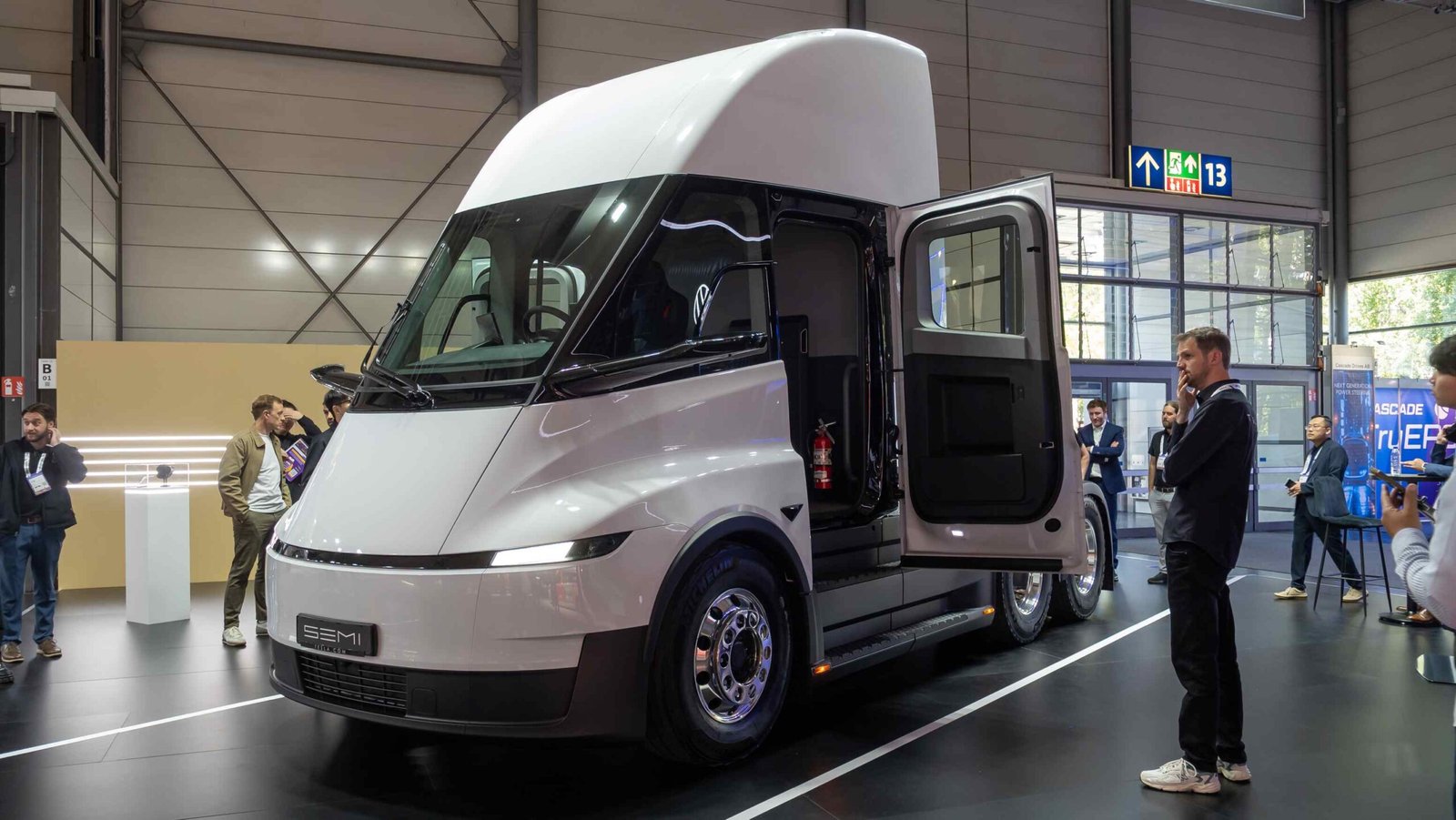
A New Upgraded Tesla Semi 2.0 Just LEAKED From Elon Musk’s Factory: The future of electric freight transportation is evolving rapidly, and Tesla is working to transform the heavy-duty trucking industry with its revolutionary Tesla Semi 2.0.
New engineering insights and factory developments highlight a vehicle designed to combine exceptional efficiency, advanced battery technology, simplified maintenance, and large-scale manufacturing. While the idea of a leaked upgrade has generated excitement, the technical details discussed here should be treated as reported engineering insights rather than confirmation of an official Tesla announcement.
Unlike traditional diesel trucks, which depend on complex mechanical engines and extensive fuel systems, the Tesla Semi uses an advanced electric powertrain designed to reduce operating expenses and improve transportation efficiency. From its aerodynamic exterior to its ambitious manufacturing plans, the Semi represents Tesla’s broader vision of building a complete electric freight ecosystem.
Tesla Semi 2.0: A New Era of Electric Trucking
The commercial trucking industry depends on reliability, operating costs, and the ability to transport heavy cargo over long distances. Every hour a truck spends in a repair shop can reduce revenue and disrupt delivery schedules.
Tesla’s approach focuses on more than simply replacing diesel engines with electric motors. The company is integrating vehicle design, battery engineering, manufacturing automation, and serviceability into a unified system.
The potential advantages include reduced energy costs, fewer conventional powertrain components, rapid charging, and a manufacturing process designed for higher production volumes.
For fleet operators, these improvements could make electric trucks increasingly attractive for regional distribution and long-distance freight operations.
Modular Design Could Make Repairs Faster
Replace Individual Sections Instead of Entire Assemblies
One of the most interesting aspects of the Tesla Semi’s design is its modular front-end structure. Traditional heavy-duty trucks can require extensive repairs when major front-end components are damaged. A sectional design can allow technicians to replace individual panels or components rather than rebuilding a larger assembly.
This approach could significantly reduce repair time following minor collisions or damage from road debris.
For companies operating large fleets, vehicle uptime is a major financial consideration. A truck that returns to service quickly can complete more deliveries and avoid unnecessary downtime.
Aerodynamics Remain a Priority
The Semi’s distinctive curved front end is designed to manage airflow around the vehicle. At highway speeds, aerodynamic drag can have a substantial effect on energy consumption.
Maintaining the truck’s original aerodynamic profile after repairs is therefore important for preserving its efficiency.
By combining modular repairability with aerodynamic engineering, Tesla aims to address two important challenges in commercial trucking: maintenance costs and energy consumption.
Advanced Battery Architecture and Serviceable Modules
A Battery Pack Built for Heavy-Duty Operations
The battery system is one of the most important components of an electric semi-truck. It must deliver substantial power while enduring vibration, heavy loads, temperature changes, and repeated charging cycles.
According to the supplied engineering overview, the Tesla Semi battery pack incorporates approximately 3,000 weld points and seven different joining techniques. The cabin reportedly contains around 2,800 weld points, highlighting the manufacturing complexity involved in building a heavy-duty electric vehicle.
These figures illustrate the importance of precise assembly and quality control.
Why Replaceable Battery Modules Matter
A particularly valuable feature described in the source is the use of serviceable battery modules. If a component develops a problem, the ability to repair or replace a specific section could reduce the need to replace the entire battery pack.
This matters because battery-related repairs can represent a significant expense over a truck’s working life.
For fleet managers, the real measure of battery technology is not just its capacity or charging speed. It is also its long-term durability, repairability, and total cost of ownership.
Tesla Semi 2.0 Performance and Charging Technology
Up to 500 Miles of Range
The long-range Tesla Semi configuration is described as offering up to 500 miles of range on a single charge. Such a capability could make the truck suitable for demanding freight routes, depending on cargo weight, weather, terrain, and driving conditions.
The source also reports an average energy consumption figure of approximately 1.7 kWh per mile.
Actual results will vary with operating conditions, so fleet operators must evaluate real-world performance rather than relying exclusively on published estimates.
Powerful Electric Motors in a Compact Package
The Tesla Semi’s electric drive units are remarkably compact compared with the individual cylinders of a conventional heavy-duty diesel engine.
Despite their size, the reported powertrain specifications include up to 800 kW of drive power. Electric motors also provide strong torque delivery, an important advantage when accelerating with heavy cargo or climbing steep gradients.
The electric architecture eliminates many traditional engine-related maintenance requirements, although battery systems, tires, brakes, cooling components, and high-voltage equipment still require inspection and servicing.
Megawatt-Level Charging
Charging speed is another major factor in the future of electric freight. The supplied source describes a charging architecture capable of accepting up to 1.2 megawatts under suitable conditions.
It also reports the ability to recover up to 60% of the truck’s range in approximately 30 minutes.
Such charging performance could help fleet operators schedule charging around legally required rest periods and delivery breaks. However, actual charging times depend on battery temperature, charger capability, the battery’s state of charge, and available electrical infrastructure.
Thermal Management and Improved Maneuverability
Keeping Battery and Motors Within Operating Limits
Heavy acceleration, steep climbs, and high-power charging generate substantial heat. An effective thermal management system helps maintain battery performance and protect important electrical components.
The engineering overview describes an indirect thermal architecture and three thermal compressors for the long-range configuration. It also highlights Tesla’s efforts to develop proprietary compressor technology.
Greater integration of cooling systems and powertrain components could help Tesla optimize efficiency, simplify manufacturing, and reduce dependence on external suppliers.
A Tighter Turning Radius
The Semi is also described as featuring independent front suspension, providing maneuverability intended to help drivers navigate loading docks, distribution centers, and congested delivery locations.
For commercial fleets, easier maneuvering can reduce the difficulty of operating a large vehicle in confined spaces.
Tesla’s 1.88-Million-Square-Foot Manufacturing Facility
Aiming for 50,000 Trucks Annually
Large-scale production could determine whether the Tesla Semi becomes a major force in commercial transportation.
The supplied overview describes a dedicated 1.88-million-square-foot manufacturing facility designed around a potential production target of 50,000 trucks per year, equivalent to roughly 1,000 trucks per week.
This is an ambitious target, not a guarantee of actual output. Production rates depend on factory readiness, supplier capacity, workforce training, quality control, and customer demand.
Automation and Vertical Integration
Tesla’s manufacturing strategy reportedly includes producing important components internally, including battery packs, drive axles, stampings, high-voltage distribution systems, cooling modules, and seats.
The facility is also described as using a 2,800-ton stamping press supported by approximately 600 sensors. Automated assembly equipment helps position the cabin and chassis accurately before subsequent production stages.
These systems are intended to improve consistency and identify manufacturing issues early.
Another reported feature is the use of powder coating, which can reduce the space required for certain finishing operations and minimize solvent-related emissions compared with conventional liquid-paint processes.
Multiple Configurations on One Production Line
The factory concept also emphasizes flexibility, with the ability to manufacture standard-range, long-range, and European-specification versions on a shared architecture.
This approach could help Tesla serve different commercial markets without requiring entirely separate production facilities for every configuration.
Can Tesla Semi 2.0 Transform Global Logistics?
The Tesla Semi’s long-term success will depend on more than impressive engineering figures. Fleet operators must consider the purchase price, charging infrastructure, electricity costs, payload requirements, maintenance expenses, battery longevity, and resale value.
For routes with predictable schedules and access to suitable charging infrastructure, electric freight trucks could offer meaningful operating advantages. However, diesel trucks may remain practical for some routes where charging access, operating conditions, or vehicle economics favor conventional powertrains.
Tesla’s greatest opportunity lies in demonstrating that its technology works reliably across thousands of vehicles and millions of miles.
Final Thoughts
The reported upgrades associated with the Tesla Semi 2.0 point toward a broader transformation in commercial trucking. Modular repairs, serviceable battery architecture, compact electric motors, high-power charging, advanced thermal management, and automated manufacturing could collectively improve the economics of electric freight.
The reported 500-mile range, 800 kW power output, and ambitious 50,000-truck annual production target illustrate the scale of Tesla’s ambitions, although specifications and production goals must be distinguished from independently verified operating results.
Ultimately, the decisive question is whether Tesla can deliver these benefits consistently in real-world fleet operations. If it succeeds, the Tesla Semi could become an important part of the transition toward more efficient, lower-emission, and increasingly electrified global logistics.
FAQs
1. What is the Tesla Semi 2.0?
The Tesla Semi 2.0 refers to an upgraded version of Tesla’s electric heavy-duty truck concept, focusing on improved battery technology, powertrain efficiency, modular repairs, and manufacturing scalability. The specific upgrades should be distinguished from officially confirmed Tesla announcements.
2. What is the expected range of the Tesla Semi 2.0?
The long-range Tesla Semi configuration is described as offering up to 500 miles on a single charge. Actual range can vary depending on cargo weight, weather, terrain, driving speed, and operating conditions.
3. How much power does the Tesla Semi produce?
The supplied engineering overview reports up to 800 kW of drive power. This electric powertrain is designed to deliver the performance required for demanding heavy-duty freight transportation.
4. How efficient is the Tesla Semi?
The reported energy consumption is approximately 1.7 kWh per mile. Real-world efficiency depends on factors such as road conditions, payload, temperature, and driving habits.
5. How fast can the Tesla Semi charge?
The supplied source describes a charging system capable of accepting up to 1.2 megawatts under suitable conditions. Charging speed varies according to charger capacity, battery temperature, and the battery’s state of charge.
6. How much range can the Tesla Semi recover in 30 minutes?
According to the provided engineering overview, the Tesla Semi can recover up to 60% of its range in approximately 30 minutes under suitable charging conditions. Actual results may differ.
7. What makes the Tesla Semi’s modular design important?
The modular design allows certain damaged front-end sections to be replaced individually instead of requiring extensive repairs to an entire assembly. This approach could reduce maintenance time and improve fleet availability.
8. Does the Tesla Semi have replaceable battery modules?
The supplied source describes serviceable and replaceable battery modules. This design could allow technicians to address certain battery problems without replacing the entire battery pack, potentially reducing repair costs.
9. How many weld points are used in the Tesla Semi battery pack?
The engineering overview reports approximately 3,000 weld points in the battery pack. It also describes seven different joining techniques intended to support structural durability and manufacturing precision.
10. How big is Tesla’s dedicated Semi factory?
The provided source describes a dedicated manufacturing facility measuring approximately 1.88 million square feet. The facility is intended to support large-scale production of Tesla’s electric heavy-duty trucks.
11. What is Tesla’s annual production target for the Semi?
The reported manufacturing target is 50,000 trucks per year, equivalent to roughly 1,000 trucks per week. This represents an ambitious production goal rather than a guarantee of actual output.
12. What manufacturing technologies does the Tesla Semi factory use?
The supplied overview highlights advanced automation, precision assembly, vertical integration, and sensor-assisted stamping. It also describes a 2,800-ton stamping press equipped with approximately 600 sensors.
13. Does the Tesla Semi use an advanced thermal management system?
Yes. The source describes an indirect thermal management architecture and three thermal compressors for the long-range configuration. These systems are designed to help control heat generated during driving and high-power charging.
14. How could the Tesla Semi reduce operating costs for trucking companies?
The Tesla Semi could reduce certain operating expenses through electric powertrain efficiency, lower dependence on conventional engine maintenance, modular repairs, and potentially lower energy costs. Actual savings depend on electricity prices, vehicle purchase costs, maintenance, charging infrastructure, and route requirements.
15. Can the Tesla Semi 2.0 transform the future of freight transportation?
The Tesla Semi 2.0 could contribute to the transition toward electric freight by combining long-range capability, high-power charging, advanced manufacturing, and serviceable components. Its long-term success will depend on reliable performance, competitive operating costs, charging availability, and the ability to scale production.
Read More:
- Elon Musk roasts India’s billionaire Mukesh Ambani as Starlink fight heats up
- Elon Musk’s $179 Tesla Wheelchair: Features, Specs, and Everything You Need to Know
- The $20,000 Tesla Motorhome: 400 Miles, Solar Power, and Self-Driving Innovation
- SpaceX’s new Starship Flight 15 Launch date DELAY to Do Something Impossible
- The Boring Company’s NEW Dubai Loop is INSANE
3 thoughts on “A New Upgraded Tesla Semi 2.0 Just LEAKED From Elon Musk’s Factory”