
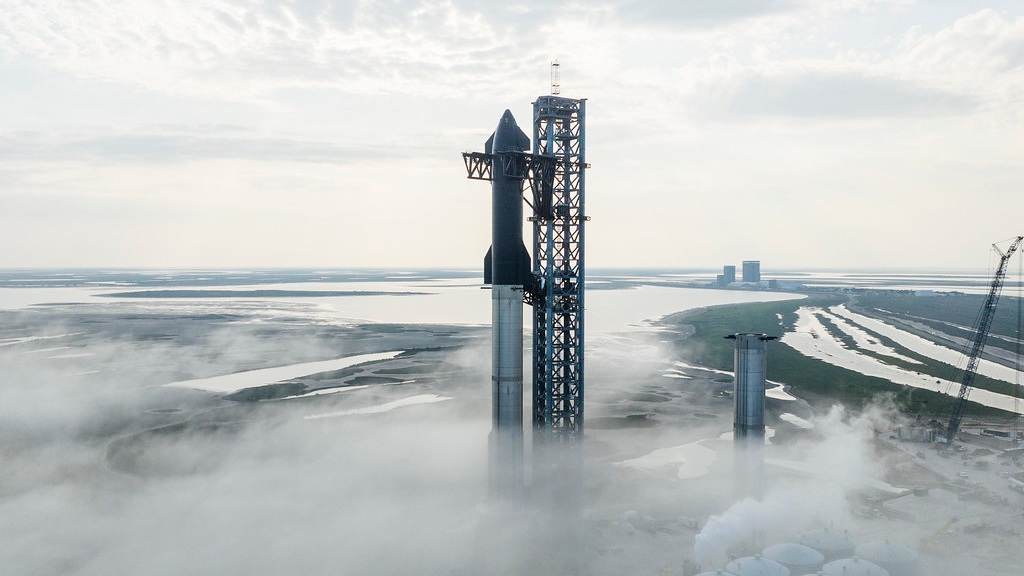
Starship S40 finally Completed Full-Engine Fire Test, Faster Than Expected! Pad-2 in Strange Tests: The pace of SpaceX Starship development has once again stunned the aerospace world. Just when many expected a brief pause after the latest testing campaign, Starbase, Texas shifted into an even higher gear. With Starship S40 completing a successful full-duration six-engine static fire, Starship S41 rapidly finishing cryogenic testing, and Orbital Launch Pad 2 undergoing a series of unusual water deluge tests, all signs point toward Flight 13 arriving much sooner than many expected.
The speed of these developments highlights SpaceX’s unique engineering philosophy: test quickly, learn rapidly, and improve continuously. Every rollout, engine firing, and infrastructure upgrade is another step toward making fully reusable spaceflight a practical reality.
SpaceX Accelerates Starship Development
Unlike traditional aerospace programs that often require months between major milestones, SpaceX continues to compress development timelines dramatically.
Instead of slowing down after previous launch campaigns, Starbase has entered one of its busiest testing periods of 2026. Engineers are simultaneously advancing vehicle testing, booster preparations, and launch pad improvements.
This rapid pace has surprised even experienced Starship watchers.
The biggest highlight? Starship S40 completed its full-engine static fire only days after many expected it to enter a lengthy inspection phase.
Starship S40’s Record-Breaking Turnaround
The timeline of Starship S40 tells the story of how quickly SpaceX now operates.
Timeline of Recent Events
- June 23: S40 rolled out to Massey’s Test Site.
- June 28: S41 arrived for cryogenic testing.
- June 29–30: S41 completed two cryogenic proof tests.
- June 30: S41 returned to the production yard.
- June 30 (Night): S40 unexpectedly returned to the test stand.
- July 1: S40 completed a full-duration six-engine static fire test.
Initially, many observers believed S40 would remain in the production yard for weeks while engineers analyzed data from its earlier single-engine test.
Instead, SpaceX surprised everyone by moving the vehicle back to Massey’s under the cover of darkness without the usual advance notices.
By the following morning, massive white vapor clouds signaled that liquid oxygen and liquid methane loading operations had already begun.
S40 Successfully Completes Full Six-Engine Static Fire
The highlight of July 1 came at 5:01 PM Central Time, when all six Raptor engines ignited together.
This was far more significant than the earlier single-engine test.
The six engines generated an estimated 1,700+ metric tons of thrust, shaking the test site and producing enormous dust clouds around the flame trench.
More importantly, this wasn’t a short ignition.
The engines burned continuously for approximately 60 seconds, providing engineers with valuable real-world performance data.
Why the Full-Duration Burn Matters
A one-minute static fire allows engineers to evaluate several critical systems under sustained operating conditions.
Long-Duration Thermal Performance
Extended burns help verify that engine components can survive prolonged exposure to extreme temperatures without suffering excessive thermal stress or material degradation.
Propellant Flow Stability
During longer burns, engineers can carefully monitor how liquid oxygen (LOX) and liquid methane (CH4) move through the propulsion system while fuel levels decrease.
Thrust Vector Control
Maintaining stable engine steering throughout an extended burn helps validate guidance systems that will later operate during actual flight.
Overall Engine Reliability
Perhaps most importantly, the successful test showed no major anomalies or premature shutdowns, indicating the upgraded Raptor engines are becoming increasingly reliable.
What’s Next for Starship S40?
Following the successful static fire, S40 is expected to return to the production facility for final flight preparations.
Remaining Work Includes
Flight Termination System (FTS)
Engineers will install and verify the vehicle’s safety system before launch approval.
Payload Door Verification
The payload bay doors must complete functional testing to ensure proper operation during future missions.
Aerodynamic Flap Inspections
The large forward and aft flaps will undergo additional inspections and calibration to ensure stable atmospheric flight and controlled reentry.
With these remaining tasks completed, Starship S40 will be ready for Flight 13.
Starship S41 Quietly Finished Its Own Mission
While S40 attracted most of the attention, Starship S41 quietly achieved an equally impressive milestone.
After arriving at Massey’s Test Site on June 28, S41 completed two cryogenic proof tests within just 48 hours.
Cryogenic testing validates the vehicle’s structural integrity while fully loaded with ultra-cold propellants.
After completing both tests successfully, S41 returned to the production yard on June 30, demonstrating how rapidly SpaceX can now cycle multiple Starship vehicles through testing.
Pad 2 Undergoes Major Upgrades
While Starship vehicles continue advancing, SpaceX has also been transforming Orbital Launch Pad 2.
The launch infrastructure is just as important as the rocket itself.
For rapid reusability to become practical, the launch pad must survive repeated launches with minimal repairs.
Recent upgrades include:
Stronger Mechazilla Catch System
Engineers have installed new catch rails and strengthened structural interfaces that will eventually support routine booster recovery operations.
Quick Disconnect Improvements
The Booster Quick Disconnect (BQD) system recently completed successful mechanical testing after extensive modifications.
Improved Structural Protection
Additional steel shielding now surrounds key launch tower components to better withstand intense heat and acoustic energy during launches.
Expanded Propellant Storage
New storage tanks increase fueling capacity, making back-to-back launch operations much more practical.
Together, these upgrades bring SpaceX one step closer to airline-like launch operations.
The Strange Double Water Deluge Tests
Perhaps the most mysterious activity occurred on June 30 and July 1.
Instead of performing a single water deluge test, SpaceX conducted two separate deluge sequences each day.
Even more unusual was the water flow itself.
Rather than erupting primarily from beneath the launch mount, water first spread across the upper deck before cascading downward.
This unusual configuration immediately sparked speculation throughout the Starship community.
Could SpaceX Be Preparing for Booster Catches?
One of the strongest theories centers on Super Heavy booster recovery.
Following launch, the booster separates from Starship and returns toward the launch site approximately seven to eight minutes later.
Interestingly, the interval between SpaceX’s paired deluge tests matched this exact timeline.
Many observers now believe the upper-deck water system may be designed to cool the launch tower immediately before booster capture.
Why This Makes Sense
A returning Super Heavy booster still radiates enormous heat from its engines.
Flooding the upper launch mount with water immediately before capture could:
- Reduce thermal stress
- Protect tower structures
- Prevent metal warping
- Prepare the pad for rapid reuse
If this theory proves correct, SpaceX is already testing systems that support routine booster recovery in future missions.
Flight 13 Timeline Looks Increasingly Realistic
With Booster 20 (B20) already completing preliminary cryogenic testing, the schedule for Flight 13 is becoming clearer.
Expected Flight 13 Schedule
Early July
- Booster 20 rollout
Mid July
- Full Booster static fire
Third Week of July
- Wet Dress Rehearsal (WDR)
- Flight Termination System verification
Late July
- Potential Flight 13 launch window
Of course, the timeline depends on a successful 33-engine Super Heavy static fire, one of the most complex rocket tests ever attempted.
Even a single unexpected sensor reading could shift the launch into early August.
Will Flight 13 Feature a Booster Catch?
Despite all the recent infrastructure improvements, a Mechazilla booster catch during Flight 13 still appears unlikely.
Previous flights provided valuable recovery data, but engineers will likely seek additional validation before risking the launch tower.
Instead, Booster 20 is expected to perform another highly controlled ocean splashdown.
This allows SpaceX to validate upgraded structures, grid fin systems, and thermal protection while minimizing operational risk.
The unusual Pad 2 testing likely represents preparation for Flight 14 or Flight 15, when tower catches could become far more realistic.
Final Thoughts
The latest developments at Starbase demonstrate that SpaceX continues to redefine how quickly modern rockets can be developed and tested.
The rapid progression of Starship S40, the swift testing campaign for S41, extensive Pad 2 upgrades, and the mysterious double water deluge tests all point toward one conclusion: Flight 13 is approaching faster than many expected.
Every successful engine firing, every infrastructure improvement, and every unusual experiment moves SpaceX closer to its ultimate objective—creating a fully reusable launch system capable of supporting frequent missions to Earth orbit, the Moon, and eventually Mars.
If current progress continues, the coming weeks could become another historic chapter in the Starship program, with Flight 13 serving as yet another major milestone on the road toward routine, rapid, and reliable spaceflight.
FAQs
1. What is Starship S40?
Starship S40 is one of SpaceX’s latest Starship upper-stage prototypes designed for testing advanced systems, engine performance, and future orbital missions. It is expected to support the upcoming Flight 13 mission after completing final preparations.
2. What is a full-engine static fire test?
A full-engine static fire test is a ground test in which all of a rocket’s engines ignite while the vehicle remains securely attached to the launch stand. This allows engineers to verify engine performance, fuel flow, and system reliability before launch.
3. How many engines does Starship S40 have?
Starship S40 is equipped with six Raptor engines, including three sea-level Raptors and three vacuum-optimized Raptors, which work together during different phases of flight.
4. Why is the six-engine static fire important?
The successful six-engine static fire confirms that all engines can operate together for an extended period. It also provides valuable data on thermal performance, thrust control, and propellant flow before the spacecraft’s next flight.
5. What happened during the Starship S40 static fire test?
On July 1, Starship S40 successfully ignited all six Raptor engines and completed a full-duration burn lasting about one minute without any major reported issues, marking a significant milestone in its testing campaign.
6. What is Starship S41?
Starship S41 is another Starship prototype currently undergoing development. It recently completed two cryogenic proof tests before returning to the production site for additional work.
7. What is cryogenic testing?
Cryogenic testing involves filling a rocket with extremely cold propellants like liquid oxygen and liquid methane to verify the structural strength of the tanks and ensure they can safely withstand launch conditions.
8. Why is SpaceX upgrading Pad 2?
SpaceX is upgrading Orbital Launch Pad 2 to improve durability, increase fueling efficiency, strengthen recovery systems, and support the company’s long-term goal of rapid rocket reusability.
9. What were the unusual double water deluge tests?
SpaceX conducted two closely spaced water deluge tests on consecutive days. The unique timing and water flow pattern have led many observers to believe the company is evaluating new cooling methods for future booster recovery operations.
10. What is the purpose of the water deluge system?
The water deluge system reduces extreme heat, vibration, and acoustic energy generated during rocket launches. It helps protect both the launch pad and surrounding infrastructure from damage.
11. What is Flight 13?
Flight 13 is expected to be the next major Starship integrated flight test, featuring Starship S40 and Booster 20 after both vehicles complete all required testing and safety checks.
12. Will Flight 13 include a Super Heavy booster catch?
Current expectations suggest that Flight 13 is more likely to end with another controlled ocean splashdown for the Super Heavy booster rather than a return-to-launch-site tower catch, although final plans may change based on testing results.
13. What is Booster 20 (B20)?
Booster 20 (B20) is the Super Heavy first-stage booster currently being prepared for Flight 13. It is expected to undergo static fire testing before launch approval.
14. What is SpaceX’s ultimate goal with Starship?
SpaceX aims to build a fully reusable launch system capable of dramatically lowering the cost of space travel while supporting missions to Earth orbit, the Moon, Mars, and beyond.
15. When could Starship Flight 13 launch?
If all remaining vehicle tests and booster static fires are completed successfully, Flight 13 could launch in late July, although additional testing or unexpected technical findings could move the schedule into early August.
Read More:
- Elon Musk Unveils New Tesla Mega Projects That SHOCKED China
- Elon Musk outlines Tesla Optimus production expectations
- Tesla expands Robotaxi to Florida, marking its third state for autonomy
- Tesla Semi involved in first known fatal crash in Nevada
- Tesla’s strong Q2 deliveries: Four key drivers behind the surprise