
A close-up image of a Cybercab engineering vehicle in Peabody, Massachusetts, reveals a compact triangular side repeater camera housing equipped with an integrated washer mechanism.
This seemingly small hardware addition could prove to be one of the most critical components for achieving reliable, unsupervised Full Self-Driving (FSD) — not just for the dedicated Robotaxi but potentially for existing AI4-equipped vehicles as well.
The washer system’s importance cannot be overstated in Tesla’s vision-only autonomy approach. Cameras are the sole sensory input for the neural networks powering FSD, constantly interpreting the environment for safe navigation. In real-world conditions, however, lenses quickly accumulate rain, snow, mud, dust, or road spray.
Many of us Tesla owners, especially those who deal with any sort of winter weather at all, know the all-too-common alert that pops up when cameras are obstructed:
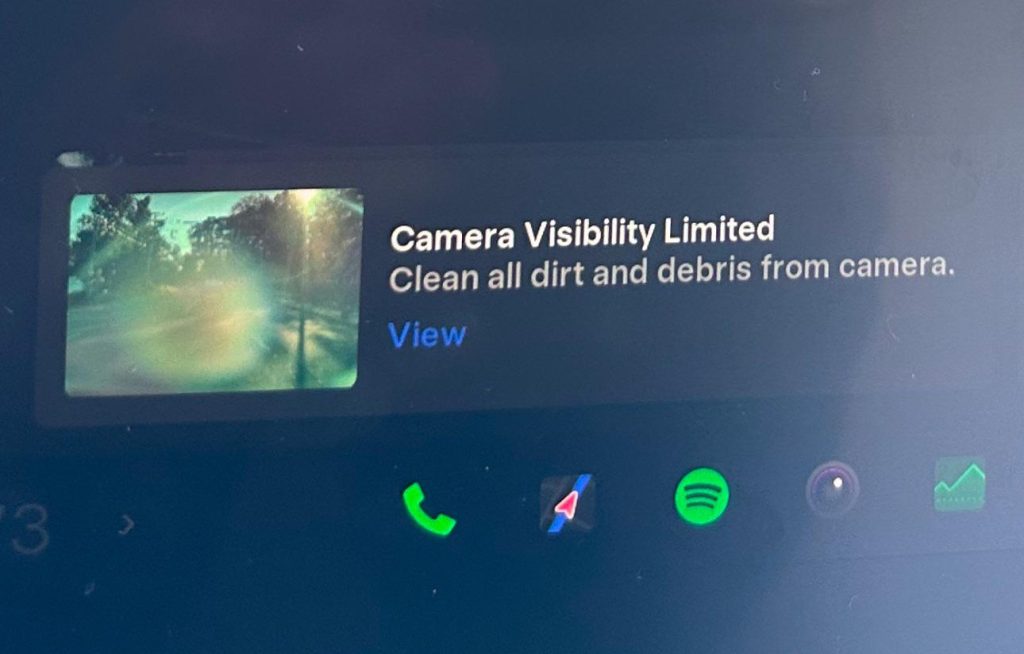
Even brief obstructions can drop perception confidence, trigger safety disengagements, or force the vehicle to pull over, although these are relatively rare. Instead, most of the time, the camera will need a wipe from the owner next time they stop the car.
But unlike human drivers who can manually clear their view, a Robotaxi operating 24/7 without a steering wheel or mirrors must maintain pristine vision autonomously. The Cybercab’s side repeater washer delivers targeted cleaning bursts precisely where needed for merging, lane changes, and blind-spot monitoring — functions that demand uninterrupted visibility from the external cameras:
And this is how the side camera and washer look like on a Cybercab. This is from an Engineering vehicle in Peabody MA. pic.twitter.com/Re8VknpmLM
— Tobias Goebel (Unsupervised) (@tpgoebel) June 17, 2026
This hardware directly tackles a known pain point in current FSD deployments. Owners frequently report camera-related alerts during inclement weather, which is understandable, but needs to be solved for a true autonomous experience.
For a production Robotaxi fleet aiming for high utilization and minimal downtime, robust washer systems represent a foundational reliability upgrade; essentially, they’re a must-have. Early sightings suggest the design may extend to rear cameras as well, creating a comprehensive cleaning architecture that keeps the entire vision suite operational in harsh environments.
Without it, even the most advanced neural nets struggle when their “eyes” are compromised.
What Does This Mean for AI4 Cars?
This Cybercab detail raises timely questions for AI4 cars already on the road. While Hardware 4 delivers superior compute and camera resolution compared to earlier versions, production models typically lack dedicated side and rear washers. Tesla has included them on Model Y robotaxis that it is using in the fleet:
Tesla Robotaxi has a highly-requested hardware feature not available on typical Model Ys
As Tesla refines unsupervised FSD for broader release, the gap in environmental resilience becomes evident. Software improvements can help mitigate issues, but they cannot fully replace physical cleaning in heavy rain or muddy conditions. Analysts and owners increasingly speculate that AI4 vehicles may eventually require similar washer retrofits — or a future AI4.5 variant — to match the Cybercab’s all-weather readiness and support the same level of autonomy.
As testing progresses, the Cybercab’s washer mechanism highlights Tesla’s pragmatic focus on real-world robustness. It may well become the hardware piece that determines how quickly and reliably FSD scales from prototypes to everyday vehicles.
The post Tesla Cybercab has one important piece that AI4 cars might need for FSD appeared first on TESLARATI.
1 thought on “Tesla Cybercab has one important piece that AI4 cars might need for FSD”