
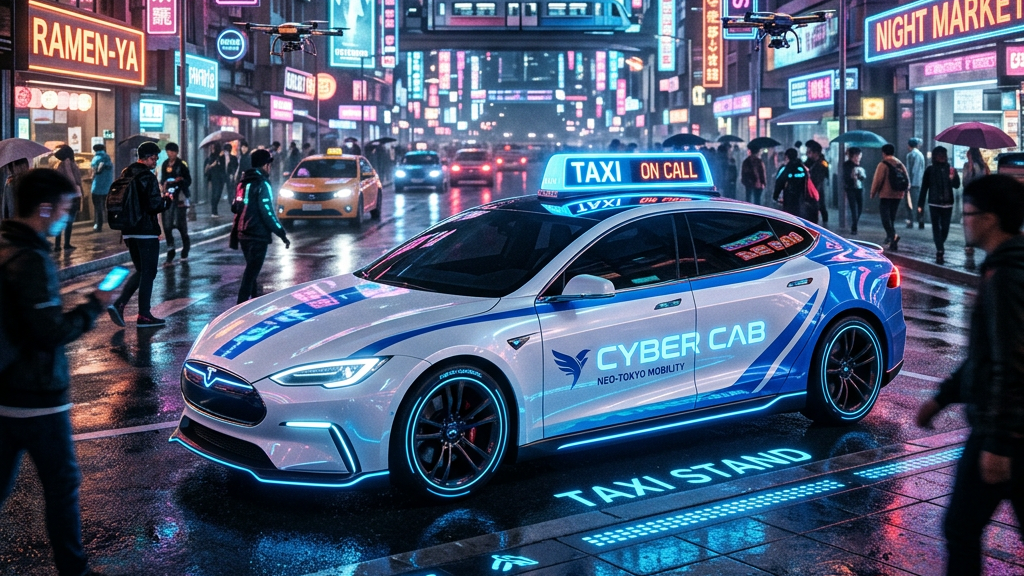
The Tesla Cybercab Robotaxi Bombshell Upgrade 2026 represents a major evolution in autonomous transportation technology. Tesla’s next-generation robotaxi platform combines localized offline edge computing, Starlink V5 satellite connectivity, and advanced AI-driven autonomous systems to create a scalable driverless mobility network.
Unlike traditional autonomous vehicle platforms that depend heavily on cloud computing and continuous cellular connections, the Tesla Cybercab architecture is designed around a powerful principle: critical driving decisions must happen inside the vehicle itself. Satellite connectivity acts as an additional communication layer, while the vehicle’s onboard AI hardware manages perception, planning, and control.
This approach creates a more reliable and resilient autonomous system capable of operating even when external connectivity is unavailable.
Starlink V5 Integration: A New Era of Connected Robotaxis
One of the most significant upgrades in the Cybercab platform is the integration of a Starlink V5 flat-panel satellite terminal. Production-intent Cybercab units observed at Gigafactory Texas revealed a roof-mounted satellite communication system positioned alongside the vehicle’s primary camera and sensor suite.
The integration of Starlink V5 transforms the Cybercab into a highly connected autonomous vehicle capable of maintaining communication beyond traditional cellular networks.
Starlink V5 Hardware Optimization for Vehicles
The automotive-focused Starlink V5 terminal has been redesigned for efficiency compared with earlier residential satellite hardware.
Key Starlink V5 Cybercab advantages include:
- Lower power consumption: The terminal operates at approximately 35–50 watts, significantly reducing energy usage compared with previous Starlink hardware.
- Reduced weight: At around 2.4 pounds, the compact flat-panel design minimizes additional vehicle mass.
- High-speed connectivity: The system delivers 375+ Mbps peak download speeds, enabling advanced telemetry, entertainment, and fleet communication.
This optimization allows Tesla to integrate satellite connectivity without creating unnecessary battery drain or aerodynamic penalties.
How Starlink V5 Supports the Cybercab Fleet
The Starlink connection is not designed to control the vehicle’s driving decisions. Instead, it functions as an auxiliary communication pipeline supporting fleet operations and passenger services.
Fleet Management and Telemetry Functions
Starlink V5 enables several important capabilities:
Continuous over-the-air updates: Tesla can distribute software improvements, security patches, and autonomous driving updates across large fleets.
Remote support capabilities: In complex situations, fleet operators can receive vehicle data and provide assistance.
Edge-case data uploads: Rare driving scenarios can be collected and analyzed to improve future autonomous models.
Passenger Experience Improvements
The satellite connection also enhances the passenger experience by supporting:
- High-definition video streaming
- Real-time navigation updates
- Reliable connectivity in remote areas
- Future entertainment services
The result is a robotaxi experience that combines autonomous transportation with always-available digital services.
Offline Edge AI: Why Cybercab Does Not Depend on the Cloud
A major concern with connected autonomous vehicles is what happens when internet access fails. Tesla’s Cybercab architecture addresses this challenge through offline autonomous edge computing.
The vehicle’s core safety systems operate independently from satellite or cellular networks.
Autonomous Driving Runs Locally Inside the Vehicle
The Cybercab uses onboard AI processing for:
- Real-time perception
- Occupancy network evaluation
- Path planning
- Vehicle control and actuation
This means the vehicle does not need to communicate with external servers before making critical driving decisions.
If Starlink or cellular connectivity becomes unavailable, the autonomous driving system continues operating using its internal computing resources.
Dual AI4 Chips: The Compute Foundation Behind Cybercab
The Cybercab platform is powered by advanced Tesla AI4 hardware designed to process massive amounts of visual information from multiple onboard cameras.
The system uses:
- Dual AI4 computing chips
- 32GB+ combined high-bandwidth memory capacity
- Optimized processing for end-to-end neural networks
This hardware foundation allows Tesla’s autonomous system to analyze complex environments with minimal latency.
Instead of sending camera data to the cloud for processing, Cybercab performs real-time decisions locally, creating a faster and more dependable autonomous experience.
Tesla and SpaceX Ecosystem Strategy
The integration of Starlink technology into Cybercab represents a broader strategic connection between Tesla and SpaceX.
By combining autonomous vehicles with satellite connectivity, both companies can create a powerful technology ecosystem.
Global Autonomous Fleet Connectivity
A large Cybercab fleet equipped with Starlink could provide reliable communication in areas where traditional networks are limited.
Potential benefits include:
- Rural autonomous transportation
- Disaster-area mobility services
- Off-grid fleet management
- Reliable emergency communication
This gives Tesla an advantage in regions where cellular infrastructure cannot support large-scale robotaxi operations.
New Recurring Revenue Opportunities
The Cybercab ecosystem could also increase demand for satellite connectivity services.
Millions of autonomous vehicles could become connected Starlink endpoints, creating additional subscription opportunities while expanding SpaceX’s satellite network utilization.
Tesla Robotaxi Deployment and Unsupervised Operations
Tesla’s autonomous strategy is moving beyond traditional supervised testing toward broader commercial robotaxi deployment.
The Cybercab platform is designed for unsupervised autonomous ride-hailing, meaning vehicles can operate without a safety driver occupying the driver seat in approved areas.
Robotaxi Deployment Expansion
Potential operating regions include major metropolitan markets such as:
- Orlando, Florida
- Tampa, Florida
- Miami, Florida
- Dallas, Texas
- Houston, Texas
- Austin, Texas
- San Francisco Bay Area
These deployments rely on controlled operating zones, fleet management infrastructure, automated charging solutions, and maintenance facilities.
Cybercab vs Traditional Autonomous Vehicle Systems
The Cybercab introduces several architectural improvements compared with earlier autonomous vehicle approaches.
| System Area | Traditional Approach | Cybercab Upgrade |
|---|---|---|
| Connectivity | Cellular networks | Starlink V5 satellite integration |
| Computing | Cloud-assisted systems | Local AI edge processing |
| Safety Operation | Hybrid dependency | Offline autonomous execution |
| Hardware | Earlier AI platforms | Dual AI4 processors |
| Fleet Model | Supervised testing | Unsupervised robotaxi deployment |
This architecture focuses on reliability, scalability, and global deployment potential.
The Future of Autonomous Transportation
The Tesla Cybercab Robotaxi Bombshell Upgrade 2026 highlights a shift in how autonomous vehicles may be built in the future.
Instead of depending on constant cloud communication, Tesla’s approach combines:
- Powerful onboard AI
- Satellite-based connectivity
- Large-scale fleet management
- Autonomous software improvements
The combination of Tesla AI technology and Starlink connectivity creates a foundation for a new generation of driverless transportation.
As autonomous fleets expand, the Cybercab could become a key platform in Tesla’s vision of scalable, fully autonomous mobility.
FAQs
1. What is the Tesla Cybercab Robotaxi Bombshell Upgrade 2026?
The Tesla Cybercab Robotaxi Bombshell Upgrade 2026 refers to Tesla’s next-generation autonomous vehicle architecture that combines AI-powered onboard computing, Starlink V5 satellite connectivity, and a fully autonomous ride-hailing system. The platform is designed to reduce dependence on cloud processing while improving fleet scalability and reliability.
2. Does Tesla Cybercab require an internet connection to drive autonomously?
No. The Cybercab is designed with offline edge AI architecture, meaning critical autonomous driving functions such as perception, path planning, and vehicle control are performed locally inside the vehicle. Satellite or cellular connectivity is used mainly for telemetry, updates, and passenger services.
3. What is the purpose of Starlink V5 in Tesla Cybercab?
The Starlink V5 terminal acts as a high-speed communication system for the Cybercab fleet. It supports fleet management, software updates, remote assistance, passenger entertainment, and connectivity in areas with limited cellular coverage.
4. How does Starlink V5 improve Tesla Cybercab performance?
Starlink V5 improves Cybercab operations by providing reliable satellite communication with lower power consumption and a compact design. It enables continuous fleet communication without interfering with the vehicle’s autonomous driving functions.
5. How much power does the Cybercab Starlink V5 terminal use?
The embedded Starlink V5 terminal is optimized for vehicle applications and uses approximately 35–50 watts of power, reducing energy consumption compared with earlier Starlink hardware versions.
6. Can Tesla Cybercab operate without Starlink or cellular signals?
Yes. The Cybercab’s safety-critical autonomous systems operate independently of external networks. If satellite or cellular connectivity is lost, onboard AI hardware continues processing sensor data and controlling the vehicle.
7. What AI hardware powers Tesla Cybercab?
Tesla Cybercab uses advanced AI4 computing hardware, including dual AI4 chips designed to process high-resolution camera feeds and run large-scale autonomous driving neural networks with low latency.
8. What role does AI4 hardware play in autonomous driving?
AI4 hardware enables the Cybercab to perform real-time tasks such as:
- Object detection
- Road environment analysis
- Occupancy prediction
- Path planning
- Vehicle control decisions
This reduces dependence on external computing systems.
9. How fast is the Starlink V5 connection inside Cybercab?
The Starlink V5 terminal is designed to deliver approximately 375+ Mbps peak download speeds, supporting high-bandwidth applications such as telemetry uploads, passenger streaming, and fleet communication.
10. Will Tesla Cybercab work in rural areas without 5G coverage?
Yes. One of the major advantages of combining Starlink satellite connectivity with autonomous edge computing is the ability to support operations in areas where traditional cellular networks are unavailable or unreliable.
11. What makes Tesla Cybercab different from traditional robotaxis?
Traditional autonomous vehicles often rely heavily on cloud-based systems and continuous network connectivity. Cybercab focuses on local AI processing, allowing autonomous decisions to happen inside the vehicle while using connectivity as an additional support layer.
12. Is Tesla Cybercab a fully driverless vehicle?
The Cybercab platform is designed for unsupervised autonomous ride-hailing, meaning approved vehicles can operate without a human safety driver in specific deployment zones when regulatory and operational requirements are met.
13. How does Cybercab support Tesla and SpaceX’s ecosystem strategy?
Cybercab creates a connection between Tesla’s autonomous transportation network and SpaceX’s Starlink satellite infrastructure. A large autonomous fleet could become a major user base for satellite connectivity services while improving global vehicle communication.
14. When could Tesla Cybercab become widely available?
Tesla’s Cybercab deployment timeline depends on autonomous technology validation, regulatory approvals, manufacturing scale, and regional requirements. Large-scale commercial expansion is expected to develop gradually as Tesla expands testing and fleet operations.
15. What is the future impact of Tesla Cybercab technology?
Tesla Cybercab could transform transportation by enabling scalable autonomous ride-hailing, reducing dependence on human drivers, improving mobility access, and creating a connected transportation network powered by AI and satellite technology.
Read More:
- Tesla stock tumbles after earnings, one of its sharpest single-day declines
- SpaceX Starship Flight 13 faces wrath of the Texas skies
- Tesla door handle saga gets its latest chapter and a big change is coming
- Tesla short sellers win big after shares fall after earnings
- Tesla’s Supercharger Diner probably just secured more locations