
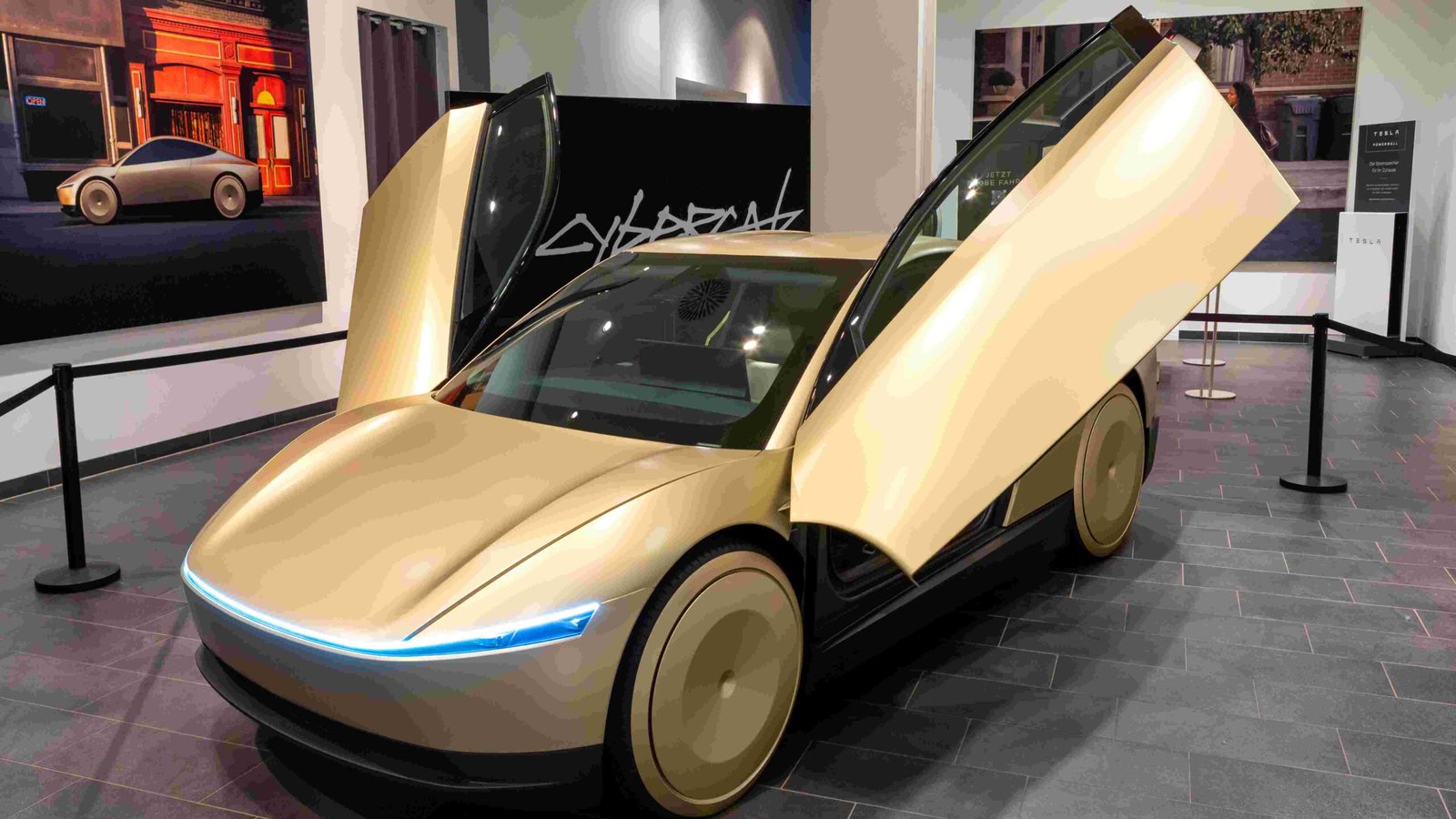
Tesla Cybercab Robotaxi Spotted New UPGRADE! Massive Fleet Coming: Tesla is accelerating its vision for autonomous transportation with major developments spanning the Cybercab robotaxi, AI chip manufacturing, the next-generation Roadster, and vehicle safety. From production Cybercabs equipped with Starlink connectivity to a new energy strategy for the massive TeraFab facility, these updates reveal how Tesla is building an increasingly integrated transportation and technology ecosystem.
Tesla Cybercab Robotaxi Production Is Ramping Up
The Tesla Cybercab is moving closer to large-scale deployment, with production vehicles reportedly accumulating at staging facilities across Texas. Unlike conventional Tesla vehicles, the Cybercab is designed specifically for autonomous operation and is expected to target a price of around $30,000.
The vehicle uses Tesla’s AI4 computing platform and a vision-based autonomous driving architecture. Its ability to process navigation and perception locally is an important part of Tesla’s strategy for deploying autonomous vehicles at scale.
However, one of the most interesting new developments is the addition of integrated Starlink hardware.
Cybercab Gets Integrated Starlink V5 Connectivity
Production Cybercabs have reportedly been spotted with a compact Starlink V5 antenna integrated into the roof. This is significant because it turns satellite connectivity into a built-in part of the robotaxi platform rather than an external accessory.
The satellite connection could provide several advantages for a large autonomous fleet.
First, remote fleet monitoring could remain available in areas where cellular coverage is weak or unavailable. This could be particularly useful for robotaxis operating in rural regions or on long-distance routes.
Second, passengers could potentially benefit from high-speed internet connectivity while traveling. Streaming, remote work, cloud applications, and other connected services could become part of the Cybercab experience.
Finally, satellite connectivity could support over-the-air software updates and vehicle diagnostics, giving Tesla another communication pathway for its autonomous fleet.
Hundreds of Cybercabs Could Be Heading Toward Deployment
Reports of yellow Cybercabs gathering at Tesla staging locations in Texas suggest that the company is building a meaningful initial fleet.
Estimates have placed the number of vehicles produced at approximately 500 to 1,000 units, although production figures should be treated as estimates until Tesla provides official numbers.
The early manufacturing ramp is likely to be challenging because Cybercab represents a substantially different vehicle architecture from Tesla’s existing models.
Why Cybercab Production Could Be Slower Initially
One factor is the normal manufacturing learning curve. New vehicle programs typically begin slowly before production processes become more efficient.
Another challenge involves 4680 battery cell supply. Tesla’s battery production must support multiple vehicle programs, including Cybercab, Tesla Semi, and Model Y production.
Tesla is also balancing hardware production with Full Self-Driving validation. For a vehicle designed around autonomous operation, manufacturing capacity alone is not enough. The software, safety systems, fleet monitoring infrastructure, and regulatory requirements all need to progress together.
TeraFab: Tesla and SpaceX Plan Massive AI Chip Infrastructure
Tesla’s ambitions extend beyond vehicles. The planned TeraFab semiconductor facility in Texas is expected to play an important role in producing advanced computing hardware for future AI systems.
The facility is associated with a reported investment of approximately $16.8 billion and is being developed at the former Gibbons Creek coal plant site in Grimes County, Texas.
One of the most notable aspects of the project is its proposed energy infrastructure.
Why TeraFab Needs Reliable 24/7 Power
Semiconductor manufacturing requires extremely stable electricity. Even brief power disturbances can potentially disrupt sensitive manufacturing processes and damage production runs.
Tesla and SpaceX therefore appear to be pursuing a strategy centered on firm, uninterrupted power rather than relying entirely on the conventional public grid.
The proposed architecture includes on-site natural gas generation combined with large-scale battery energy storage systems (BESS).
This could allow the facility to operate with a high degree of energy independence while reducing dependence on lengthy grid-interconnection timelines.
The approach is especially interesting because Tesla is also one of the world’s most prominent developers of solar energy and battery storage products. TeraFab demonstrates how different energy technologies can potentially be combined to meet the demanding requirements of semiconductor manufacturing.
Next-Generation Tesla Roadster Moves Closer to Demonstration
While the Cybercab represents Tesla’s autonomous future, the next-generation Tesla Roadster continues to represent the company’s high-performance ambitions.
First unveiled in 2017, the second-generation Roadster has experienced a lengthy development timeline. However, recent comments from Tesla Chief Designer Franz von Holzhausen indicate that the vehicle is progressing toward a public demonstration.
SpaceX Thrusters Could Make the Roadster Extraordinary
One of the Roadster’s most talked-about features is an optional SpaceX cold-gas thruster package designed to dramatically improve acceleration and performance.
Tesla has previously promoted ambitious performance targets for the Roadster, and the proposed propulsion technology could make it one of the most unusual production-oriented performance EVs ever developed.
Although a demonstration may arrive sooner, customer deliveries are expected no earlier than 2027, according to the timeline described in the source material.
Tesla Model 3 and Model Y Face Headlight Recall
Not every Tesla update is about future technology. The company is also addressing a physical safety issue involving certain vehicles.
Tesla is recalling 20,349 vehicles in the United States because affected low-beam headlights can exceed federal brightness requirements under specific testing conditions.
The recall reportedly covers:
- 18,735 Model Y vehicles built between 2020 and 2023.
- 1,614 Model 3 vehicles built between 2017 and 2023.
Why This Tesla Recall Requires Physical Service
Testing reportedly found peak brightness of up to approximately 230 candela, compared with a federal limit of around 125 candela for the applicable testing zone.
Because the issue requires a physical correction, it cannot be resolved through an over-the-air software update.
Affected owners are expected to receive notification and will need to schedule service at a Tesla Service Center.
What These Tesla Developments Mean
Taken together, these developments demonstrate how Tesla is pursuing several major technological goals simultaneously.
The Cybercab represents Tesla’s push toward autonomous transportation and potentially large-scale robotaxi networks. Integrated Starlink connectivity could provide another layer of communication and fleet management.
The TeraFab project represents Tesla and SpaceX’s effort to secure advanced computing capacity and the infrastructure required to manufacture AI hardware at enormous scale.
Meanwhile, the next-generation Roadster demonstrates that Tesla continues to pursue extreme performance alongside autonomy and manufacturing expansion.
Finally, the Model 3 and Model Y recall highlights an important reality: even highly software-focused vehicles still require conventional physical service when a hardware-related safety issue occurs.
Conclusion: Tesla Is Building More Than Electric Cars
Tesla’s latest developments point toward a company increasingly focused on autonomous mobility, AI computing, satellite connectivity, energy infrastructure, and advanced vehicle engineering.
The Cybercab may ultimately become the most important of these projects if Tesla succeeds in deploying a massive autonomous fleet. Its combination of local AI processing, integrated connectivity, and purpose-built design could create an entirely different model of urban transportation.
At the same time, TeraFab could strengthen Tesla’s access to the computing hardware needed for future AI systems, while the Roadster keeps the company’s performance ambitions alive.
The coming years will determine whether these ambitious projects can move successfully from prototype and production ramp to reliable mass deployment. For Tesla, the future increasingly appears to be about far more than electric vehicles—it is about building an interconnected transportation, AI, energy, and communications ecosystem.
FAQs
1. What is the Tesla Cybercab?
The Tesla Cybercab is a purpose-built autonomous robotaxi designed to operate without traditional driver controls. It is intended to support Tesla’s broader Full Self-Driving and autonomous transportation strategy.
2. How much could the Tesla Cybercab cost?
Tesla has discussed a target price of approximately $30,000 for the Cybercab. The final production price, however, may depend on manufacturing costs, configuration, regulations, and Tesla’s eventual commercial strategy.
3. Does the Cybercab have a steering wheel and pedals?
The Cybercab is designed specifically for autonomous transportation and has been shown without a conventional steering wheel or pedals. Its purpose-built design distinguishes it from Tesla’s existing consumer vehicles.
4. What is the new Cybercab Starlink upgrade?
Production Cybercabs have reportedly been spotted with a Starlink V5 antenna integrated into the roof. The system could provide satellite connectivity for fleet monitoring, communications, software updates, and passenger internet services.
5. Why would a robotaxi need Starlink?
Starlink connectivity could help Cybercabs maintain communication in locations where cellular networks are weak or unavailable. It may also support remote diagnostics, fleet monitoring, emergency assistance, and high-bandwidth connectivity.
6. How many Cybercabs has Tesla produced?
Estimates mentioned in the source material suggest that approximately 500 to 1,000 Cybercabs may have been produced and moved to staging facilities in Texas. These figures should be considered estimates rather than officially confirmed Tesla production numbers.
7. Why could Cybercab production be ramping slowly?
Several factors could affect the production ramp, including the new vehicle architecture, battery supply constraints, manufacturing optimization, and the validation of Tesla’s autonomous driving technology.
8. What is Tesla’s TeraFab project?
TeraFab is a planned large-scale semiconductor manufacturing facility associated with Tesla and SpaceX in Texas. The project is intended to support the production of advanced computing hardware needed for future AI and autonomous systems.
9. Why does TeraFab need its own power infrastructure?
Semiconductor manufacturing requires stable, continuous electricity. Power interruptions or voltage fluctuations can disrupt sensitive manufacturing processes, so dedicated energy infrastructure can help provide the reliability required for 24/7 operations.
10. How will TeraFab generate electricity?
The proposed strategy includes on-site natural gas power generation combined with large-scale battery energy storage systems. This approach could provide firm power while reducing dependence on the public electricity grid.
11. What is happening with the next-generation Tesla Roadster?
The second-generation Tesla Roadster continues to progress toward a public demonstration. Tesla has previously presented the vehicle as an ultra-high-performance electric car, and recent updates suggest development is continuing.
12. Will the new Tesla Roadster use SpaceX technology?
Tesla has discussed an optional SpaceX cold-gas thruster package for the Roadster. The proposed system is intended to enhance acceleration and performance, although the exact production configuration and availability remain subject to Tesla’s final plans.
13. When could the next-generation Roadster reach customers?
Based on the timeline discussed in the source material, customer deliveries could begin in 2027 or later. Tesla’s production and delivery schedule may change as development continues.
14. Why is Tesla recalling Model 3 and Model Y vehicles?
Tesla is addressing a headlight safety issue affecting certain Model 3 and Model Y vehicles. Testing found that the low-beam headlights could exceed applicable federal brightness limits under specific testing conditions.
15. How many Tesla vehicles are affected by the headlight recall?
The recall reportedly covers 20,349 vehicles in the United States, including approximately 18,735 Model Y vehicles and 1,614 Model 3 vehicles from specified production years.
16. Can the Tesla headlight recall be fixed with an OTA update?
No. According to the source material, the headlight issue requires a physical service-center repair rather than an over-the-air software update. Affected owners will need to follow Tesla’s recall instructions and schedule the required service.
Read More:
- Elon Musk Reveals New TeraFab AI Factory
- SpaceX’s next trillion dollar bet has nothing to do with rockets, Musk tells staff
- Tesla CEO Elon Musk says flying cars are coming
- SpaceX Starship Flight 14 Launch This Month Confirmed! Static Fire Test in Days
- NEW TESLA 4680 BATTERY Just Exposed A Hidden Problem Inside Giga Berlin
- Another Tesla SpaceX merger prediction by ARK Invest has Elon Musk talking