
The success of the Artemis 2 mission has given NASA a powerful boost, but the journey toward Artemis 3 is shaping up to be one of the most challenging and competitive eras in the history of space exploration. This is no longer just about reaching space—it’s about maintaining leadership in an increasingly crowded and ambitious global arena.
NASA, long considered the undisputed leader in human spaceflight, is now navigating a rapidly evolving landscape filled with both international rivals and private-sector innovators. The transition from orbiting Earth to landing humans back on the Moon is not merely a technological leap—it is a defining moment. At the heart of this mission lies a high-stakes competition between two aerospace giants: SpaceX and Blue Origin.
The Foundation: SLS and Orion
At the core of Artemis 3 are two critical components: the Space Launch System (SLS) and the Orion spacecraft. These systems form the backbone of NASA’s deep space ambitions.
After Artemis 1 revealed vulnerabilities, particularly damage to launch infrastructure, NASA has taken major steps to strengthen its mobile launch tower. These upgrades are designed to reduce turnaround times between missions, ensuring a smoother and more efficient launch schedule moving forward.
Much of the hardware required for Artemis 3 is already in place. This includes the booster engines, upper stage, and the Orion capsule itself. Orion, built to carry astronauts safely beyond low Earth orbit, represents NASA’s next-generation crew vehicle designed specifically for deep space missions.
However, even with these advancements, SLS and Orion only complete part of the equation. The real challenge lies in what comes next: landing humans on the Moon.
The Missing Piece: Human Landing System (HLS)
To successfully place astronauts on the lunar surface, NASA requires a Human Landing System (HLS). Rather than developing this system entirely in-house, NASA has turned to private industry—sparking a fierce and high-profile competition.
This decision has transformed Artemis 3 into more than a mission. It is now a battleground for innovation, engineering excellence, and strategic dominance.
The Competitors: SpaceX vs. Blue Origin
SpaceX and the Evolution of Starship
In 2021, SpaceX secured the initial contract to develop the Human Landing System using its Starship vehicle. At the time, Starship was still in its early stages—a series of experimental prototypes that often ended in dramatic failures.
Despite early setbacks, SpaceX has made rapid progress. Starship has evolved from small-scale test flights into a massive launch system powered by the Super Heavy booster. This progression demonstrates SpaceX’s ability to iterate quickly and push boundaries.
However, building a fully reliable, human-rated lunar lander has proven more difficult than anticipated. Timelines have slipped, and the complexity of the mission has slowed development.
Blue Origin’s Rise as a Serious Contender
In May 2023, Blue Origin entered the race with its own lunar lander contract. Initially known for suborbital tourism flights, the company shifted its focus toward heavy-lift capabilities and lunar exploration.
Its New Glenn rocket and Blue Moon lander quickly became central to its ambitions. By early 2025, Blue Origin had effectively caught up with SpaceX in terms of progress.
A major milestone came in November 2025, when New Glenn completed a highly successful test flight. The mission included satellite deployment toward Mars and a controlled booster landing on a floating platform—an achievement that demonstrated both precision and reliability.
This success marked a turning point, proving that Blue Origin is no longer a secondary player but a true competitor in the race to the Moon.
The New Mission Profile for Artemis 3
NASA has made a crucial adjustment to the Artemis 3 plan. Instead of proceeding directly to a lunar landing, the agency is prioritizing safety and testing.
The updated mission strategy emphasizes extensive validation in Earth orbit before committing to the long journey to the Moon. This shift reflects lessons learned from past missions and the increasing complexity of modern space systems.
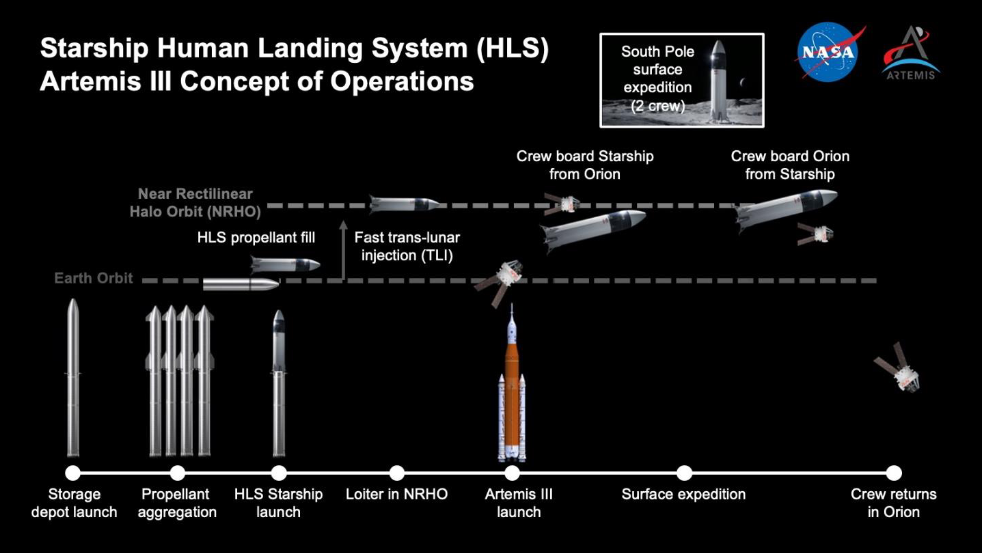
Step 1: The Orbital Refueling Challenge
One of the most significant technical hurdles in Artemis 3 is orbital refueling.
Both Starship and Blue Moon are enormous vehicles that consume most of their fuel simply reaching Earth orbit. To continue toward the Moon, they must be refueled in space—a process that has never been executed at this scale.
SpaceX plans to launch an additional Starship configured as a fuel tanker. This tanker will transfer propellant to the lunar lander while in orbit.
Blue Origin, on the other hand, will use a dedicated propellant transport vehicle designed specifically for refueling operations.
This step is critical. Without successful orbital refueling, the mission cannot proceed.
Step 2: The Orion Rendezvous
Once the landers are fueled and ready, the SLS rocket will launch a crew of four astronauts aboard Orion.
Instead of heading directly to the Moon, Orion will rendezvous with the lander in low Earth orbit. This phase will involve a series of “shakedown” tests designed to verify systems, procedures, and crew readiness.
The docking process varies depending on the lander design:
- Blue Moon: Orion docks from the side, connecting with the crew module located beneath large fuel tanks.
- Starship: Orion docks at the top, leading into a spacious interior that offers significantly more room than previous lunar modules.
These differences highlight the contrasting engineering philosophies of the two companies.
Testing the Next Generation of Spacesuits
While docked in orbit, astronauts will conduct critical tests of new lunar spacesuits developed by Axiom Space.
These suits represent a major leap forward from the bulky Apollo-era designs. They are engineered for flexibility, mobility, and durability, enabling astronauts to perform complex tasks on the lunar surface.
The most important test will involve exposing the suits to the vacuum of space. Astronauts will enter the lander’s airlock and simulate real lunar conditions.
This phase ensures that both the suits and the astronauts are fully prepared for lunar operations.
The Road to 2027 and Beyond
NASA’s timeline for Artemis 3 is ambitious and tightly packed with milestones.
- May 2026: SpaceX plans to test Starship Version 3, expected to be the first fully refined iteration.
- May 2026: Blue Origin will test Blue Moon Mark 1, a cargo-focused lunar lander.
- 2027: The Artemis 3 orbital mission is scheduled to take place.
Following these events, NASA intends to launch an uncrewed mission known as “Artemis 3.5”. This mission will attempt a fully autonomous lunar landing, serving as a final proof of safety before humans descend to the surface.
Why the Urgency? A New Space Race
The push behind Artemis 3 is driven by more than scientific curiosity. A new global space race is underway.
Countries around the world, particularly China, are advancing their own lunar exploration programs. Plans for permanent lunar bases and long-term habitation are actively being developed.
For NASA and its partners, Artemis 3 represents a strategic objective. It is about securing leadership on the Moon and shaping the future of space exploration.
The mission carries symbolic and geopolitical weight. The next flag planted on the Moon will signal technological dominance and global influence.
The Battle of the Titans
At its core, Artemis 3 is a clash between two powerful visions of the future.
SpaceX emphasizes rapid innovation, iterative design, and bold experimentation. Its Starship program reflects pushing limits and learning through testing.
Blue Origin focuses on methodical development, precision engineering, and long-term sustainability. Its approach prioritizes reliability and steady progress.
Both strategies have strengths—and both are being tested under immense pressure.
What’s at Stake for Humanity
Artemis 3 is not just another mission—it is a stepping stone toward a permanent human presence beyond Earth.
Success will open the door to:
- Sustainable lunar bases
- Deep space exploration missions
- Future journeys to Mars
- New scientific discoveries
Failure, on the other hand, could delay progress and shift the balance of power in space exploration.
Conclusion: The Countdown to History
As 2027 approaches, the world is watching closely. Artemis 3 represents the culmination of years of planning, innovation, and competition.
NASA stands at the center, but it is no longer acting alone. The collaboration—and competition—between SpaceX and Blue Origin has redefined space exploration.
The question is no longer whether humanity will return to the Moon. The real question is: who will get us there first—and how?
In this new era of exploration, the stakes have never been higher. Artemis 3 is a defining moment that will shape the future of humanity in space.
And when the time comes, one of these titans will carry humanity back to the Moon—and beyond.
FAQs
1. What is Artemis 3?
Artemis 3 is NASA’s mission to land humans on the Moon again, marking the first crewed lunar landing since the Apollo era.
2. When will Artemis 3 launch?
The mission is currently targeted for 2027, although timelines may shift due to technical and testing requirements.
3. What is the main goal of Artemis 3?
The primary objective is to safely land astronauts on the Moon and return them to Earth, while also preparing for long-term lunar exploration.
4. What spacecraft will be used in Artemis 3?
The mission will use the Space Launch System (SLS) rocket, the Orion spacecraft, and a Human Landing System (HLS) developed by private companies.
5. What is the Human Landing System (HLS)?
HLS is the spacecraft that will take astronauts from orbit to the Moon’s surface, making it a critical component of the mission.
6. Which companies are building the lunar landers?
SpaceX and Blue Origin are the two main companies competing to provide the lunar landing systems.
7. What is SpaceX’s role in Artemis 3?
SpaceX is developing a lunar version of its Starship vehicle, designed to transport astronauts to and from the Moon’s surface.
8. What is Blue Origin’s role in Artemis 3?
Blue Origin is developing the Blue Moon lander and New Glenn rocket, aiming to compete directly with SpaceX’s solution.
9. Why is orbital refueling important for Artemis 3?
Orbital refueling allows large spacecraft to be fueled in space, enabling them to travel farther, including to the Moon.
10. Will Artemis 3 go directly to the Moon?
No, the updated plan includes extensive testing in Earth orbit first, ensuring maximum safety before lunar travel.
11. How many astronauts will be on Artemis 3?
The mission is expected to carry a crew of four astronauts aboard Orion.
12. What new technology will be tested during the mission?
Astronauts will test next-generation lunar spacesuits, advanced docking systems, and orbital refueling techniques.
13. What is Artemis 3.5?
Artemis 3.5 is a planned uncrewed mission that will attempt a fully autonomous Moon landing to verify safety.
14. Why is Artemis 3 considered so important?
It is a key step toward establishing a permanent human presence on the Moon and advancing future missions to Mars.
15. Is there a new space race happening?
Yes, a new global space race is underway, with countries like China and private companies competing for lunar dominance.
Read More:
- Tesla Signature Model S, X owners get hit with crazy no-resale clause
- Tesla Cybertruck sales bolstered by bold Musk move, report claims
- Tesla is pushing Robotaxi features to owner cars with Spring Update
- Elon Musk Confirmed Starship Flight 12 Launch Schedule after Big WDR test! Countdown begins
- Elon Musk’s UNBELIEVABLE Moon Base Plan after Artemis 2 Revealed, Like never before
1 thought on “What is Actually Happening on Artemis 3”