
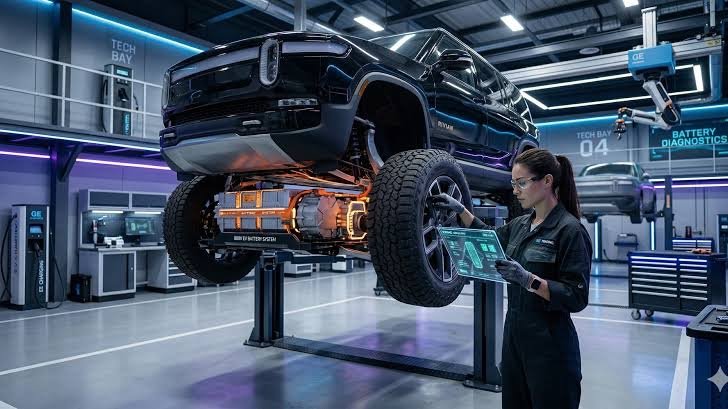
World’s First Solid-State Battery Announces Price: For years, solid-state battery technology has been viewed as one of the biggest breakthroughs needed to transform electric vehicles. Unlike conventional lithium-ion batteries that use liquid electrolytes, solid-state cells replace that liquid layer with a solid electrolyte, potentially delivering higher energy density, faster charging, improved safety, and longer driving range.
Now, the technology is moving closer to commercial reality. Gotion High-Tech has announced a targeted commercial pricing benchmark of around $150 per kWh for its Gemstone all-solid-state battery. If achieved at meaningful production volumes, this could represent an important shift from expensive laboratory technology toward practical automotive deployment.
Why the $150/kWh Target Matters
The biggest challenge facing solid-state batteries has never simply been performance. Researchers have demonstrated impressive energy-density figures for years, but producing these cells consistently and economically has been much harder.
A commercial target of $150/kWh changes the conversation. Instead of asking whether solid-state batteries can work, the industry can increasingly focus on how quickly they can be manufactured at scale.
For an EV with a 100-kWh battery, a $150/kWh cell cost would represent approximately $15,000 in raw cell costs before the rest of the battery-pack and vehicle expenses are included.
That remains more expensive than some conventional battery technologies, but solid-state batteries could compensate through higher energy density, reduced cooling requirements, faster charging, and potentially longer range.
How Solid-State Batteries Are Different
Replacing Liquid Electrolytes
Conventional lithium-ion batteries use a liquid electrolyte to transport lithium ions between the cathode and anode. Although modern battery-management systems have made these batteries considerably safer, the electrolyte remains a major component of battery safety engineering.
An all-solid-state battery replaces this liquid medium with a solid inorganic electrolyte, potentially using sulfide-, oxide-, or other solid materials.
This creates a fundamentally different cell architecture.
Improved Thermal Stability
One of the major attractions of solid-state technology is the possibility of significantly improving thermal stability.
Traditional batteries can experience thermal runaway under extreme conditions. Solid electrolytes are generally less flammable than conventional liquid electrolytes, potentially reducing the consequences of severe battery failures.
However, this does not mean that every solid-state battery is completely immune to overheating or failure. Cell design, manufacturing quality, charging conditions, and thermal management remain important.
Higher Energy Density Could Transform EVs
The most exciting advantage may be energy density.
Conventional EV batteries must balance range, weight, cost, durability, and safety. A battery pack capable of storing more energy without adding substantial mass could fundamentally change vehicle design.
Solid-state architectures can potentially support silicon-rich or lithium-metal anodes, allowing significantly more lithium to be stored within the same physical space.
The source material describes potential energy densities of approximately 350–500 Wh/kg, although real-world commercial pack-level performance can differ substantially from laboratory or cell-level figures.
Higher energy density could allow automakers to choose between several possibilities:
- Longer driving range
- Smaller and lighter battery packs
- Lower vehicle weight
- More interior or cargo space
- Better acceleration efficiency
- Greater flexibility in vehicle packaging
For consumers, the most visible benefit could be an EV capable of traveling hundreds of miles farther without requiring a dramatically larger battery.
The Biggest Challenge: Mass Production
Interfacial Contact Is Critical
Producing a solid-state battery is considerably more complicated than simply replacing a liquid with a solid.
Lithium ions must travel efficiently through the solid electrolyte while maintaining close contact between the electrolyte and electrodes. During repeated charging and discharging, materials can expand and contract.
That can create microcracks, gaps, voids, and interface resistance.
If contact between the layers deteriorates, battery performance and cycle life can decline.
This is why manufacturing precision is one of the most important factors in commercial solid-state battery development.
Gotion’s Gemstone Approach
According to the supplied information, Gotion’s Gemstone technology uses specialized inorganic electrolyte processing and binder chemistry intended to preserve contact between battery components during demanding charge-discharge cycles.
The objective is straightforward: create a solid-state cell that maintains reliable internal connections while also being manufacturable at commercial scale.
Successfully achieving both goals is what could make solid-state batteries commercially transformative.
How the Economics Compare
The reported $150/kWh target puts the Gemstone battery into a much more interesting position compared with established EV chemistries.
| Battery Chemistry | Approx. Cost | Potential Energy Density | Primary Application |
|---|---|---|---|
| LFP | ~$60–$80/kWh | 140–180 Wh/kg | Mass-market EVs |
| NCM | ~$90–$120/kWh | 240–300 Wh/kg | Long-range/performance EVs |
| Gemstone Solid-State | ~$150/kWh target | 350–500 Wh/kg claimed | Next-generation EVs |
These figures should be viewed as broad comparisons rather than guaranteed production specifications because battery costs and energy density vary by manufacturer, production volume, pack design, and market conditions.
The key advantage of solid-state technology is therefore not simply price. It is the possibility of delivering significantly greater performance at a commercially meaningful cost.
Could Solid-State Batteries Enable Ultra-Fast Charging?
Charging speed is another major area of interest.
Consumers often hesitate to adopt EVs because charging can require considerably more planning than refueling a gasoline vehicle. Solid-state designs could potentially support higher charging rates while reducing some of the risks associated with conventional lithium-ion architectures.
The supplied technology outlook points toward charging times potentially approaching 10% to 80% in under 10 minutes for future implementations.
That figure should be considered a technological target rather than a universal specification. Actual charging speed depends on the battery chemistry, charging infrastructure, temperature, battery-management system, and vehicle architecture.
Nevertheless, faster charging could dramatically improve the ownership experience.
What This Means for the EV Industry
Commercially viable solid-state batteries could create a ripple effect across the automotive industry.
Smaller Cooling Systems
If battery thermal characteristics improve, manufacturers could potentially reduce the complexity and weight of some battery cooling systems.
Longer-Range EVs
Higher energy density could make 600-mile-plus EVs more technically practical without requiring enormous battery packs.
Faster Charging Networks
If batteries can safely accept higher charging power, charging infrastructure could evolve toward shorter stops that more closely resemble conventional refueling experiences.
New Battery Competition
A commercially competitive solid-state battery would also increase pressure on existing battery manufacturers. Companies developing LFP, NCM, lithium-metal, sodium-ion, and other next-generation technologies would have additional incentive to improve cost, energy density, charging speed, and durability.
The Beginning of a New Battery Era
The announcement surrounding Gotion’s Gemstone technology highlights how the solid-state battery race is changing.
For decades, solid-state batteries were primarily associated with research laboratories, prototypes, and ambitious future projections. The biggest question was whether their impressive technical potential could ever be translated into affordable mass production.
A targeted price of $150/kWh suggests that commercial economics are becoming part of the discussion.
The technology still faces major challenges, including manufacturing scale, durability, interface stability, supply chains, charging performance, and real-world cost. Those challenges will determine how quickly solid-state batteries move from limited production into mainstream electric vehicles.
But if manufacturers can successfully combine high energy density, rapid charging, safety, long cycle life, and competitive production costs, solid-state batteries could fundamentally reshape the next generation of electric transportation.
The race is no longer only about building the most advanced battery in a laboratory. It is about building millions of reliable cells at a price automakers and consumers can afford.
FAQs
1. What is a solid-state battery?
A solid-state battery is an advanced battery that uses a solid electrolyte instead of the liquid electrolyte found in conventional lithium-ion batteries. This design can potentially improve energy density, safety, charging speed, and battery performance.
2. What price has Gotion announced for its solid-state battery?
Gotion High-Tech has announced a targeted commercial pricing benchmark of approximately $150 per kWh for its Gemstone all-solid-state battery.
3. Why is the $150/kWh target important?
The $150/kWh target is important because it moves solid-state technology closer to commercial viability. Historically, solid-state batteries have been expensive to manufacture, making large-scale automotive deployment difficult.
4. How is a solid-state battery different from a lithium-ion battery?
The primary difference is the electrolyte. Traditional lithium-ion batteries use a liquid electrolyte, while solid-state batteries use a solid electrolyte. This can enable improved thermal stability and potentially higher energy density.
5. Are solid-state batteries safer than conventional EV batteries?
Solid-state batteries have the potential to be safer because many solid electrolytes are less flammable than conventional liquid electrolytes. However, solid-state technology is not completely immune to battery failures, overheating, or other engineering risks.
6. How much energy density can solid-state batteries achieve?
The supplied technology outlook describes potential energy densities of approximately 350–500 Wh/kg at the cell level. Actual commercial and pack-level performance can vary depending on battery design and manufacturing technology.
7. Could solid-state batteries provide longer EV range?
Yes. Higher energy density could allow electric vehicles to store more energy without dramatically increasing battery weight or size. This could make 600-mile-plus EV ranges more technically achievable in future vehicles.
8. Can solid-state batteries charge faster?
Solid-state batteries have the potential to support very fast charging because of their advanced cell architecture. Future implementations could potentially achieve extremely short charging times, although actual performance will depend on the battery, vehicle, charger, temperature, and charging system.
9. What is the biggest challenge facing solid-state batteries?
One of the biggest challenges is mass production. Maintaining consistent contact between the solid electrolyte and electrodes is difficult because microscopic cracks, gaps, and material expansion can reduce battery performance and lifespan.
10. What is Gotion’s Gemstone battery?
Gemstone is Gotion High-Tech’s all-solid-state battery technology. The technology is designed around a solid electrolyte architecture and is intended to address challenges involving energy density, durability, safety, and commercial manufacturing.
11. How much would a 100 kWh solid-state battery cost at $150/kWh?
At $150 per kWh, a 100 kWh battery would have an approximate raw cell cost of $15,000. This does not represent the complete cost of the finished battery pack or vehicle.
12. Could solid-state batteries reduce EV weight?
Potentially, yes. Higher energy density could allow manufacturers to achieve the same driving range with a smaller and lighter battery pack. Reduced cooling requirements could also provide additional opportunities for weight and packaging optimization.
13. Will solid-state batteries eliminate thermal runaway completely?
No battery technology should be described as completely risk-free. Solid-state batteries can reduce certain fire and thermal-runaway risks, but cell defects, mechanical damage, charging conditions, and other factors can still affect safety.
14. When will solid-state batteries become common in electric vehicles?
The timing will depend on manufacturing scale, cost, durability, regulatory approval, and automaker adoption. A commercial pricing target is an important step, but widespread adoption requires reliable high-volume production.
15. Could solid-state batteries change the EV industry?
Yes. If manufacturers achieve competitive costs while maintaining high energy density, fast charging, long cycle life, and strong safety, solid-state batteries could significantly influence the future of long-range EVs, charging infrastructure, vehicle design, and battery manufacturing.
Read More:
- Tesla ships ‘spooky’ Halloween Mode with creepy and fun features
- Tesla Model 3 and Model Y can now do what only Cybertruck could
- Tesla FSD changed its mind mid-intersection, and it may have saved a life
- Elon Musk Revealed Secret Behind Starship Orbital Flight totally Humiliated Haters
- Everything About Elon Musk’s Tesla Semi 2027 Revealed