
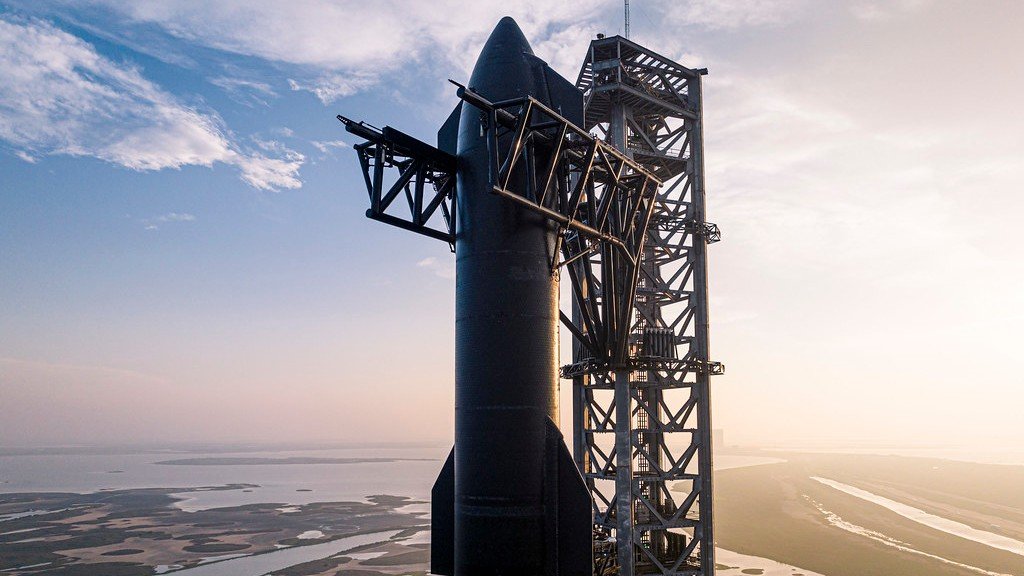
SpaceX Updated New Footage Revealed Unexpected S40 Status after 32 days of Floating: The aerospace industry is entering another exciting phase as SpaceX Starship, NASA’s Artemis program, and next-generation orbital infrastructure continue to evolve. New footage and recovery operations have revealed important details about Starship 40 (S40) after the vehicle spent 32 days floating in the ocean following its orbital-class flight.
At the same time, SpaceX is preparing Booster 21 (B-21) for the next Starship flight campaign, while NASA is reshaping the Artemis III mission architecture to prioritize critical docking demonstrations in low Earth orbit.
These developments offer a closer look at how engineers are addressing reusability, thermal protection, marine recovery, launch infrastructure, and lunar mission planning.
Starship 40 Recovered After 32 Days at Sea
Following its flight, atmospheric re-entry, and soft splashdown, Starship 40 remained in the waters near Christmas Island for approximately 32 days. The extended period at sea created a rare opportunity to examine how Starship hardware responds to prolonged exposure to saltwater and ocean conditions.
The recovery operation entered a major new phase when the semi-submersible heavy-lift vessel Forte arrived to collect the spacecraft and transport it toward Starbase in Boca Chica, Texas.
How the S40 Ocean Recovery Worked
Recovering a vehicle approximately 50 meters tall from the open ocean required a carefully coordinated marine operation.
The cargo deck of Forte was partially submerged to allow S40 to be maneuvered into position. Once the spacecraft was correctly aligned above the deck, the vessel de-ballasted, raising the deck and Starship above the waterline.
A specialized securing framework was then used to stabilize S40. This is particularly important during the long voyage because ocean swells, rolling, and pitching could place significant loads on the spacecraft.
Transporting S40 on the deck also provides engineers with safer and more continuous access to the vehicle during the journey back to Starbase. Teams can inspect structural areas, internal bays, and other components while the spacecraft is secured to the vessel.
Forte was also expected to carry additional crew supplies, scaffolding, platforms, and specialized engineering equipment to support the inspection process during the multi-month transit.
New S40 Footage Shows Heat Shield and Structural Damage
Before S40 was loaded onto Forte, engineers approached the spacecraft using small boats. These inspections allowed teams to get close to the vehicle and collect valuable hardware samples.
One of the main areas of interest was the Thermal Protection System (TPS), which is essential for protecting Starship from the extreme temperatures generated during atmospheric re-entry.
What Engineers Found on Starship 40
The latest observations indicate several notable areas of damage and degradation:
- Forward flaps: Two flaps appeared to be completely missing, while other remaining surfaces showed substantial saltwater erosion.
- Heat shield tiles: Localized tile loss was visible, along with peeling of the ablative layer and areas where the underlying stainless-steel structure was exposed.
- Exterior hull: White streaks were associated with apparent coolant leakage, while yellow-orange discoloration was consistent with exposure to extreme re-entry temperatures.
- Raptor engine area: Some nozzle edges appeared warped, while sea-level engines showed indications of mounting displacement.
Although these conditions may appear severe, the data collected from S40 could become extremely valuable for future Starship development.
Why the S40 Heat Shield Matters
The heat shield remains one of Starship’s most important engineering challenges.
For a fully reusable spacecraft, surviving atmospheric entry is not enough. The vehicle must eventually complete repeated missions with increasingly predictable thermal performance and minimal refurbishment.
S40’s extended exposure to seawater also provides engineers with information that cannot be obtained from laboratory testing alone. Understanding corrosion, tile degradation, structural exposure, and post-flight hardware condition can help SpaceX improve future vehicles and flight profiles.
As Starship moves toward more operational orbital missions, reliable atmospheric entry and controlled landing or splashdown performance will become increasingly important.
Booster 21 Prepares for Starship Flight 14
While S40 begins its journey back to Starbase, SpaceX’s ground teams are preparing Booster 21 (B-21) for the next major Starship campaign.
B-21 is currently installed on the Orbital Launch Mount (OLM), where engineers are working through the necessary procedures before its static fire test.
Quick Disconnect Issue Delays Static Fire
A planned static fire test encountered a scrub after engineers identified a mechanical anomaly involving the Liquid Oxygen Booster Quick Disconnect (BQD) arm.
The BQD system is a critical part of the ground infrastructure because it provides the connection between the launch-site plumbing and the booster.
Rather than returning B-21 to the Orbital Assembly Building, teams were able to reconnect the LOX interface and verify the integrity of the ground plumbing seals while the booster remained at the launch site.
Following inspections and pad preparation, SpaceX continued working toward a new testing opportunity.
The successful completion of the static fire will represent another important milestone on the road toward Starship Flight 14.
NASA Changes the Artemis III Mission Architecture
SpaceX’s Starship developments are occurring alongside major changes in NASA’s lunar exploration strategy.
NASA’s Artemis III mission profile has undergone an important architectural adjustment. Instead of immediately proceeding with the originally envisioned direct lunar landing profile, the mission is being reshaped around low Earth orbit demonstrations involving Orion and Human Landing Systems.
Artemis III to Focus on Orion and HLS Docking
The revised architecture is designed to test the ability of NASA’s Orion spacecraft to dock with Human Landing System (HLS) vehicles being developed by SpaceX and Blue Origin.
This approach allows NASA to demonstrate critical rendezvous and docking technologies before proceeding with later lunar operations.
One major consequence is the removal of the active Interim Cryogenic Propulsion Stage (ICPS) from the Artemis III configuration.
Because the revised mission will remain in low Earth orbit, the active upper-stage propulsion system required for a trans-lunar injection burn is not needed in the same way.
An inert structural spacer will instead occupy the relevant position, with the active upper-stage configuration preserved for a later Artemis mission.
What Happens to Artemis CubeSats?
The architectural change also affects secondary payloads.
CubeSats carried on earlier Artemis missions were designed to take advantage of the SLS upper-stage configuration and its ability to perform a trans-lunar injection (TLI) burn.
Without an active ICPS on Artemis III, NASA cannot deploy these secondary spacecraft in the same manner.
Artemis I carried 10 CubeSats, with mixed results among the individual spacecraft. Artemis II is expected to carry four international 12U CubeSats designed to investigate areas including space weather and radiation.
Future secondary payload opportunities are therefore being evaluated for Artemis IV and Artemis V, currently targeted for the latter part of the decade.
Key Aerospace Milestones to Watch
The latest developments highlight three very different but interconnected areas of spaceflight development.
Starship 40
S40 is now secured aboard the heavy-lift vessel Forte, beginning its long journey toward Starbase. Its damaged heat shield, structural areas, and engine hardware could provide valuable engineering data for future Starship vehicles.
Booster 21
B-21 remains a central focus of SpaceX’s Flight 14 campaign. Ground teams are addressing the BQD issue and preparing the launch infrastructure for static fire testing.
Artemis III
NASA’s revised Artemis III architecture demonstrates how quickly major space programs can adapt. The mission’s focus on Orion-HLS docking demonstrations in low Earth orbit could provide critical information before future lunar missions.
Conclusion
The latest Starship 40 recovery footage provides a rare look at what happens to a large reusable spacecraft after re-entry and prolonged exposure to the ocean. From heat shield degradation and saltwater corrosion to engine-area inspections, S40 is effectively becoming a valuable source of real-world engineering data.
Meanwhile, Booster 21 is moving through ground preparations for Starship Flight 14, while NASA is modifying the Artemis III architecture to concentrate on essential Orion and HLS docking demonstrations.
Together, these developments show that modern spaceflight is not simply about launching rockets. It involves continuous testing, recovery, hardware analysis, infrastructure improvements, and mission redesign.
For SpaceX and NASA alike, the coming months could provide important insights into the future of reusable spacecraft, orbital transportation, and human lunar exploration.
FAQs
1. What happened to SpaceX Starship S40 after its flight?
Starship 40 (S40) completed its flight, re-entered Earth’s atmosphere, and made a soft ocean splashdown. It then remained floating near Christmas Island for 32 days before recovery operations began.
2. How was Starship S40 recovered from the ocean?
S40 was recovered using the semi-submersible heavy-lift vessel Forte. The vessel partially submerged its cargo deck, allowing the spacecraft to be positioned over the deck before the ship raised it above the waterline.
3. Why did SpaceX recover Starship S40?
Recovering S40 allows engineers to perform detailed post-flight inspections and hardware analysis. The vehicle can provide valuable information about its heat shield, structure, engines, and other components after an actual flight.
4. What condition was Starship S40 in after 32 days in the ocean?
New footage showed evidence of saltwater erosion, heat shield tile loss, structural exposure, and apparent engine-area damage. Engineers are studying the vehicle to distinguish flight-related damage from degradation caused by prolonged ocean exposure.
5. What happened to S40’s heat shield tiles?
Some areas showed localized tile loss, peeling of the ablative layer, and exposed stainless-steel structure. The condition of these tiles is particularly important because the heat shield protects Starship during atmospheric re-entry.
6. Why is the S40 Thermal Protection System important?
The Thermal Protection System (TPS) protects Starship from the extreme temperatures experienced during atmospheric re-entry. Reliable TPS performance is essential if Starship is to become a fully reusable spacecraft.
7. What is SpaceX Booster 21?
Booster 21 (B-21) is a Super Heavy booster being prepared for a future Starship flight. It is currently undergoing ground preparations at Starbase ahead of its static fire testing.
8. Why was the Booster 21 static fire test delayed?
The planned test was scrubbed after engineers identified a mechanical issue involving the Liquid Oxygen Booster Quick Disconnect (BQD) arm on the Orbital Launch Mount.
9. Did Booster 21 need to return to the assembly building?
No. SpaceX teams were able to reconnect the LOX BQD interface and verify ground plumbing seals while keeping B-21 at the launch site.
10. What is Starship Flight 14?
Starship Flight 14 is the next planned major Starship flight campaign involving the Super Heavy booster and Starship upper stage. Preparations include ground testing, launch-pad inspections, and static fire activities.
11. What is changing with NASA’s Artemis III mission?
NASA has revised the Artemis III mission architecture. Instead of focusing solely on the originally envisioned direct lunar landing profile, the revised approach emphasizes low Earth orbit demonstrations and Orion-HLS docking operations.
12. What is the role of the Orion spacecraft in Artemis III?
The Orion spacecraft is expected to participate in demonstrations involving docking with Human Landing System (HLS) vehicles. These tests are intended to validate important technologies before future lunar missions.
13. Why is the ICPS being removed from Artemis III?
The Interim Cryogenic Propulsion Stage (ICPS) is not required in the same way for the revised low Earth orbit mission profile. An inert structural spacer is planned instead, while the active upper-stage configuration can be used for a later Artemis mission.
14. Will Artemis III carry CubeSats?
Under the revised configuration, Artemis III will not deploy CubeSats in the traditional manner because the mission will not use an active ICPS for a trans-lunar injection. Secondary payload opportunities are being considered for later missions, including Artemis IV and Artemis V.
15. How many CubeSats were launched on Artemis I?
Artemis I carried 10 CubeSats intended for deep-space scientific and technology demonstrations. Their individual missions experienced varying levels of success.
16. Why are the S40, Booster 21, and Artemis III developments important?
Together, these developments demonstrate the rapidly changing nature of modern spaceflight. S40 is providing real-world recovery and re-entry data, B-21 is advancing Starship’s next flight campaign, and Artemis III is adapting its architecture to test critical Orion and HLS docking technologies before future lunar exploration.
Read More:
- New CATL 2000 Mile Range Battery & $63/kWh Change Everything
- Tesla Cybercab uses a unique strategy for picking up the right rider
- Police sergeant recounts his Neuralink journey with Elon Musk’s brain chip
- Tesla Semi’s biggest adoptee gives an update on production timeline
- Tesla Theater might be getting plenty more streaming platforms
2 thoughts on “SpaceX Updated New Footage Revealed Unexpected S40 Status after 32 days of Floating”