
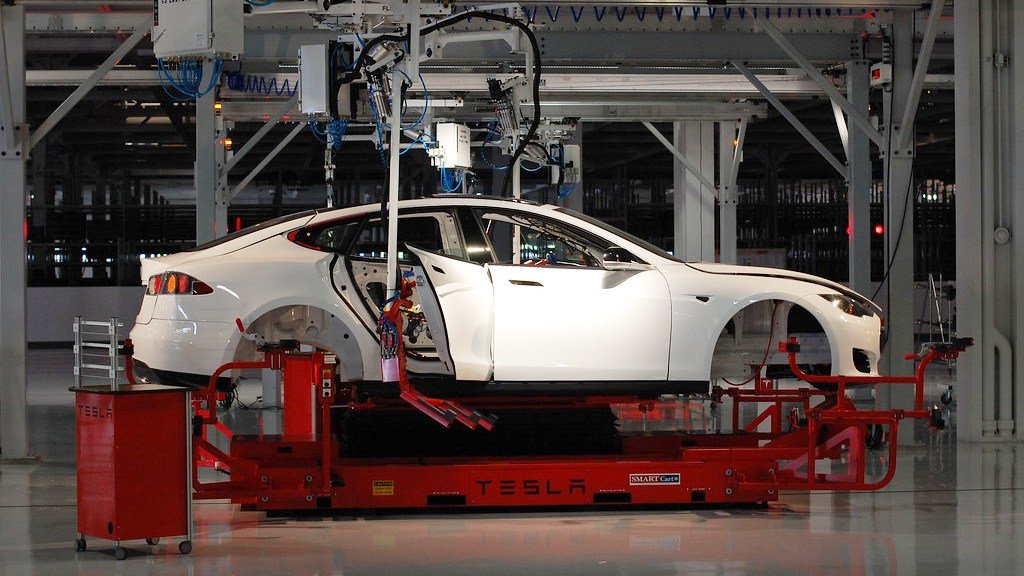
Take A Look This Incredible Tesla Giga Press 50,000 Tons Destroying EV Industries: The global automotive industry has spent decades improving traditional manufacturing methods through small, incremental changes. From stamping and welding to robotic assembly, most vehicle factories have continued to rely on production principles that have remained relatively familiar for generations. Tesla, however, is taking a radically different approach.
At Gigafactory Texas, Tesla’s latest manufacturing developments point toward a future where massive die-casting machines, advanced metallurgy, automation, and autonomous vehicle technology work together as one integrated production system.
At the center of this transformation is the potential 50,000-ton Giga Press, a machine designed to push mega-casting technology far beyond the scale Tesla has previously used. Combined with purpose-built hardware for the company’s planned Cybercab robotaxi fleet, the technology could significantly change how electric vehicles are manufactured and operated.
Tesla’s 50,000-Ton Giga Press Could Change EV Manufacturing
Tesla first attracted worldwide attention to mega-casting when it introduced a 6,100-ton Giga Press for Model Y production. Instead of manufacturing dozens of individual stamped and welded components, Tesla used a large die-casting process to create major structural sections as a single component.
The company later introduced larger machines, including 9,200-ton and 16,000-ton casting systems, particularly for larger and more structurally demanding vehicles such as the Cybertruck.
Now, the proposed 50,000-ton Giga Press represents an enormous jump in scale.
What Does 50,000 Tons of Clamping Force Mean?
The term 50,000 tons can easily be misunderstood. It does not mean that 50,000 tons of force is directly used to inject molten aluminum into a mold.
Instead, the figure refers to the machine’s clamping force—the enormous mechanical force used to hold the two halves of a die securely together during the casting process.
When molten aluminum is injected into a large mold at high pressure, the liquid metal generates forces that attempt to separate the die halves. If the clamping system cannot withstand those forces, molten metal can escape from the mold, potentially destroying the component and creating serious manufacturing and safety problems.
As a casting becomes larger and covers more of a vehicle’s structure, the required clamping force increases dramatically.
How a 50,000-Ton Mega-Casting Process Works
Creating a giant structural casting requires far more than simply injecting molten aluminum into a large mold. Temperature control, alloy cleanliness, vacuum management, lubrication, cooling, and quality inspection all have to work together.
1. Aluminum Melting and Thermal Preparation
Raw aluminum ingots and recycled material are melted in a primary furnace at temperatures around 850°C. The molten alloy is then transferred through heated systems into an electric holding tank.
Maintaining the correct temperature is essential because the metal must remain sufficiently fluid for high-speed injection while maintaining the desired material characteristics.
2. Refining and Degassing
Before casting, the molten aluminum undergoes refining. Argon degassing helps remove dissolved hydrogen from the metal, while filtration helps capture unwanted inclusions.
A nitrogen blanket can also help reduce oxidation during the holding process.
These steps are critical because microscopic gas pockets or contaminants can become weaknesses inside a structural component.
3. Automated Die Preparation
Before injection begins, robotic equipment prepares the die surface with lubricant. The process can use precisely controlled quantities of soybean-oil-based die lubricant to reduce friction and help the casting release from the mold.
At the same time, a vacuum system removes air from the mold cavity.
Reducing trapped air is especially important for large structural castings because excessive porosity can compromise the component’s mechanical properties.
4. High-Speed Injection and Clamping
Once the mold is prepared, a high-speed piston forces the molten aluminum into the die cavity.
The 50,000-ton clamping system keeps the enormous die halves locked together while the alloy fills the cavity and begins to solidify.
This combination of high-speed injection and extreme clamping force makes it possible to manufacture structural components that would be extremely difficult to produce using conventional stamping and welding techniques.
5. Cooling and X-Ray Inspection
After solidification, the casting can undergo rapid cooling before moving toward quality inspection.
Large structural components require extremely strict inspection standards. X-ray non-destructive testing can identify internal voids, gas pockets, or other defects that might not be visible from the outside.
Only components that meet the required structural standards should continue toward vehicle assembly.
Fewer Parts Could Mean a Faster Tesla Factory
One of the biggest advantages of mega-casting is manufacturing simplification.
Instead of producing and assembling dozens of individual stamped components, a large casting can combine many of those parts into a single structural component.
Tesla has demonstrated this approach by replacing numerous individual components with large die-cast sections.
The potential benefits include:
- Fewer individual parts
- Reduced welding operations
- Fewer assembly steps
- Less factory floor space
- Lower robotic complexity
- Potentially faster production
- Reduced manufacturing costs
This is one reason Tesla’s Giga Press strategy is attracting attention throughout the automotive industry.
Does Giga Casting Make Tesla Vehicles Harder to Repair?
Early criticism of mega-casting focused heavily on repairability.
The argument was straightforward: if dozens of separate components become one huge casting, wouldn’t a relatively small accident force an expensive structural replacement?
However, real-world repair procedures suggest the situation can be more nuanced.
Localized Structural Repairs Can Be Possible
Tesla has developed service procedures for repairing certain damaged structural casting areas. Depending on the severity and location of the damage, technicians may use approaches such as cold straightening, approved welding procedures, reinforcement plates, or localized structural repairs.
Research from Thatcham Research has also examined the repair economics of large cast structures.
The broader lesson is that mega-casting does not automatically mean every damaged vehicle must receive an entire new frame. Repairability depends heavily on the engineering and service procedures designed around the casting.
Tesla Cybercab Connects Manufacturing With Robotaxi Operations
Tesla’s manufacturing strategy is also closely connected to its ambitions for autonomous transportation.
The Cybercab is being developed as a purpose-built vehicle for commercial autonomous operation rather than simply as a conventional passenger vehicle with self-driving software added later.
Reported specifications include a battery capacity of approximately 53.3 kWh, an estimated range of up to 418 miles, and a single front-wheel-drive motor producing around 219 horsepower.
One particularly important feature is its planned wireless inductive charging system, which could allow vehicles operating in a commercial fleet to recharge with minimal human involvement.
Purpose-Built Hardware for Autonomous Fleets
A private passenger vehicle can sit unused for many hours. A commercial robotaxi has a completely different operating requirement.
A successful robotaxi needs to maximize uptime, reliability, connectivity, sensor visibility, and automated maintenance.
Automated Camera Cleaning
One example is automated sensor maintenance.
A vehicle operating continuously in rain, mud, dust, and road spray cannot depend on a human driver to clean its cameras. Purpose-built camera-cleaning systems could use water and air nozzles to maintain visibility across the vehicle’s external sensors.
This could become an important feature for autonomous fleets operating around the clock.
Connectivity and Fleet Telemetry
Autonomous fleet vehicles also require continuous communication with centralized systems.
The proposed Cybercab infrastructure includes connectivity designed for fleet telemetry, remote operations, navigation updates, and vehicle monitoring. Satellite and cellular communication could provide additional redundancy in areas where conventional networks are unreliable.
FSD Hardware Could Prepare Cybercab for Future Software
Another major component is computing power.
Tesla’s future autonomous vehicles are expected to use upgraded computing hardware designed to provide additional processing capacity for increasingly sophisticated Full Self-Driving software.
Rather than building a vehicle around today’s software requirements alone, Tesla’s strategy appears focused on creating enough hardware headroom for future autonomous systems.
That approach could be particularly important for a commercial fleet, where vehicles may operate for significantly more hours than privately owned cars.
The Bigger Picture: Tesla Is Reinventing the Factory
The most important aspect of the 50,000-ton Giga Press may not simply be its enormous size.
The bigger story is Tesla’s attempt to rethink the entire automotive production chain.
Traditional vehicle manufacturing separates stamping, welding, painting, assembly, and numerous supplier operations into highly complex production networks. Tesla’s mega-casting strategy attempts to reduce the number of components and manufacturing steps while increasing automation.
When combined with purpose-built autonomous vehicles, wireless charging, automated sensor maintenance, advanced computing, and fleet infrastructure, the company is effectively pursuing a new manufacturing model.
Conclusion
The potential 50,000-ton Tesla Giga Press represents one of the most ambitious developments in automotive manufacturing. By dramatically increasing casting scale, Tesla could reduce component counts, simplify assembly, and potentially accelerate EV production.
At the same time, the Cybercab demonstrates how Tesla is connecting vehicle manufacturing with autonomous fleet operations. Purpose-built hardware, automated cleaning, wireless charging, advanced computing, and continuous telemetry could all contribute to a commercially viable robotaxi network.
Whether Tesla ultimately reaches the full potential of this strategy remains to be seen. But one thing is clear: mega-casting and autonomous vehicle architecture are pushing the automotive industry toward a fundamentally different way of designing, manufacturing, and operating cars.
FAQs
1. What is Tesla’s 50,000-ton Giga Press?
The 50,000-ton Giga Press is a proposed next-generation mega-casting machine designed to produce extremely large aluminum structural components. Its 50,000-ton rating refers to the machine’s clamping force, which holds the casting die closed during high-pressure metal injection.
2. What does 50,000 tons of clamping force mean?
It refers to the force used to keep the two halves of the massive casting mold together. During injection, molten aluminum creates pressure that can push the die apart, so enormous clamping force is required to maintain a secure seal.
3. Why is Tesla using Giga Press technology?
Tesla uses Giga Press technology to reduce the number of individual components required to build a vehicle. Large castings can replace numerous stamped and welded parts, potentially reducing manufacturing complexity, assembly time, robotics, and production costs.
4. How does mega-casting benefit EV manufacturing?
Mega-casting can simplify vehicle production by combining multiple structural components into a single casting. This may reduce welding operations, factory equipment requirements, assembly steps, and the overall complexity of the manufacturing process.
5. How large is Tesla’s 50,000-ton Giga Press?
The proposed machine would be enormous, with a footprint potentially comparable to a large house. Its scale is necessary because the machine would be designed to create exceptionally large structural vehicle castings.
6. What material does the Giga Press use?
Tesla’s mega-casting process primarily uses aluminum alloys. Aluminum offers a useful combination of relatively low weight, strength, corrosion resistance, and castability, making it suitable for large automotive structural components.
7. How is molten aluminum prepared before casting?
The aluminum can be melted at high temperatures and transferred to a controlled holding system. Degassing, filtration, temperature management, and oxidation control help prepare the alloy before it enters the casting machine.
8. Why is vacuum used during the casting process?
A vacuum system removes air from the mold cavity before molten aluminum enters. Reducing trapped air can help minimize porosity and internal defects, which is particularly important when producing large structural components.
9. Does Giga-casting make Tesla vehicles impossible to repair?
No. Giga-casting does not automatically mean that an entire vehicle structure must be replaced after every accident. Depending on the location and severity of damage, approved repair procedures may allow localized repairs, reinforcement, or other structural restoration techniques.
10. Can Tesla’s mega-castings reduce repair costs?
Potentially, yes. The economics depend on the type and location of damage, repair procedures, labor requirements, and replacement-part costs. Research into Tesla’s structural castings has found scenarios where repairs can be less expensive than repairing comparable multi-piece structures.
11. What is the Tesla Cybercab?
The Cybercab is Tesla’s purpose-built vehicle concept for autonomous ride-hailing. Unlike a conventional passenger vehicle adapted for autonomous operation, it is being designed around the requirements of a commercial robotaxi fleet.
12. What is the expected range of the Cybercab?
The specifications described in the source material estimate an EPA-rated range of up to approximately 418 miles, although final production specifications and official ratings can change.
13. How could Cybercab use wireless charging?
Cybercab vehicles are designed around autonomous wireless inductive charging. This could allow fleet vehicles to recharge without requiring a person to plug in a traditional charging cable, potentially reducing downtime and manual fleet operations.
14. Why does an autonomous vehicle need automated camera cleaning?
Robotaxis depend heavily on cameras and other sensors. Rain, mud, dust, and road grime can obstruct sensor views. Automated cleaning systems could help maintain sensor visibility without requiring a human operator to stop and clean the vehicle.
15. Could Tesla’s Giga Press change the automotive industry?
The technology has the potential to influence the wider automotive industry by encouraging manufacturers to adopt larger structural castings, greater automation, and simpler vehicle architectures. If Tesla can successfully combine mega-casting with high-volume EV production and autonomous fleet operations, it could accelerate a broader shift in how electric vehicles are designed and manufactured.
Read More:
- OpenAI cites distrust of SpaceX in decision to drop Cursor partnership
- SpaceX Updated New Footage Revealed Unexpected S40 Status after 32 days of Floating
- New CATL 2000 Mile Range Battery & $63/kWh Change Everything
- Tesla Cybercab uses a unique strategy for picking up the right rider
- Police sergeant recounts his Neuralink journey with Elon Musk’s brain chip
2 thoughts on “Take A Look This Incredible Tesla Giga Press 50,000 Tons Destroying EV Industries”