
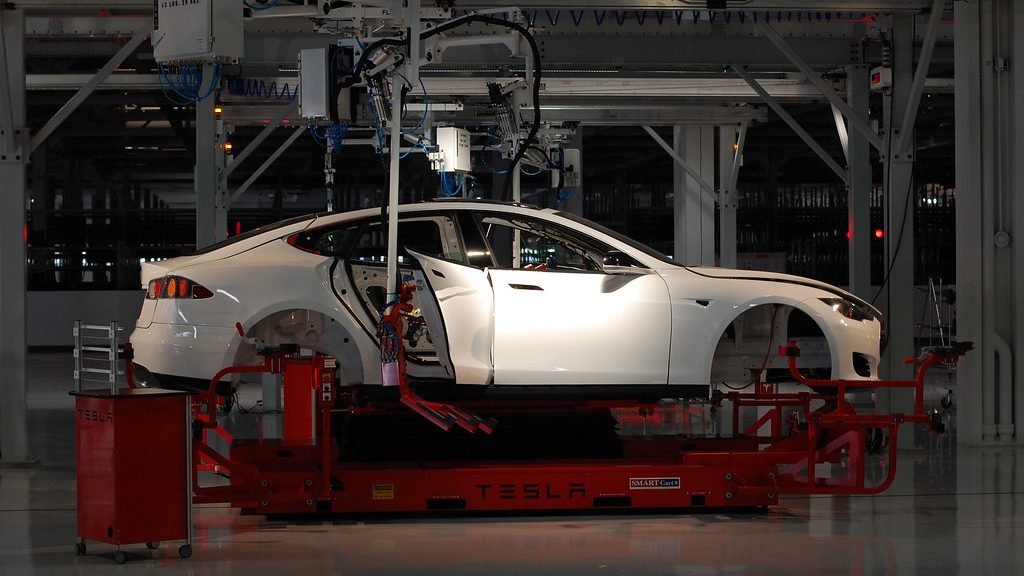
Tesla’s Giga Press 4.0 INSANE Speed, Cars Are Made So Fast: Tesla is pushing automotive manufacturing into a new era with its Giga Press 4.0, an ultra-large die-casting concept designed to dramatically simplify how vehicles are built. Instead of assembling hundreds of stamped metal components with extensive welding operations, the technology aims to create massive structural vehicle sections in single casting operations.
The evolution from conventional stamping to megacasting could have major consequences for production speed, factory size, vehicle weight, and manufacturing costs. As Tesla develops next-generation vehicles such as the Cybercab, increasingly integrated casting technology could become an important part of its broader manufacturing strategy.
What Is Tesla’s Giga Press 4.0?
The Giga Press is essentially a massive high-pressure aluminum die-casting machine. It injects molten aluminum alloy into a specially engineered mold under extremely high pressure, producing a large structural component.
Earlier Giga Press systems were already capable of replacing dozens of individual stamped parts with a single casting. Tesla’s Model Y, for example, helped demonstrate how a large rear underbody casting could replace a complicated collection of smaller components.
The proposed evolution toward Giga Press 4.0 takes that concept even further.
Instead of creating relatively isolated sections, the goal is to produce larger and more integrated structural assemblies, potentially including substantial portions of the vehicle underbody.
From Hundreds of Parts to One Large Casting
Traditional automobile manufacturing is highly complex. A conventional body shop may require numerous stamping operations before individual pieces are transported to welding stations.
The basic process looks like this:
Stamped Parts → Welding Robots → Body Structure → Painting → Final Assembly
Megacasting dramatically simplifies that architecture:
Molten Aluminum → High-Pressure Die Casting → Large Structural Component
This reduction in manufacturing steps is one of the biggest reasons Tesla has invested heavily in gigantic casting machines.
Why Megacasting Can Make Cars Faster
One of the most important advantages of megacasting is the potential reduction in the number of individual manufacturing operations.
A conventional body structure can contain dozens of stamped components that need to be positioned and joined together. Every additional component introduces another manufacturing, transportation, alignment, fastening, and inspection requirement.
A giant casting combines many of these functions.
Fewer Welding Robots
Traditional automotive factories use extensive robotic welding systems to join body components. Each robot, fixture, conveyor, and inspection station requires factory space and capital investment.
With large structural castings, many joining operations disappear.
Tesla can potentially replace a complex collection of stamped parts with one integrated casting, reducing the number of welds and simplifying the body shop.
This does not mean welding disappears entirely, but it can substantially change where and how it is used.
Smaller Factory Footprints
Another major advantage is manufacturing density.
If dozens of machines and assembly stations can be replaced by a smaller number of highly productive casting systems, manufacturers can potentially produce more vehicles within a smaller factory area.
This concept is especially important for Tesla because the company’s manufacturing strategy focuses heavily on automation, high production volume, and simplified vehicle architectures.
A smaller manufacturing footprint can also reduce construction requirements and potentially lower factory expansion costs.
Giga Press Generations: From Model Y to Cybercab
Tesla’s casting strategy has evolved significantly.
| Giga Press Generation | Approx. Clamping Force | Vehicle Application | Manufacturing Significance |
|---|---|---|---|
| Giga Press 1.0 / 2.0 | 5,500–6,100 tons | Model Y | Large rear structural casting |
| Giga Press 3.0 | 9,000+ tons | Model Y, Cybertruck | Larger structural castings |
| Giga Press 4.0 | 12,000+ tons concept | Cybercab / next-generation platforms | Greater structural integration |
The progression demonstrates an important manufacturing philosophy: make fewer parts, integrate more functions, and automate more of the production process.
The exact specifications and production configuration of any future Giga Press 4.0 system can depend on Tesla’s final engineering and factory implementation.
How Giga Press 4.0 Connects to Tesla’s Unboxed Manufacturing
Perhaps the most interesting aspect of Tesla’s megacasting strategy is how it connects to the company’s broader Unboxed Manufacturing concept.
Traditional factories generally move a vehicle through a long sequence of stations. The body gradually becomes a finished car as components are installed along a conveyor.
Tesla’s proposed approach is different.
Parallel Manufacturing Instead of One Long Line
Instead of constructing the entire vehicle sequentially, Tesla’s Unboxed approach aims to manufacture major vehicle sections in parallel.
For example, different production streams could work independently on:
- Front structural castings
- Rear structural castings
- Battery structures
- Interior modules
- Exterior body sections
- Other pre-assembled vehicle components
These sections can then converge during final assembly.
The result could be a manufacturing system where multiple parts of the vehicle are built simultaneously rather than waiting for one operation to finish before the next begins.
Why Cybercab Matters
The Cybercab is particularly relevant because an affordable autonomous vehicle needs to be produced at extremely high volume to achieve the economics Tesla has described for its next-generation transportation strategy.
That makes manufacturing efficiency critical.
If Tesla can simplify the body structure, reduce assembly operations, and increase automation, the company could potentially create a production architecture designed around high-volume, lower-complexity vehicle manufacturing.
Weight and Structural Advantages
Large aluminum castings can also provide opportunities for structural optimization.
Instead of connecting numerous separate components, engineers can design an integrated casting around specific load paths.
This may help improve:
- Structural rigidity
- Weight efficiency
- Component integration
- Crash-load management
- Manufacturing consistency
However, casting larger components does not automatically guarantee a lighter or safer vehicle. Engineers still have to balance material thickness, alloy characteristics, crash requirements, manufacturing tolerances, and repair considerations.
The Biggest Engineering Challenges
The technology also introduces significant challenges.
Thermal Management
A massive die repeatedly receives molten aluminum at high temperatures. This creates enormous thermal stresses within the mold.
The die must survive repeated production cycles without excessive deformation, cracking, or degradation.
Advanced cooling channels and precise thermal control therefore become extremely important.
Porosity and Casting Quality
Large castings must maintain consistent material properties throughout the entire component.
Tiny internal defects, including micro-porosity, can potentially compromise structural performance.
Manufacturers therefore need sophisticated process monitoring and inspection technologies to identify defects before components enter vehicle assembly.
Repairability
There is also an important question surrounding collision repairs.
A vehicle constructed from large structural castings may require a different repair philosophy than one assembled from many smaller stamped pieces.
Instead of straightening or replacing individual sheet-metal components, severe damage could require replacement of an entire modular structural section.
That could affect repair procedures, insurance calculations, service equipment, and replacement-part logistics.
The Future of Automotive Manufacturing
Tesla’s Giga Press strategy represents more than simply building a larger casting machine. It reflects a broader effort to redesign the automobile around manufacturing efficiency.
The traditional approach creates thousands of components and then assembles them.
Tesla’s megacasting philosophy moves in the opposite direction: fewer components, larger integrated structures, fewer joining operations, and greater automation.
If Giga Press 4.0 reaches the production scale envisioned for next-generation platforms, it could become an important foundation for Tesla’s manufacturing ambitions.
The biggest question is not simply how quickly a single casting machine can produce a part. It is whether the entire factory can be redesigned around that capability.
If Tesla successfully combines large structural castings, parallel assembly, automation, and Unboxed Manufacturing, the result could be a radically different way of producing vehicles.
That is what makes the Giga Press 4.0 concept so significant: it is not merely about making one component faster. It is about changing the architecture of the factory itself.
FAQs
1. What is Tesla Giga Press 4.0?
Tesla Giga Press 4.0 refers to the next-generation ultra-large high-pressure die-casting technology associated with Tesla’s strategy of producing larger vehicle structures as integrated castings.
2. How is Giga Press 4.0 different from traditional manufacturing?
Traditional manufacturing uses many stamped metal parts that are joined using welding, adhesives, and other processes. Megacasting can combine many of these components into large single-piece structural castings.
3. How large is Tesla Giga Press 4.0?
The concept described in the source involves a machine with 12,000+ tons of clamping force. The exact production specifications of future Tesla equipment may vary depending on the final factory configuration.
4. Which Tesla vehicles could use Giga Press 4.0?
The technology is associated with next-generation Tesla platforms, particularly concepts such as the Cybercab, where simplified high-volume manufacturing could be especially valuable.
5. Can Giga Press 4.0 reduce welding?
Yes. Large structural castings can replace many individual stamped components, potentially eliminating a substantial number of welding operations and robotic stations.
6. Does Giga Press 4.0 make Tesla cars faster?
The machine itself does not make an entire vehicle instantly. Its benefit comes from reducing the number of manufacturing steps, components, and joining operations, which can help shorten overall production cycles.
7. What is megacasting?
Megacasting is a manufacturing process in which extremely large die-casting machines produce substantial vehicle structures as single components rather than assembling numerous smaller stamped pieces.
8. What are the main benefits of Giga Press technology?
Key potential benefits include fewer components, reduced welding, smaller manufacturing footprints, simplified assembly, improved automation, and potentially lower production costs.
9. What is Tesla’s Unboxed Manufacturing system?
Tesla’s Unboxed Manufacturing concept aims to build different vehicle sections in parallel before bringing them together during later stages of production, rather than relying entirely on one long sequential assembly line.
10. Why is Giga Press important for the Cybercab?
A vehicle designed for large-scale autonomous transportation would require an efficient production system. Large castings could help Tesla create a simpler vehicle architecture with fewer manufacturing operations.
11. Can Giga Press reduce factory size?
Potentially, yes. Replacing many stamping, welding, and assembly stations with highly integrated casting operations can reduce the amount of floor space required for certain manufacturing processes.
12. Can large castings make Tesla vehicles lighter?
They can create opportunities for weight optimization by integrating multiple structural components and designing material around specific load paths. However, the final vehicle weight depends on the complete vehicle architecture and engineering requirements.
13. What are the biggest challenges with ultra-large die casting?
Major challenges include thermal stress, die wear, casting defects, porosity control, dimensional accuracy, cooling requirements, and maintaining consistent quality across very large components.
14. Will Giga Press change how Tesla vehicles are repaired?
It could. If vehicles contain larger structural castings, some collision repairs may involve replacing larger modular structural sections rather than repairing numerous individual stamped components.
15. Why is Tesla investing in megacasting technology?
The broader objective is to create a simpler, faster, and more automated manufacturing system. By integrating more vehicle structures into fewer components, Tesla aims to support high-volume production while reducing manufacturing complexity.
Read More:
- Tesla teases “Halloween Mode” update with Optimus rising from a graveyard
- Tesla just made its headlights even better through a software update
- Starlink launches Communities Program for passive income through internet sharing
- Starship New Footage revealed How S41 Heat Shield was Perfect after 2 Hours in Orbit
- Unreal INSIDE Elon Musk’s $119B Terafab Largest Building On Earth