
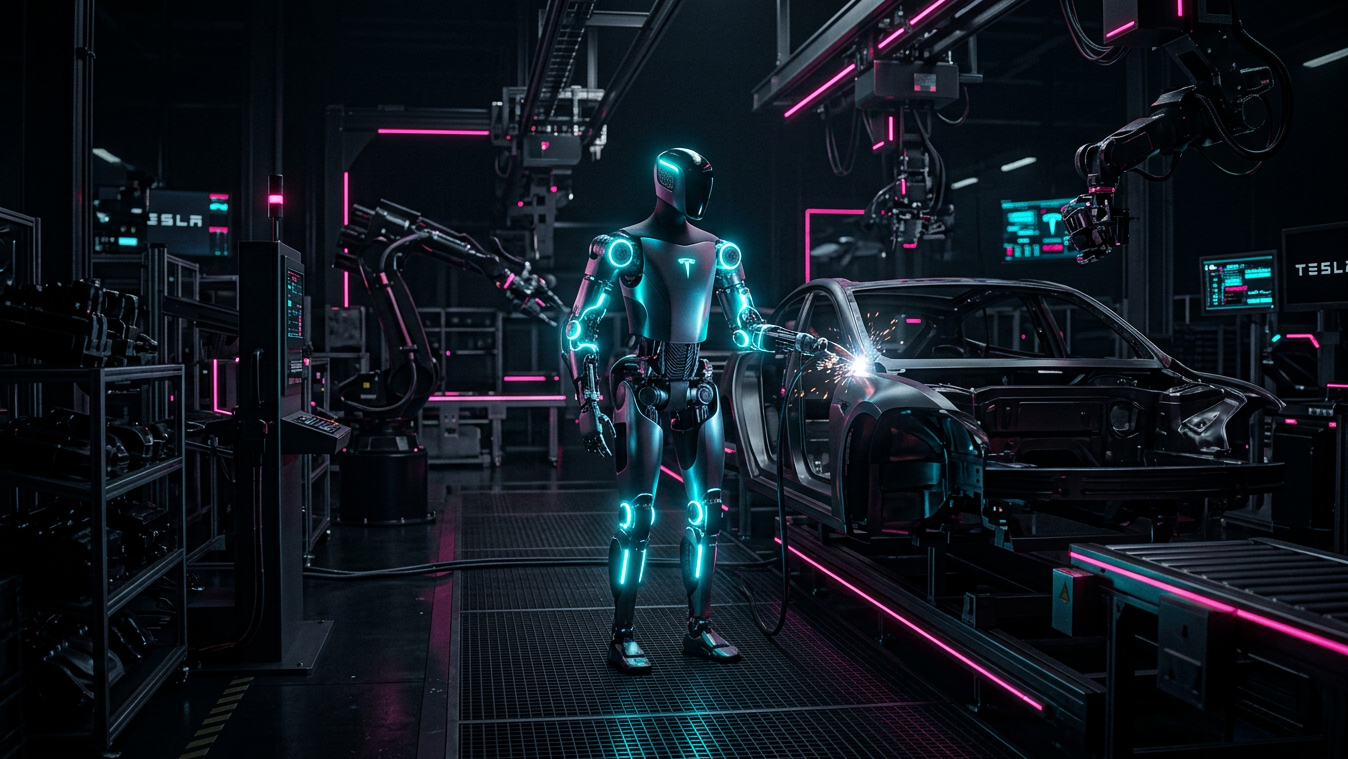
New 2027 Tesla Bot Optimus Gen 3 Revealed: Tesla’s robotics ambitions are moving beyond the idea of building one universal humanoid robot for every possible task. The emerging strategy surrounding the 2027 Tesla Bot Optimus Gen 3 points toward a broader robotic ecosystem, where different Optimus variants could be optimized for factories, precision work, public environments, and homes.
Rather than forcing one mechanical design to handle every situation, Tesla may be developing a modular Optimus robot family with different chassis structures, actuators, sensors, materials, and software configurations. This approach could make humanoid robots more practical while allowing Tesla to target multiple markets simultaneously.
Tesla Optimus Gen 3 Could Become a Robot Family
The original vision for Optimus was straightforward: create a general-purpose humanoid capable of performing repetitive factory work before eventually becoming a useful household assistant.
However, real-world robotics creates conflicting engineering requirements. A robot moving heavy battery components needs high torque and rugged hardware, while a robot handling fragile objects needs extremely sensitive tactile feedback.
This is where a specialized Optimus family becomes strategically interesting.
Potential variants could include:
- Industrial Heavy Optimus for factories
- Optimus Bio for precision and human-contact applications
- Synthetic Optimus for testing artificial skin and human-like movement
- Home Optimus or Cybergirl for domestic environments
All could potentially share Tesla’s underlying AI architecture, software systems, neural networks, and manufacturing technologies while using different physical hardware.
Industrial Heavy Optimus: Built for Maximum Strength
Reinforced Chassis and Heavy-Duty Hardware
The industrial version would prioritize strength, reliability, thermal endurance, and payload capacity rather than appearance.
A reinforced structural frame could provide greater stability during demanding factory operations. Wider feet and a lower center of gravity would also help the robot remain stable while carrying heavy components.
The biggest advantage would come from its actuator system.
Instead of optimizing every joint for delicate human-like movement, an industrial Optimus could use higher-torque actuators in the shoulders, knees, hips, and back. Its hands could also use rugged gripping mechanisms designed for automotive components.
Safety Becomes a Core Requirement
Factories are complicated environments filled with machinery, humans, moving vehicles, and heavy components. A commercial industrial humanoid therefore needs multiple layers of protection.
Potential technologies include emergency shutdown systems, wide-angle sensors, mechanical hard stops, advanced vision, and collision detection.
The goal would be to allow Optimus to work alongside humans without creating additional workplace hazards.
Optimus Bio Could Focus on Precision
Advanced Tactile Sensing
At the opposite end of the spectrum would be a precision-oriented Optimus variant.
Instead of maximizing lifting power, Optimus Bio could focus on extremely controlled movements and sensitive physical interaction. Advanced tactile sensors across the palms and fingers could allow the robot to detect pressure, slipping objects, and subtle changes in contact.
This is particularly important for tasks involving fragile objects.
Imagine a robot picking up a glass container. A conventional robotic gripper might apply a predetermined amount of force. A highly advanced humanoid could continuously adjust its grip based on real-time tactile information.
The Importance of Human-Robot Interaction
A precision Optimus could eventually find applications in laboratories, cleanrooms, rehabilitation environments, reception areas, and other controlled spaces.
The central engineering challenge would be combining accurate perception with extremely fast force-feedback adjustments.
This could allow a robot to interact with humans and objects more naturally without accidentally applying excessive force.
Synthetic Optimus Could Test Artificial Skin
Another intriguing direction involves making robots appear and feel more human.
Solving the Uncanny Valley Problem
Humanoid proportions alone do not necessarily make a robot comfortable to interact with. A machine with realistic skin, movements, and facial features can sometimes enter the psychological uncanny valley, where something appears almost human but still feels unnatural.
Tesla could use a specialized synthetic Optimus platform to study this problem.
A possible layered construction could include a flexible outer elastomer, artificial muscle contours, thermal-management channels, and a sensor-focused facial interface.
| Component | Possible Function |
|---|---|
| Synthetic outer layer | Provides realistic texture and friction |
| Flexible internal padding | Creates natural-looking movement |
| Thermal channels | Removes heat generated by actuators |
| Sensor mask | Houses cameras and perception hardware |
| Tactile sensors | Detect physical contact and pressure |
The objective would not simply be cosmetic. Synthetic materials could also influence durability, thermal management, cleaning resistance, and human interaction.
Home Optimus Could Be Tesla’s Biggest Opportunity
A Smaller and Quieter Household Robot
The consumer market may ultimately represent the largest opportunity for Optimus.
A household robot would face very different requirements from an industrial machine. Homes contain narrow hallways, stairs, furniture, pets, children, fragile objects, and unpredictable layouts.
That means a domestic Optimus would likely need a lighter and more compact design.
Noise would also become important. Industrial robots can tolerate significant mechanical noise because factories are already loud. A home assistant operating overnight would need much quieter actuators.
Tesla Ecosystem Integration
One of Tesla’s potential advantages is its broader technology ecosystem.
A future household Optimus could theoretically interact with Tesla vehicles, home security systems, energy storage, and other connected devices.
For example, a robot might receive a delivery, move objects around the house, assist with laundry, monitor certain areas, or coordinate household routines.
The larger vision would be a robot that does not simply perform isolated commands but becomes part of an autonomous home environment.
The Biggest Challenge Is Still AI
Hardware Alone Cannot Create a General-Purpose Robot
Despite impressive mechanical progress, the most difficult Optimus problem may not be its body.
It is the AI generalization problem.
A factory robot can be programmed to perform the same movement hundreds or thousands of times. A household robot faces a completely different challenge.
A cup could be in a different location. A chair could block a pathway. A package could have an unfamiliar shape. Lighting could change. A person could suddenly walk into the robot’s path.
The machine needs to understand what is happening and adapt.
That requires sophisticated computer vision, spatial reasoning, tactile perception, planning, and real-time decision-making.
From Repetition to Reasoning
The transition from scripted automation to true autonomy is enormous.
A robot that repeatedly performs one factory task may demonstrate impressive reliability, but a commercially useful household humanoid must understand thousands of unpredictable situations.
Tesla’s progress with neural-network-based autonomy could therefore become important to Optimus development. The long-term objective is potentially a system capable of learning generalized behaviors rather than memorizing individual movements.
Why a Modular Optimus Strategy Makes Sense
Developing multiple physical variants may initially seem more complicated, but it could actually solve several engineering conflicts.
A factory robot can prioritize torque and durability. A laboratory robot can prioritize precision and tactile sensing. A domestic robot can emphasize quiet operation, compact dimensions, and safety.
The underlying software could remain highly standardized while the physical hardware changes according to the application.
This resembles Tesla’s broader manufacturing philosophy: standardize what can be standardized and optimize what needs to be specialized.
The Road Ahead for Tesla Bot Optimus Gen 3
The future of Tesla robotics may therefore be much larger than a single humanoid product.
The New 2027 Tesla Bot Optimus Gen 3 could represent the foundation of a broader platform where specialized robots share common AI and manufacturing technologies.
Industrial Optimus could transform repetitive factory operations. Precision-focused variants could handle delicate tasks. Synthetic platforms could investigate human-machine interaction, while domestic models could eventually bring humanoid robotics into everyday homes.
The biggest question remains whether Tesla can solve AI generalization, reliability, cost, battery endurance, actuator durability, and safe autonomous operation at commercial scale.
If those challenges are overcome, Optimus could evolve from an experimental humanoid into an entire robotics platform spanning factories, laboratories, public spaces, and homes.
FAQs
1. What is the 2027 Tesla Bot Optimus Gen 3?
The Tesla Bot Optimus Gen 3 is the next-generation humanoid robot concept associated with Tesla’s long-term robotics program. It is expected to focus on improved mobility, dexterity, AI capabilities, and autonomous task execution.
2. Will Tesla Optimus Gen 3 be a single robot or a family of robots?
Tesla could potentially develop a family of specialized Optimus robots rather than relying on one design for every application. Different variants could target industrial, precision, public, and household environments.
3. What is the Industrial Heavy Optimus?
The Industrial Heavy Optimus concept is designed around strength and durability. It could use reinforced structural components, higher-torque actuators, wider feet, and rugged end-effectors for demanding factory operations.
4. What would an industrial Optimus be used for?
An industrial Optimus could perform repetitive tasks such as moving components, handling automotive parts, transporting materials, and assisting with manufacturing operations.
5. What is Optimus Bio?
Optimus Bio is a proposed precision-oriented version that emphasizes tactile sensing, delicate manipulation, and controlled physical interaction rather than maximum lifting strength.
6. Why is tactile sensing important for humanoid robots?
Tactile sensing allows a robot to determine how much pressure it is applying, whether an object is slipping, and how it is physically interacting with its surroundings. This could be essential for handling fragile objects.
7. Could Optimus work in medical or laboratory environments?
A precision-focused Optimus could potentially be useful in laboratories, cleanrooms, rehabilitation facilities, and other controlled environments, although these applications would require extensive testing and regulatory validation.
8. What is Synthetic Optimus?
Synthetic Optimus refers to a concept focused on testing artificial skin, flexible outer materials, human-like proportions, thermal management, and human-robot interaction.
9. Why would Tesla develop synthetic skin for Optimus?
Synthetic materials could potentially improve touch interaction, durability, appearance, friction characteristics, and protection of internal components. They could also help researchers study how people respond to humanoid robots.
10. What is the Tesla Cybergirl or Home Optimus concept?
The Home Optimus concept represents a potential domestic version of Tesla’s humanoid robot. It could be designed for household environments and tasks such as organizing objects, assisting with chores, and interacting with connected home systems.
11. Would a household Optimus be different from a factory Optimus?
Yes. A household robot would likely prioritize quiet operation, compact dimensions, lower weight, safety, and delicate object handling, while a factory version would emphasize payload capacity and durability.
12. Could Optimus connect with Tesla vehicles and home systems?
A future Optimus could potentially integrate with Tesla’s broader ecosystem, allowing it to interact with vehicles, security systems, energy products, and other connected devices. The exact capabilities depend on Tesla’s eventual product architecture.
13. What is the biggest challenge facing Optimus Gen 3?
One of the biggest challenges is AI task generalization. A commercially useful humanoid must adapt to changing environments rather than simply repeat pre-programmed movements.
14. Can Optimus perform completely unpredictable tasks?
Current humanoid robotics remains limited in unpredictable environments. The long-term objective is for Optimus to use AI perception, planning, vision, tactile feedback, and learned behaviors to adapt to unfamiliar situations.
15. How could Tesla improve Optimus Gen 3?
Tesla could improve the robot through better actuators, lighter materials, improved hands, tactile sensors, batteries, neural networks, cameras, and onboard computing.
16. Could Optimus eventually become a household robot?
Yes, a household robot is one of the major potential applications for Optimus. However, it would need to achieve high levels of reliability, safety, autonomy, affordability, and energy efficiency before widespread consumer adoption.
17. What could the future of Tesla Optimus look like?
Tesla could eventually develop an Optimus robotics platform with specialized versions for factories, laboratories, public spaces, and homes. If Tesla succeeds in combining scalable manufacturing with advanced AI, Optimus could become one of the company’s most important future technologies.
Read More:
- Tesla ships ‘spooky’ Halloween Mode with creepy and fun features
- Tesla Model 3 and Model Y can now do what only Cybertruck could
- Tesla FSD changed its mind mid-intersection, and it may have saved a life
- Elon Musk Revealed Secret Behind Starship Orbital Flight totally Humiliated Haters
- Everything About Elon Musk’s Tesla Semi 2027 Revealed