
The Boring Company’s NEW Dubai Loop is INSANE: Urban traffic congestion remains one of the biggest challenges facing modern cities. As metropolitan populations grow, traditional road networks and public transportation systems struggle to accommodate increasing numbers of commuters. From long traffic jams to overcrowded transit stations, urban mobility has become a major concern for city planners worldwide.
Now, The Boring Company, founded by Elon Musk, is advancing a different approach to transportation: moving vehicles underground through a network of compact tunnels. Its ambitious Dubai Loop project aims to transform how people travel across one of the world’s most innovative cities.
By combining electric vehicles, advanced tunnel-boring technology, and point-to-point transportation, the Dubai Loop represents a potentially important development in the future of urban mobility. Instead of expanding roads endlessly or relying exclusively on conventional subway systems, this underground transportation concept could provide another way to move people efficiently through congested districts.
What Is The Boring Company’s Dubai Loop?
The Dubai Loop is an underground transportation concept associated with Elon Musk’s The Boring Company and Dubai’s Roads and Transport Authority (RTA). The system is designed to move passengers through dedicated tunnels using electric vehicles rather than conventional trains.
Dubai has established itself as a global center for business, tourism, finance, and technological innovation. However, the city’s continued growth also creates transportation challenges, particularly around major commercial districts, shopping destinations, and business centers.
Traditional metro expansions and elevated rail systems can require extensive planning, major construction projects, and substantial investment. The Loop concept offers an alternative approach by using smaller tunnels designed specifically for passenger vehicles.
The objective is straightforward: move passengers underground, reduce exposure to surface traffic, and connect important destinations through direct routes.
The project’s proposed connections between major destinations, including the Dubai International Financial Centre (DIFC) and Dubai Mall, highlight its potential to serve commuters, business travelers, and tourists.
How Does the Dubai Loop Work?
Teslas in Tunnels
The system is often described as “Teslas in Tunnels” because it uses electric vehicles to transport passengers through underground roadways.
Vehicles such as the Tesla Model Y could serve as transportation units, carrying individuals or small groups between designated stations. Rather than following the operating pattern of a conventional subway train, vehicles could be dispatched according to passenger demand and destination.
For example, someone traveling from DIFC to Dubai Mall could enter a station, board an available vehicle, and travel through an underground route toward the destination.
The main advantage is the potential for direct, point-to-point transportation. Depending on the route and operating conditions, passengers may avoid multiple intermediate stops and some of the delays associated with busy surface roads.
The exact travel experience would depend on the final station layout, vehicle operations, traffic management, and system capacity.
A Different Approach to Public Transportation
Conventional metro systems move large numbers of passengers on trains that follow fixed routes and timetables. The Loop model instead emphasizes smaller electric vehicles traveling through dedicated tunnels.
This approach could offer greater flexibility for certain journeys, particularly between destinations with concentrated travel demand.
However, the system’s practical performance depends on how many vehicles can safely operate, how efficiently passengers enter and exit stations, and how well the network handles peak-hour demand.
The key innovation is not simply putting electric cars underground; it is designing the tunnels, vehicles, and stations as an integrated transportation system.
Dubai Loop Expansion Plans and Future Connectivity
Connecting Major Business Districts
Dubai’s transportation ambitions extend beyond a single underground corridor. An expanded Loop network could connect important commercial and visitor destinations, helping passengers travel between business districts without depending entirely on surface roads.
Proposed connections involving areas such as the Dubai World Trade Centre, Business Bay, DIFC, and Dubai Mall illustrate the types of destinations that could benefit from additional underground mobility options.
These districts attract workers, residents, shoppers, and international visitors. Improving connections between them could make daily travel more convenient while supporting the city’s broader economic development.
The Potential for a Larger Tunnel Network
Some project descriptions envision a network extending across approximately 22 kilometers (13.8 miles) and incorporating around 19 stations.
Such figures should be understood as proposed development specifications rather than a guarantee that every station or tunnel segment will be completed exactly as described. Final routes, construction schedules, station locations, and passenger capacity depend on official project plans and implementation.
If expanded successfully, the network could provide a useful additional transportation option for thousands of daily journeys.
The broader ambition is to create an underground mobility network that can grow in stages instead of requiring an entire citywide system to be built before passengers begin using it.
The Technology Behind The Boring Company’s Tunnels
One of the biggest challenges facing underground transportation is the cost and complexity of excavation. Conventional tunneling projects can require extensive engineering, specialized machinery, and lengthy construction schedules.
The Boring Company aims to address these challenges through innovations in tunnel-boring equipment, tunnel dimensions, and construction methods.
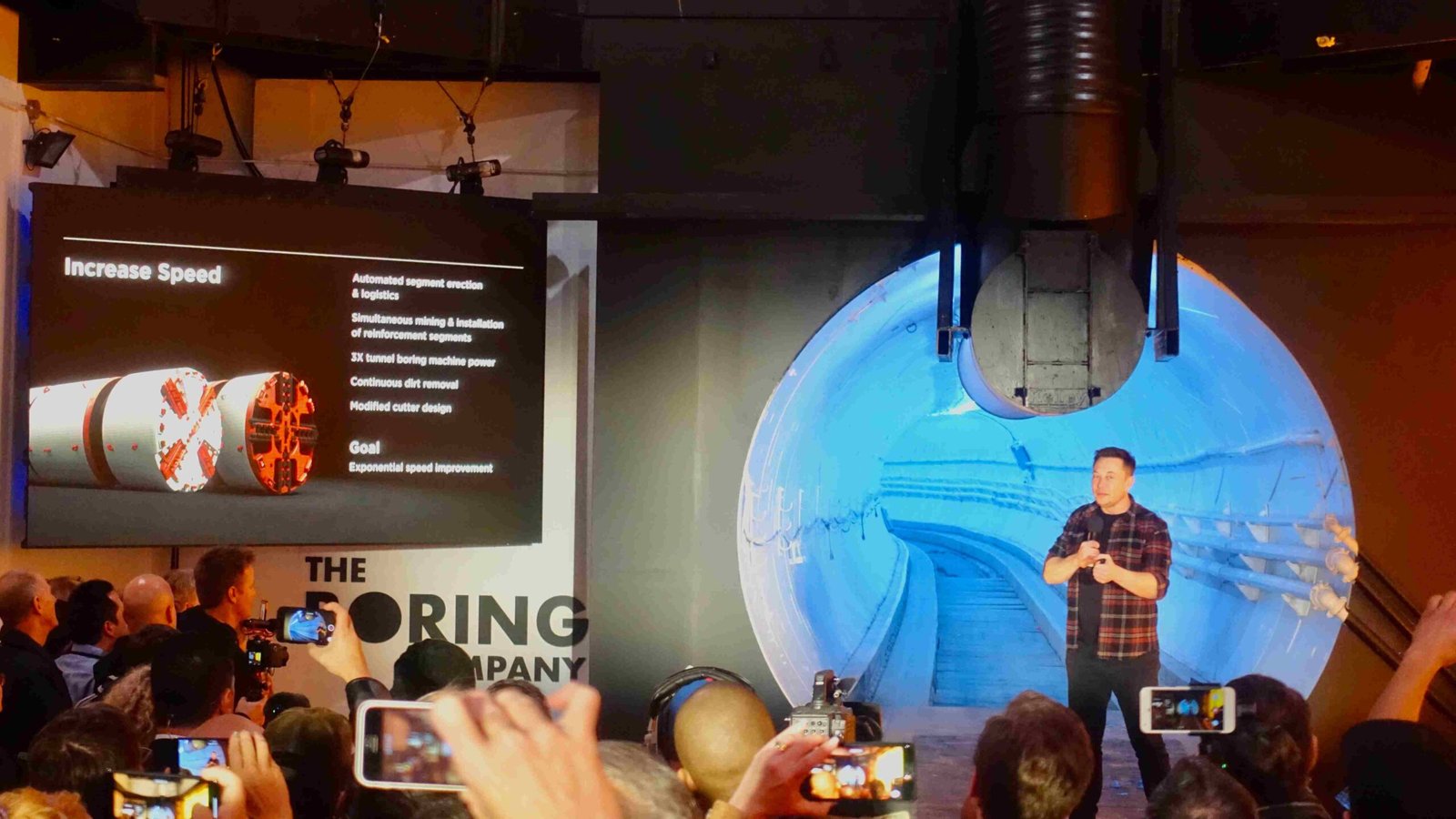
1. Advanced Prufrock Tunnel-Boring Machines
The company’s Prufrock tunnel-boring machines (TBMs) are designed to improve excavation efficiency and support the development of smaller transportation tunnels.
These machines use specialized cutting equipment to excavate soil and rock while supporting the tunnel structure as construction progresses.
Continuous excavation and improvements in machine design may reduce delays associated with traditional tunneling methods. However, actual construction speed depends on ground conditions, utilities, groundwater, safety requirements, and other site-specific factors.
2. Smaller Tunnel Diameters
A major feature of the Loop approach is the use of tunnels sized for passenger vehicles instead of large subway trains.
Smaller tunnels can require less excavation and lining material, potentially lowering construction costs and reducing the amount of soil that must be removed.
This design could make underground transportation financially attractive for selected corridors where a conventional metro line would be difficult to justify.
Nevertheless, emergency access, ventilation, drainage, vehicle clearance, and passenger evacuation requirements must still be incorporated into the design.
3. Electric Vehicles and Efficient Operations
Electric vehicles are central to the Loop concept. Using an all-electric fleet eliminates tailpipe emissions inside the tunnels and can reduce local air pollution compared with combustion-engine vehicles.
The broader environmental impact would depend on electricity generation, vehicle manufacturing, construction materials, and how many passengers the system carries.
Vehicle automation may also play a role in future operations, but the level of autonomy and operational arrangements must be established through the project’s actual specifications.
4. Reusing Excavated Materials
Tunnel construction generates significant quantities of excavated soil and rock. The Boring Company has explored ways to repurpose excavated material into useful construction products, including bricks.
Reusing suitable excavated material could reduce waste and support more resource-efficient construction. Its feasibility depends on the composition, quality, and processing requirements of the material recovered at each site.
Economic and Environmental Benefits of the Dubai Loop
Reducing Surface Traffic
By moving some journeys underground, the Dubai Loop could help reduce pressure on busy roads around participating destinations.
The benefits would depend on whether the system attracts people who would otherwise drive, how many passengers it can transport, and whether stations connect conveniently with existing public transportation.
An effective network could complement Dubai’s metro, buses, taxis, and other mobility services rather than replace them entirely.
Potentially Lower Infrastructure Costs
Construction cost is one of the most important advantages the Loop model seeks to deliver. Compact tunnels may require less excavation than conventional subway infrastructure, potentially lowering costs for selected projects.
However, the total cost must include stations, vehicle fleets, utilities, safety systems, maintenance, and long-term operations. A fair comparison with metro systems must also consider passenger capacity and the cost per passenger transported.
The Loop could be especially useful for targeted connections where demand patterns support smaller vehicles instead of high-capacity trains.
Supporting Sustainable Urban Development
Dubai continues to invest in infrastructure that supports economic growth, tourism, and more efficient urban mobility.
An electric underground transportation network could contribute to these objectives by offering another alternative to private car journeys. It may also reduce the need to dedicate additional surface space to roads in certain locations.
Zero tailpipe emissions do not mean zero total environmental impact, but electrification and careful construction planning could contribute to a more sustainable transportation strategy.
Challenges Facing the Dubai Loop
Despite its potential, the Dubai Loop must overcome several practical challenges before its long-term benefits can be fully evaluated.
First, passenger capacity is crucial. Smaller vehicles must operate efficiently to move large numbers of people during busy commuting periods.
Second, station access and passenger boarding must be carefully designed to prevent bottlenecks. A fast tunnel offers limited benefit if passengers spend excessive time waiting to enter vehicles.
Third, construction beneath a developed city requires detailed geological surveys, utility coordination, and rigorous safety planning.
Finally, the project must demonstrate reliable operations, reasonable costs, and convenient connections with existing transportation services.
These factors will determine whether the Loop becomes a useful complement to Dubai’s transportation network or a more limited service for particular destinations.
Conclusion: Is the Dubai Loop the Future of Urban Transportation?
The Boring Company’s Dubai Loop represents an ambitious effort to rethink how people move through modern cities. By combining compact underground tunnels, electric vehicles, and direct passenger routes, the concept offers an alternative to relying exclusively on conventional roads and rail infrastructure.
Dubai provides an interesting environment for this experiment because of its growing economy, international visitor numbers, and continued investment in innovative infrastructure.
If construction, operating costs, passenger capacity, and safety targets can be achieved, the Loop could become a valuable addition to the city’s transportation network.
The ultimate test will be real-world performance. Faster journeys, reliable service, affordable construction, and measurable reductions in road congestion will matter more than futuristic promises alone.
If the project delivers on these goals, Dubai could help demonstrate how underground electric transportation might serve selected urban corridors around the world.
The future of mobility will likely involve multiple complementary systems rather than a single universal solution. The Dubai Loop could become one important part of that future if its ambitious engineering vision translates into dependable everyday transportation.
FAQs
1. What is The Boring Company’s Dubai Loop?
The Dubai Loop is an underground transportation project associated with Elon Musk’s The Boring Company and Dubai’s Roads and Transport Authority (RTA). It is designed to transport passengers through dedicated tunnels using electric vehicles.
2. Who founded The Boring Company?
Elon Musk founded The Boring Company in 2016 to develop innovative tunneling technologies and reduce the cost of underground transportation infrastructure.
3. How does the Dubai Loop transportation system work?
The Dubai Loop uses electric vehicles traveling through underground tunnels to connect designated stations. Passengers can travel toward their destinations without necessarily stopping at every station along a conventional fixed transit route.
4. Which vehicles could be used in the Dubai Loop?
The system is associated with Tesla electric vehicles, including vehicles such as the Tesla Model Y. The final vehicle configuration and operational specifications depend on the project’s implementation plans.
5. Which locations could the Dubai Loop connect?
Potentially relevant destinations include the Dubai International Financial Centre (DIFC), Dubai Mall, Dubai World Trade Centre, and Business Bay. The exact routes and station locations depend on the officially implemented network.
6. How long is the proposed Dubai Loop network?
Some project descriptions envision an expanded network covering approximately 22 kilometers (13.8 miles). The final length will depend on the approved development phases and completed tunnel infrastructure.
7. How many stations could the Dubai Loop have?
Some proposed expansion descriptions refer to approximately 19 stations. The final number may change as planning, construction, and operational requirements are developed.
8. What is the main advantage of the Dubai Loop?
The main potential advantage is direct underground transportation that can bypass surface road congestion. The system could provide convenient connections between selected destinations while complementing Dubai’s existing public transportation network.
9. What technology does The Boring Company use to build tunnels?
The Boring Company develops advanced tunnel-boring machines, including its Prufrock series. These machines are designed to improve excavation efficiency and support the construction of compact underground transportation tunnels.
10. Is the Dubai Loop environmentally friendly?
The Loop’s electric vehicles produce zero tailpipe emissions during operation. However, the project’s overall environmental impact also depends on electricity generation, construction materials, excavation, and vehicle manufacturing.
11. Could the Dubai Loop reduce traffic congestion?
The system could help reduce congestion if enough travelers use it instead of private cars and other road-based transportation. Its actual impact will depend on passenger capacity, station accessibility, service frequency, and network coverage.
12. Is the Dubai Loop cheaper than a conventional metro system?
Smaller tunnels may reduce excavation and construction costs compared with some conventional subway projects. However, total expenses include stations, vehicles, safety systems, maintenance, and operations, so actual costs must be compared using project-specific data.
13. What challenges could affect the Dubai Loop project?
Potential challenges include construction costs, passenger capacity, tunnel safety, emergency evacuation, station design, and integration with existing transportation systems. Geological conditions and underground utilities can also influence construction schedules.
14. Can the Dubai Loop operate autonomously?
Electric vehicles and automated transportation are central to the broader Loop concept, but the exact level of vehicle autonomy used in Dubai depends on the project’s approved operating and safety specifications.
15. Could the Dubai Loop influence transportation in other cities?
Yes. If the project demonstrates reliable service, effective congestion relief, and competitive costs, it could provide valuable lessons for other cities exploring underground electric transportation systems. Its long-term influence will depend on real-world performance and passenger demand.
Read More:
- Trump presents Elon Musk with National Medal of Science, calls him “modern-day Thomas Edison”
- It’s official: SpaceX takes aim at Verizon, AT&T, and T-Mobile
- Elon Musk’s surprise addition to the X Takeover lineup has fans talking
- SpaceX’s First Starship Launch in Florida This Year finally Coming
- 5 Reasons Tesla Cybercab Is A GAME CHANGER! Shocking Details REVEALED
1 thought on “The Boring Company’s NEW Dubai Loop is INSANE”