
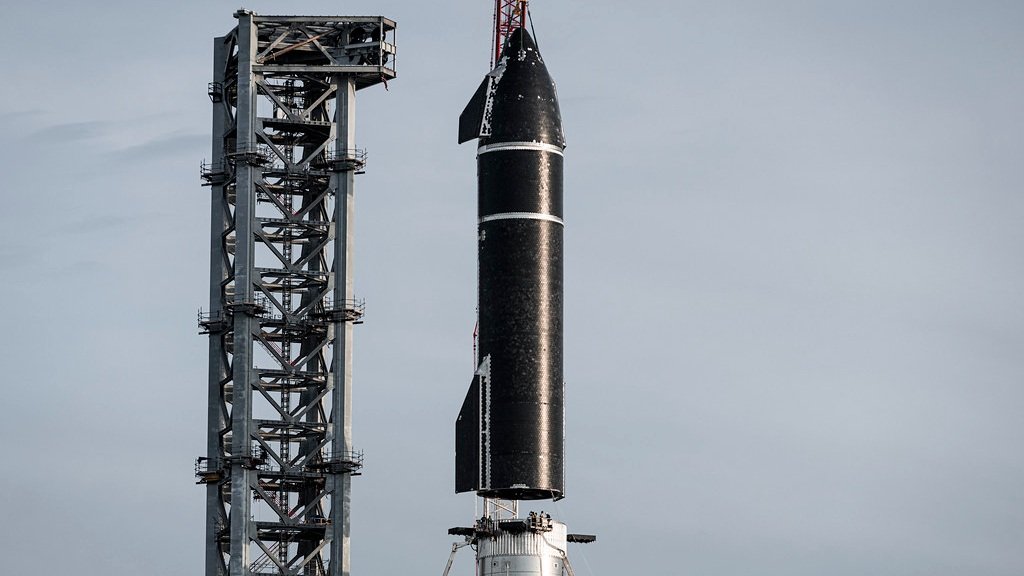
The Real Reason Starship Has 33 Engines: When SpaceX launched its Starship rocket for the first time on April 20, 2023, the world witnessed a remarkable moment in modern aerospace engineering. The enormous stainless steel rocket immediately attracted attention because of its futuristic design, unprecedented size, and ambitious mission to transform space exploration. However, one of its most impressive engineering features was hidden beneath the massive Super Heavy booster: 33 powerful rocket engines working together to generate enormous thrust.
The decision to use 33 engines was not simply about making the rocket more powerful. It reflected a carefully developed engineering strategy designed to improve reliability, combustion stability, landing precision, and manufacturing scalability. These four factors help explain why SpaceX chose a cluster of smaller engines instead of relying on a handful of enormous ones.
Understanding this decision reveals how Elon Musk’s company plans to make rockets more reusable, affordable, and capable of supporting future missions to the Moon and Mars.
1. Engine Redundancy Makes Starship More Resilient
One of the most obvious advantages of using 33 engines is engine redundancy. When a rocket depends on only a few engines, the failure of a single unit can create a serious problem during flight. A vehicle equipped with many engines, however, can potentially tolerate individual engine failures without immediately losing its ability to continue flying.
Historically, heavy-lift launch vehicles have used different engine configurations. NASA’s Saturn V, for example, employed five F-1 engines on its first stage, while the Space Launch System uses four RS-25 engines on its core stage alongside solid rocket boosters.
Starship’s Super Heavy booster takes a different approach by distributing thrust across a much larger engine cluster.
How Multiple Engines Improve Flight Reliability
The booster’s flight computers monitor engine performance and can respond to certain failures by shutting down affected engines and adjusting the vehicle’s operation. This approach provides additional flexibility when unexpected problems occur.
During Starship’s early test flights, engine anomalies demonstrated the challenges of operating such a complex system. The ability to manage engine failures is an important part of the vehicle’s design, although redundancy alone cannot guarantee mission success.
The key advantage is fault tolerance: SpaceX can design the rocket to accommodate certain engine failures rather than treating every individual malfunction as an automatic mission-ending event.
2. Smaller Engines Help Manage Combustion Instability
The second reason involves one of the most difficult problems in rocket engineering: combustion instability.
Rocket engines generate thrust by burning fuel and oxidizer inside a combustion chamber. This process produces extremely hot, high-pressure gases that expand through a nozzle at enormous speeds.
As engines become larger, controlling the complex interactions between pressure waves, fuel injection, and combustion can become increasingly challenging. A poorly controlled pressure oscillation can damage engine components or, in severe cases, destroy the engine.
Lessons From NASA’s Saturn V F-1 Engine
NASA’s legendary F-1 engine powered the first stage of the Saturn V rocket that carried astronauts toward the Moon. Each F-1 produced approximately 1.5 million pounds of sea-level thrust, making it one of the most powerful single-chamber liquid-fueled rocket engines ever flown.
However, developing the F-1 required extensive engineering work. Early testing revealed severe combustion-instability problems that engineers had to solve before the engine could safely support crewed lunar missions.
NASA engineers developed specialized injector designs and acoustic-control techniques, including baffles, to help stabilize combustion.
SpaceX’s strategy differs in an important way. Rather than continually increasing the size of individual engines, the company uses a large cluster of Raptor engines to generate the booster’s required thrust.
This approach does not eliminate combustion instability, but it distributes the total thrust requirement across multiple engines and avoids depending on one exceptionally large combustion chamber.
The lesson is that bigger is not always better in rocket engineering. Sometimes, multiple manageable systems can provide a more practical path toward achieving extraordinary performance.
3. Thirty-Three Engines Help Solve the Rocket Landing Challenge
Launching a rocket is only one part of SpaceX’s long-term strategy. The company also wants to recover and reuse its launch vehicles, reducing the cost of sending payloads into space.
However, landing a rocket vertically presents a difficult physics problem.
Why Rockets Cannot Simply Hover Like Helicopters
Unlike helicopters or conventional aircraft, rocket engines cannot generally reduce their thrust indefinitely. Each engine has a minimum stable operating level, and that minimum may produce more thrust than a nearly empty rocket needs to remain at a fixed altitude.
SpaceX’s Falcon 9 addresses this challenge through a maneuver commonly called a hover slam. The booster performs a carefully timed landing burn and touches down as its engines shut down. It does not hover stationary above the ground before landing.
If the landing burn is mistimed, the booster could strike the ground too hard or retain enough upward momentum to bounce.
Starship’s Super Heavy booster has a different recovery objective. SpaceX is developing a system in which the booster returns to the launch site and is caught by the tower’s enormous mechanical arms, often nicknamed Mechazilla’s chopsticks.
How Engine Clustering Supports Precision Recovery
Using numerous engines gives engineers more flexibility when designing thrust control and engine-out operating strategies. The minimum thrust available from an appropriately selected engine configuration can be better matched to the vehicle’s changing mass during its return.
However, the number of engines alone does not guarantee a successful catch. Recovery also depends on engine throttling, vehicle guidance, structural performance, aerodynamic behavior, and precise coordination with the launch tower.
The larger engine cluster is therefore part of a broader system intended to make rapid rocket recovery and reuse practical.
If SpaceX can consistently recover and relaunch its boosters, it could reduce hardware replacement costs and increase launch frequency.
4. Manufacturing Scale Is Essential to SpaceX’s Vision
The fourth reason is manufacturing. SpaceX does not want Starship to remain an experimental rocket launched only occasionally. Its broader ambition is to develop a reusable transportation system capable of supporting frequent missions to Earth orbit, the Moon, and eventually Mars.
That goal requires producing engines in much greater quantities than traditional space programs typically needed.
Why Mass Production Matters
The Saturn V program used 15 flight vehicles, each powered by five F-1 engines on its first stage. The engines were extraordinarily powerful, but producing them required specialized facilities, extensive testing, and significant engineering resources.
By comparison, SpaceX designs its Raptor engines around an industrial production strategy that emphasizes repeatable manufacturing, design improvements, and increasing production efficiency.
Smaller individual engines can offer practical manufacturing advantages because production processes can be standardized across many units. They may also allow engineers to test improvements on individual engine designs without redesigning one enormous powerplant.
Nevertheless, manufacturing thousands of engines remains a substantial challenge. Each engine must meet demanding requirements for performance, durability, quality control, and safety.
Building a Reusable Space Transportation System
SpaceX’s long-term objective requires more than powerful rockets. It needs a complete production and operations system that can support frequent launches and rapid turnaround.
A reusable Starship system could eventually transport satellites, cargo, scientific equipment, and potentially astronauts. It could also support NASA’s plans for future lunar exploration, subject to mission development and certification.
For Mars missions, the combination of high payload capacity and reusability could become particularly important because transporting large quantities of equipment and supplies requires substantial launch capacity.
Mass production is therefore central to the Starship strategy. If the company can manufacture engines efficiently and reuse its vehicles reliably, it may be able to lower the cost of access to space over time.
Why SpaceX Chose 33 Engines Instead of a Few Giant Engines
The 33-engine configuration represents a balance between several competing engineering requirements. A single enormous engine might simplify some aspects of the vehicle’s architecture, but it would introduce different challenges involving combustion control, manufacturing, maintenance, and failure management.
By distributing thrust among multiple Raptor engines, SpaceX can pursue a design that supports fault tolerance, controllable thrust, and repeatable industrial production.
| Engineering challenge | How the 33-engine configuration helps |
|---|---|
| Engine failure | Provides opportunities for fault-tolerant operation |
| Combustion challenges | Avoids relying on one extremely large combustion chamber |
| Landing control | Supports flexible engine operation and thrust management |
| Manufacturing | Encourages standardized engine production |
| Reusability | Contributes to a system designed for repeated booster recovery |
These advantages come with trade-offs. More engines mean more components, plumbing, control requirements, and potential failure points. SpaceX must manage this complexity through careful engineering, software, testing, and manufacturing quality.
The success of the configuration ultimately depends on how reliably the entire rocket performs, not simply on the number of engines installed.
Conclusion
The real reason Starship has 33 engines goes far beyond generating enormous thrust. The configuration reflects SpaceX’s broader approach to solving the most difficult challenges in modern rocketry.
Engine redundancy can improve fault tolerance. A cluster of smaller engines offers an alternative to scaling a single combustion chamber to extreme dimensions. The configuration also supports the thrust-control strategies needed for ambitious booster recovery operations, while standardized engines may help SpaceX expand production.
None of these benefits is automatic, and Starship still faces substantial technical and operational challenges. Nevertheless, its engine architecture demonstrates a different way of thinking about heavy-lift launch vehicles.
If SpaceX can combine reliable Raptor engines, rapid manufacturing, and successful vehicle recovery, Starship could help make frequent, reusable spaceflight increasingly practical.
Ultimately, 33 engines are not just about power—they are part of a larger strategy to make rockets more resilient, reusable, and scalable. That strategy could shape the future of satellite deployment, lunar exploration, and humanity’s ambitions to reach Mars.
FAQs
1. Why does SpaceX Starship have 33 engines?
SpaceX’s Starship Super Heavy booster uses 33 Raptor engines to generate enormous thrust for launch. This configuration also supports engine redundancy, thrust control, manufacturing scalability, and reusable rocket operations.
2. What type of engines does the Starship Super Heavy booster use?
The Super Heavy booster uses SpaceX Raptor engines, which are liquid-fueled rocket engines that burn liquid methane and liquid oxygen. They use a full-flow staged-combustion cycle designed to deliver high performance and efficiency.
3. How powerful are the 33 Starship engines?
Each Raptor engine produces substantial thrust, and the combined output of the 33-engine configuration gives Super Heavy the power needed to lift the massive Starship vehicle from Earth. Exact total thrust depends on the engine version and operating conditions.
4. What is the main advantage of having 33 rocket engines?
One major advantage is engine redundancy. If certain engines experience problems during flight, the rocket’s control systems may be able to compensate for the affected engines and continue operating, depending on the severity and location of the failures.
5. Can Starship continue flying if one of its engines fails?
Starship is designed with the ability to manage certain engine failures. Its flight computers can monitor engine performance and respond to anomalies. However, an engine failure does not guarantee that the rocket will survive, because the outcome depends on the nature of the malfunction and the vehicle’s flight conditions.
6. Why didn’t SpaceX build one enormous rocket engine instead?
A single enormous engine would present significant challenges involving combustion stability, manufacturing, maintenance, and reliability. Using multiple engines distributes the total thrust requirement across smaller units and can make production and system development more manageable.
7. What is combustion instability in rocket engines?
Combustion instability occurs when pressure fluctuations and combustion processes interact in ways that create potentially dangerous oscillations inside an engine. These oscillations can damage components or cause engine failure if they are not properly controlled.
8. What can SpaceX learn from NASA’s F-1 engine?
NASA’s F-1 engine, used on the Saturn V rocket, demonstrated the extraordinary power of large liquid-fueled engines. Its development also showed how difficult combustion instability can be to control. SpaceX’s clustered-engine approach represents a different way to achieve the thrust required for heavy-lift missions.
9. Why is it difficult for a rocket to hover before landing?
Rocket engines have limits on how far their thrust can be reduced while maintaining stable operation. If an engine produces more thrust than the vehicle’s weight, the rocket accelerates upward. This makes precise landing burns essential for successful booster recovery.
10. What is a hover slam landing?
A hover slam is a rocket landing maneuver in which the vehicle performs a carefully timed engine burn and touches down as the engines shut down. SpaceX uses this technique with Falcon 9 boosters rather than hovering stationary above the landing surface.
11. How do 33 engines help Starship land or get caught by the launch tower?
The multiple-engine configuration provides flexibility for thrust management and engine operation. This can support the precision required for Super Heavy recovery. However, a successful tower catch also depends on guidance, structural control, engine performance, and coordination with the tower’s mechanical arms.
12. What are Mechazilla’s chopsticks?
Mechazilla’s chopsticks are the large mechanical arms mounted on SpaceX’s launch tower. They are designed to catch returning Super Heavy boosters, helping SpaceX recover valuable rocket hardware and potentially reduce the time required between launches.
13. How does the 33-engine design help SpaceX manufacture rockets?
Using multiple standardized engines can support repeatable production processes, automated manufacturing, and incremental design improvements. SpaceX aims to increase Raptor engine production to support its long-term Starship launch ambitions.
14. Why is rocket reusability important for SpaceX?
Rocket reusability allows SpaceX to recover and reuse valuable hardware instead of manufacturing an entirely new vehicle for every mission. If recovery and refurbishment become reliable and efficient, reusability could reduce launch costs and increase flight frequency.
15. Will Starship’s 33 engines help humans reach Mars?
The 33-engine Super Heavy configuration provides the launch thrust needed to send Starship toward orbit. Combined with Starship’s planned reusability and in-space refueling capabilities, the system is intended to support future Mars exploration and transportation missions. Crewed Mars missions still require substantial development and testing.
16. What makes Starship’s 33-engine configuration different from traditional rockets?
Traditional rockets often use fewer, larger engines or different combinations of liquid and solid propulsion systems. Starship’s Super Heavy booster distributes thrust across 33 Raptor engines, combining high launch power with a design intended to support engine-out operation, precise recovery, and scalable manufacturing. Its long-term success will depend on the reliability of the complete rocket system.
Read More: