
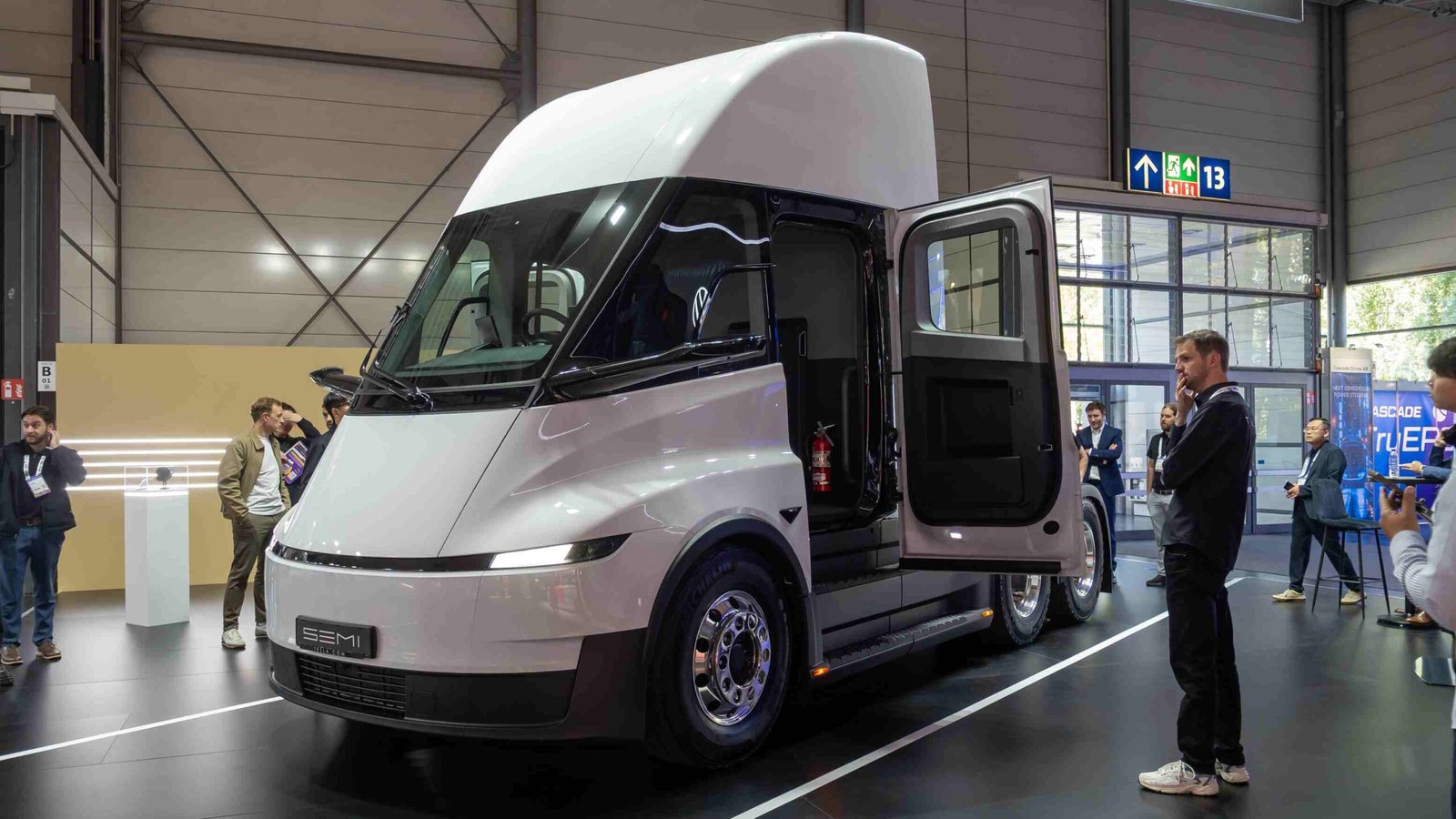
Tesla’s 3 BIGGEST 2027 Reveals Could CHANGE America Forever: Tesla is preparing for a potentially transformative period as it moves beyond traditional electric vehicles and expands into electric freight transportation, humanoid robotics, and fully autonomous mobility. As 2027 approaches, three major developments could reshape how Americans transport goods, automate work, and travel through their cities.
Under Elon Musk’s leadership, Tesla is pursuing technologies designed to do more than improve existing products. The company aims to build an ecosystem in which electric trucks reduce freight emissions, Optimus robots perform physical tasks, and CyberCabs provide autonomous transportation. However, turning these ambitious projects into commercially successful products will depend on manufacturing capacity, technical reliability, costs, and regulatory approval.
Here are the three biggest Tesla developments to watch as the company moves toward 2027.
1. Tesla Semi: The Electric Truck Revolution
Production Expansion Could Transform American Freight
One of Tesla’s most important commercial projects is the Tesla Semi, a heavy-duty electric truck designed to challenge diesel-powered freight transportation.
According to the supplied report, Tesla began production Semi deliveries from its Nevada facility on September 24, 2026. Major fleet operators, including PepsiCo, DHL, and US Foods, were identified as initial recipients. These deployments could help demonstrate whether battery-electric trucks can meet the demanding requirements of large logistics operations.
Tesla’s long-term target is to produce 50,000 Semi trucks annually. Reaching that level would require substantial improvements in factory throughput, battery availability, supplier coordination, and automated assembly.
At that production rate, Tesla would need to manufacture approximately 137 trucks every day. Achieving this target consistently would be a major industrial challenge, particularly because commercial customers require dependable deliveries, predictable operating costs, and reliable vehicle performance.
Range and Megacharging Technology
Tesla has presented two primary Semi configurations: a standard-range version rated at 325 miles and a long-range version rated at 500 miles. These figures could make the truck suitable for different freight routes, although actual performance depends on payload, weather, terrain, and driving conditions.
Another important technology is Tesla’s proposed Megacharger system, which is designed to deliver charging power of up to 1.2 megawatts. High-power charging could reduce downtime for commercial fleets and make electric trucks more practical for demanding delivery schedules.
For fleet operators, however, range and charging speed are only part of the equation. They must also consider electricity prices, financing, battery durability, maintenance, depreciation, and charging infrastructure.
Why the Tesla Semi Matters in 2027
If Tesla increases production and demonstrates consistent real-world performance, the Semi could help accelerate the transition toward electric commercial transportation. Large fleets could benefit from lower maintenance requirements and reduced exposure to diesel fuel costs.
Nevertheless, Tesla’s annual production target remains an ambition rather than proof of achieved capacity. By 2027, the most important indicators will be actual deliveries, factory output, vehicle uptime, and the total cost of ownership compared with diesel trucks.
2. Tesla Optimus: Humanoid Robots Could Change the Workplace
Why Human-Like Hands Are the Biggest Challenge
Tesla’s second major development is Optimus, its humanoid robot project. Unlike conventional industrial robots designed for specific repetitive movements, Optimus is intended to perform a broader range of physical tasks in factories and potentially in homes.
One of the biggest engineering obstacles is developing human-like robotic hands. Walking and maintaining balance are difficult, but manipulating everyday objects requires another level of precision.
Consider opening a jar, turning a screwdriver, folding clothes, or picking up a fragile glass. Each task requires carefully controlled force, accurate movement, and continuous feedback from sensors.
Tesla must develop hands capable of combining dexterity, tactile sensing, mechanical strength, and reliability. Increasing the number of joints can improve movement, but it can also raise manufacturing costs and create additional opportunities for mechanical failure.
From Factory Automation to Everyday Assistance
A factory offers a relatively structured environment. Objects are often positioned in predictable locations, workstations are organized, and tasks follow established procedures.
A home is much less predictable. Furniture moves, objects are misplaced, doorways become blocked, and people behave in unexpected ways.
For example, carrying a laundry basket requires a robot to identify the basket, estimate its weight, establish a secure grip, navigate obstacles, and place it in the correct location. If something changes along the way, the robot must adapt rather than simply repeat a programmed sequence.
That requires sophisticated artificial intelligence, computer vision, motion planning, and error recovery.
Could Optimus Become a Major Business?
If Tesla successfully develops reliable humanoid robots, the potential applications could extend across manufacturing, warehousing, material handling, and household assistance.
Robots could eventually take on repetitive or physically demanding work, allowing human employees to concentrate on supervision, problem-solving, and other responsibilities. However, these benefits depend on safe operation, useful capabilities, acceptable pricing, and dependable performance.
For 2027, the key question is whether Tesla can move Optimus from controlled demonstrations and factory experiments toward repeatable, useful real-world work. A robot that performs one impressive task is not necessarily ready to function as a general-purpose assistant.
3. Tesla CyberCab: The Future of Driverless Transportation
A Purpose-Built Robotaxi Without Traditional Controls
The third major development is Tesla’s CyberCab, a compact vehicle designed specifically for autonomous ride-hailing.
Unlike conventional cars adapted for driverless testing, the CyberCab concept eliminates the traditional steering wheel and pedals. Its two-seat configuration is intended to support a transportation model in which passengers request rides without operating the vehicle themselves.
The supplied report identifies several technical specifications from 2026 certification documents: a 48 kWh battery pack, a 219-horsepower motor, and a curb weight of approximately 3,113 pounds.
A relatively small battery could help control vehicle costs while supporting frequent urban journeys. The commercial success of this approach, however, will depend on actual energy consumption, charging schedules, passenger demand, and vehicle utilization.
Robotaxi Miles and Autonomous Software
Tesla’s broader robotaxi program is another important part of the story. The supplied report states that Tesla reported approximately 2.4 million cumulative paid robotaxi miles through June 2026.
That figure reflects the broader autonomous-testing fleet rather than miles driven exclusively by the purpose-built CyberCab. The distinction matters because different vehicles, operating conditions, and levels of autonomy can produce different results.
To scale a driverless taxi service, Tesla must demonstrate that its software can reliably handle pedestrians, cyclists, temporary traffic signals, road construction, unusual intersections, and other unpredictable situations.
Autonomous driving reliability is critical because a vehicle operating without conventional driver controls cannot depend on a human driver to take over in the same way as a traditional supervised vehicle.
Regulation Could Determine the Rollout
The CyberCab also faces regulatory challenges. The supplied report describes a September 2026 review by the National Highway Traffic Safety Administration concerning the vehicle’s lack of conventional driver controls and the requirements of existing federal safety standards.
Regulatory review does not automatically mean a vehicle is unsafe, but it can influence deployment schedules, vehicle design, and the conditions under which commercial services may operate.
If Tesla can satisfy applicable safety requirements and demonstrate reliable autonomous performance, the CyberCab could help reshape urban mobility through on-demand, driverless transportation. If technical or regulatory obstacles remain unresolved, widespread deployment could take longer than expected.
What These Three Tesla Reveals Mean for America
Tesla’s Semi, Optimus, and CyberCab target three different industries, but they share a common strategy: combining electric power, software, artificial intelligence, and large-scale manufacturing.
The Semi could influence freight transportation. Optimus could change how certain physical tasks are performed in factories and other workplaces. CyberCab could introduce new models for urban ride-hailing.
Together, these projects could create opportunities for new manufacturing jobs, charging infrastructure, robotics development, and autonomous mobility services. They could also intensify competition, require workforce training, and raise questions about safety, employment, and regulation.
Still, ambitious targets should not be confused with completed achievements. Production capacity, real-world performance, customer adoption, and financial sustainability will determine whether these technologies become mainstream.
Conclusion
The road toward 2027 could be a defining chapter for Tesla. The Tesla Semi, Optimus humanoid robot, and CyberCab robotaxi represent three major attempts to expand the company beyond passenger electric cars.
Each project faces significant challenges, from scaling heavy-truck production to mastering robotic dexterity and securing approval for vehicles without traditional driver controls.
If Tesla can overcome these obstacles, its technologies could influence American freight networks, workplaces, and urban transportation. The biggest reveal may ultimately be not a single product launch, but whether Tesla can turn its ambitious engineering vision into reliable, affordable, large-scale technology.
For now, 2027 should be viewed as an important period to watch—not a guarantee that every promised capability or production target will be achieved.
FAQs
1. What are Tesla’s three biggest reveals expected in 2027?
Tesla’s three major developments to watch are the Tesla Semi electric truck, the Optimus humanoid robot, and the CyberCab autonomous robotaxi. These projects could expand Tesla’s influence beyond passenger electric vehicles.
2. What is the Tesla Semi?
The Tesla Semi is a heavy-duty battery-electric truck designed for commercial freight transportation. It aims to reduce diesel consumption while offering competitive driving range, charging speed, and operating costs.
3. What is Tesla’s annual production target for the Semi?
Tesla has a long-term target of producing 50,000 Semi trucks annually. Achieving this goal will require increased manufacturing capacity, reliable battery supplies, efficient assembly lines, and strong customer demand.
4. What is the expected range of the Tesla Semi?
The supplied source describes two configurations: a standard-range version rated at 325 miles and a long-range version rated at 500 miles. Actual range may vary depending on payload, weather, terrain, and driving conditions.
5. What is Tesla Megacharger technology?
Tesla’s Megacharger is a high-power charging system designed for the Semi. The source describes charging power of up to 1.2 megawatts, potentially helping commercial trucks recharge during scheduled driver breaks.
6. How could the Tesla Semi change the American trucking industry?
The Tesla Semi could help reduce diesel consumption and potentially lower maintenance expenses. Its impact will depend on purchase prices, electricity costs, charging infrastructure, vehicle reliability, and total operating costs compared with diesel trucks.
7. What is Tesla Optimus?
Tesla Optimus is a humanoid robot project designed to perform physical tasks in industrial environments and potentially homes. It combines robotics hardware, artificial intelligence, sensors, and motion control to pursue a broader range of capabilities.
8. What is the biggest challenge facing Tesla Optimus?
One major challenge is developing human-like robotic hands that can manipulate objects precisely and safely. Tasks such as opening containers, handling fragile objects, and using tools require sophisticated tactile sensing and accurate force control.
9. Could Tesla Optimus work inside homes?
Optimus is intended to have applications beyond factories, including potential household assistance. However, homes are unpredictable environments, so the robot must navigate obstacles, handle unfamiliar objects, and respond safely to changing situations.
10. How could Tesla Optimus affect American jobs?
If humanoid robots become reliable and affordable, they could perform repetitive or physically demanding tasks in factories, warehouses, and other workplaces. Their broader employment effects will depend on adoption rates, productivity improvements, costs, and how businesses adapt their workforces.
11. What is the Tesla CyberCab?
The Tesla CyberCab is a purpose-built autonomous ride-hailing vehicle designed to transport passengers without conventional manual driving controls. Its proposed design features two seats and no traditional steering wheel or pedals.
12. What battery and motor specifications are described for the CyberCab?
The supplied source identifies a 48 kWh battery pack, a 219-horsepower motor, and a curb weight of approximately 3,113 pounds. These figures are attributed to certification documents discussed in the source.
13. How could Tesla CyberCab change urban transportation?
If deployed successfully, CyberCab could provide on-demand driverless rides and change how people access urban transportation. Its success will depend on autonomous software reliability, passenger demand, operating costs, charging availability, and regulatory approval.
14. What challenges could delay Tesla’s 2027 plans?
Tesla faces challenges involving manufacturing scalability, technical reliability, production costs, supply-chain constraints, and regulatory requirements. The Semi must demonstrate dependable freight performance, Optimus must master complex physical tasks, and CyberCab must meet applicable autonomous-vehicle safety requirements.
15. Will Tesla’s three major projects definitely transform America in 2027?
Not necessarily. The Tesla Semi, Optimus, and CyberCab have the potential to influence freight transportation, industrial automation, and urban mobility. However, their actual impact will depend on commercial deployment, real-world performance, affordability, customer adoption, and safety approvals. The year 2027 is an important period to watch, not a guarantee that every target will be achieved.
Read More:
- Amazon shuts out Elon Musk’s Grok Bot so he may just build his own rival store
- Tesla Roadster: Three configs, one can fly, 0-60 in 0.8 seconds
- How Tesla’s Roadster fan system and thrusters are built to dominate the corners
- Tesla’s flying Roadster just revealed something bigger than the car
- Elon Musk Has Finally Unveiled a Flying Tesla Roadster 2026