
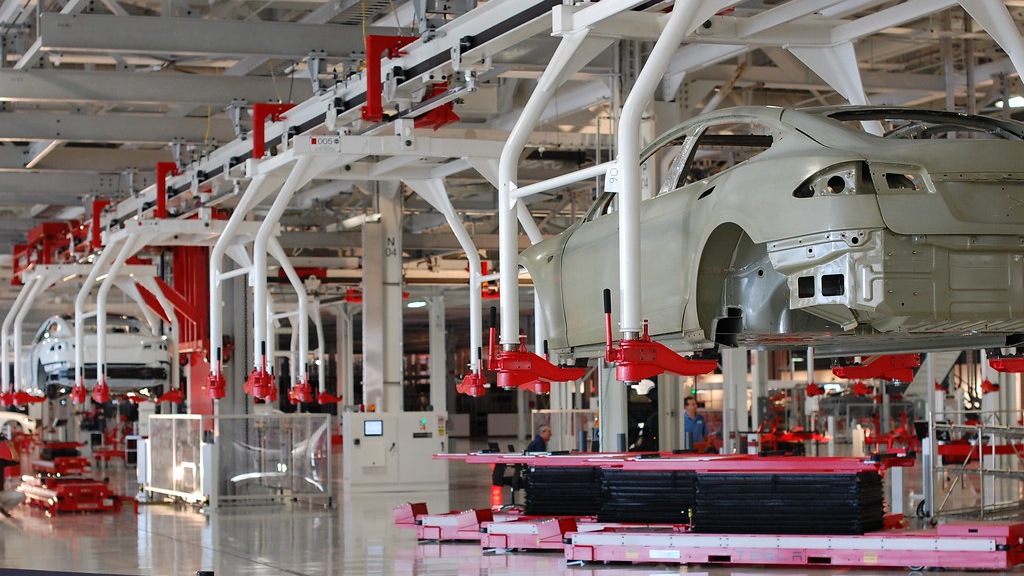
Tesla Giga Press 4.0 REVEALED — This 4X Upgrade Is Insane: The automotive industry is experiencing one of the most significant manufacturing revolutions in its history, and at the center of this transformation is Tesla’s Giga Press 4.0. After months of speculation surrounding the highly restricted production zones inside Giga Texas, new details have finally emerged—and they reveal a manufacturing breakthrough that could permanently reshape how vehicles are built.
Unlike a simple machine upgrade, the Tesla Giga Press 4.0 delivers an estimated 4X improvement in manufacturing performance, including faster production cycles, smaller factory footprints, lower capital expenditures, and enhanced structural integration. More importantly, it serves as the foundation for Tesla’s revolutionary “Unboxed” manufacturing process, a strategy designed to enable mass production of affordable electric vehicles priced between $25,000 and $30,000.
In this article, we’ll explore how Tesla’s latest manufacturing innovation works, why it matters, and how it could create an enormous competitive advantage over traditional automakers.
What Is Tesla Giga Press 4.0?
The original Giga Press technology already disrupted automotive manufacturing by replacing dozens of separate stamped steel components with a single massive aluminum casting. Tesla used earlier generations of the Giga Press to consolidate approximately 70 different parts into a single rear underbody casting for the Model Y.
This innovation eliminated hundreds of weld points, simplified assembly, reduced weight, and lowered production costs.
Now, Giga Press 4.0 takes this concept to an entirely new level.
Instead of producing only specific structural sections, Tesla’s newest machine is capable of manufacturing complex hollow-box vehicle underbody structures in a single casting cycle, creating stronger and lighter vehicle architectures while dramatically improving manufacturing efficiency.
The Physics Behind Tesla’s Giga Press 4.0
Massive Castings in Just 80–90 Seconds
One of the most astonishing achievements of the Giga Press 4.0 is its speed.
The machine can create a highly complex structural casting in only 80 to 90 seconds, a remarkable accomplishment considering the size and complexity of the component being produced.
To achieve this, Tesla combines several advanced technologies:
- Injection speeds reaching 10 meters per second
- AI-controlled fluid dynamics optimization
- Real-time vacuum evacuation systems
- Precision 3D-printed sand core integration
Together, these technologies allow molten aluminum to flow rapidly and uniformly through the mold while minimizing defects and ensuring structural consistency.
AI-Powered Fluid Optimization
A major breakthrough lies in Tesla’s use of artificial intelligence to control the casting process.
AI algorithms monitor:
- Injection vectors
- Mold filling patterns
- Air evacuation sequences
- Pressure distribution
This intelligent control system reportedly accelerates mold filling and vacuum evacuation by approximately four times compared to conventional casting systems.
The result is faster production, higher quality, and significantly improved manufacturing efficiency.
How Giga Press 4.0 Eliminates Traditional Factory Bottlenecks
Replacing Hundreds of Robots
Traditional automotive body shops are enormous operations.
A conventional assembly line often requires:
- More than 300 welding robots
- Thousands of precision weld points
- Multiple assembly stations
- Large factory floor space
Tesla’s Giga Press 4.0 effectively eliminates much of this complexity.
Instead of assembling dozens of individual components through welding and stamping operations, a single machine produces nearly 1,000 completed underbody modules per day.
400% More Production Per Square Meter
One of the most impressive statistics associated with Giga Press 4.0 is its manufacturing density.
Tesla claims the technology delivers approximately a 400% increase in vehicle output per square meter of factory space.
This means:
- Smaller factories
- Lower operating costs
- Faster production scaling
- Reduced capital investment
For an industry where factory expansion often costs billions of dollars, this advantage is enormous.
Tesla’s Revolutionary Unboxed Manufacturing Process
Breaking Away from Henry Ford’s Assembly Line
For over a century, automotive manufacturing has followed a basic principle introduced by Henry Ford: move a vehicle body down a linear assembly line while workers and robots install components.
Although effective, this method has limitations.
Workers often need to operate inside cramped vehicle interiors, making assembly slower and more complex.
Tesla’s Unboxed Process changes everything.
Six Independent Vehicle Modules
Instead of building a car sequentially, Tesla divides the vehicle into six independent sub-assemblies.
These modules are constructed simultaneously in separate production zones before being merged into a finished vehicle.
This approach dramatically improves efficiency because:
- Multiple assembly processes occur at the same time
- Robots have unrestricted access
- Components can be pre-assembled off-line
- Manufacturing bottlenecks are minimized
The flat monolithic underbody produced by the Giga Press 4.0 serves as the structural foundation for this entire process.
Why the Unboxed Process Is a Game Changer
Open-Space Assembly
Because Tesla’s cast underbody lacks traditional structural obstacles during assembly, robots can easily install:
- Structural battery packs
- Electric drivetrains
- Seating modules
- Wiring systems
Without roof structures and pillars blocking access, robotic automation becomes significantly easier.
This design creates a manufacturing workflow unlike anything currently used in traditional automotive factories.
Massive Efficiency Gains
Tesla’s internal data suggests the combination of Giga Press 4.0 and the Unboxed Process can deliver:
50% Reduction in Manufacturing Costs
By reducing part counts and assembly complexity, Tesla dramatically lowers production expenses.
40% Smaller Factory Footprint
Simplified assembly lines require less space, lowering construction and operating costs.
25% Faster Vehicle Assembly
Parallel manufacturing significantly reduces total assembly time.
40% Less Manual Labor
Automation replaces many repetitive assembly tasks previously performed by human workers.
These improvements are critical to Tesla’s goal of producing affordable next-generation EVs.
The Material Science Advantage Behind Giga Press 4.0
More Than Just a Bigger Machine
Many automotive manufacturers assume they can replicate Tesla’s success simply by purchasing large casting equipment.
However, the hardware represents only part of the equation.
Tesla has invested heavily in:
- Proprietary aluminum alloys
- Advanced metallurgy
- AI inspection systems
- Specialized tooling materials
Together, these innovations create a manufacturing ecosystem that is difficult to duplicate.
Tesla’s Proprietary Aluminum Alloy
Surviving Extreme Thermal Stress
During casting, Tesla’s aluminum alloy undergoes an intense thermal journey:
- Starts at approximately 850°C
- Cools to roughly 400°C inside the mold
- Quenches rapidly to around 50°C
Normally, such extreme temperature changes would cause:
- Warping
- Cracking
- Structural defects
Tesla’s proprietary alloy formulation is specifically engineered to withstand these conditions without requiring lengthy post-processing heat treatments.
This capability dramatically improves production speed.
AI-Powered X-Ray Inspection
Quality control is another area where Tesla has innovated aggressively.
Each casting undergoes:
- 28 high-resolution X-ray scans
- Automated defect analysis
- Computer vision inspection
The entire process takes approximately 84 seconds.
Tesla’s AI systems evaluate structural integrity in less than one second, helping maintain an almost zero-defect production environment.
Tesla’s 3D-Printable Tool Steel Breakthrough
A Hidden Innovation Few People Are Discussing
One of the most important advancements associated with Giga Press 4.0 isn’t the casting machine itself.
It’s Tesla’s newly patented 3D-printable tool steel alloy.
This specialized material was developed specifically for manufacturing the massive molds used by the Giga Press.
Extreme Strength at High Temperatures
The new alloy targets:
- 950 MPa yield strength
- Operational temperatures up to 450°C
- Exceptional resistance to thermal fatigue
This is important because casting molds repeatedly experience extreme heating and cooling cycles.
Traditional tooling materials eventually crack or deform under these conditions.
Tesla’s new alloy is engineered to resist both wear and thermal shock simultaneously.
Advanced Computational Metallurgy
Tesla reportedly used advanced simulation software to optimize:
- Carbide formation
- Phase transformations
- Material composition
The resulting alloy combines:
- Carbon
- Nickel
- Chromium
- Molybdenum
- Vanadium
- Tungsten
- Manganese
- Copper
- Cobalt
This sophisticated chemical balance creates a tool steel specifically optimized for additive manufacturing and long-term durability.
Conformal Cooling Channels: The Secret Productivity Booster
Why Cooling Matters
In large-scale casting operations, cooling often determines overall production speed.
Even if a press can inject molten metal quickly, production cannot continue until the casting solidifies.
Traditional molds use straight drilled cooling channels.
While functional, these channels struggle to cool complex geometries uniformly.
This creates:
- Thermal hotspots
- Longer cycle times
- Increased tool wear
Tesla’s 3D-Printed Cooling Solution
Tesla solves this problem using conformal cooling channels manufactured through metal 3D printing.
These channels follow the exact contours of the mold surface.
Benefits include:
- More uniform cooling
- Faster solidification
- Reduced thermal stress
- Extended tool life
Up to 23% More Daily Output
According to reported data, this innovation can reduce casting cycle times by 10 to 15 seconds.
That may sound minor, but in continuous industrial production it translates into:
- 12.5% to 23% higher output
- 120 to 250 additional castings per day
- Increased factory productivity without additional equipment
This demonstrates how small engineering improvements can generate massive economic benefits.
How Giga Press 4.0 Disrupts the Automotive Supply Chain
The Traditional Supply Chain Problem
A conventional vehicle underbody requires approximately:
- 70 stamped components
- Up to 50 suppliers
- Extensive logistics coordination
- Large transportation networks
This complexity creates vulnerabilities.
A single delayed component can halt production across an entire factory.
Tesla’s Simplified Approach
The Giga Press 4.0 replaces all of that complexity with a single monolithic aluminum casting.
As a result:
- Supplier dependency drops dramatically
- Freight requirements decrease
- Inventory complexity shrinks
- Manufacturing becomes more resilient
Tesla reportedly reduces supplier reliance from roughly 50 vendors to only 5 localized partners.
$450 Million Annual Savings
This simplified logistics model could generate approximately $450 million in annual savings at Giga Texas alone.
That level of cost reduction provides a substantial competitive advantage.
Massive Material Cost Reductions
Lower Cost Per Pound
Traditional stamp-and-weld manufacturing averages around:
$2.50 per pound
Tesla’s casting approach reportedly reduces costs to:
$0.75 per pound
That represents approximately a 70% reduction in material-related manufacturing expenses.
Longer Tool Life
Tesla’s advanced cooling technology also extends mold lifespan significantly.
Typical mold lifespan:
- Approximately 50,000 cycles
Tesla’s improved tooling:
- Up to 150,000 cycles
Tooling costs reportedly decrease from:
- $1.5 million
- To roughly $900,000
These savings further improve profitability.
Vehicle Durability Benefits
Stronger Structures with Fewer Failure Points
Traditional stamped steel chassis contain:
- Welds
- Seams
- Stress concentration zones
Over time, these areas become potential failure points.
Monolithic cast structures eliminate many of these weaknesses.
Extended Vehicle Lifespan
According to engineering simulations:
Traditional Chassis
- Approximately 150,000 miles lifespan
- Vulnerable under high-load conditions
Tesla Monolithic Casting
- Approximately 250,000 miles lifespan
- Capable of surviving 7G stress loads
That represents a remarkable 66% increase in operational lifespan.
Real-world fleet data reportedly shows structural uptime approaching 98.7%, significantly exceeding traditional industry averages.
Why Legacy Automakers May Struggle to Catch Up
Manufacturing Is Tesla’s Real Competitive Advantage
Most discussions about Tesla focus on:
- Electric vehicles
- Batteries
- Software
- Full Self-Driving technology
However, manufacturing may ultimately become Tesla’s greatest strength.
The Giga Press 4.0 demonstrates that Tesla is not merely building cars differently—it is redesigning the entire production process from the ground up.
Years Ahead of Competitors
Industry estimates suggest traditional automakers could require:
- 3 to 5 years of development
- Hundreds of millions of dollars in investment
Simply to reach earlier generations of Tesla’s mega-casting capabilities.
Meanwhile, Tesla continues advancing:
- Casting technology
- Tool steel development
- AI manufacturing systems
- Factory automation
This widening gap creates what many analysts describe as a powerful manufacturing moat.
Conclusion
The Tesla Giga Press 4.0 represents far more than another factory machine. It is a complete reimagining of automotive manufacturing.
By combining mega-casting technology, AI-driven process control, advanced metallurgy, 3D-printed tooling, and the revolutionary Unboxed manufacturing process, Tesla is creating a production system capable of delivering vehicles faster, cheaper, and with greater structural integrity than traditional methods.
The numbers are staggering:
- 4X manufacturing performance improvement
- 400% higher output density
- 50% lower manufacturing costs
- 40% smaller factory footprint
- 25% faster assembly
- 66% longer vehicle lifespan
As Tesla prepares to launch affordable next-generation EVs such as the anticipated Model 2 and Cyber Cab, the Giga Press 4.0 could become the technology that finally unlocks true mass-market electric transportation.
If these manufacturing claims continue to hold up in real-world production, Tesla may have done more than improve automotive manufacturing—it may have rewritten the rules of industrial production itself.
FAQs
1. What is Tesla Giga Press 4.0?
Tesla Giga Press 4.0 is the latest generation of Tesla’s mega-casting technology that manufactures large vehicle structural components as single-piece aluminum castings. It significantly improves production speed, efficiency, and cost reduction compared to traditional automotive manufacturing.
2. How is Giga Press 4.0 different from previous Giga Press machines?
Unlike earlier Giga Press systems that primarily produced front or rear vehicle sections, Giga Press 4.0 can create more complex, hollow structural underbody components while delivering approximately 4X better manufacturing performance through faster cycle times, improved cooling, and advanced automation.
3. What is Tesla’s Unboxed Manufacturing Process?
The Unboxed Process is Tesla’s next-generation vehicle assembly method that divides a car into six independent modules built simultaneously before final assembly. This eliminates many bottlenecks found in traditional linear assembly lines.
4. How fast can Tesla Giga Press 4.0 produce a casting?
Tesla’s Giga Press 4.0 can complete a large structural casting in approximately 80 to 90 seconds, making it one of the fastest large-scale automotive casting systems ever developed.
5. How many parts does Giga Press 4.0 replace?
Tesla’s mega-casting technology can replace around 70 individual stamped steel components with a single monolithic aluminum casting, dramatically simplifying vehicle construction.
6. Why is mega-casting important for electric vehicles?
Mega-casting reduces vehicle weight, lowers production costs, improves structural rigidity, minimizes assembly complexity, and helps manufacturers scale EV production more efficiently.
7. How does artificial intelligence help the Giga Press 4.0?
Tesla uses AI-powered fluid dynamics algorithms to optimize molten aluminum flow, vacuum evacuation, and mold filling processes. AI is also used for automated X-ray inspections and defect detection.
8. What are conformal cooling channels?
Conformal cooling channels are 3D-printed cooling pathways inside casting molds that follow the exact shape of the component. They provide more uniform cooling, reduce hotspots, and shorten production cycle times.
9. How much can Giga Press 4.0 reduce manufacturing costs?
Tesla estimates that combining Giga Press 4.0 with the Unboxed Process could reduce direct manufacturing costs by approximately 50%, helping make affordable EVs possible.
10. How many castings can a single Giga Press 4.0 produce daily?
A single machine can reportedly produce nearly 1,000 completed underbody modules per day, with advanced cooling technologies potentially increasing output even further.
11. What materials are used in Tesla’s mega-castings?
Tesla uses a proprietary aluminum alloy engineered to withstand extreme thermal stress, rapid cooling, and structural loading while maintaining dimensional accuracy and durability.
12. How does Giga Press 4.0 impact Tesla’s supply chain?
By replacing dozens of separate components with a single casting, Tesla dramatically reduces supplier dependencies, logistics complexity, inventory management, and transportation costs.
13. What vehicles will use Giga Press 4.0 technology?
The technology is expected to play a major role in Tesla’s future affordable EV platform, including the rumored Tesla Model 2 and the dedicated Cyber Cab robotaxi.
14. How durable are Tesla’s monolithic cast structures?
Engineering simulations suggest Tesla’s monolithic cast chassis can withstand up to 250,000 miles of use and survive significantly higher stress loads than conventional stamped-steel structures.
15. Why can’t other automakers easily copy Tesla’s Giga Press 4.0?
The machine itself is only part of the system. Tesla’s advantage also includes proprietary alloys, AI-driven manufacturing software, specialized tool steel, advanced cooling technology, and integrated factory workflows.
16. What makes Tesla Giga Press 4.0 a manufacturing breakthrough?
The combination of mega-casting, AI optimization, 3D-printed tooling, advanced metallurgy, and Unboxed assembly creates a manufacturing platform that improves speed, reduces costs, simplifies production, and increases vehicle durability—making it one of the most significant automotive innovations in decades.
Read More:
- The Boring Company just doubled its tunneling power in Nashville
- Tesla Cybercab gets huge nod of support from Texas DOT official
- Tesla patent aims to improve common on-road complaint
- Elon Musk predicts Grok will start to challenge Hollywood by the end of 2026
- Tesla Full Self-Driving and App Connectivity save life in medical emergency
1 thought on “Tesla Giga Press 4.0 REVEALED — This 4X Upgrade Is Insane”