
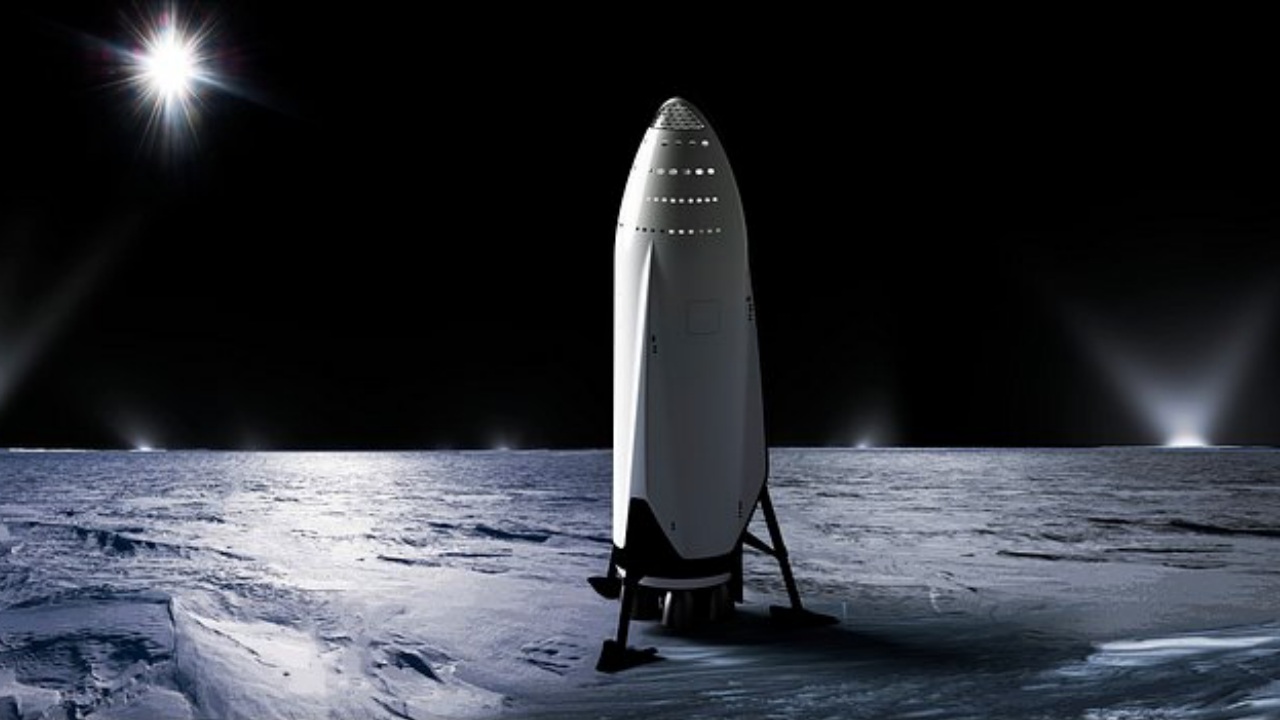
Crazy Solution to Land Astronauts from Starship HLS on the Moon Without 35m Elevator: The modern space race is no longer about planting a flag and returning home. Instead, it is about building a permanent human presence beyond Earth. At the heart of this ambitious vision is NASA’s Artemis Program, which aims to establish sustainable lunar operations and eventually pave the way for missions to Mars.
A key component of this strategy is SpaceX’s Starship Human Landing System (HLS), a lunar version of Starship specifically designed to transport astronauts and cargo between lunar orbit and the Moon’s surface. While Starship HLS offers unprecedented payload capacity and operational flexibility, it also introduces a unique engineering challenge that has become one of the most discussed issues in lunar exploration.
The problem is surprisingly simple: How do astronauts safely travel 35 meters (115 feet) from the spacecraft to the lunar surface?
This challenge has inspired engineers to explore a radical alternative that could completely transform lunar landings: landing Starship sideways instead of vertically.
The Evolution of Lunar Exploration
During the Apollo era, lunar missions were designed for short visits. Astronauts landed, conducted scientific experiments, planted flags, and returned to Earth.
Today’s goals are dramatically different.
NASA and its commercial partners are pursuing:
- Permanent lunar infrastructure
- Long-duration human habitation
- Resource extraction
- Autonomous logistics systems
- Preparation for Mars colonization
These objectives require spacecraft capable of transporting massive amounts of equipment, habitats, rovers, and construction materials.
This is where Starship HLS stands apart from every previous lunar lander.
Standing more than 50 meters tall, Starship HLS dwarfs all historical lunar spacecraft and promises to deliver more cargo than any lunar vehicle ever built.
However, its enormous size creates significant operational challenges.
Why the 35-Meter Elevator Has Become a Major Concern
Comparing Starship to Previous Lunar Landers
To understand the issue, it helps to compare Starship HLS with previous lunar vehicles.
| Spacecraft | Height |
|---|---|
| Apollo Lunar Module | ~7 meters |
| Blue Moon Mark II | ~16 meters |
| Starship HLS | ~50 meters |
The Apollo Lunar Module allowed astronauts to climb down a simple ladder because the cabin sat only a few meters above the surface.
Starship HLS is a completely different story.
Because the vehicle’s lower sections are occupied by enormous liquid oxygen and liquid methane tanks, the crew compartment is located much higher up. As a result, astronauts must descend approximately 35 meters to reach the lunar surface.
That’s equivalent to climbing down from an 11-story building.
NASA’s Biggest Safety Concern
The Elevator System
SpaceX’s current solution involves a cable-suspended elevator system running along the exterior of Starship HLS.
The elevator transports astronauts and cargo between the lunar surface and the spacecraft’s crew area.
While innovative, this design introduces several concerns:
- Mechanical failure
- Motor burnout
- Cable entanglement
- Jamming mechanisms
- Control system malfunctions
NASA’s Office of Inspector General (OIG) has identified the elevator as one of the most significant operational risks within the Human Landing System program.
The primary issue is straightforward:
If the elevator fails while astronauts are on the lunar surface, there is currently no practical backup method for re-entering the spacecraft.
A traditional ladder extending 35 meters would be cumbersome, dangerous, and difficult to use while wearing bulky spacesuits.
Lunar Gravity Creates Additional Problems
The Moon’s environment makes elevator operations even more complicated.
Reduced Gravity Effects
The Moon’s gravity is only about one-sixth of Earth’s gravity.
Although astronauts weigh less, the lower gravitational force changes how suspended systems behave.
Potential issues include:
- Increased swinging motion
- Pendulum-like oscillations
- Difficult stabilization
- Unpredictable movement patterns
Unlike Earth, the Moon has virtually no atmosphere.
This means there is no air resistance to naturally dampen oscillations.
A suspended elevator platform could continue swaying much longer than expected, making operations more challenging.
NASA’s Requirement for Fail-Safe Systems
Every mission-critical system must satisfy strict safety standards.
NASA generally requires:
Fail-Safe Design
A system must continue operating even if one major component fails.
Fail-Operational Design
The system should maintain functionality despite certain failures without endangering the crew.
To meet these standards, SpaceX is exploring:
- Redundant motors
- Backup cable systems
- Multiple power supplies
- Secondary control systems
However, the complexity of maintaining a reliable 35-meter elevator in the harsh lunar environment remains a major engineering challenge.
Stability Challenges of a 50-Meter Lunar Lander
The elevator isn’t the only concern.
The sheer size of Starship HLS creates stability issues from the moment it touches down.
The Landing Leg Problem
On Earth, SpaceX originally envisioned a future where Starships would be caught by giant mechanical tower arms known as Mechazilla.
This concept eliminates the need for heavy landing legs.
Unfortunately, there are no launch towers on the Moon.
Starship HLS therefore requires traditional landing gear.
Designing landing legs for a 50-meter spacecraft introduces several trade-offs.
Increased Mass
Larger landing legs mean:
- More structural reinforcement
- Wider support footprints
- Additional shock absorption systems
All of this adds weight, reducing efficiency.
Reduced Payload Capacity
Every kilogram dedicated to landing gear is a kilogram unavailable for:
- Scientific equipment
- Habitats
- Cargo
- Exploration vehicles
The Lunar South Pole Is Extremely Difficult Terrain
Future Artemis missions are targeting the Lunar South Pole.
Unlike the relatively flat Apollo landing sites, this region contains:
- Deep craters
- Sharp ridges
- Uneven regolith
- Steep slopes
- Rocky terrain
Landing a 50-meter spacecraft in such an environment presents significant risks.
Recent Lunar Missions Demonstrate the Danger
Recent robotic lunar missions have shown how unforgiving the Moon can be.
Several spacecraft have:
- Tipped over after landing
- Experienced structural damage
- Landed at unexpected angles
For robotic missions, these failures represent financial losses.
For a crewed Starship mission, a similar event could become one of the most serious accidents in space exploration history.
The Crazy Alternative: Landing Starship Sideways
To address these concerns, engineers have proposed a radical idea.
Instead of remaining vertical, Starship HLS could rotate and land horizontally.
How a Sideways Landing Would Work
The process would occur in several stages:
Step 1: Vertical Descent
Starship would perform a standard powered descent toward the lunar surface.
Step 2: Controlled Rotation
During the final phase of landing, the spacecraft would gradually rotate 90 degrees.
Step 3: Horizontal Touchdown
The vehicle would settle onto the surface while lying on its side.
This maneuver would require:
- Precision engine control
- Advanced guidance software
- Powerful attitude-control thrusters
- Perfect timing
While technically challenging, the benefits could be substantial.
Eliminating the 35-Meter Elevator Completely
The biggest advantage of a horizontal landing is obvious.
No Elevator Required
With Starship resting sideways, the crew hatch would be only about 4–5 meters above the surface.
Astronauts could use:
- Simple ladders
- Small ramps
- Lightweight access systems
This dramatically reduces operational complexity and failure risks.
Improved Crew Safety
Traditional aerospace engineering favors simplicity.
A ladder contains very few failure points.
An elevator contains:
- Motors
- Cables
- Pulleys
- Sensors
- Electronics
- Control systems
Removing these components instantly improves reliability.
Additional Benefits of a Horizontal Starship
The advantages extend beyond astronaut access.
Lower Center of Gravity
A horizontal spacecraft has a significantly lower center of mass.
Benefits include:
- Improved stability
- Reduced tipping risk
- Better performance on uneven terrain
Instead of supporting a towering structure, the vehicle spreads its weight across a larger footprint.
Easier Cargo Operations
Future lunar missions will transport:
- Rovers
- Habitats
- Drilling systems
- Scientific laboratories
- Power infrastructure
Unloading these assets from a horizontal spacecraft is much easier than lowering them from a height of 115 feet.
This simplifies logistics and improves operational efficiency.
Instant Lunar Habitat
One of the most exciting advantages is habitat creation.
An empty Starship lying horizontally can immediately become a lunar base.
Engineers have long discussed transforming Starship into a ready-made habitat by:
- Installing living quarters
- Creating laboratories
- Adding storage areas
- Building command centers
This concept aligns closely with SpaceX’s long-term vision for Moon Base Alpha and future Martian settlements.
The Technical Challenges of Sideways Landing
Despite its advantages, horizontal landing is far from simple.
Propulsion Complexity
Executing a controlled rotation during descent requires extraordinary precision.
The spacecraft must balance:
- Engine thrust
- Rotational momentum
- Vehicle stability
- Surface proximity
Even a small error could result in mission failure.
The Challenge of Lunar Liftoff
Landing is only half the equation.
The spacecraft must also return astronauts to lunar orbit.
This means Starship would need to:
- Raise its nose.
- Reorient vertically.
- Ignite its main engines.
- Ascend safely.
Any mistake during this sequence could have catastrophic consequences.
Structural Stress Redistribution
Rockets are designed to handle loads vertically.
When positioned horizontally:
- Weight distribution changes
- Stress concentrates at contact points
- Hull deformation risks increase
The spacecraft would require:
- Reinforced bulkheads
- Additional structural supports
- Stronger sidewall construction
These modifications add mass and complexity.
Interior Design Challenges
A standard Starship is built for vertical operations.
Rotating the spacecraft changes everything.
Systems affected include:
- Plumbing
- Air circulation
- Crew quarters
- Cargo storage
- Control stations
- Fluid management systems
Every component would need to function in multiple orientations.
Building a $20 Billion Lunar Civilization
Whether SpaceX chooses the elevator solution or a horizontal landing architecture, the broader goal remains unchanged.
NASA is investing in the foundation of a permanent lunar economy.
Program estimates suggest the development of sustained lunar infrastructure could exceed $20 billion.
This investment supports a vision far larger than individual missions.
The objective is the creation of an entire lunar ecosystem.
Why the Lunar South Pole Is So Valuable
The Lunar South Pole has become the most strategically important region on the Moon.
Massive Water Ice Deposits
Certain craters remain in permanent darkness.
These locations contain large reserves of water ice preserved for billions of years.
This resource is extraordinarily valuable.
Water Is the Fuel of the Space Age
Water can be used for:
- Drinking
- Oxygen production
- Life-support systems
- Rocket fuel generation
Using electrolysis, water can be separated into:
- Hydrogen
- Oxygen
These are critical ingredients for future space transportation systems.
Producing fuel on the Moon dramatically reduces launch costs from Earth.
The Blueprint for a Lunar City
NASA planners envision a carefully organized settlement.
Potential infrastructure includes:
Elevated Areas
Used for:
- Solar power arrays
- Communication systems
- Crew habitats
Crater Regions
Used for:
- Water extraction
- Mining operations
Remote Zones
Reserved for:
- Nuclear power stations
- Industrial facilities
The resulting layout resembles urban planning more than traditional space exploration.
The Growing Artemis Commercial Ecosystem
NASA is not building the Moon alone.
Instead, it has created a network of commercial partners.
Major participants include:
- SpaceX
- Blue Origin
- Firefly Aerospace
- Astrolab
- Lunar Outpost
Together, these companies are developing the infrastructure necessary for long-term lunar operations.
Autonomous Rovers Will Arrive Before Humans
Future Artemis missions will rely heavily on robotic systems.
Advanced autonomous vehicles will:
- Survey terrain
- Transport cargo
- Mark construction zones
- Prepare landing areas
By the time astronauts arrive, much of the groundwork may already be complete.
Orbital Refueling: The Real Key to Lunar Expansion
Perhaps the most important challenge facing Starship is not landing at all.
It is orbital refueling.
Why Refueling Matters
A fully loaded Starship consumes enormous amounts of propellant reaching orbit.
To travel to the Moon, it must be refueled in space.
This requires:
- Tanker Starships
- Orbital fuel depots
- Cryogenic fluid transfer systems
Successfully demonstrating this capability could revolutionize deep-space transportation.
Building an Interplanetary Logistics Network
Once orbital refueling becomes routine, Starship transforms into more than a spacecraft.
It becomes infrastructure.
A landed Starship can serve as:
- A habitat
- A laboratory
- A command center
- A medical facility
- A storage depot
This flexibility is a major reason NASA selected Starship HLS for Artemis missions.
Conclusion
The challenge of transporting astronauts from a 35-meter-high Starship HLS to the lunar surface may seem like a minor engineering detail, but it highlights the enormous complexity of building a permanent human presence beyond Earth.
The current elevator-based approach remains SpaceX’s primary solution, yet concerns regarding reliability, safety, and redundancy continue to drive discussions about alternative architectures.
Among the most fascinating concepts is the idea of landing Starship horizontally, a bold proposal that could eliminate the elevator entirely while improving stability, cargo handling, and habitat deployment.
Although the sideways landing concept introduces its own propulsion, structural, and operational challenges, it demonstrates the innovative thinking required for humanity’s next giant leap.
As NASA, SpaceX, and their commercial partners push toward a future of permanent lunar settlements, the real competition is no longer about who reaches the Moon first. The new space race is about who can build the first sustainable extraterrestrial civilization—and Starship HLS may be the vehicle that makes it possible.
FAQs
1. What is Starship Human Landing System (HLS)?
Starship HLS is a modified version of SpaceX’s Starship spacecraft designed specifically to transport astronauts and cargo between lunar orbit and the Moon’s surface as part of NASA’s Artemis program.
2. Why is the Starship HLS elevator considered a major challenge?
The crew hatch is located approximately 35 meters (115 feet) above the lunar surface. Astronauts must use an elevator to reach the ground, and a failure of this system could create serious operational and safety risks.
3. How tall is Starship HLS compared to the Apollo Lunar Module?
The Apollo Lunar Module was about 7 meters tall, while Starship HLS stands over 50 meters tall, making it the largest crewed lunar lander ever proposed.
4. Why can’t astronauts simply use a ladder instead of an elevator?
A ladder extending 35 meters would be difficult and dangerous to climb while wearing bulky lunar spacesuits, especially during repeated Moon surface operations.
5. What concerns has NASA raised about the Starship elevator?
NASA’s Office of Inspector General has identified the elevator as a critical risk because there is currently no practical backup method for astronauts to re-enter the spacecraft if the elevator becomes inoperable.
6. What is the sideways landing concept for Starship HLS?
The sideways landing concept proposes rotating Starship into a horizontal position just before touchdown, allowing astronauts to exit through a hatch only a few meters above the lunar surface.
7. How would a horizontal Starship landing eliminate the elevator problem?
With the spacecraft lying on its side, astronauts could use a simple ladder or ramp instead of relying on a complex elevator system.
8. What are the advantages of landing Starship horizontally on the Moon?
Benefits include improved stability, easier cargo unloading, lower tipping risk, simplified astronaut access, and the potential to use the spacecraft as an instant lunar habitat.
9. What challenges would a sideways Starship landing create?
The maneuver would require extremely precise propulsion control, structural reinforcement, reconfigured internal systems, and a reliable method for returning the spacecraft to a vertical launch position.
10. Why is the lunar South Pole important for future missions?
The lunar South Pole contains permanently shadowed craters believed to hold significant deposits of water ice, which can support life-support systems and fuel production.
11. How can water ice help build a permanent Moon base?
Water can be converted into drinking water, breathable oxygen, and rocket propellant, reducing the need to transport these resources from Earth.
12. What role does Starship HLS play in NASA’s Artemis program?
Starship HLS is expected to serve as the primary crewed lunar lander, transporting astronauts from lunar orbit to the surface and supporting future lunar infrastructure development.
13. What is orbital refueling and why is it important?
Orbital refueling involves transferring fuel between spacecraft in Earth orbit. It enables Starship to carry enough propellant for deep-space missions to the Moon and eventually Mars.
14. How much cargo can Starship potentially deliver to space?
Starship is designed to carry more than 100 metric tons to low Earth orbit, making it one of the most powerful launch systems ever developed.
15. Could Starship become part of a permanent lunar settlement?
Yes. Engineers envision retired or repurposed Starships serving as habitats, laboratories, storage facilities, command centers, and other infrastructure for long-term lunar colonies.
Read More:
- President Trump touts new Air Force One with Musk technology
- DELIVERY NOW! Tesla Semi Gen 2 Gets SHOCKING New Upgrade
- SpaceX’s Much Safer Way to Land Starship on the Moon Shocked NASA
- Elon Musk UPDATE Neuralink 4.0 Chip Destroy Entire BCI Industry
- Elon Musk challenges Tesla credit rating from Moody’s after SpaceX gets a higher one
2 thoughts on “Crazy Solution to Land Astronauts from Starship HLS on the Moon Without 35m Elevator”