
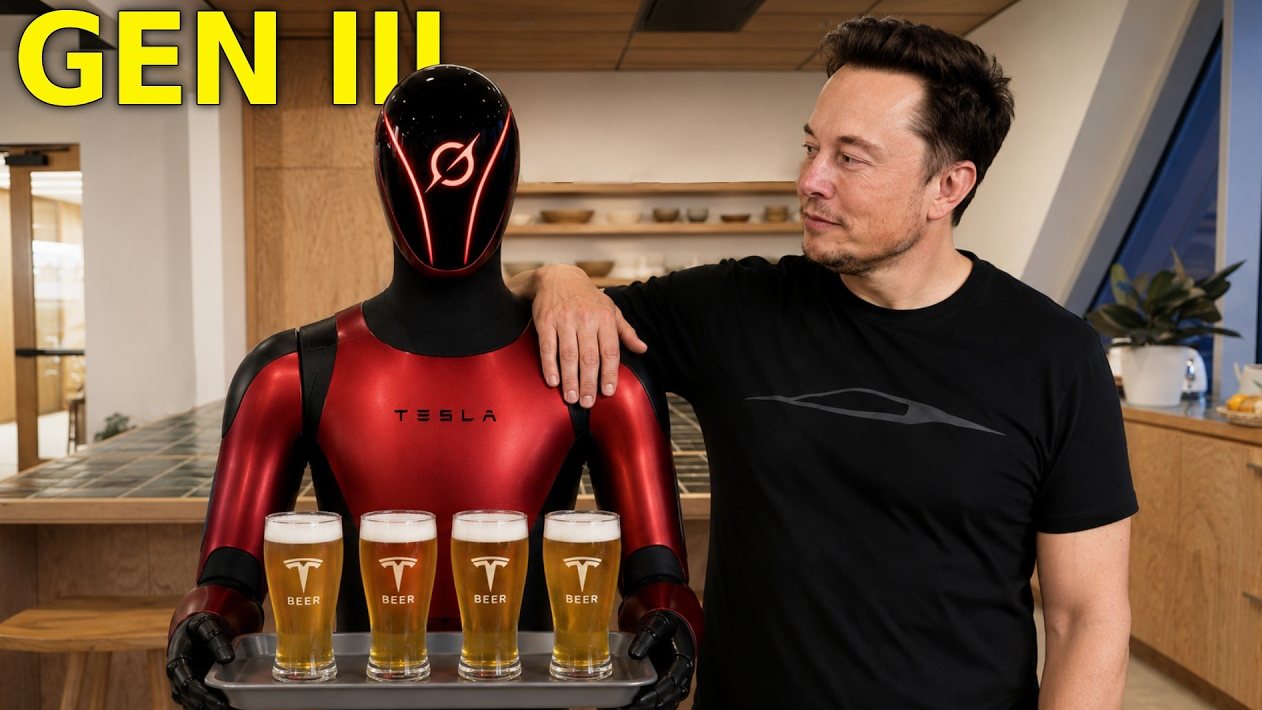
Tesla Bot Gen 3 Gets Major Upgrade For Tesla’s 1M Robot Goal: The race to build humanoid robots is entering a new era, and Tesla Bot Gen 3, also known as Optimus, is at the center of this transformation. What was once considered an experimental robotics project is now evolving into a large-scale industrial platform designed to reshape manufacturing, logistics, retail, and even home assistance.
Tesla is reportedly making significant investments in factory expansion, artificial intelligence, and supply chain infrastructure to support its ambitious vision of producing 1 million humanoid robots annually. With major upgrades to the robot’s mechanical design, AI computing capabilities, and manufacturing strategy, the company appears focused on bringing autonomous labor into mainstream industries.
In this article, we’ll explore the latest Tesla Bot Gen 3 upgrades, the transformation of the Fremont factory, the power of Cortex 2.0, and how Tesla plans to achieve its million-robot goal.
Tesla Bot Gen 3: A Major Leap in Humanoid Robotics
Building a humanoid robot that can survive the demanding conditions of an industrial factory is far more challenging than creating a research prototype. Tesla’s latest Gen 3 Optimus focuses on improving durability, precision, efficiency, and intelligence.
Unlike earlier versions, the new generation has been redesigned for continuous operation inside automotive production facilities where heavy lifting, repetitive motion, and constant impact are everyday requirements.
These improvements make Tesla Bot Gen 3 far more capable of performing real-world industrial tasks.
Advanced Cycloidal Drive System Improves Strength
One of the biggest engineering upgrades in Tesla Bot Gen 3 is the replacement of traditional harmonic drives in high-load joints.
Why Harmonic Drives Were a Limitation
Earlier humanoid robots depended heavily on harmonic drive systems because they are lightweight and accurate. However, these systems can wear out quickly under repeated heavy loads and sudden impacts.
For robots expected to work around the clock inside factories, this becomes a major reliability concern.
Tesla’s Cycloidal Solution
Tesla has replaced harmonic drives in critical joints such as the:
- Hips
- Shoulders
- Heavy-duty movement systems
with cycloidal reduction gears.
This provides several advantages:
- Higher torque output
- Improved shock absorption
- Greater durability
- Longer operating life
Meanwhile, harmonic drives remain in the wrists, where lightweight movement and precision are more important than heavy lifting.
The New 22-Degree-of-Freedom Biomimetic Hand
Perhaps the most impressive upgrade is Tesla’s completely redesigned robotic hand.
Smarter Mechanical Design
Instead of placing numerous actuators inside the hand itself, Tesla relocated them into the robot’s forearm.
The fingers are now controlled using a sophisticated biomimetic tendon system, closely resembling how human muscles and tendons work.
This redesign offers multiple benefits:
- Much lighter hands
- Higher precision
- Better balance
- Reduced mechanical complexity
Twice the Dexterity
Tesla has increased the robot’s hand capability from 11 Degrees of Freedom (DoF) to 22 Degrees of Freedom.
Combined with advanced tactile sensors, the robot can perform both delicate and heavy-duty work, including:
- Handling fragile objects
- Picking up small components
- Organizing inventory
- Stacking battery cells
- Operating factory equipment
This dramatically expands the range of tasks Optimus can perform inside industrial environments.
Tesla’s $685 Million Supply Chain Expansion
Large-scale robotics production requires an equally large manufacturing ecosystem.
Tesla has reportedly placed a $685 million component order focused on high-precision actuators—the robotic “muscles” that power Optimus.
Industry reports suggest this supply agreement could support production of approximately 180,000 humanoid robots during the initial manufacturing phase.
This represents a dramatic increase from Tesla’s earlier plans, which discussed deploying around 10,000 Optimus robots for internal operations before wider commercialization.
The expansion indicates that Tesla is preparing for mass production rather than limited pilot programs.
Fremont Factory Is Being Transformed
One of the biggest signs of Tesla’s confidence is the transformation of its historic Fremont factory.
Instead of dedicating valuable production space exclusively to premium electric vehicles, Tesla is reportedly converting portions of the facility into a large-scale Tesla Bot Gen 3 manufacturing center.
From Electric Cars to Humanoid Robots
Previously, this production area focused on:
Now the same space could eventually manufacture:
- Up to 1 million Optimus robots every year
If achieved, this would represent one of the largest industrial robotics manufacturing operations in history.
Cortex 2.0: The AI Brain Behind Tesla Bot
A humanoid robot is only as intelligent as the AI powering it.
Tesla’s answer is Cortex 2.0, an enormous AI training supercomputer designed specifically for:
- Robot learning
- Computer vision
- Neural network training
- Autonomous decision making
- Full Self-Driving development
Massive GPU Infrastructure
The Cortex cluster reportedly utilizes hundreds of thousands of advanced GPUs capable of processing enormous amounts of visual and behavioral data.
Every movement, object recognition task, and factory interaction contributes to improving future versions of Optimus.
This continuous learning approach allows Tesla to update robots with increasingly capable AI models over time.
Megapacks Keep Cortex Running
Running one of the world’s largest AI clusters requires enormous amounts of electricity.
Tesla is supporting Cortex 2.0 with hundreds of Megapack energy storage systems capable of storing nearly 1 gigawatt-hour of electricity.
These battery systems help:
- Reduce pressure on the electrical grid
- Maintain uninterrupted AI training
- Improve energy efficiency
- Support around-the-clock computing
This infrastructure ensures that robot training continues even during periods of high power demand.
The Megapod Vision: A Distributed AI Network
Tesla’s ambitions extend beyond centralized data centers.
The company has introduced the concept of Megapod, modular computing facilities designed to work alongside its global Supercharger network.
Because charging stations experience lower usage during nighttime hours, Tesla could use available electrical capacity for AI computation.
Potential benefits include:
- Distributed AI processing
- Faster fleet optimization
- Reduced infrastructure costs
- Scalable robot training worldwide
Combined with Tesla’s custom AI chips, this approach could create one of the world’s largest distributed computing networks.
Industries That Could Benefit from Tesla Bot Gen 3
Tesla’s long-term strategy extends well beyond automobile manufacturing.
1. Manufacturing
Factories worldwide face ongoing labor shortages.
Tesla Bot could perform repetitive work such as:
- Material transport
- Assembly assistance
- Quality inspections
- Machine loading
2. Warehousing and Logistics
Distribution centers operate around the clock.
Humanoid robots could automate:
- Package sorting
- Pallet building
- Inventory movement
- Container unloading
This could significantly improve productivity while reducing operational costs.
3. Retail
Large retail stores require constant shelf stocking and inventory management.
Tesla Bot could assist with:
- Shelf replenishment
- Product organization
- Inventory counting
- Backroom logistics
Employees would then have more time for customer-facing responsibilities.
4. Healthcare and Elder Care
As populations continue aging worldwide, caregiver shortages are becoming increasingly common.
Future versions of Optimus may eventually provide:
- Medication reminders
- Household assistance
- Mobility support
- Daily living assistance
Although consumer adoption may take longer, continued manufacturing scale could reduce costs over time.
Why Tesla’s 1 Million Robot Goal Matters
Producing 1 million humanoid robots annually would fundamentally change robotics economics.
Greater production volume generally leads to:
- Lower manufacturing costs
- Improved software development
- Faster AI learning
- Higher hardware reliability
- Wider commercial adoption
Tesla appears to be following a strategy similar to its electric vehicle business—build at scale, continuously improve software, and reduce costs through manufacturing efficiency.
Final Thoughts
The latest Tesla Bot Gen 3 upgrades represent far more than an incremental hardware refresh. From cycloidal drive systems and 22-DoF biomimetic hands to the massive Cortex 2.0 AI supercomputer and the ongoing Fremont factory transformation, Tesla is building an ecosystem capable of supporting industrial-scale humanoid robotics.
While achieving a production target of 1 million robots per year remains an ambitious objective, the investments in manufacturing, artificial intelligence, energy infrastructure, and supply chains suggest Tesla is preparing for a future where humanoid robots become a common part of everyday industry.
If these plans materialize, Tesla Bot Gen 3 could become one of the most significant technological innovations of the decade, transforming manufacturing, logistics, retail, and eventually even homes around the world.
FAQs
1. What is Tesla Bot Gen 3?
Tesla Bot Gen 3, also known as Optimus, is Tesla’s latest humanoid robot designed to perform repetitive, physically demanding, and precision-based tasks in factories, warehouses, and eventually homes.
2. What are the major upgrades in Tesla Bot Gen 3?
Tesla Bot Gen 3 features cycloidal drive systems, a 22-degree-of-freedom biomimetic hand, improved tactile sensors, advanced AI, and enhanced durability for industrial applications.
3. Why did Tesla replace harmonic drives with cycloidal gears?
Cycloidal gears offer higher torque, better shock absorption, and greater durability, making them more suitable for heavy industrial work than traditional harmonic drives.
4. What is special about the 22-DoF robotic hand?
The new robotic hand offers 22 Degrees of Freedom (DoF), allowing it to perform delicate tasks like handling fragile objects while also managing heavy industrial operations with precision.
5. What is the purpose of Tesla’s Cortex 2.0 supercomputer?
Cortex 2.0 is Tesla’s AI training supercomputer that processes massive amounts of visual and operational data to improve Optimus robots and Full Self-Driving technology.
6. Why is Tesla transforming the Fremont factory?
Tesla is reportedly converting part of its Fremont factory into a large-scale Optimus production facility to support its long-term goal of manufacturing up to one million robots annually.
7. What is Tesla’s 1 million robot goal?
Tesla aims to eventually produce one million Optimus humanoid robots per year to serve industries such as manufacturing, logistics, retail, and healthcare.
8. How much does Tesla expect Optimus to cost?
Tesla has suggested a long-term target price of approximately $20,000 to $30,000 per Optimus robot, although final pricing has not been officially confirmed.
9. What industries can benefit from Tesla Bot Gen 3?
Potential industries include automotive manufacturing, warehousing, logistics, retail, healthcare, elder care, hospitality, and home assistance.
10. Can Tesla Bot work alongside humans?
Yes. Optimus is designed to operate safely in environments built for people, allowing it to assist human workers with repetitive and physically demanding tasks.
11. What is Tesla’s Megapod project?
Megapod is Tesla’s proposed modular AI computing infrastructure that could use unused electricity from Supercharger stations to support AI training and fleet optimization.
12. Will Tesla Bot replace human workers?
Tesla positions Optimus as a tool for handling repetitive, dangerous, and labor-intensive tasks, allowing human workers to focus on more skilled, creative, and customer-oriented responsibilities.
13. When will Tesla Bot Gen 3 be available?
Tesla has indicated that initial production is expected to begin with internal deployments before expanding to commercial customers, though exact timelines may change.
14. How intelligent is Tesla Bot Gen 3?
Tesla Bot Gen 3 uses advanced AI, computer vision, and neural networks trained on Tesla’s powerful computing infrastructure, enabling it to recognize objects, navigate environments, and perform complex tasks.
15. Can Tesla Bot be used in homes?
Tesla’s long-term vision includes household assistance such as cleaning, carrying items, medication reminders, and helping elderly individuals, although industrial applications are expected first.
16. Why is Tesla Bot Gen 3 important for the future of robotics?
Tesla Bot Gen 3 combines advanced hardware, artificial intelligence, scalable manufacturing, and energy-efficient infrastructure, making it one of the most ambitious humanoid robotics projects currently under development.
Read More:
- This Is How SpaceX Will Take Over The Internet
- SpaceX gets initial stock coverage from Tesla’s biggest bull
- Tesla gets its latest short from Michael Burry: ‘Happy it jumped back to this level’
- Tesla Optimus project fires up as Musk sees production line progress
- Tesla’s $119B TeraFab Secret Finally Revealed