
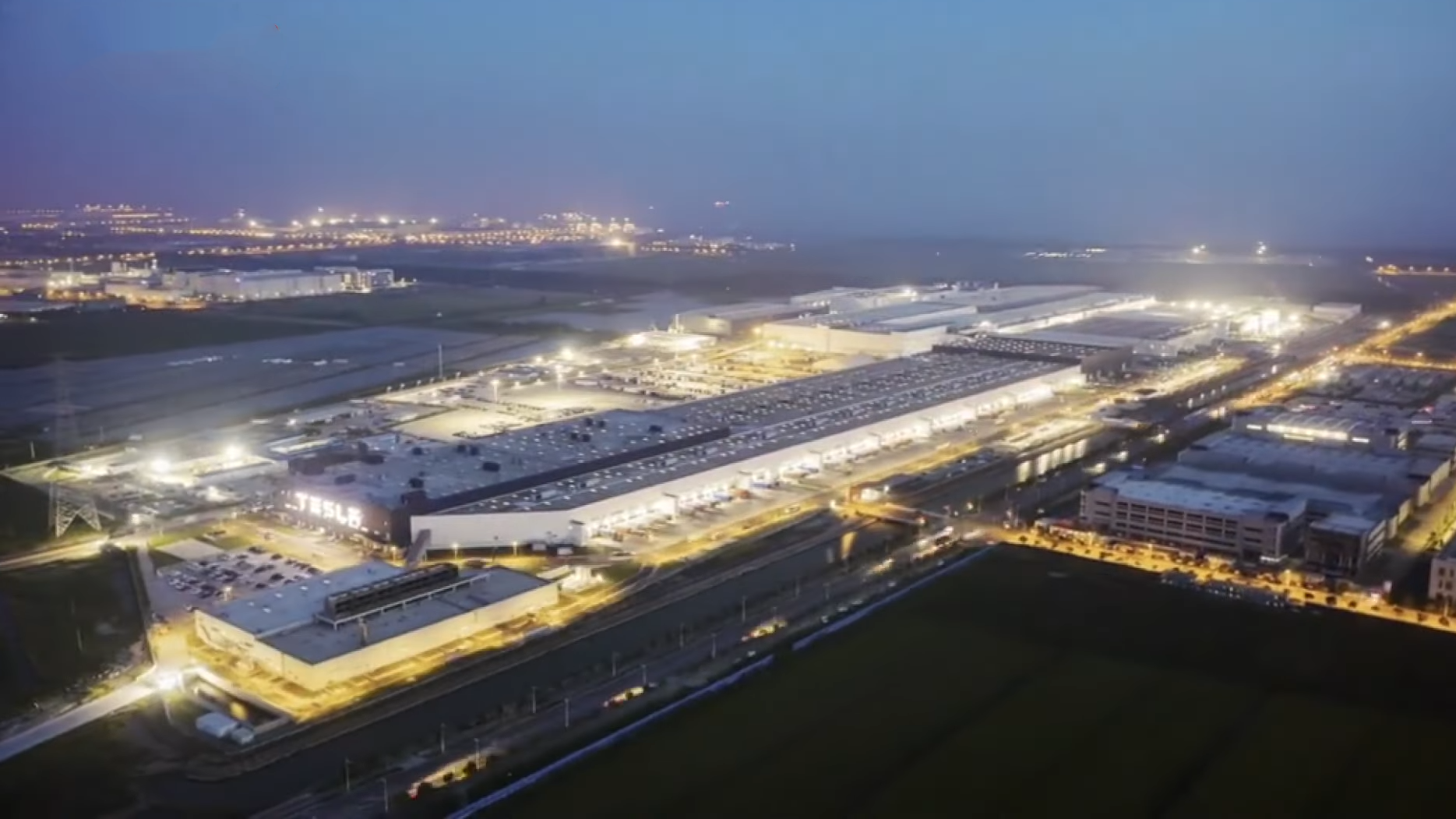
Tesla’s $119B TeraFab Secret Finally Revealed: The race to dominate artificial intelligence, semiconductor manufacturing, and advanced robotics is entering a new phase, and Tesla appears to be making one of the boldest industrial bets in modern history. Recent developments surrounding the company’s mysterious TeraFab project suggest that Tesla is no longer content with designing chips—it wants to manufacture them as well.
Drone footage captured during mid-2026 revealed extensive land preparation around Giga Texas, while officials in Grimes County, Texas, approved major tax incentives for a proposed semiconductor mega-campus. If completed, the facility could become one of the largest industrial complexes ever built, with a projected investment of $119 billion.
Tesla’s TeraFab: A $119 Billion Vision
The proposed TeraFab project spans more than 22,000 acres, making it approximately 10 times larger than the current Giga Texas facility. What initially appeared to be another factory expansion has evolved into an ambitious plan to establish a fully integrated semiconductor manufacturing ecosystem.
Public filings indicate an initial investment commitment of around $55 billion, while long-term development phases could push total capital expenditure to $119 billion. This represents a dramatic increase from the earlier $25 billion estimate previously discussed by Elon Musk.
The scale of the investment reflects Tesla’s transition from a fabless chip designer into a company aiming to control every stage of semiconductor production.
A Unified Silicon Platform for Tesla, SpaceX, and xAI
One Factory, Three Industries
One of TeraFab’s most ambitious objectives is creating a single manufacturing platform capable of producing chips for multiple industries simultaneously.
These include:
- Tesla’s Full Self-Driving (FSD) processors
- Optimus humanoid robot controllers
- SpaceX radiation-hardened aerospace processors
Instead of maintaining separate manufacturing pipelines, Tesla aims to build a unified ecosystem capable of serving all three businesses under one roof.
This strategy could significantly improve efficiency while reducing long-term manufacturing costs.
The Engineering Challenge
Producing chips for automobiles and spacecraft involves completely different engineering requirements.
Automotive processors must be low-cost, highly efficient, and manufactured in enormous quantities. In contrast, aerospace chips must withstand extreme radiation, temperature fluctuations, and long-duration space missions.
Successfully combining these manufacturing standards inside one facility would represent a major breakthrough in semiconductor engineering.
Intel Could Become Tesla’s Strategic Partner
Building an advanced semiconductor fabrication facility from scratch typically requires decades of experience.
To accelerate development, reports suggest Tesla is exploring collaboration with Intel, potentially using the company’s advanced 14A process technology.
Rather than abandoning vertical integration, Tesla appears willing to leverage Intel’s manufacturing expertise while maintaining long-term control over chip production.
Such a partnership would allow Tesla to bypass years of costly research and move more quickly toward producing sub-2nm semiconductor technology.
Why Tesla Is Investing So Much
The Need for Vertical Integration
Tesla’s expanding businesses require an enormous supply of custom silicon.
Industry estimates suggest Elon Musk’s companies could collectively consume more than 200 billion integrated circuits throughout their operational lifetimes.
These chips would power:
- Tesla electric vehicles
- Optimus humanoid robots
- SpaceX satellites
- Starlink communication systems
- Future AI infrastructure
Depending entirely on external foundries creates supply chain risks that could disrupt production during geopolitical conflicts or manufacturing shortages.
TeraFab aims to eliminate that vulnerability by bringing semiconductor production in-house.
Financial Strategy Behind the $119 Billion Project
Although headlines focus on the enormous $119 billion valuation, official legal filings reveal a much more structured investment strategy.
Rather than committing every dollar upfront, Tesla and its partners have established minimum legally binding investment thresholds, allowing construction to proceed in carefully planned phases.
For example, public documents indicate SpaceX is committed to investing at least $5 billion by 2030, alongside local employment requirements.
This phased approach helps secure tax incentives while preserving flexibility if economic conditions change.
Building an Independent Industrial City
More Than Just a Semiconductor Factory
TeraFab is being designed as a completely self-sufficient industrial ecosystem.
Plans reportedly include:
- Dedicated natural gas power plants
- Private water treatment facilities
- Independent emergency services
- Industrial cooling infrastructure
Rather than relying on Texas’ existing electrical grid, the project aims to generate much of its own power.
This level of independence reflects the enormous energy and water demands associated with modern semiconductor manufacturing.
Moving Beyond the Fabless Model
Tesla currently relies on external partners like Samsung Electronics to manufacture advanced AI processors.
However, delays in advanced 2-nanometer manufacturing have highlighted one major weakness of the fabless business model.
Even companies with world-class chip designs remain dependent on outside manufacturers for production capacity.
With competition accelerating in autonomous driving and robotics, Tesla cannot afford manufacturing delays beyond its control.
TeraFab represents an effort to integrate:
- Chip design
- Semiconductor fabrication
- Hardware deployment
into one continuous production cycle.
TeraFab vs. Tesla’s Cortex AI Cluster
Many people confuse TeraFab with Tesla’s Cortex AI supercomputer, but they serve very different purposes.
TeraFab
TeraFab manufactures the physical silicon chips that power Tesla products.
Cortex
The Cortex cluster trains massive AI models using thousands of high-performance GPUs inside specialized data centers.
Together, they create a powerful closed-loop ecosystem:
- TeraFab builds AI chips.
- Tesla vehicles and Optimus robots deploy them.
- Real-world data returns to Cortex.
- Improved AI models are developed.
- New generations of custom chips are manufactured.
This integrated cycle could give Tesla significant advantages in AI development.
Reducing Dependence on Nvidia
Today’s AI industry depends heavily on Nvidia GPUs.
As demand continues growing, companies spend billions securing limited GPU supplies.
Tesla’s long-term objective is to reduce this dependency by designing proprietary AI accelerators and manufacturing them internally through TeraFab.
This strategy offers several benefits:
- Lower hardware costs
- Greater supply chain security
- Optimized AI performance
- Reduced reliance on third-party vendors
Owning both hardware design and manufacturing could become one of Tesla’s strongest competitive advantages.
Future Milestones for TeraFab
Several major developments will determine whether TeraFab succeeds:
Infrastructure Development
Construction of utilities, transportation networks, and power systems across the massive Grimes County site.
Advanced Manufacturing Equipment
Installation and calibration of next-generation semiconductor lithography equipment, including potential Intel technology.
Long-Term Funding
Continued capital investment, potentially supported by future financing events, will be essential during the project’s early years.
If Tesla achieves stable high-volume production of sub-2nm chips, it could fundamentally reshape the global semiconductor industry.
Final Thoughts
Tesla’s $119 billion TeraFab project represents far more than another factory expansion. It is a strategic attempt to build a fully integrated semiconductor ecosystem capable of supporting electric vehicles, humanoid robots, space technology, and artificial intelligence from a single manufacturing platform.
If successful, TeraFab could reduce Tesla’s dependence on external foundries, strengthen supply chain resilience, and position the company as one of the world’s most influential semiconductor manufacturers.
While significant engineering and financial challenges remain, the project demonstrates Tesla’s long-term ambition to control every critical layer of AI hardware production. In an era where silicon has become as valuable as software, TeraFab may prove to be one of the most important industrial investments of the decade.
FAQs
1. What is Tesla’s TeraFab project?
Tesla’s TeraFab is a proposed $119 billion semiconductor manufacturing facility designed to produce advanced AI chips for Tesla vehicles, Optimus robots, SpaceX, and xAI.
2. Where will Tesla’s TeraFab be located?
The planned TeraFab facility is expected to be built in Grimes County, Texas, near the Gibbons Creek Reservoir, close to Tesla’s existing Giga Texas campus.
3. How large is Tesla’s TeraFab?
The proposed site covers more than 22,000 acres, making it approximately 10 times larger than the current Giga Texas factory.
4. Why is Tesla building its own semiconductor factory?
Tesla aims to reduce its dependence on external chip manufacturers, improve supply chain security, lower production costs, and gain complete control over AI chip manufacturing.
5. What is the estimated cost of Tesla’s TeraFab?
Current public filings suggest an initial investment of around $55 billion, with long-term development costs potentially reaching $119 billion.
6. What types of chips will TeraFab manufacture?
TeraFab is expected to manufacture AI processors for Tesla’s Full Self-Driving (FSD) systems, Optimus humanoid robots, and radiation-hardened chips for SpaceX missions.
7. Is Intel involved in the TeraFab project?
Reports indicate Tesla has explored collaboration with Intel, potentially using Intel’s advanced 14A manufacturing process to accelerate semiconductor production.
8. How does TeraFab differ from Tesla’s Cortex AI cluster?
TeraFab manufactures physical semiconductor chips, while the Cortex AI cluster is a supercomputing platform used to train artificial intelligence models.
9. Why is vertical integration important for Tesla?
Vertical integration allows Tesla to control chip design, manufacturing, and deployment, reducing production delays and improving overall efficiency.
10. Will TeraFab reduce Tesla’s reliance on Nvidia?
Yes. Tesla plans to develop and manufacture its own AI chips, which could significantly reduce its dependence on Nvidia GPUs for AI processing.
11. Why is semiconductor manufacturing strategically important?
Semiconductors power modern technologies such as electric vehicles, robotics, AI systems, and satellites. Producing them in-house helps protect against global supply chain disruptions.
12. What infrastructure will support the TeraFab facility?
Plans reportedly include dedicated power generation, private water treatment systems, industrial cooling facilities, and independent emergency services, making the site largely self-sufficient.
13. How many chips could Tesla require in the future?
Industry estimates suggest Elon Musk’s companies may collectively require more than 200 billion integrated circuits over their operational lifetimes.
14. What challenges does the TeraFab project face?
Major challenges include the high construction cost, advanced semiconductor manufacturing complexity, equipment installation, production yield optimization, and long-term funding.
15. Could TeraFab change the global semiconductor industry?
If successful, TeraFab could strengthen Tesla’s position in AI hardware, reduce dependence on overseas foundries, and reshape competition in the global semiconductor market.
16. When is Tesla’s TeraFab expected to become operational?
Tesla has not announced an official completion date. The project is expected to be developed in multiple phases over the coming decade as infrastructure and semiconductor manufacturing capabilities expand.
Read More:
- New $20K Tesla Model 2 Senior Edition Aluminum Battery 6-Min Charge & Model 3 Shock
- Tesla sends production Cybercab with no steering wheel, pedals to on-road testing
- Tesla expands massive safety feature worldwide in latest update
- Tesla BIGGEST Solar Factory 1TW Inside Shocks The World
- Tesla’s INSANE New Upgrade Makes Cybercab 100% SAFE