
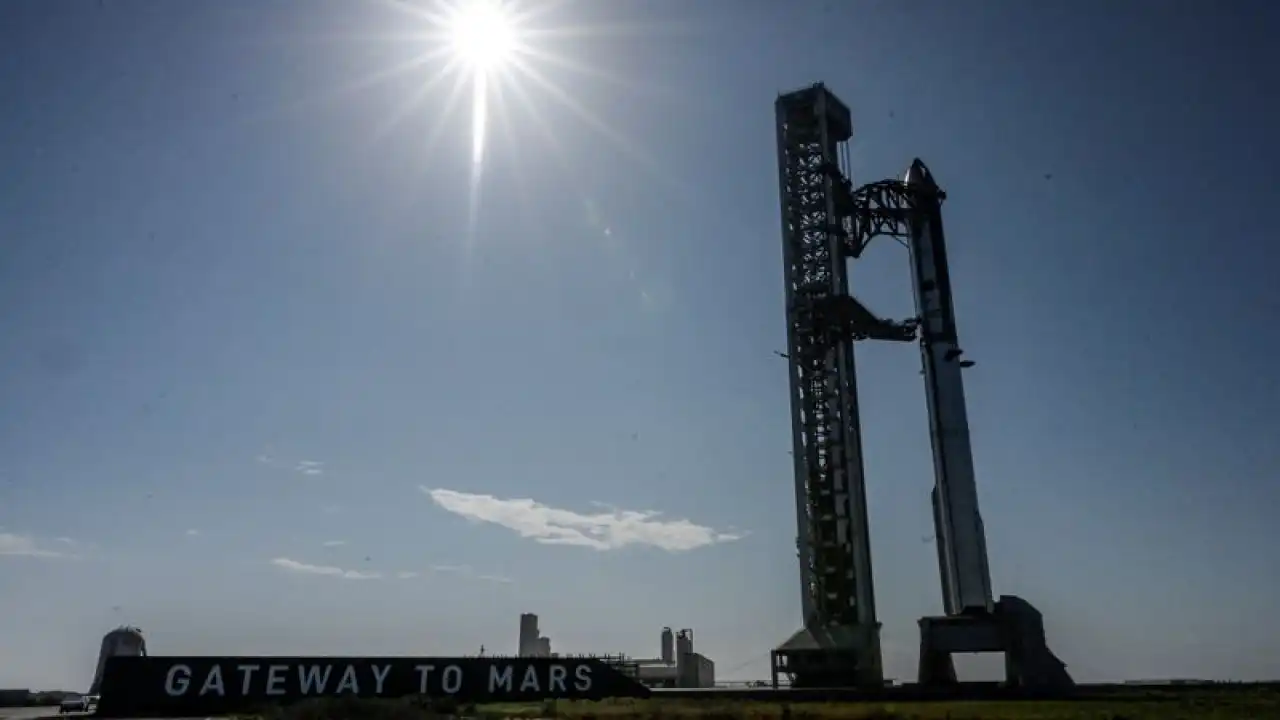
SpaceX Starship Flight 13’s New Launch Date Revealed! Test & Launch in Days, Is It Feasible: The space industry is evolving at an unprecedented speed, and SpaceX continues to lead this transformation through its philosophy of rapid testing, continuous innovation, and aggressive development cycles. What once took years to achieve is now happening in just weeks, making every update from the company a major event for the global aerospace community.
The latest developments surrounding Starship Flight 13, Starbase infrastructure upgrades, and the successful Falcon 9 Transporter-17 mission indicate that SpaceX is accelerating toward its long-term goal of making space travel more frequent, reliable, and affordable.
In this article, we’ll explore the new Starship Flight 13 launch date, examine whether the ambitious schedule is realistic, and discuss how SpaceX’s latest missions are shaping the future of space exploration.
Starship Flight 13 Gets an Aggressive New Launch Window
One of the biggest surprises came when the Federal Aviation Administration (FAA) updated its regulatory filings, revealing an unexpectedly early launch opportunity for Starship Flight 13.
The primary launch window opens on July 14, 2026, with backup opportunities extending through July 21, 2026. SpaceX is targeting a liftoff around 5:45 PM Central Time, allowing optimal daylight conditions for monitoring both the Super Heavy booster recovery and the Starship upper stage re-entry.
This schedule is far more aggressive than industry analysts expected. Most aerospace experts predicted a launch in late July or even early August because Starship missions typically require extensive hardware inspections and data reviews after each flight.
If SpaceX launches during the first few days of this window, it will mark one of the fastest turnaround times in the history of the Starship program.
Why Is SpaceX Moving So Fast?
Unlike traditional aerospace companies that spend years perfecting hardware before flying it, SpaceX follows an iterative engineering approach.
Instead of waiting for perfection, the company:
- Builds rapidly
- Tests frequently
- Learns from failures
- Implements improvements immediately
This strategy has already revolutionized the Falcon 9 program, and SpaceX is applying the same philosophy to Starship, the world’s most powerful launch vehicle.
The accelerated Flight 13 timeline demonstrates the company’s growing confidence in both its manufacturing process and flight hardware reliability.
Ship 40 Is Nearly Ready for Launch
The upper stage assigned to Flight 13 is Ship 40 (S40).
Fortunately for SpaceX, S40 has already completed the most critical propulsion tests required before launch.
Completed Milestones
Ship 40 has successfully passed:
- Single-engine static fire
- Full six-engine static fire
- Engine startup verification
- Propellant feed validation
- Raptor engine performance checks
These successful tests confirm that the vehicle’s propulsion system is operating as expected.
Final Preparations
Only a handful of operational tasks remain before S40 can be transported to the launch pad:
- Thermal protection tile inspections
- Structural verification
- Flight Termination System (FTS) installation
- Payload integration
- Final safety checks
Ground observers also spotted SpaceX’s specialized payload loader arriving at Starfactory, indicating payload integration activities have already begun.
Flight 13 is expected to carry simulated Version 3 Starlink satellites, allowing engineers to evaluate deployment systems for future operational missions.
The Mystery Behind the FAA Flight Restrictions
An interesting development emerged when the FAA issued a Temporary Flight Restriction (TFR) over Massey’s testing site between July 9 and July 15.
Normally, such restrictions are associated with major testing activities.
Industry observers believe one of two scenarios is likely:
1. Another Static Fire for Ship 40
SpaceX could conduct an additional static fire to validate software updates or recently modified components.
While this would increase mission confidence, it would likely push Flight 13 closer to July 20 or July 21.
2. Testing Ship 41
Another possibility is that the TFR is intended for Ship 41, which recently completed cryogenic testing.
If true, SpaceX could already be preparing the next Starship while Flight 13 moves toward launch, demonstrating just how quickly the production line is advancing.
Booster 20 Remains the Biggest Challenge
While Ship 40 appears nearly ready, Booster 20 (B20) still faces one major hurdle.
The Super Heavy booster has completed cryogenic proof testing but has not yet performed its critical 33-engine static fire.
This test is essential because it validates all 33 Raptor engines simultaneously before flight.
Traditional Testing Process
Normally, the sequence looks like this:
- Booster rolls to the launch pad.
- Static fire is conducted.
- Engineers review all telemetry.
- Booster returns to Mega Bay.
- Final inspections are completed.
- Booster returns to the pad for launch.
This entire process usually requires several days.
Can SpaceX Save Time?
SpaceX may choose a faster approach.
If the static fire produces flawless results, engineers could perform final inspections directly on the launch pad instead of rolling Booster 20 back to Mega Bay.
This pad-side processing could save valuable time and make a mid-July launch achievable.
Even so, many analysts still consider July 20, 2026 the most realistic launch target.
Starbase Continues Massive Infrastructure Upgrades
SpaceX isn’t only improving rockets—it is also transforming Starbase into one of the world’s most advanced launch facilities.
Orbital Launch Pad 2 Improvements
Pad 2 has recently completed extensive water-deluge testing and is now entering operational refinement.
Major upgrades include:
Improved Booster Quick Disconnect System
The Booster Quick Disconnect (BQD) system has undergone intensive mechanical testing to verify fueling operations and automated disconnect procedures.
More Precise “Chopsticks”
SpaceX engineers have upgraded the famous launch tower chopsticks with:
- Structural dampers
- Improved electric drive systems
- Reduced vibration
- Higher positioning accuracy
These upgrades are critical because the chopsticks must precisely catch returning Super Heavy boosters in mid-air.
Pad 1 Is Being Rebuilt for Starship Version 3
Construction also continues at Orbital Launch Pad 1.
Crews are rebuilding major components, including:
- Ground Support Equipment
- Flame trench
- Launch mount
- Cryogenic plumbing
- Protective shielding
One particularly important change is the complete removal of the older Ship Quick Disconnect (SQD) arm.
The existing arm was designed for earlier Starship versions.
A completely redesigned SQD system is now being developed to support the larger Version 3 Starship, which will feature greater size, improved payload capacity, and enhanced performance.
Falcon 9 Transporter-17 Sets Another Record
While Starship attracts headlines, Falcon 9 continues to dominate commercial space launches.
On July 7, 2026, SpaceX successfully launched the Transporter-17 rideshare mission from Vandenberg Space Force Base.
The mission included:
- 81 payload deployments
- Successful first-stage landing
- 11th flight for the recovered booster
- Sun-synchronous orbit insertion
Transporter-17 further strengthens SpaceX’s leadership in the small satellite launch market.
In fact, Falcon 9 had already completed 79 launches in 2026, with nearly 80% dedicated to expanding the Starlink satellite constellation.
BORE Mission Introduces Commercial Nuclear Power in Space
Perhaps the most groundbreaking payload aboard Transporter-17 was BORE, a CubeSat developed by City Labs.
Unlike conventional satellites that rely entirely on solar panels, BORE carries a NanoTritium beta-voltaic power source.
How Beta-Voltaic Batteries Work
Instead of generating electricity from heat like traditional Radioisotope Thermoelectric Generators (RTGs), beta-voltaic systems directly convert beta particles into electrical energy using semiconductor technology.
This approach offers several advantages:
- Compact design
- Long operational lifespan
- Minimal maintenance
- Continuous low-power generation
- Reliable operation without sunlight
Although BORE still uses solar panels during testing, the mission aims to prove that beta-voltaic systems can continuously power spacecraft electronics for years.
Why This Technology Matters
If successful, this innovation could transform future missions to permanently shadowed regions of the Moon, where sunlight never reaches.
Potential applications include:
- Lunar sensors
- Communication relays
- Scientific instruments
- Autonomous robotic systems
- Long-duration exploration missions
The BORE mission also represents the first commercially developed nuclear-powered payload approved under the FAA’s modernized nuclear launch regulations.
This milestone could pave the way for an entirely new generation of compact, long-lasting spacecraft powered by safe, low-risk nuclear technology.
Final Thoughts
The latest SpaceX developments highlight just how rapidly the company is advancing toward the future of reusable space transportation.
With Starship Flight 13 potentially launching within days, Ship 40 nearly flight-ready, Booster 20 approaching its crucial static fire, and Starbase receiving significant infrastructure upgrades, SpaceX continues to push the limits of aerospace engineering.
Meanwhile, Falcon 9’s Transporter-17 mission and the historic BORE nuclear-powered CubeSat demonstrate that innovation extends well beyond Starship.
Whether Flight 13 launches on July 14 or later in the FAA window, one thing is certain: SpaceX remains at the forefront of the next era of space exploration, bringing humanity closer to a future of frequent launches, reusable spacecraft, lunar exploration, and eventually, missions to Mars.
FAQs
1. What is the new launch date for SpaceX Starship Flight 13?
The FAA has opened the primary launch window for Starship Flight 13 on July 14, 2026, with backup launch opportunities available through July 21, 2026.
2. Why is Starship Flight 13 launching earlier than expected?
SpaceX has accelerated its launch schedule due to rapid hardware development, successful testing milestones, and increased confidence in its manufacturing and launch operations.
3. Which vehicles will be used for Starship Flight 13?
The mission is expected to use Ship 40 (S40) as the upper stage and Booster 20 (B20) as the Super Heavy first-stage booster.
4. Has Ship 40 completed all of its major tests?
Yes. Ship 40 has successfully completed both its single-engine static fire and full six-engine static fire, leaving only final inspections, payload integration, and safety preparations before launch.
5. What is the biggest challenge before the Flight 13 launch?
The primary challenge is Booster 20’s 33-engine static fire test, which must be successfully completed before the booster is cleared for flight.
6. Why did the FAA issue Temporary Flight Restrictions (TFRs)?
The Temporary Flight Restrictions are believed to support either additional Starship testing or Booster 20’s static fire campaign, both of which require controlled airspace for safety.
7. What payload will Starship Flight 13 carry?
Starship Flight 13 is expected to carry simulated Version 3 (V3) Starlink satellites to validate future payload deployment systems.
8. What improvements have been made at Starbase?
SpaceX has upgraded Orbital Launch Pad 2, improved the Booster Quick Disconnect system, enhanced the launch tower “chopsticks,” and continued rebuilding Pad 1 for future Starship Version 3 operations.
9. What is Falcon 9 Transporter-17?
Transporter-17 is SpaceX’s dedicated rideshare mission that successfully launched 81 payloads into a sun-synchronous orbit while recovering its first-stage booster for reuse.
10. How many Falcon 9 launches has SpaceX completed in 2026?
Following the Transporter-17 mission, Falcon 9 had completed 79 launches in 2026, highlighting SpaceX’s record-breaking launch cadence.
11. What is the BORE mission?
BORE is a CubeSat developed by City Labs that carries a commercial NanoTritium beta-voltaic power source, demonstrating a new type of long-lasting nuclear-powered energy system for spacecraft.
12. What are beta-voltaic batteries?
Beta-voltaic batteries generate electricity by converting beta particles from radioactive decay directly into electrical energy, providing a reliable long-term power source for low-power space applications.
13. Why is the BORE mission considered historic?
BORE is the first commercially developed nuclear-powered payload approved under the FAA’s modernized commercial nuclear launch framework, setting an important regulatory milestone.
14. How could beta-voltaic technology benefit future space missions?
This technology could provide continuous electrical power for spacecraft operating in permanently shadowed lunar craters, deep-space probes, scientific instruments, and long-duration autonomous missions where solar power is unavailable.
15. When is the most likely launch date for Starship Flight 13?
Although the launch window begins on July 14, 2026, many industry observers believe around July 20, 2026, is the most realistic target, allowing sufficient time for Booster 20 testing and final launch preparations.
Read More:
- SpaceX’s newest logo confirms everything about what it’s become
- California snubs Tesla in its newly passed EV incentive that favors Rivian and Lucid
- Tesla app update makes Robotaxi ownership make a lot more sense
- Elon Musk Clarified the $7,999 Tesla Tiny House 2026
- SpaceX just Did Something Never Seen with Starship Testing! Ready to Launch Every Month NOW
1 thought on “SpaceX Starship Flight 13’s New Launch Date Revealed! Test & Launch in Days, Is It Feasible”